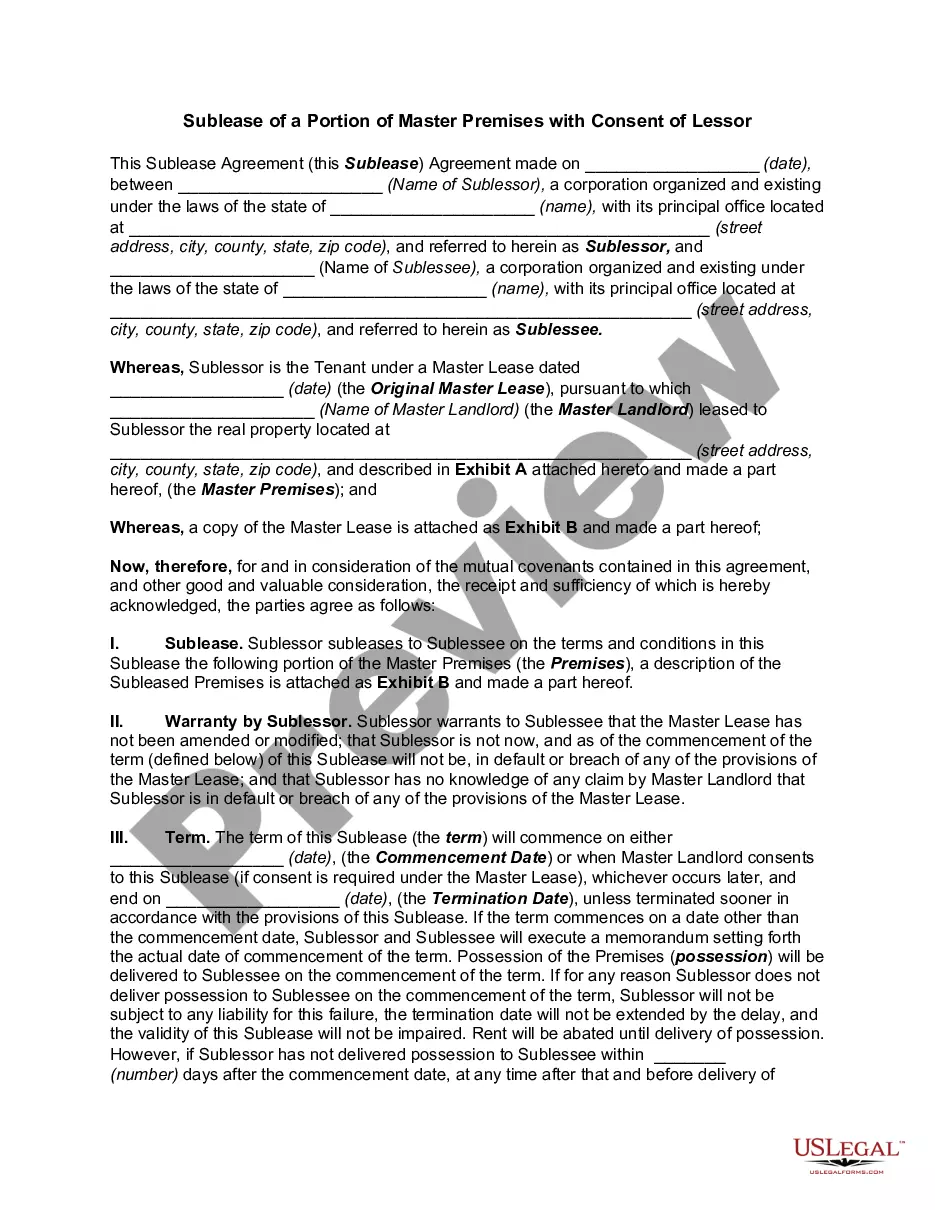
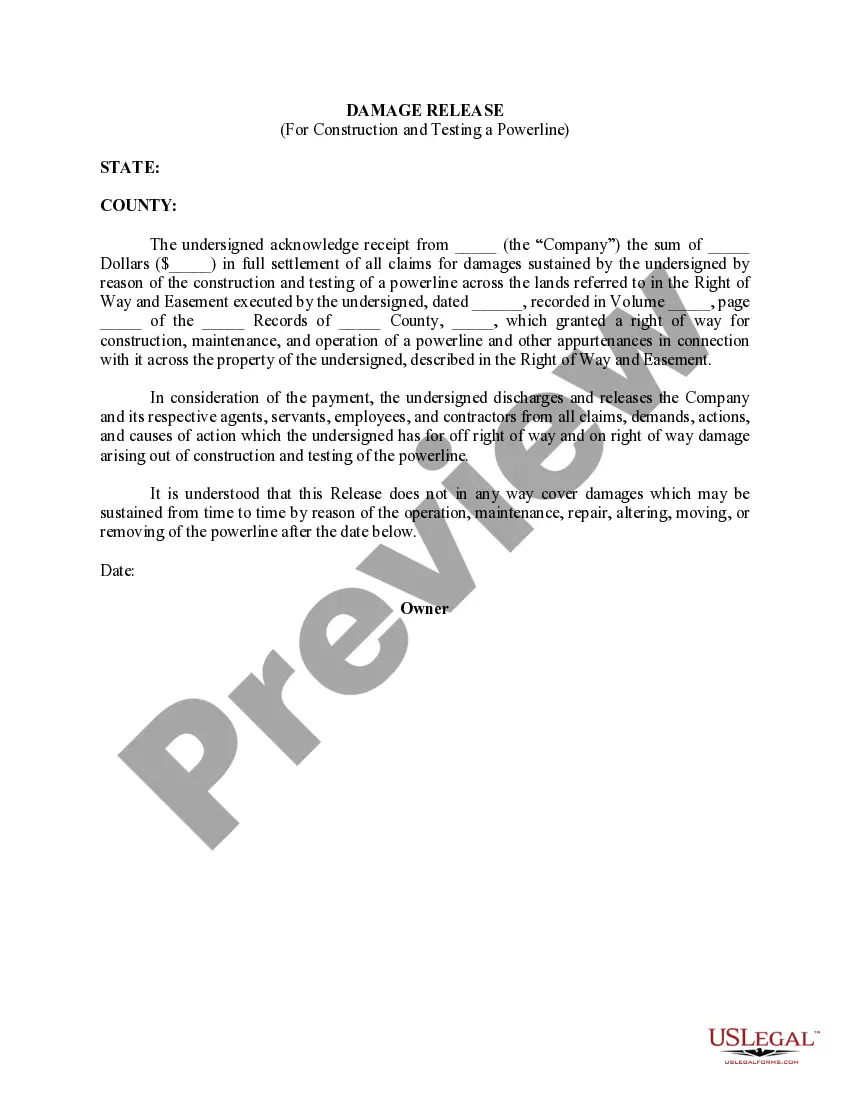
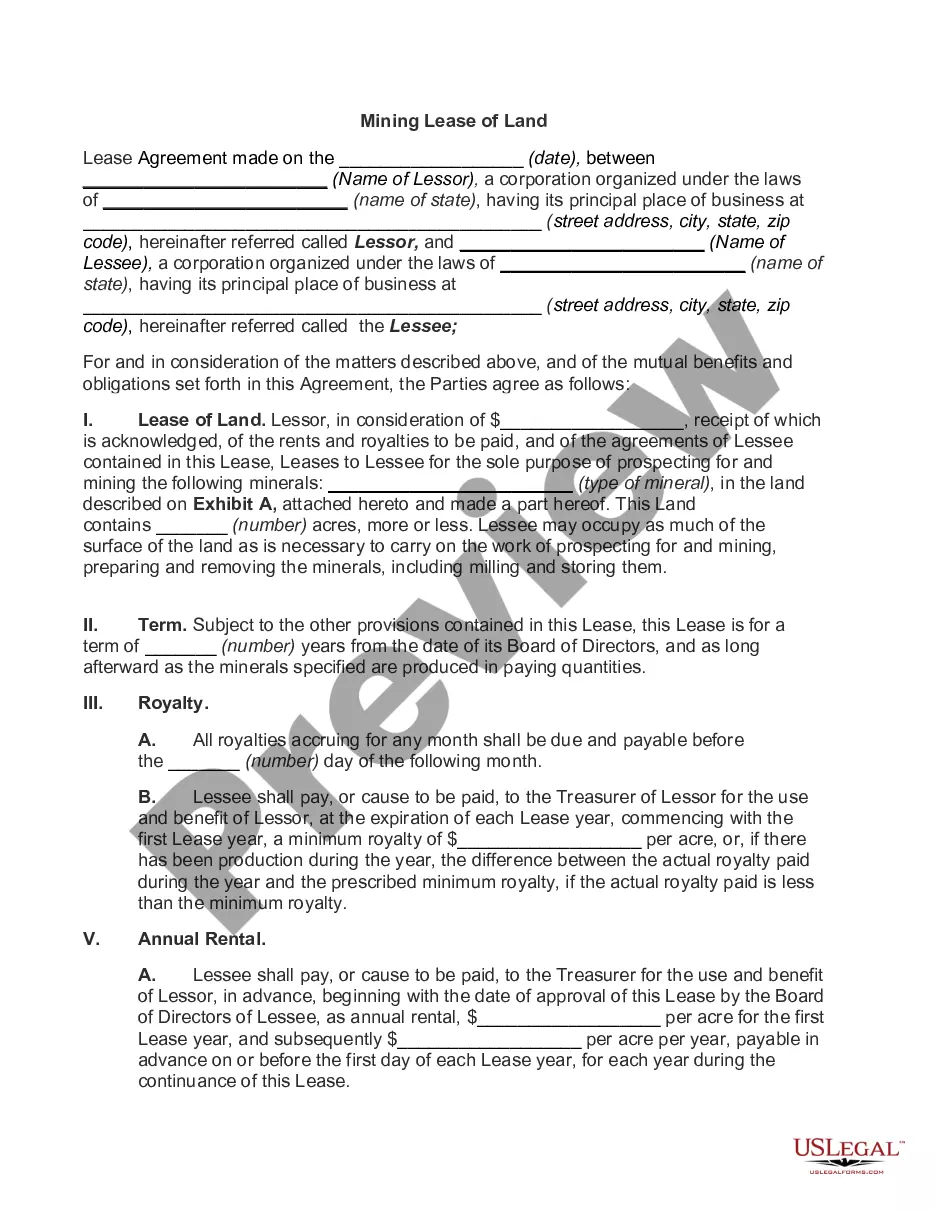
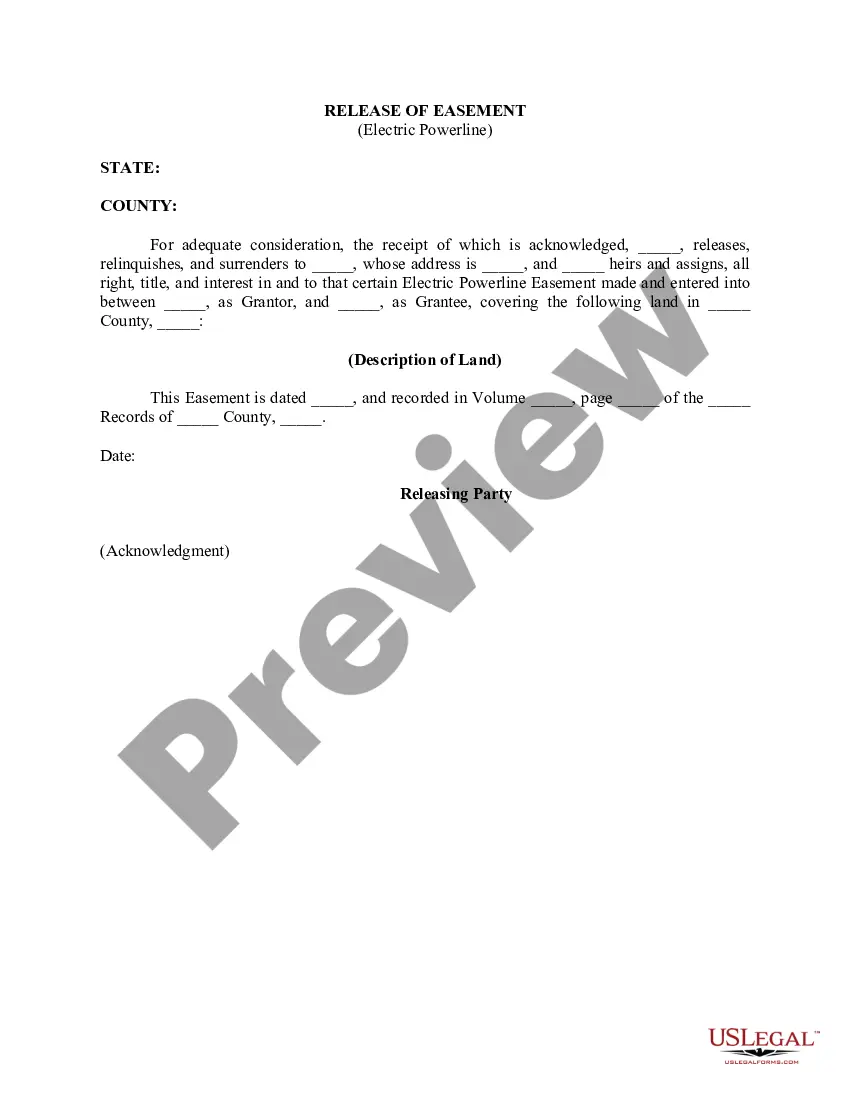
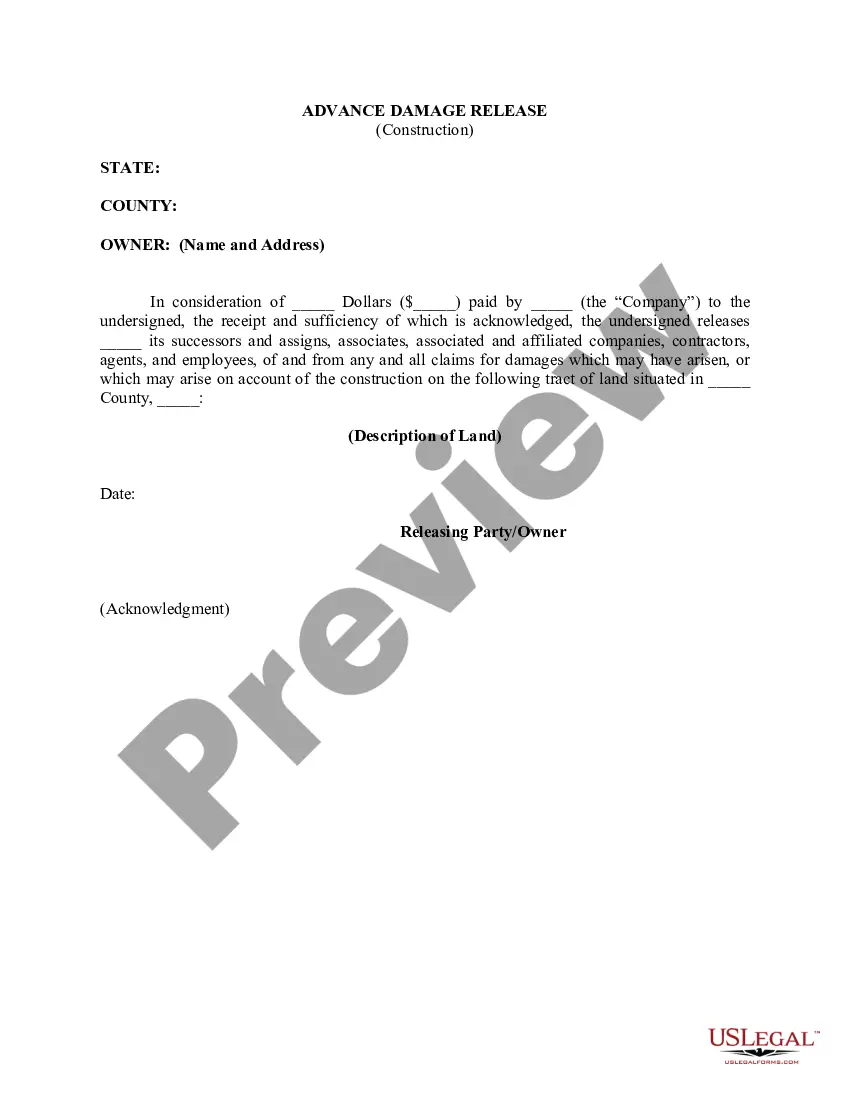
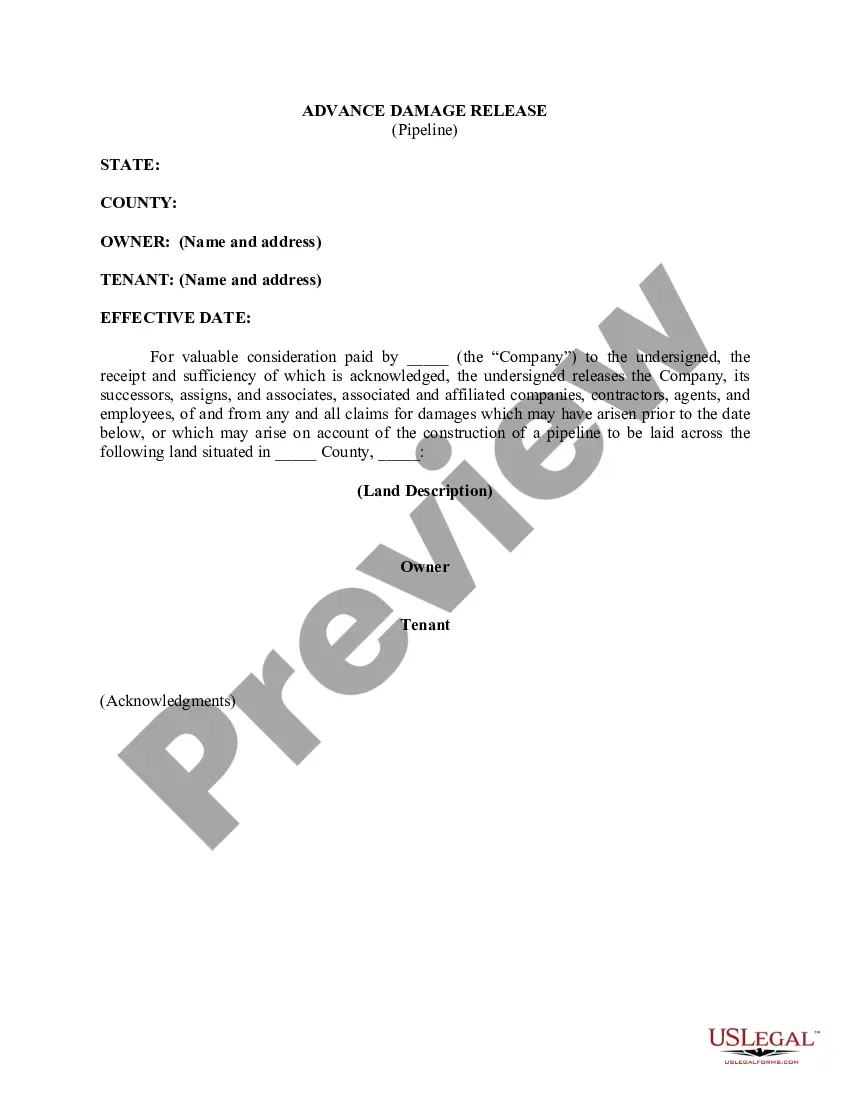
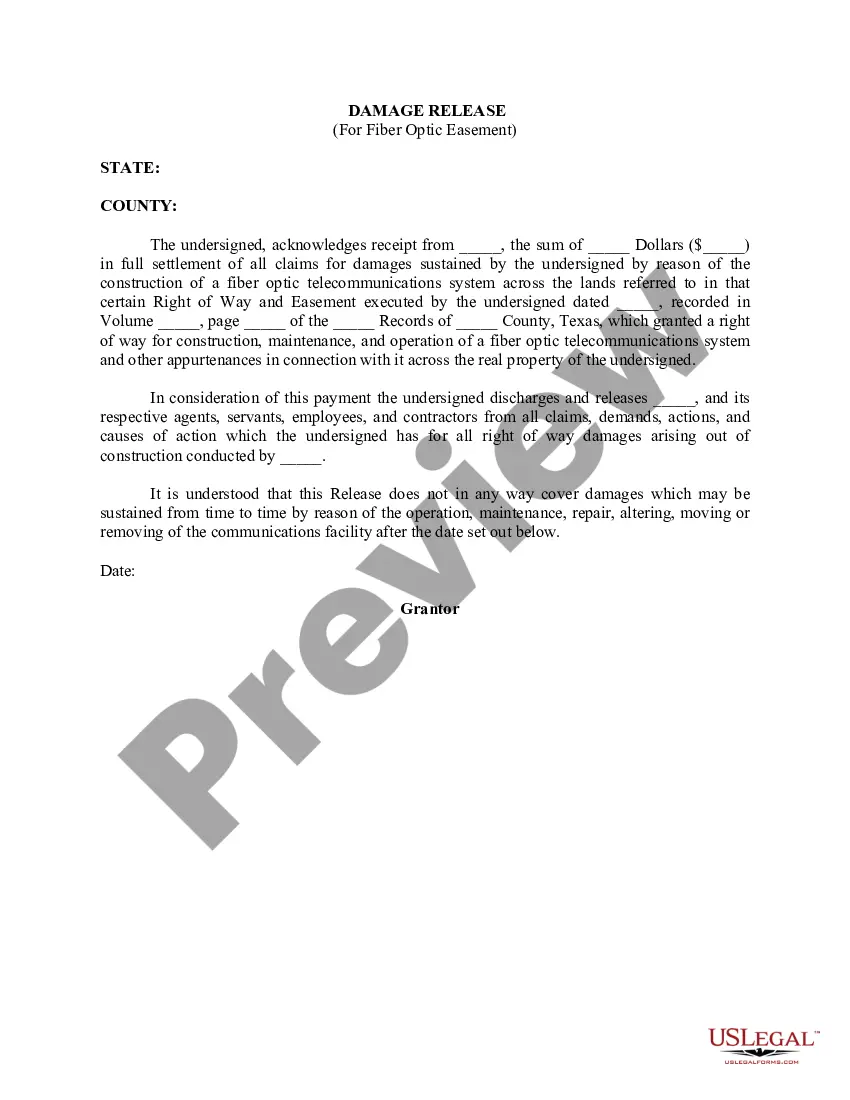
West Virginia Damage Release (For Construction and Testing a Powerline)
Description
Get your form ready online
Our built-in tools help you complete, sign, share, and store your documents in one place.
Make edits, fill in missing information, and update formatting in US Legal Forms—just like you would in MS Word.
Download a copy, print it, send it by email, or mail it via USPS—whatever works best for your next step.
Sign and collect signatures with our SignNow integration. Send to multiple recipients, set reminders, and more. Go Premium to unlock E-Sign.
If this form requires notarization, complete it online through a secure video call—no need to meet a notary in person or wait for an appointment.
We protect your documents and personal data by following strict security and privacy standards.

Make edits, fill in missing information, and update formatting in US Legal Forms—just like you would in MS Word.

Download a copy, print it, send it by email, or mail it via USPS—whatever works best for your next step.

Sign and collect signatures with our SignNow integration. Send to multiple recipients, set reminders, and more. Go Premium to unlock E-Sign.

If this form requires notarization, complete it online through a secure video call—no need to meet a notary in person or wait for an appointment.

We protect your documents and personal data by following strict security and privacy standards.
Looking for another form?



How to fill out Damage Release (For Construction And Testing A Powerline)?
Are you inside a situation that you need to have paperwork for either company or person uses almost every time? There are a lot of legitimate record layouts accessible on the Internet, but finding kinds you can trust is not straightforward. US Legal Forms gives a huge number of form layouts, just like the West Virginia Damage Release (For Construction and Testing a Powerline), which can be written in order to meet federal and state demands.
When you are already acquainted with US Legal Forms internet site and have a merchant account, merely log in. Afterward, you are able to acquire the West Virginia Damage Release (For Construction and Testing a Powerline) design.
Unless you have an bank account and wish to begin using US Legal Forms, abide by these steps:
- Find the form you will need and ensure it is to the proper town/region.
- Make use of the Preview button to analyze the shape.
- See the information to actually have chosen the correct form.
- If the form is not what you`re seeking, use the Research industry to discover the form that meets your requirements and demands.
- If you discover the proper form, click on Acquire now.
- Pick the pricing strategy you need, fill out the specified info to create your money, and pay for an order using your PayPal or credit card.
- Decide on a hassle-free data file structure and acquire your copy.
Locate all of the record layouts you may have purchased in the My Forms menu. You can aquire a further copy of West Virginia Damage Release (For Construction and Testing a Powerline) whenever, if necessary. Just go through the necessary form to acquire or printing the record design.
Use US Legal Forms, one of the most considerable selection of legitimate forms, to conserve time and avoid mistakes. The support gives appropriately made legitimate record layouts which can be used for an array of uses. Make a merchant account on US Legal Forms and start making your way of life a little easier.
Form popularity
FAQ
DO NOT lift, elevate, build or pass under a power line any object, tool or vehicle that could make contact or near- contact with the wires. To help prevent arc flashing, or an electrical explosion, it is recommended that equipment, antennas and people stay at least 14 feet away from any energized power line.
Appalachian Power, headquartered in Charleston, W.Va., provides service to AEP customers in West Virginia, Virginia and Tennessee. Appalachian Power maintains regulatory and external affairs offices in Charleston, W.Va., and Roanoke and Richmond, Va. About Us - Appalachian Power appalachianpower.com ? company ? about appalachianpower.com ? company ? about
§5003.1. Power Line Safety (Up to and Including 350kV) -- Equipment Operations. Voltage (nominal, kV, alternating current)Minimum clearance distance (feet)up to 5010over 50 to 17515over 175 to 35020over 350 to 550272 more rows 5003.1. Power Line Safety (Up to and Including 350kV) -- Equipment ... ca.gov ? title8 ca.gov ? title8
Yes, provided that you allow sufficient clearance between the highest part of the building roof and the lowest part of the power line. Can you put a building under a power line? - Quora quora.com ? Can-you-put-a-building-under-... quora.com ? Can-you-put-a-building-under-...
Well-known member. People build over power lines all the time. There is little chance that the physical power cables will fail. I'm guessing that the cables are encased in a conduit so if by the very slim outside chance that the cable or cables need to be replaced, they would be pulled from one end or the other.
A radial clearance of at least 10 feet must be maintained from the primary conductor. A vertical clearance of at least 12 feet must be maintained from the primary arm of the power pole to any structure. A vertical clearance of at least 8 feet must be maintained from the secondary arm of the power pole to any structure.