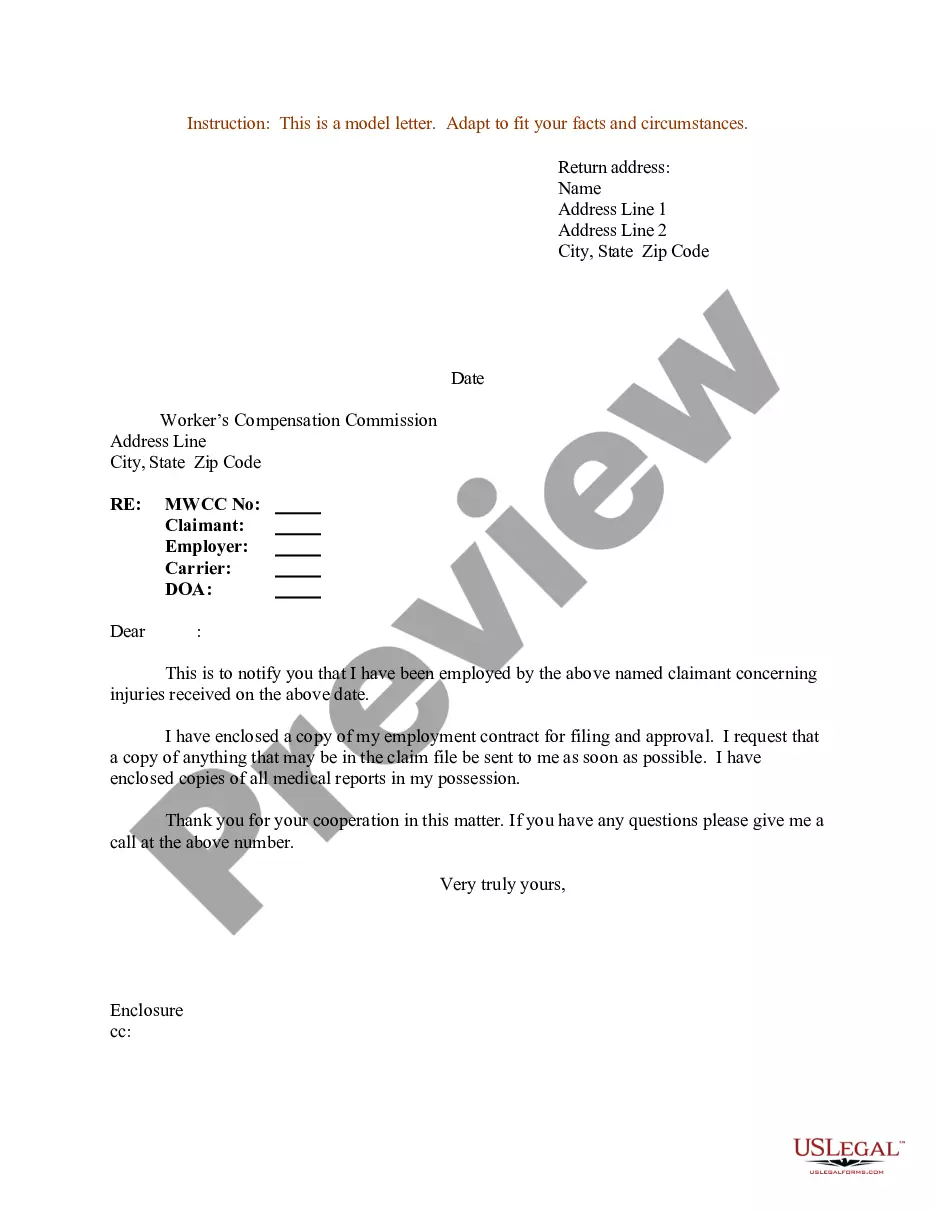
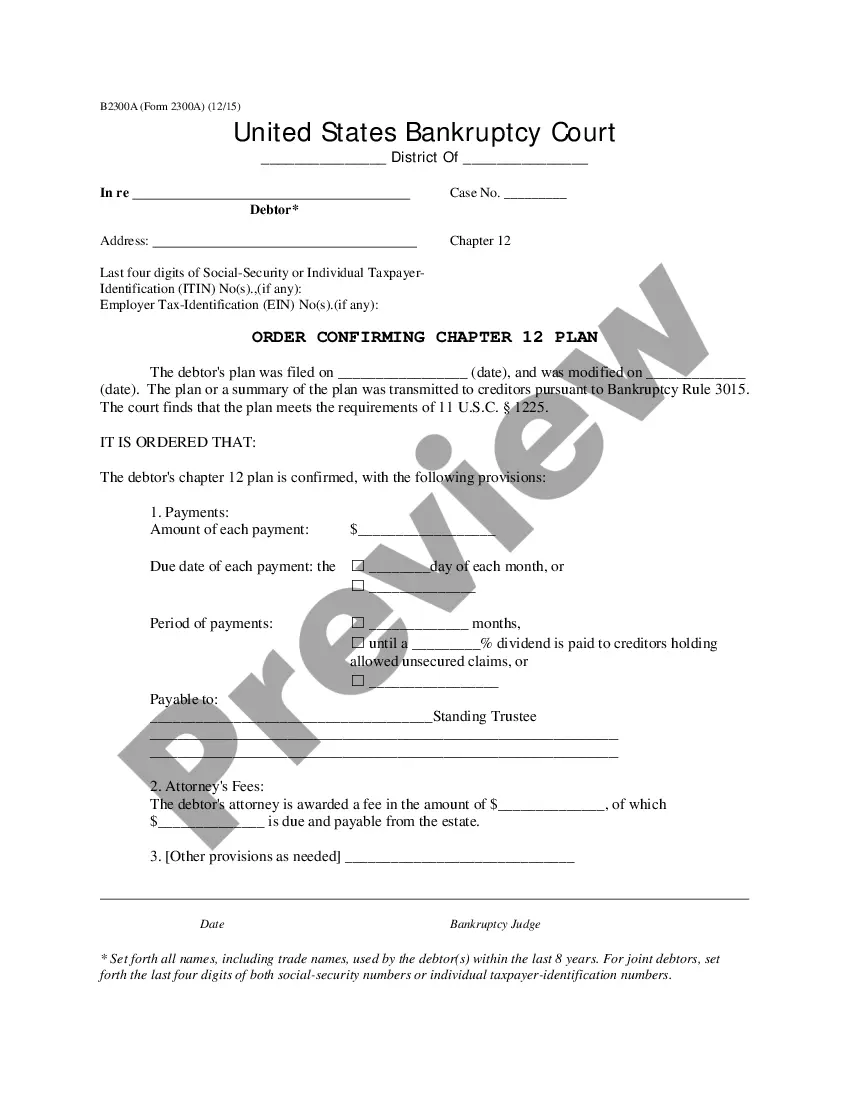
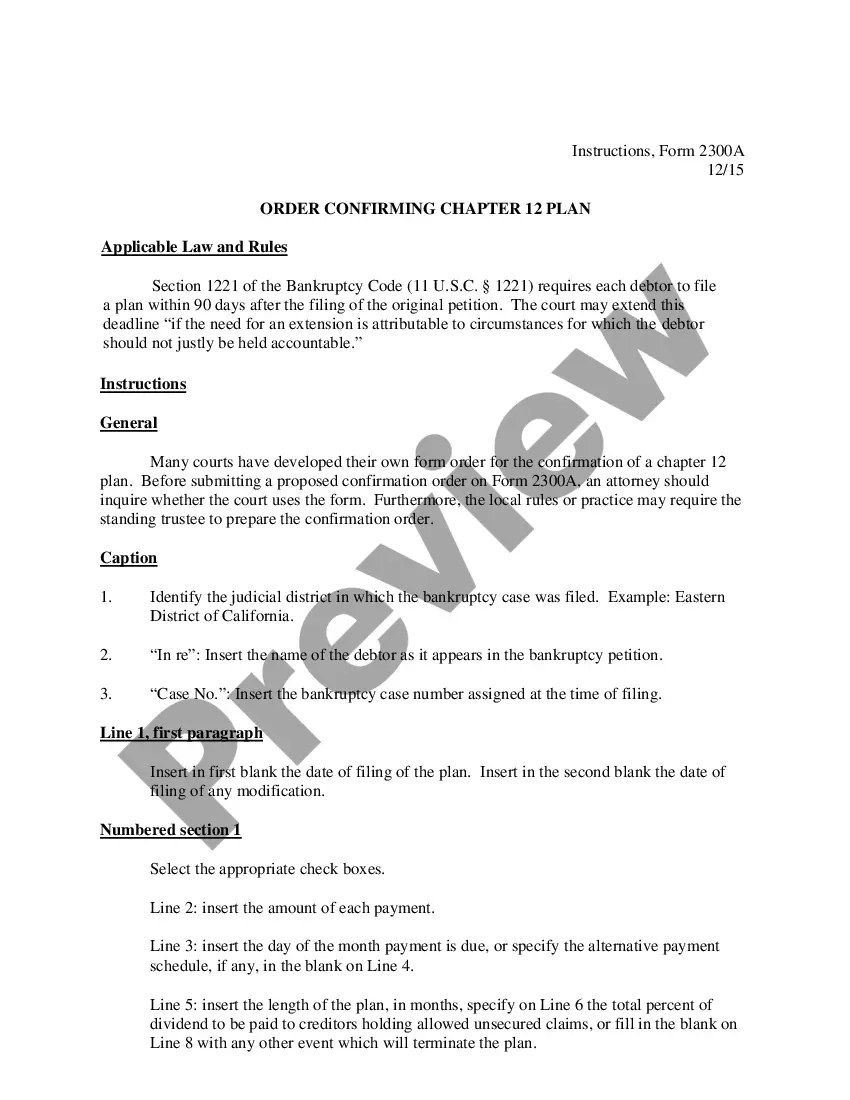
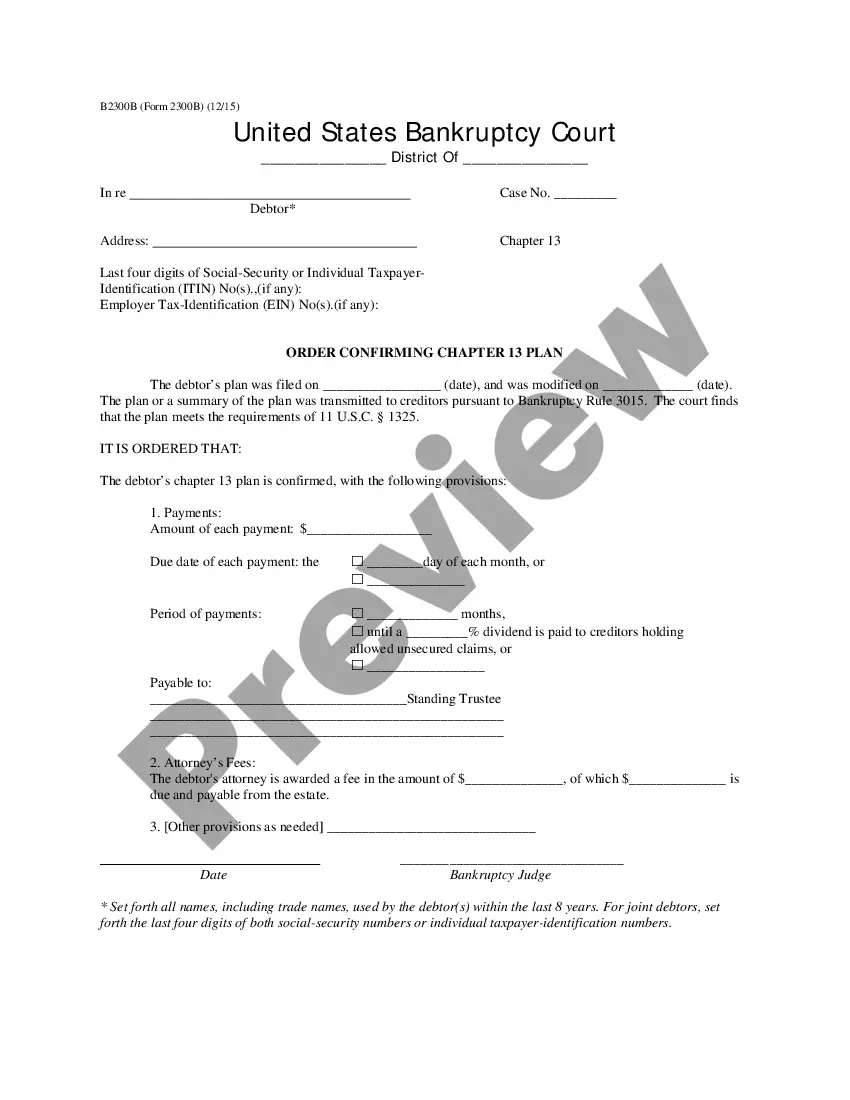
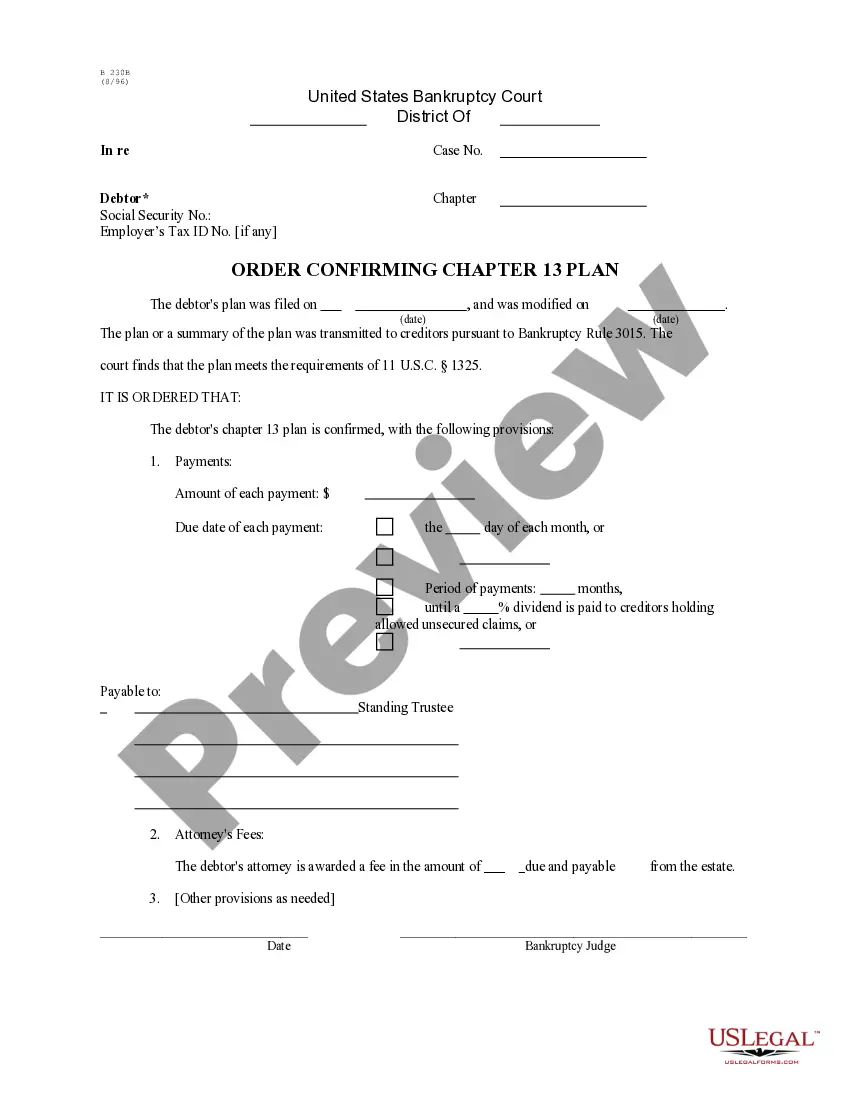
This form is an order confirming a chapter 12 plan. The plan is confirmed with certain provisions encompassing payment amount, due date of payment, and period of payments.
West Virginia Order Confirming Chapter 12 Plan - B 230A
Instant download
This website is not affiliated with any governmental entity
Public form
Description



How to fill out Order Confirming Chapter 12 Plan - B 230A?
Have you been within a situation in which you require paperwork for either organization or individual functions just about every day? There are tons of lawful record layouts accessible on the Internet, but finding ones you can trust isn`t simple. US Legal Forms offers 1000s of develop layouts, much like the West Virginia Order Confirming Chapter 12 Plan - B 230A, which can be composed to meet federal and state needs.
In case you are previously knowledgeable about US Legal Forms internet site and possess an account, simply log in. After that, you may obtain the West Virginia Order Confirming Chapter 12 Plan - B 230A design.
Should you not offer an profile and wish to start using US Legal Forms, adopt these measures:
- Get the develop you require and ensure it is for that right area/state.
- Make use of the Preview key to analyze the form.
- Read the description to actually have chosen the proper develop.
- In the event the develop isn`t what you are searching for, utilize the Search industry to find the develop that fits your needs and needs.
- When you get the right develop, click on Get now.
- Pick the costs strategy you want, fill out the necessary information and facts to generate your account, and pay for the transaction utilizing your PayPal or credit card.
- Choose a handy file file format and obtain your version.
Discover every one of the record layouts you may have bought in the My Forms menus. You can obtain a more version of West Virginia Order Confirming Chapter 12 Plan - B 230A any time, if required. Just click on the necessary develop to obtain or print the record design.
Use US Legal Forms, one of the most substantial selection of lawful types, to save time and prevent blunders. The services offers expertly created lawful record layouts which can be used for a selection of functions. Generate an account on US Legal Forms and begin making your lifestyle easier.
Form popularity
FAQ
A case filed under chapter 11 of the United States Bankruptcy Code is frequently referred to as a "reorganization" bankruptcy. Usually, the debtor remains ?in possession,? has the powers and duties of a trustee, may continue to operate its business, and may, with court approval, borrow new money.
What is the Difference Between Chapter 11 & Chapter 13 Bankruptcies? The main difference between Chapter 11 and Chapter 13 is that a Chapter 13 bankruptcy requires that the debtor pay his or her debts within five years. On the other hand, Chapter 11 allows the filer to extend the five-year period unlike Chapter 13.
Chapter 11, which is more expensive than Chapter 7, is typically intended for medium- to large-sized businesses, but smaller businesses and sole proprietors may also want to consider this type of bankruptcy. Unlike Chapter 7, Chapter 11 does not liquidate assets, only restructures debts.
The discharge received by an individual debtor in a Chapter 11 case discharges the debtor from all pre-confirmation debts except those that would not be dischargeable in a Chapter 7 case filed by the same debtor.
Ingly, the central goal of chapter 11 is to create a viable economic entity by reorganizing the debtor's debt structure. Unlike chapter 7, chapter 11 is not a liquidation of the debtor's assets. Rather, it is a reorganization of existing assets, principally as debt.
"Cram down" simply means the process by which the bankruptcy court can, as part of the confirmation of a Chapter 12 Bankruptcy Plan, force treatment upon an objecting creditor, provided the Plan otherwise meets all of the other confirmation criteria under Section 1225 of the Bankruptcy Code.
Chapter 10 was a type of corporate bankruptcy filing that was eventually retired due to its complexity. Chapter 10, originally known as ?Chapter X,? listed the processes and procedures for bankruptcies involving corporations.