West Virginia New Resident Guide
What this document covers
The New Resident Guide is an informational resource designed to assist individuals transitioning to a new home state. It outlines essential state requirements for residency, voter registration, identification cards, driver's licenses, and vehicle title and registration processes. This guide serves as a critical tool for new residents to navigate their legal obligations effectively.
Key parts of this document
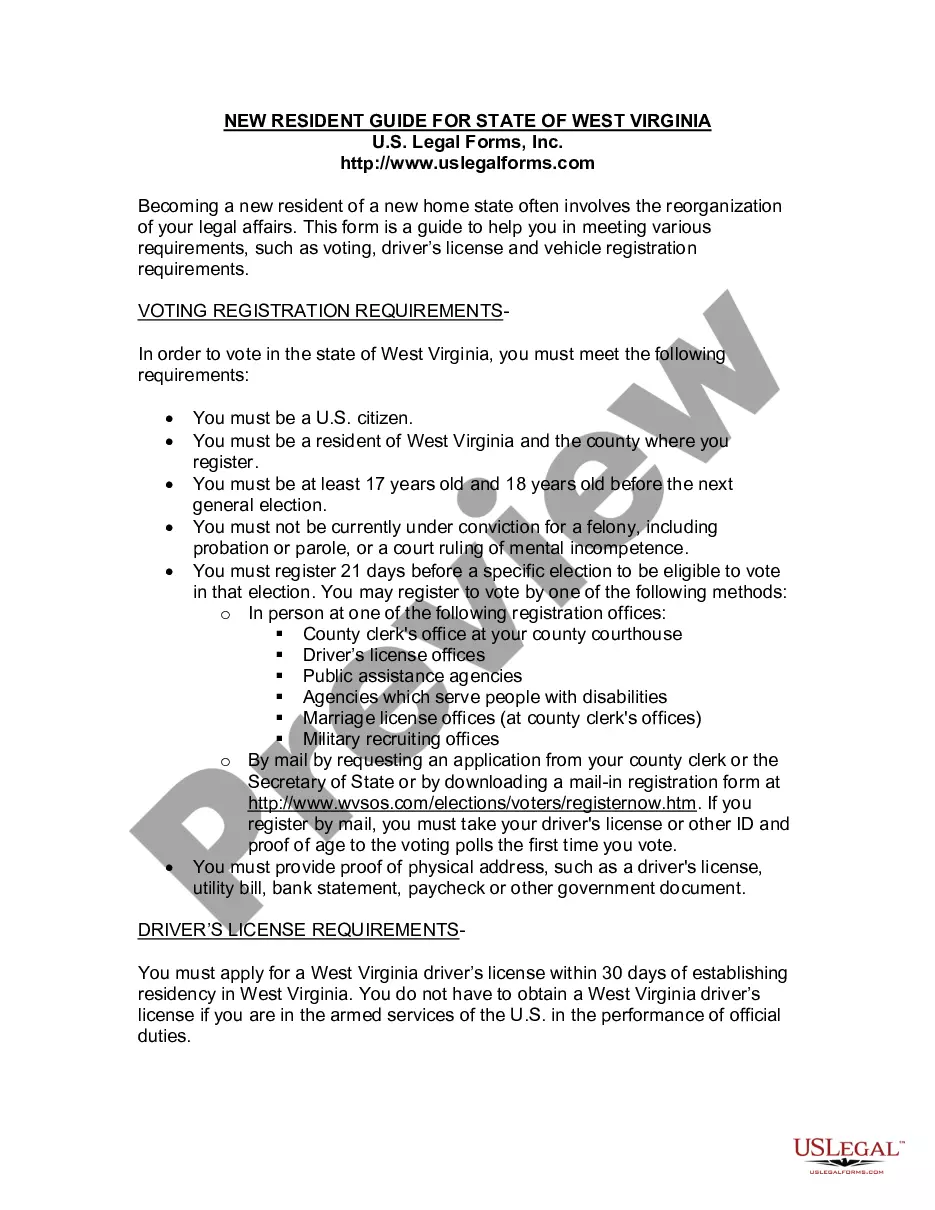
- Voting registration requirements and methods.
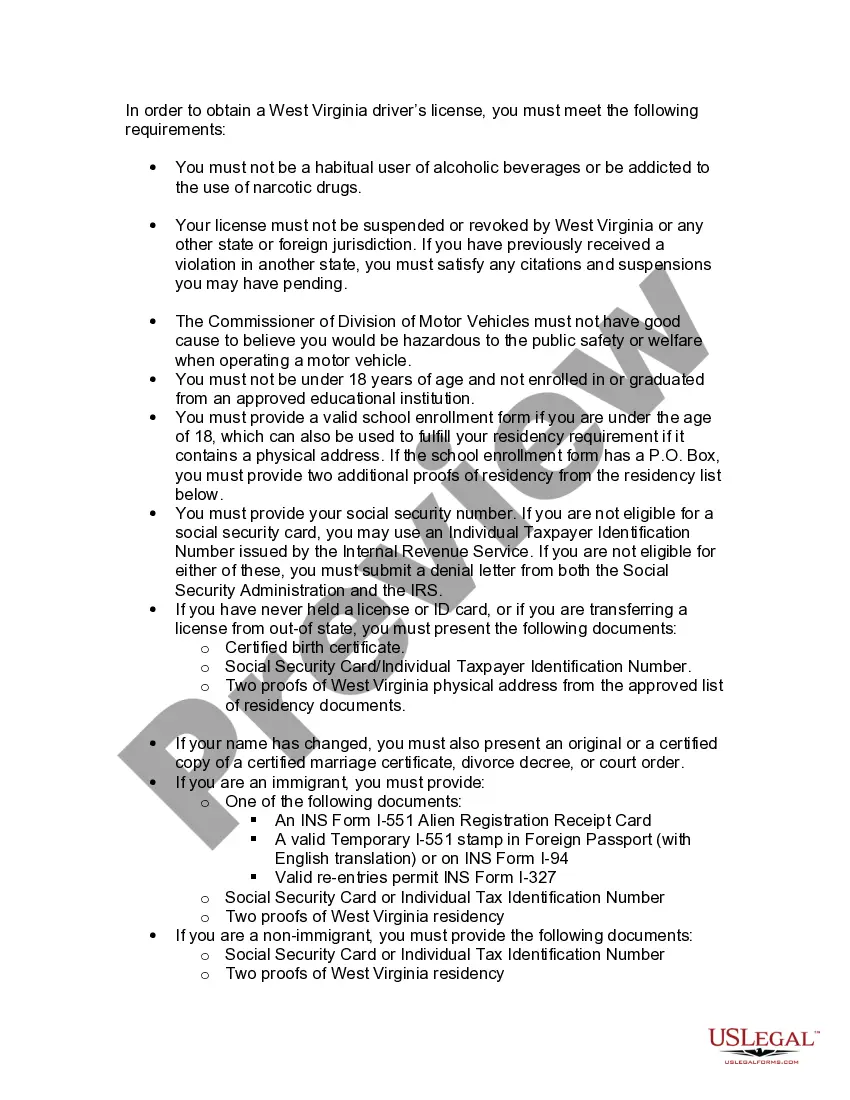
- Drivers license application criteria and processes.
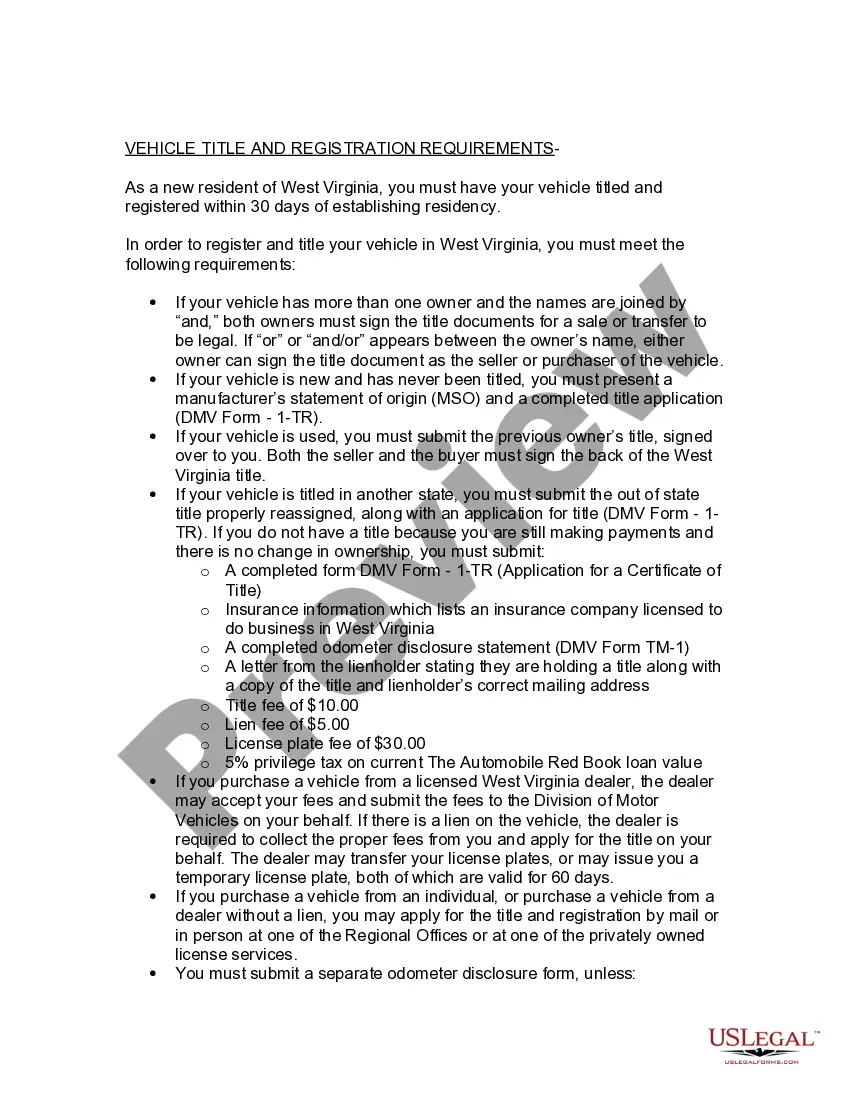
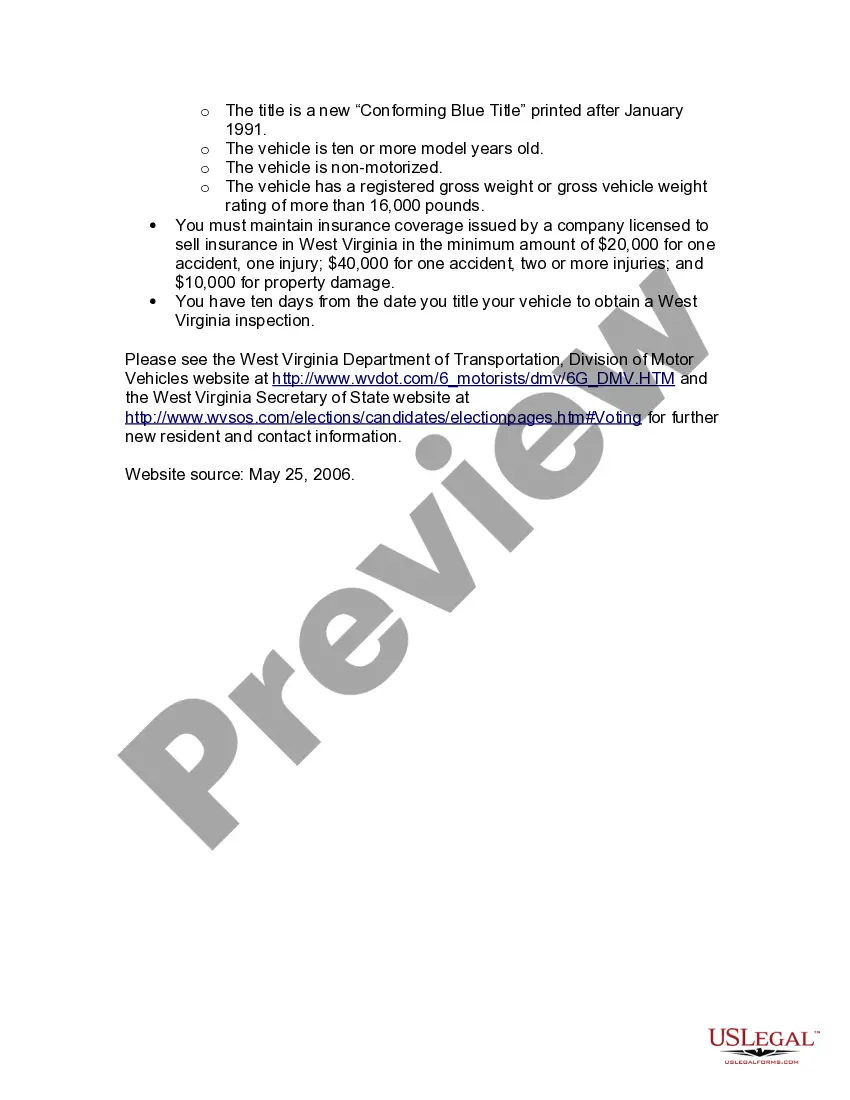
- Vehicle title and registration requirements.
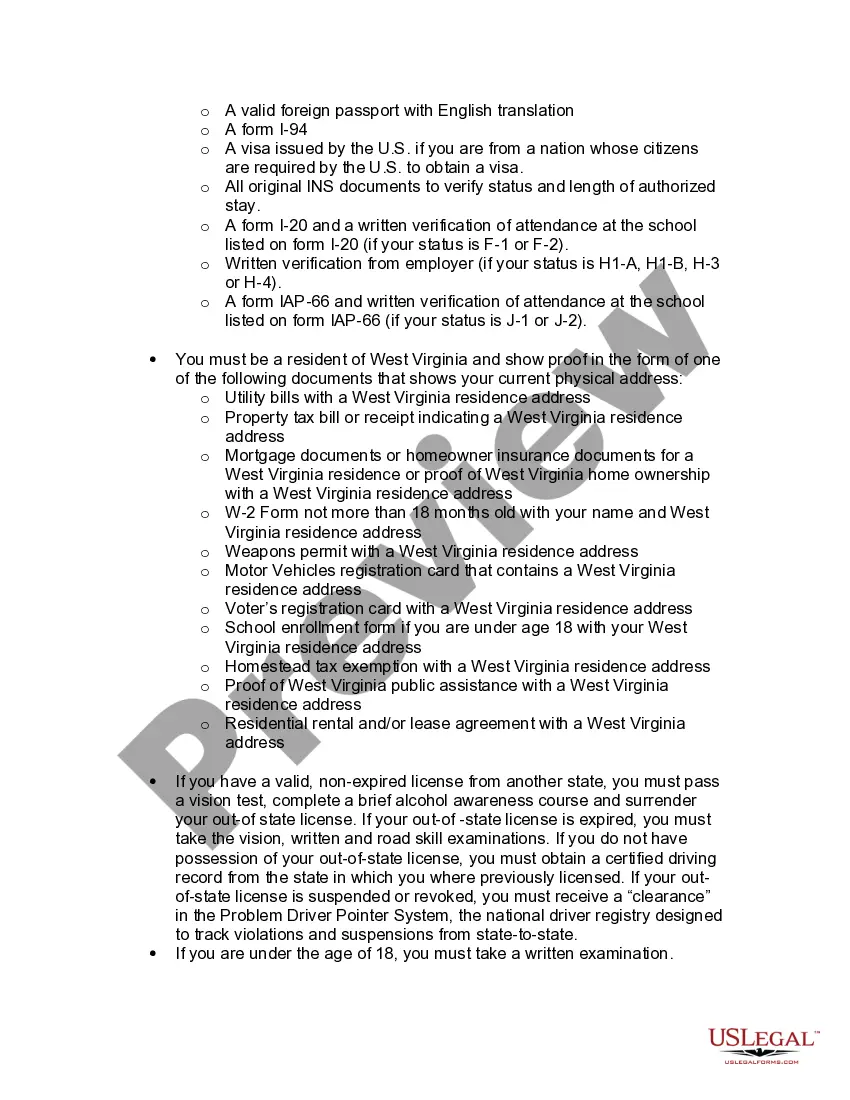
- Proof of residency documentation needed.
- Identification requirements for immigrants and non-immigrants.
Situations where this form applies
The New Resident Guide is essential for anyone moving to a new state. Use this guide when you need to register to vote, update your driver's license, or title and register your vehicle after establishing residency. It is particularly useful during the initial transition phase when you are unfamiliar with local rules and processes.
Who should use this form
- New residents relocating to a different state.
- Individuals needing to register to vote in their new state.
- People seeking to obtain a driver's license or vehicle registration after moving.
- Immigrants or non-immigrants adjusting their residency status.
How to complete this form
- Review the voter registration requirements and prepare necessary documents.
- Gather identification and proof of residency for the driver's license application.
- Complete the vehicle title application and secure any needed signatures.
- Submit your applications in person or via mail as instructed in the guide.
- Keep copies of all submitted documents for your records.
Notarization requirements for this form
This form does not typically require notarization to be legally valid. However, some jurisdictions or document types may still require it. US Legal Forms provides secure online notarization powered by Notarize, available 24/7 for added convenience.
Get your form ready online
Our built-in tools help you complete, sign, share, and store your documents in one place.
Make edits, fill in missing information, and update formatting in US Legal Forms—just like you would in MS Word.
Download a copy, print it, send it by email, or mail it via USPS—whatever works best for your next step.
Sign and collect signatures with our SignNow integration. Send to multiple recipients, set reminders, and more. Go Premium to unlock E-Sign.
If this form requires notarization, complete it online through a secure video call—no need to meet a notary in person or wait for an appointment.
We protect your documents and personal data by following strict security and privacy standards.

Make edits, fill in missing information, and update formatting in US Legal Forms—just like you would in MS Word.

Download a copy, print it, send it by email, or mail it via USPS—whatever works best for your next step.

Sign and collect signatures with our SignNow integration. Send to multiple recipients, set reminders, and more. Go Premium to unlock E-Sign.

If this form requires notarization, complete it online through a secure video call—no need to meet a notary in person or wait for an appointment.

We protect your documents and personal data by following strict security and privacy standards.
Avoid these common issues
- Failing to register to vote by the specified deadline.
- Not providing sufficient proof of residency for driver's license or vehicle registration.
- Overlooking specific requirements for international residents.
- Not verifying the completion of forms or forgetting required signatures.
Why use this form online
- Instant access to accurate and up-to-date legal information.
- Convenient download format allows for easy editing and printing.
- Structured guidance simplifies the transition process to a new residence.
- Reliability of forms drafted by licensed attorneys ensures compliance with state laws.
Legal use & context
The New Resident Guide serves as a credible resource to help individuals meet legal obligations when moving to a new state. It ensures compliance with voting, licensing, and registration laws, which can vary significantly by jurisdiction.
Quick recap
- The New Resident Guide is essential for understanding state-specific legal requirements.
- It's critical to meet application deadlines for voter registration and driver's licenses.
- Proper documentation is key to a smooth transition when moving to a new state.
- Utilizing this guide online can save time and reduce errors in legal processes.
Looking for another form?
Form popularity
FAQ
Yes. West Virginia recognizes valid out-of-state Learner's Permits.
WV utility bills (not more than 60 days old, cannot be a termination notice, and cannot be two bills issued by the same company) Tax records with a WV street address. WV mortgage documents, WV homeowner insurance documents for a WV residence, or proof of WV home ownership.
Maryland joined Oregon, California, Wyoming, Colorado, Nebraska, South Dakota, Arkansas, Illinois, Ohio, Tennessee, Alabama, Florida, North Carolina, Virginia and Maine on the list of states that do not require parallel parking demonstration as part of the driver's license exam according to a recent report from USA
Proof of identity; Proof of Social Security Number; 2 proofs of WV residency with name and physical address; School Eligibility Certificate (if under 18).
Harvard-Westlake students have said that the Winnetka DMV is known to be the easiest to pass at and that the Van Nuys and Culver City departments also have similar reputations. Lola Clark '17, who took her test at Winnetka, thinks it is easier to pass there due to road and traffic conditions.
Yes. You will need to learn how to parallel park for your WV Driving Exam.
You are considered a resident of West Virginia if you spend more than 30 days in West Virginia with the intent of West Virginia becoming your permanent residence, or if you are a domiciliary resident of Pennsylvania or Virginia and you maintain a physical presence in West Virginia for more than 183 days of the taxable
Practice your skills before your road test or before you are required to parallel park on a busy roadway. Place two plastic cones or other objects approximately fifteen feet apart to simulate the standard size of this type of parking space.
You are considered a resident of West Virginia if you spend more than 30 days in West Virginia with the intent of West Virginia becoming your permanent residence, or if you are a domiciliary resident of Pennsylvania or Virginia and you maintain a physical presence in West Virginia for more than 183 days of the taxable