Wisconsin Mutual Aid Contract for Emergencies
Description

Get your form ready online
Our built-in tools help you complete, sign, share, and store your documents in one place.
Make edits, fill in missing information, and update formatting in US Legal Forms—just like you would in MS Word.
Download a copy, print it, send it by email, or mail it via USPS—whatever works best for your next step.
Sign and collect signatures with our SignNow integration. Send to multiple recipients, set reminders, and more. Go Premium to unlock E-Sign.
If this form requires notarization, complete it online through a secure video call—no need to meet a notary in person or wait for an appointment.
We protect your documents and personal data by following strict security and privacy standards.

Make edits, fill in missing information, and update formatting in US Legal Forms—just like you would in MS Word.

Download a copy, print it, send it by email, or mail it via USPS—whatever works best for your next step.

Sign and collect signatures with our SignNow integration. Send to multiple recipients, set reminders, and more. Go Premium to unlock E-Sign.

If this form requires notarization, complete it online through a secure video call—no need to meet a notary in person or wait for an appointment.

We protect your documents and personal data by following strict security and privacy standards.
Looking for another form?


How to fill out Mutual Aid Contract For Emergencies?
If you wish to finalize, obtain, or print authentic document templates, utilize US Legal Forms, the largest repository of official forms available online.
Take advantage of the site's easy and user-friendly search feature to find the documents you need.
Numerous templates for business and personal purposes are organized by categories and regions or keywords.
Each legal document template you purchase is yours indefinitely. You have access to every form you have downloaded in your account.
Select the My documents section and choose a form to print or download again. Finalize and secure, and print the Wisconsin Mutual Aid Contract for Emergencies with US Legal Forms. There are thousands of professional and state-specific forms available for your business or personal needs.
- Use US Legal Forms to acquire the Wisconsin Mutual Aid Contract for Emergencies with just a few clicks.
- If you are already a US Legal Forms user, Log In to your account and click on the Download button to retrieve the Wisconsin Mutual Aid Contract for Emergencies.
- You can also access forms you've previously downloaded in the My documents section of your account.
- If you are using US Legal Forms for the first time, follow the steps below.
- Step 1. Make sure you have chosen the form for the correct state/region.
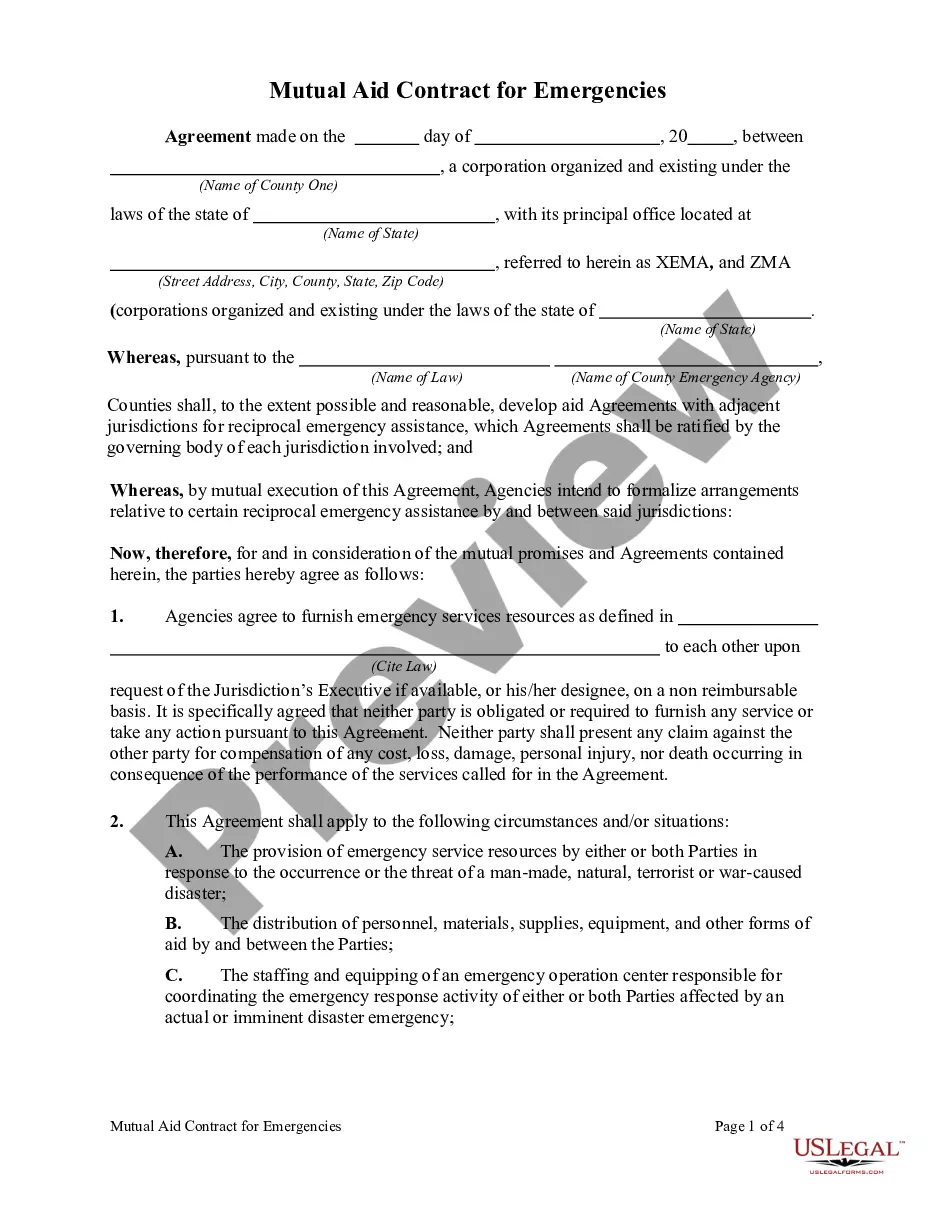
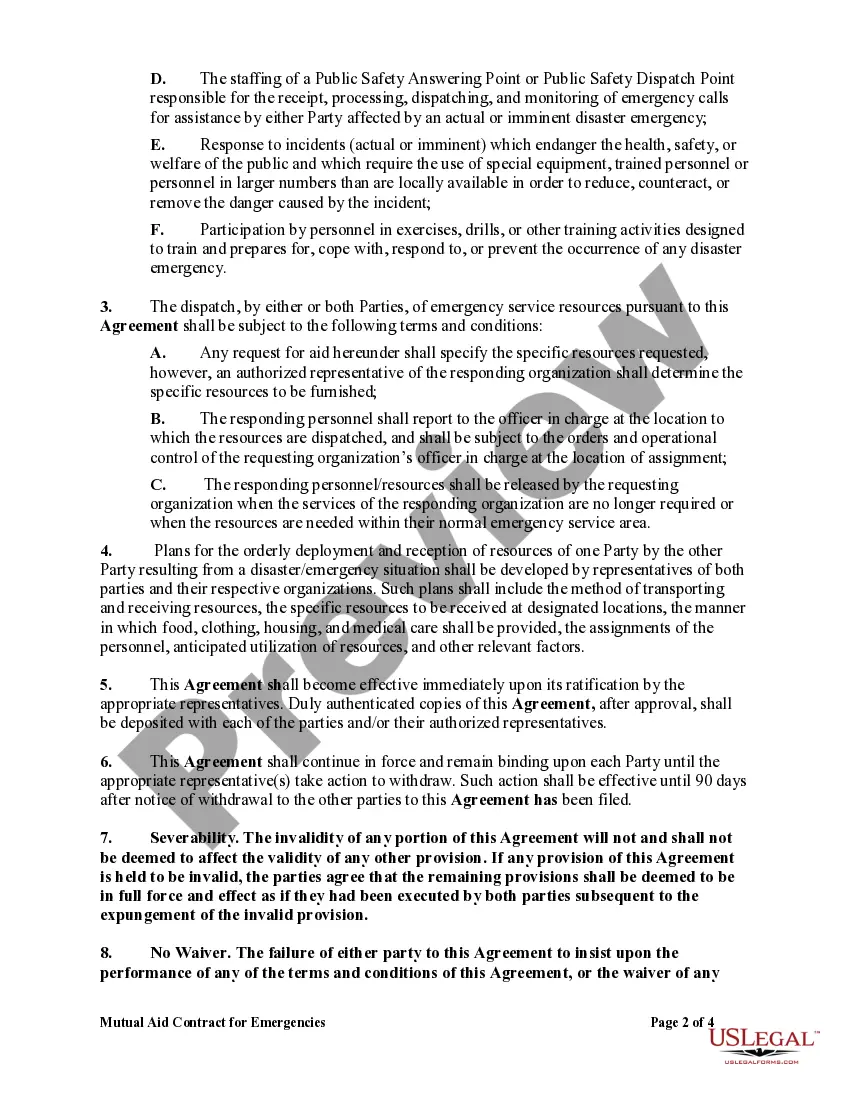
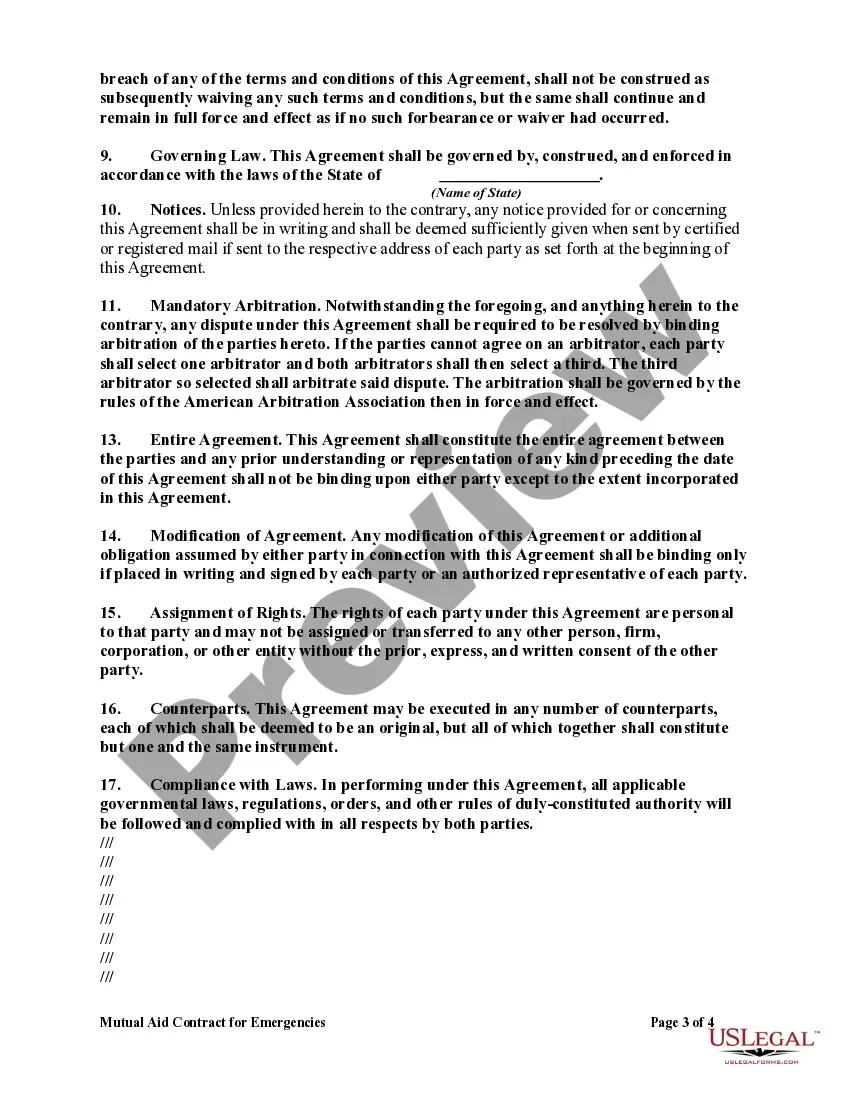
- Step 2. Use the Preview option to review the form's content. Don't forget to read the summary.
- Step 3. If you are not satisfied with the form, utilize the Search field at the top of the screen to locate other versions of the legal form template.
- Step 4. Once you have found the form you need, click on the Buy now button. Choose the pricing plan you prefer and enter your details to create an account.
- Step 5. Process the transaction. You can use your Visa or Mastercard or PayPal account to complete the payment.
- Step 6. Select the format of the legal form and download it to your device.
- Step 7. Complete, modify, and print or sign the Wisconsin Mutual Aid Contract for Emergencies.
Form popularity
FAQ
A mutual aid agreement FEMA refers to collaborative arrangements facilitated by the Federal Emergency Management Agency during disasters. In the context of a Wisconsin Mutual Aid Contract for Emergencies, it signifies the partnership between local agencies to share resources and support each other effectively. FEMA provides guidelines and resources to assist in forming these agreements, enhancing regional emergency responsiveness.
Creating a mutual aid agreement, specifically a Wisconsin Mutual Aid Contract for Emergencies, involves multiple steps. Begin by gathering necessary stakeholders to discuss goals and contributions. Next, draft the agreement with detailed terms regarding service provision and response times. Finally, ensure all parties review and sign the document, solidifying the commitment to cooperate during emergencies.
A Wisconsin Mutual Aid Contract for Emergencies typically includes three critical features. First, it outlines the responsibilities of each party involved, ensuring clarity and accountability. Second, it specifies the types of resources and services exchanged during emergencies. Lastly, it includes provisions for liability and reimbursement, protecting all parties and fostering trust.
The processes of a Wisconsin Mutual Aid Contract for Emergencies involve several key stages. Initially, participating entities must establish clear communication and set expectations. Following this, they define the scope of assistance, including what resources will be shared. Finally, they document the agreement to ensure all parties are aligned on the terms and conditions.
The first step in creating a Wisconsin Mutual Aid Contract for Emergencies is to identify the needs of your community. It's important to assess your resources and what mutual aid can offer. Engaging stakeholders and local authorities is crucial to ensure everyone is informed and willing to collaborate. This foundational step sets the stage for a successful partnership.
To request mutual aid, begin by assessing the resources you lack, and then reach out to your local emergency services. It's vital to reference the Wisconsin Mutual Aid Contract for Emergencies during your request as it outlines the process. Clarity in your request will help ensure that the needed assistance arrives as quickly as possible.
The correct steps for mutual aid requests generally include identifying the need, documenting the situation, and contacting the designated mutual aid coordinator. Utilize the Wisconsin Mutual Aid Contract for Emergencies as your framework for collaboration. Following these steps ensures clarity and effectiveness in your request.
Requesting mutual aid can often begin with contacting your local emergency management office. They will guide you through the process defined by the Wisconsin Mutual Aid Contract for Emergencies. Providing a clear description of your needs will facilitate quicker support from the appropriate agencies.
To get started with mutual aid, first review your local and state guidelines, including the Wisconsin Mutual Aid Contract for Emergencies. Next, connect with local emergency management agencies to explore partnership opportunities. These steps will lay the groundwork for establishing a successful mutual aid system.
Automatic aid refers to the immediate response from neighboring jurisdictions without a formal request, while mutual aid involves a pre-established agreement between entities, like the Wisconsin Mutual Aid Contract for Emergencies. In mutual aid, agencies can share resources and support during emergencies through a structured process. Understanding this difference is crucial for coordinating effective assistance.