Washington Conflict of Interest of General Partner and Release
Description
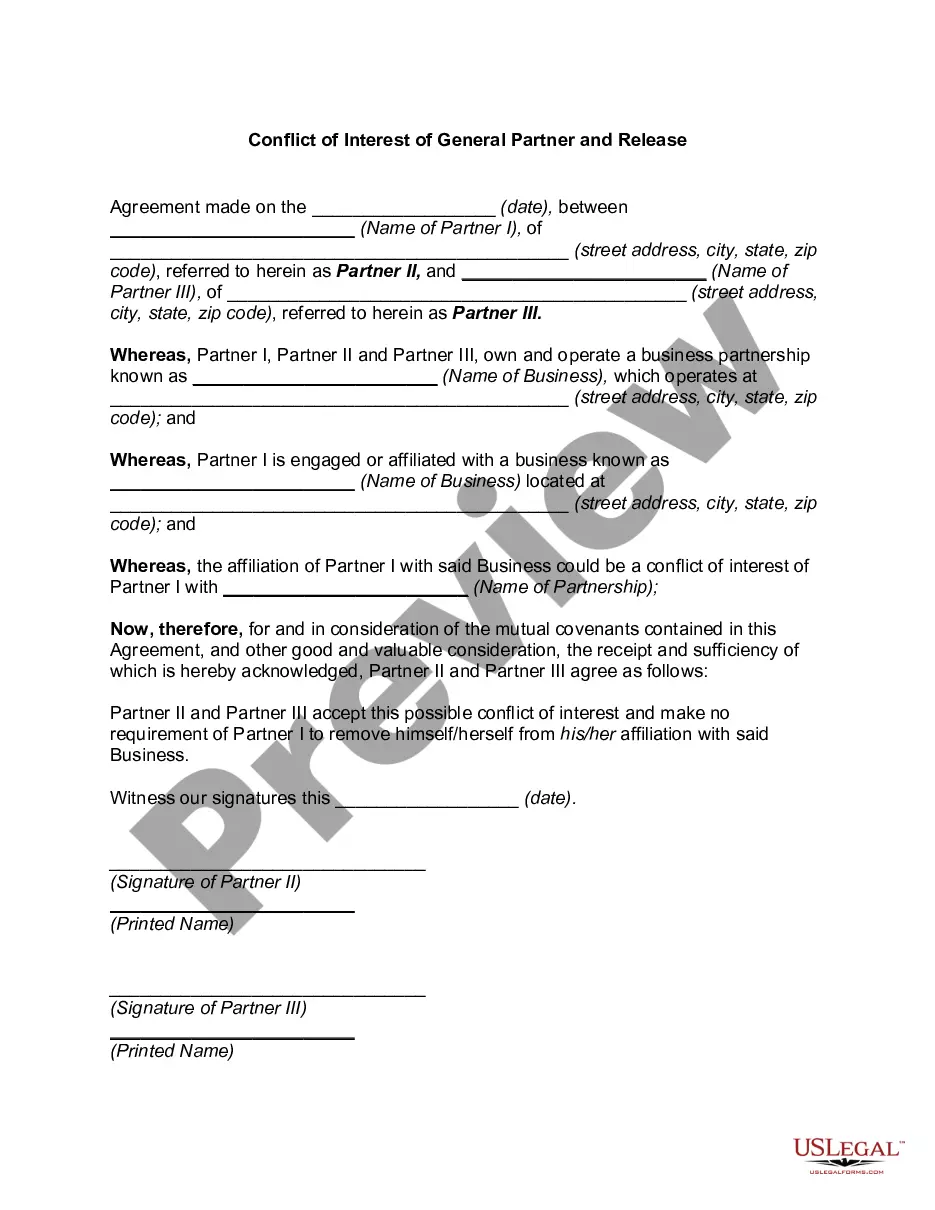
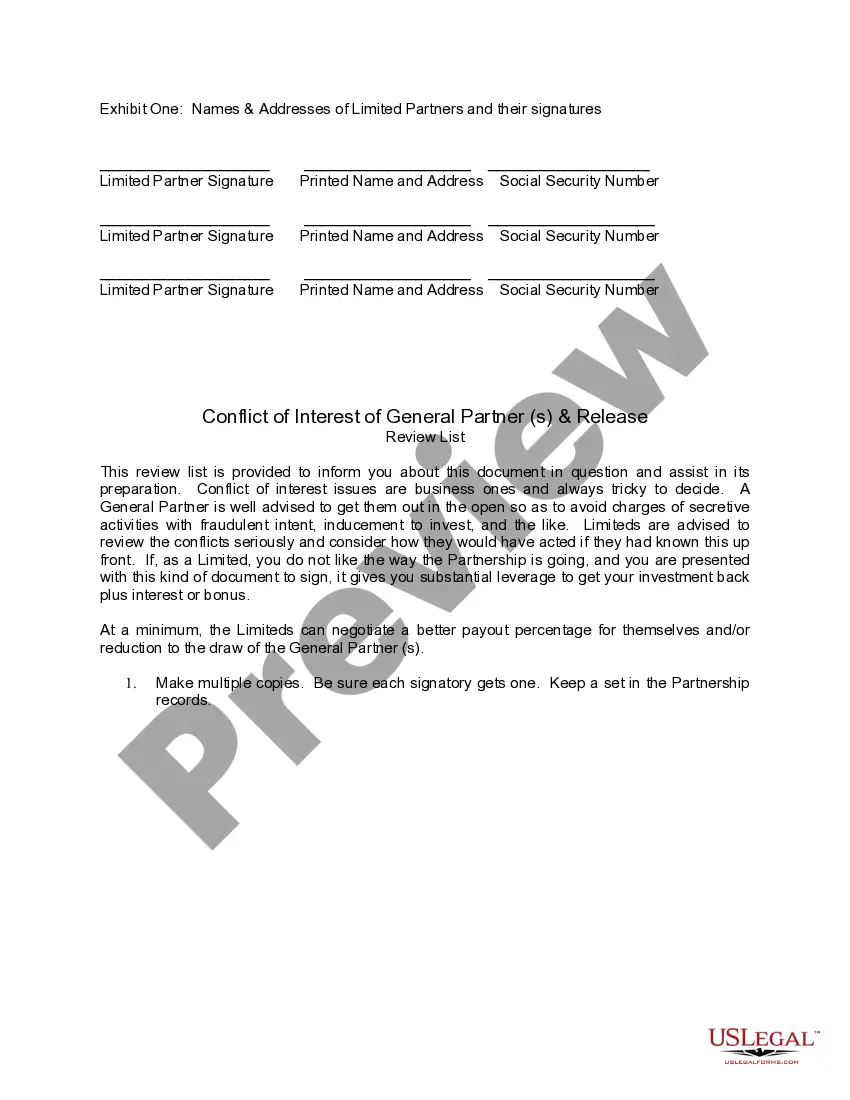



How to fill out Conflict Of Interest Of General Partner And Release?
Are you presently in a situation where you require documents for both professional or personal purposes on a regular basis.
There are numerous authentic document templates available online, but finding ones you can trust is not easy.
US Legal Forms offers thousands of form templates, such as the Washington Conflict of Interest of General Partner and Release, that are designed to comply with federal and state requirements.
When you find the correct form, click Get now.
Select the payment plan you desire, fill in the required information to create your account, and pay for the transaction using your PayPal or credit card.
- If you are already acquainted with the US Legal Forms website and have your account, simply Log In.
- After that, you can download the Washington Conflict of Interest of General Partner and Release template.
- If you do not have an account and need to start using US Legal Forms, follow these steps.
- Locate the form you need and ensure it is for the correct area/state.
- Utilize the Review feature to examine the form.
- Read the information to confirm that you have selected the proper form.
- If the form is not what you are looking for, use the Search box to find the form that meets your needs.
Form popularity
FAQ
22 Whether a lawyer may properly request a client to waive conflicts that might arise in the future is subject to the test of paragraph (b). The effectiveness of such waivers is generally determined by the extent to which the client reasonably understands the material risks that the waiver entails.
Conflicts that are not consentable, therefore, are (1) conflicts in which the lawyer cannot reasonably believe he can provide competent and diligent representation to each affected client, (2) conflicts in which the representation is prohibited by law, and (3) conflicts in which the representation involves assertion of
In general, when an individual lawyer in a firm has a conflict of interest based on Rule 1.7 or Rule 1.9, that conflict is imputed to all the lawyers associated with the firm.
Conflict waivers serve as a memorialization or proof that a client has given informed consent for a lawyer to handle a legal matter despite a disqualifying conflict of interest.
A conflict of interest is a compromising influence that is likely to negatively affect the advice which a lawyer would otherwise give to a client. A conflict of interest can adversely affect a lawyer's judgment, loyalty, and ability to safeguard the interest of a client or prospective client.
Conflict waivers serve as a memorialization or proof that a client has given informed consent for a lawyer to handle a legal matter despite a disqualifying conflict of interest.
A client can generally waive a conflict of interest that may arise in the future if that particular conflict of interest to be waived can ethically be waived and if the lawyer and client together have in their minds the conflict of interest that actually does later arise.
In very limited circumstances, a conflict will be unwaivable, but most conflicts can be waived with the affected party's informed consent. Under the Rules, no conflict can be waived without the affected party's informed consent. In some instances, that informed consent must be confirmed in writing.
The basic rule is that a lawyer may not represent two or more clients at the same time if the representation would involve a concurrent conflict of interest between the clients, unless the lawyer obtains the informed consent of the affected parties.
In general, when an individual lawyer in a firm has a conflict of interest based on Rule 1.7 or Rule 1.9, that conflict is imputed to all the lawyers associated with the firm.