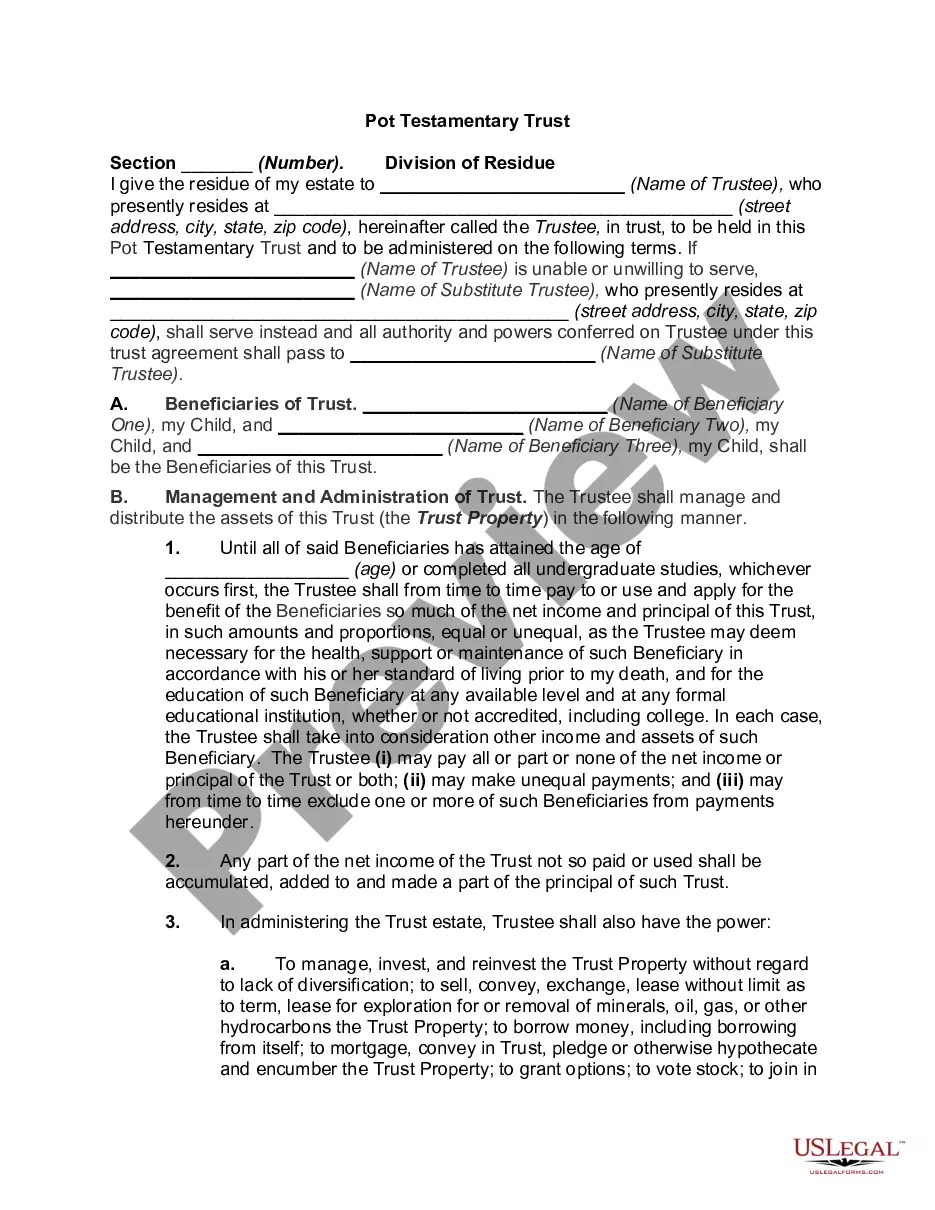
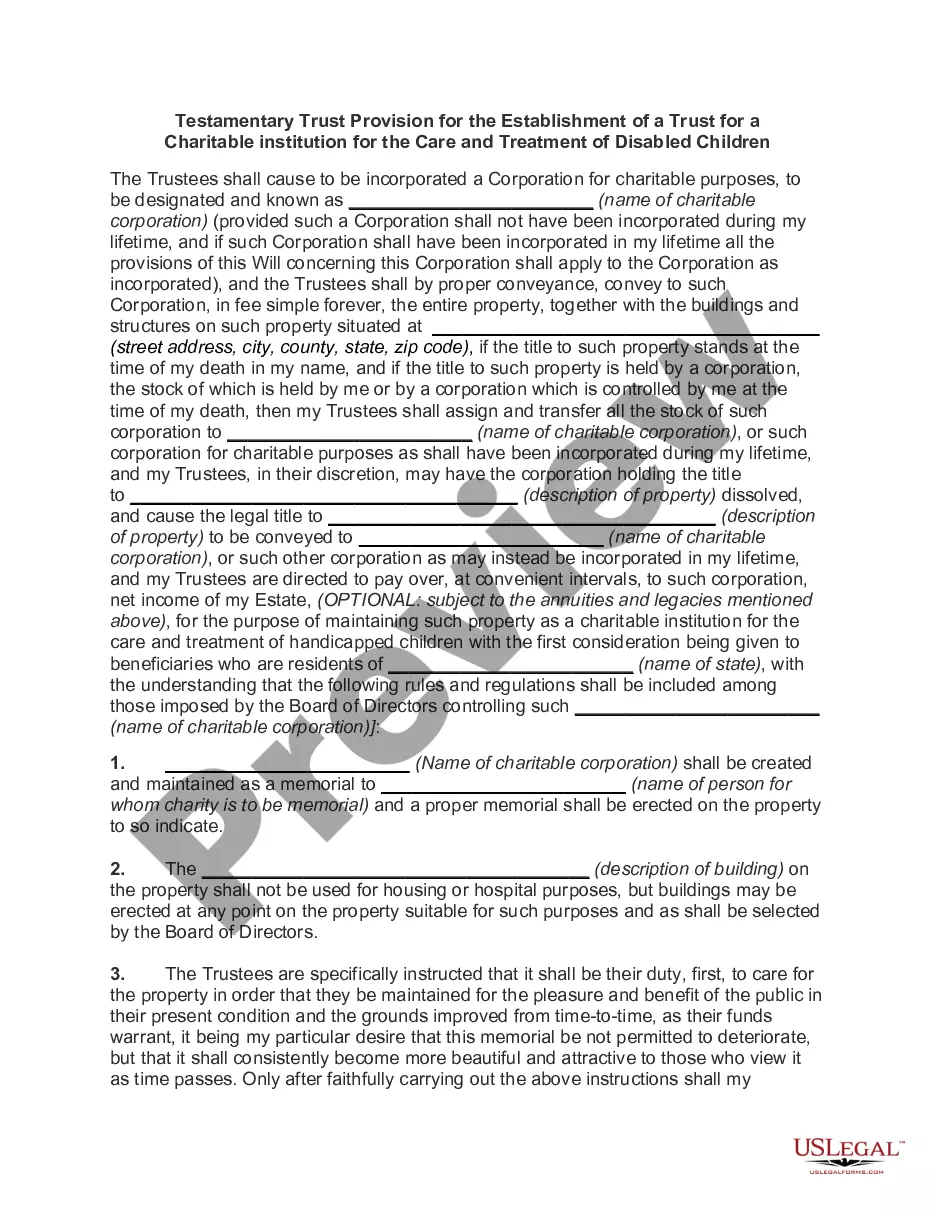
Washington Pot Testamentary Trust
Description

Get your form ready online
Our built-in tools help you complete, sign, share, and store your documents in one place.
Make edits, fill in missing information, and update formatting in US Legal Forms—just like you would in MS Word.
Download a copy, print it, send it by email, or mail it via USPS—whatever works best for your next step.
Sign and collect signatures with our SignNow integration. Send to multiple recipients, set reminders, and more. Go Premium to unlock E-Sign.
If this form requires notarization, complete it online through a secure video call—no need to meet a notary in person or wait for an appointment.
We protect your documents and personal data by following strict security and privacy standards.

Make edits, fill in missing information, and update formatting in US Legal Forms—just like you would in MS Word.

Download a copy, print it, send it by email, or mail it via USPS—whatever works best for your next step.

Sign and collect signatures with our SignNow integration. Send to multiple recipients, set reminders, and more. Go Premium to unlock E-Sign.

If this form requires notarization, complete it online through a secure video call—no need to meet a notary in person or wait for an appointment.

We protect your documents and personal data by following strict security and privacy standards.
Looking for another form?

How to fill out Pot Testamentary Trust?
If you require to finalize, obtain, or print legal document templates, utilize US Legal Forms, the leading collection of legal forms available online.
Take advantage of the website's simple and user-friendly search function to locate the documents you require.
A range of templates for business and personal purposes are organized by categories and states, or keywords.
Step 5. Process the payment. You can use your credit card or PayPal account to complete the transaction.
Step 6. Select the format of the legal form and download it to your device. Step 7. Complete, edit, and print or sign the Washington Pot Testamentary Trust. Every legal document template you purchase is yours for an extended period. You have access to all forms you downloaded in your account. Click on the My documents section and select a form to print or download again. Engage and obtain, and print the Washington Pot Testamentary Trust with US Legal Forms. There are numerous professional and state-specific forms available for your business or personal needs.
- Utilize US Legal Forms to find the Washington Pot Testamentary Trust in just a few clicks.
- If you are already a US Legal Forms user, Log In to your account and click the Download button to retrieve the Washington Pot Testamentary Trust.
- You can also access forms you previously downloaded in the My documents tab of your account.
- If you are new to US Legal Forms, follow the steps below.
- Step 1. Make sure you have chosen the form for the correct area/state.
- Step 2. Use the Review feature to browse the form's content. Be sure to check the description.
- Step 3. If you are not satisfied with the form, use the Search box at the top of the screen to find other types in the legal form template.
- Step 4. Once you have found the form you need, click on the Download now button. Choose the pricing plan you prefer and input your credentials to sign up for an account.
Form popularity
FAQ
A testamentary trust is created to manage the assets of the deceased on behalf of the beneficiaries. It is also used to reduce estate tax liabilities and ensure professional management of the assets of the deceased.
All told, the decision to use a will or a trust is largely dependent on your life circumstances and where you live. As an example, Washington State has a nominal flat-rate probate fee and a relatively straightforward probate process, so using a trust solely to avoid the cost of probate may not be the best choice.
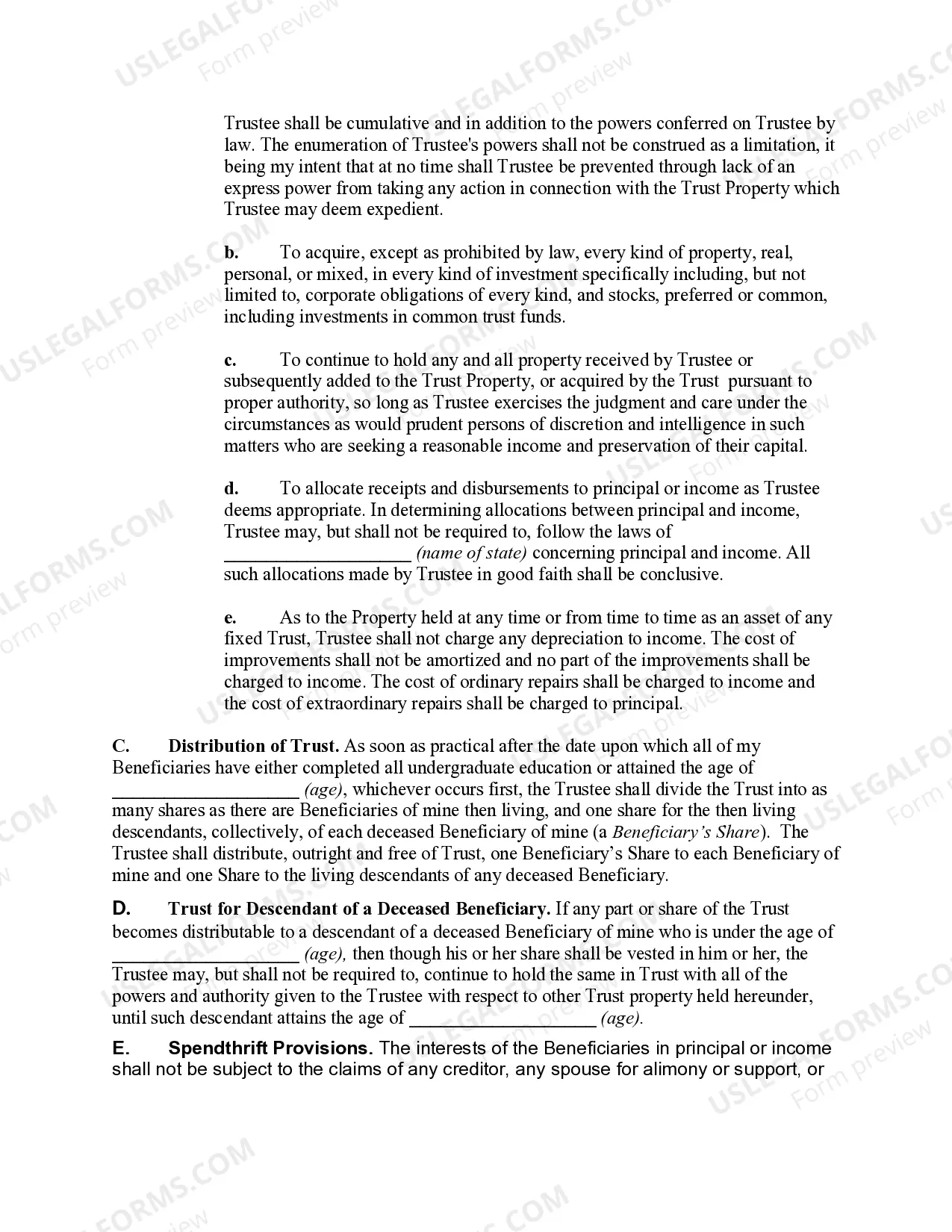
A pot trust is a type of trust that lists children as beneficiaries, with the trustee using his or her discretion as to how trust assets should be spent. If you have minor children, you might consider setting up a pot trust to meet their financial needs if something should happen to you.
The key difference is that a will becomes effective only after you die and your will has been entered into probate. Whereas a living trust bypasses the expensive and laborious process of probate, enabling your designated trustee to carry out your directives as recorded in your living trust at your death.
A testamentary trust is created to manage the assets of the deceased on behalf of the beneficiaries. It is also used to reduce estate tax liabilities and ensure professional management of the assets of the deceased.
Living trusts and testamentary trustsA living trust (sometimes called an inter vivos trust) is one created by the grantor during his or her lifetime, while a testamentary trust is a trust created by the grantor's will.
The other type of Testamentary Trusts are considered pot Trusts, essentially meaning all of one's assets are managed together. Family Testamentary Trusts allow parents to distribute assets based on each child's needs. These Trusts are typically used by parents who need or want to leave more funds to one child.
In Washington, there is a relatively high threshold for which estates must go through probate. Any estate worth less than $100,000 does not have to go to probate court, so you likely won't need a living trust if your estate is worth less than that.
Trusts are a crucial element to Estate Planning as they help provide more control over asset distribution after death. Among the various types available, a Testamentary Trust can be one of the best options for those thinking of their young children or grandchildren.
One of the drawbacks of a testamentary trust is the considerable responsibility it puts on the trustee. He must meet regularly with the probate court to demonstrate his safe handling of the trust, and depending on your wishes, his tasks may go on for many years.