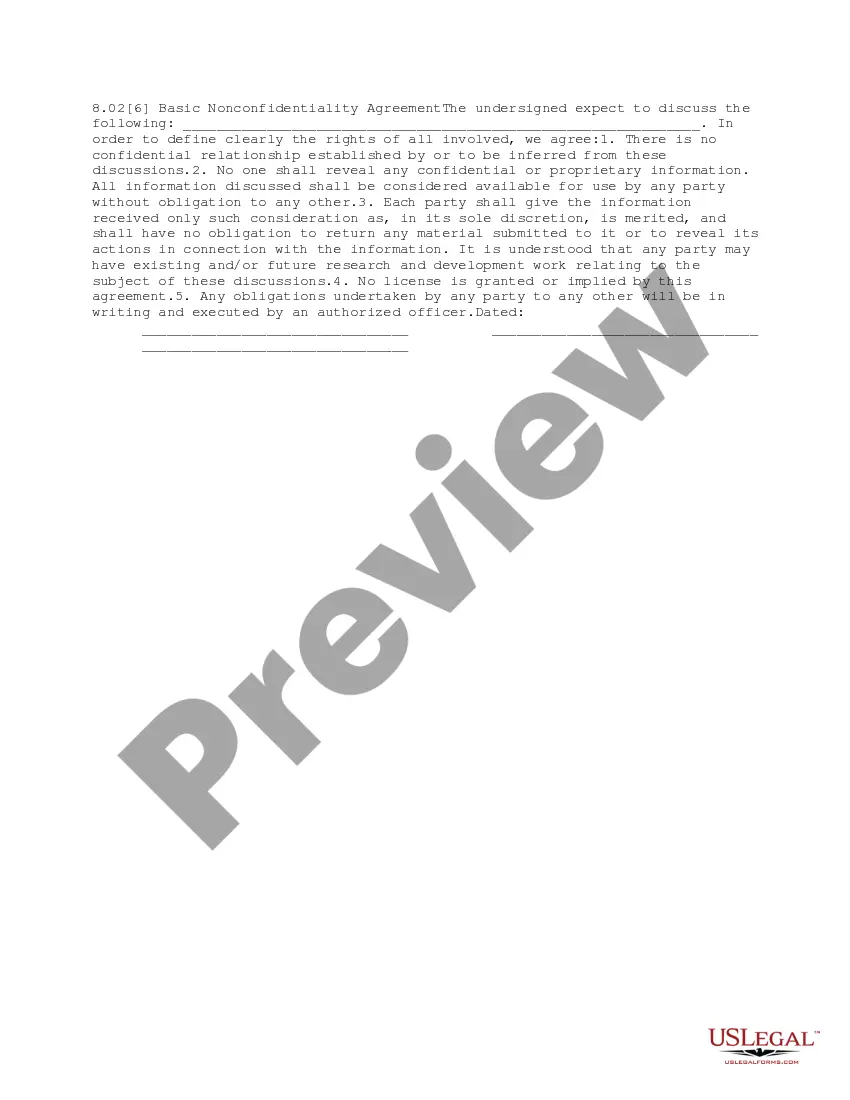
This form is a Basic Nonconfidentiality Agreement for use in negotiations or discussions where possible disclosure of licensing, patents, or commercial trade secrets is a factor.
Vermont Basic Nonconfidentiality Agreement
State:
Multi-State
Control #:
US-TS8026
Format:
Word;
PDF;
Rich Text
Instant download
Description
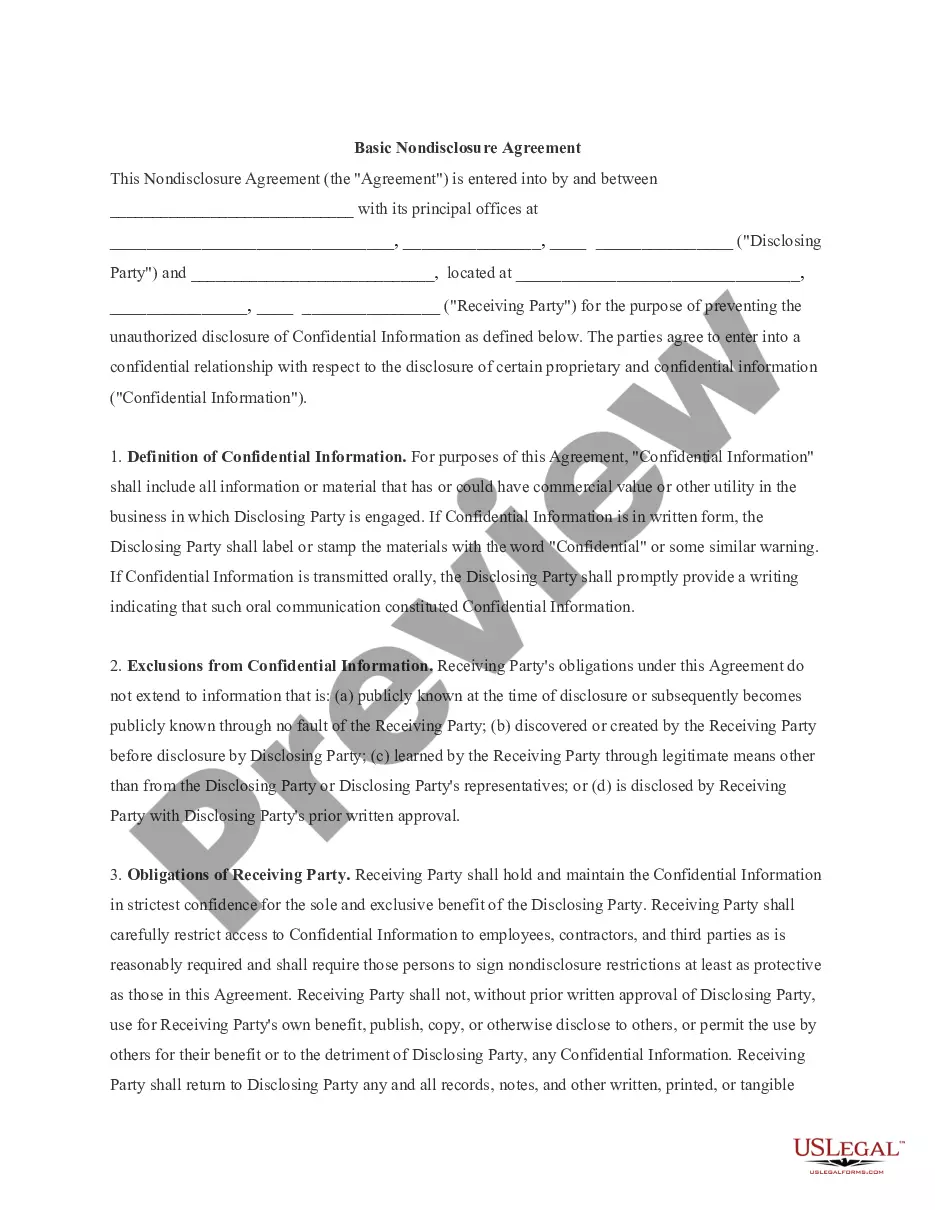
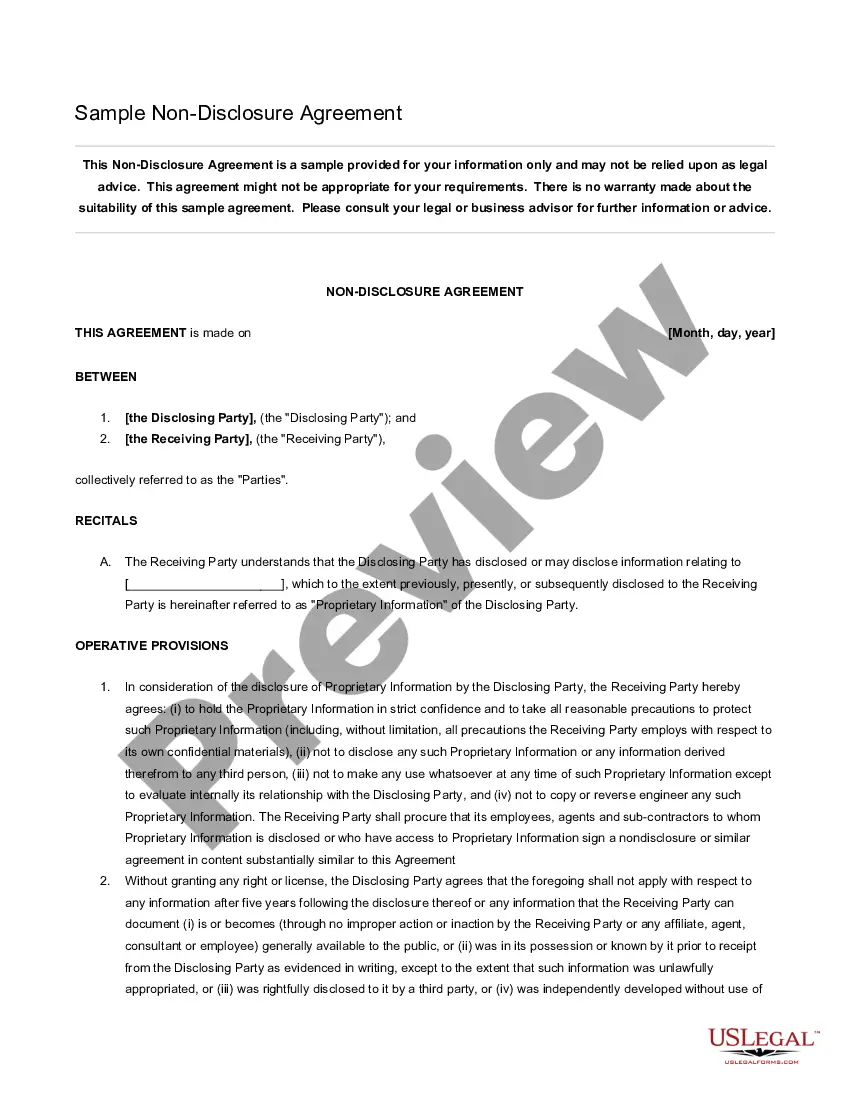
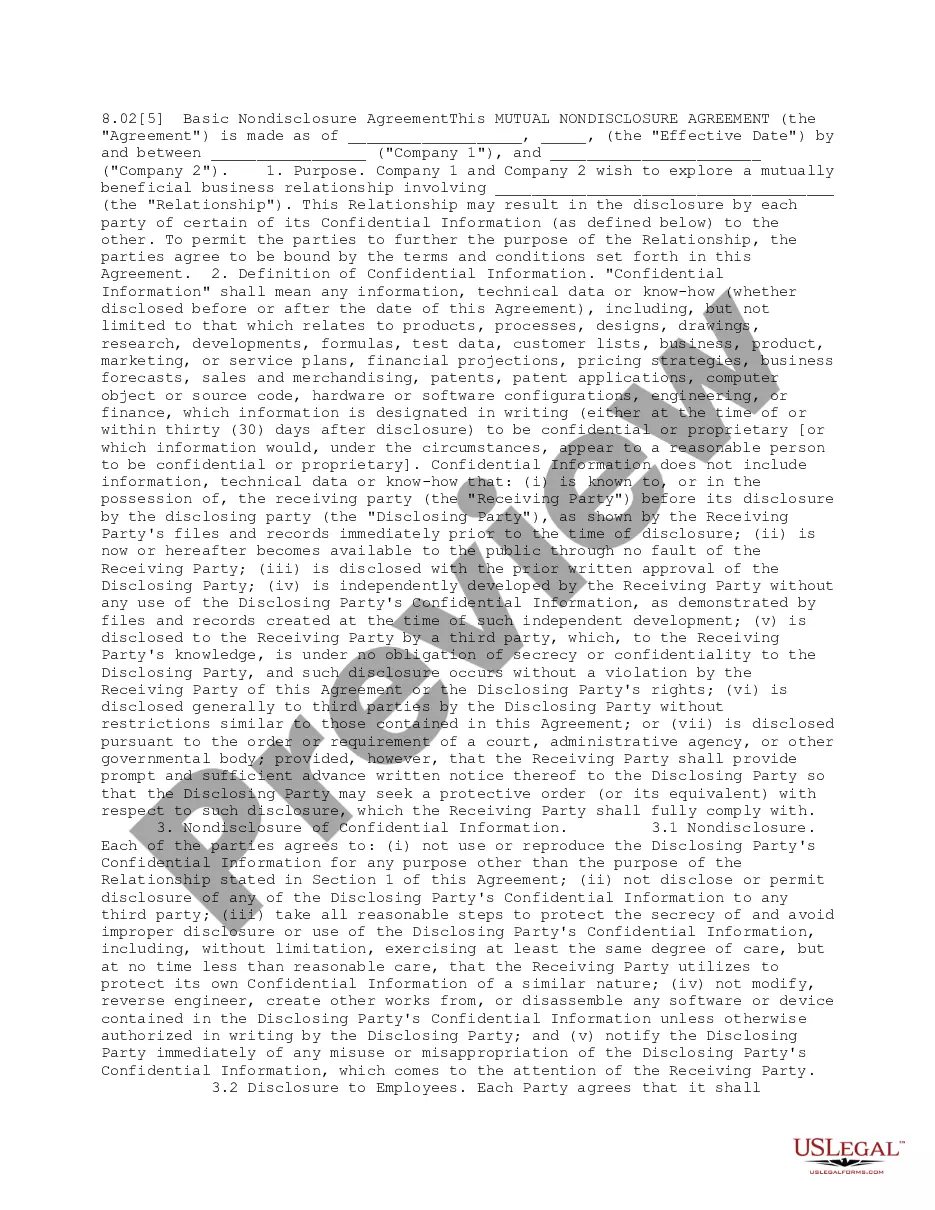
Get your form ready online
Our built-in tools help you complete, sign, share, and store your documents in one place.
Built-in online Word editor
Make edits, fill in missing information, and update formatting in US Legal Forms—just like you would in MS Word.
Export easily
Download a copy, print it, send it by email, or mail it via USPS—whatever works best for your next step.
E-sign your document
Sign and collect signatures with our SignNow integration. Send to multiple recipients, set reminders, and more. Go Premium to unlock E-Sign.
Notarize online 24/7
If this form requires notarization, complete it online through a secure video call—no need to meet a notary in person or wait for an appointment.
Store your document securely
We protect your documents and personal data by following strict security and privacy standards.

Make edits, fill in missing information, and update formatting in US Legal Forms—just like you would in MS Word.

Download a copy, print it, send it by email, or mail it via USPS—whatever works best for your next step.

Sign and collect signatures with our SignNow integration. Send to multiple recipients, set reminders, and more. Go Premium to unlock E-Sign.

If this form requires notarization, complete it online through a secure video call—no need to meet a notary in person or wait for an appointment.

We protect your documents and personal data by following strict security and privacy standards.
Looking for another form?




How to fill out Basic Nonconfidentiality Agreement?
You are able to invest hours on the web looking for the legitimate document web template that meets the state and federal demands you will need. US Legal Forms supplies a large number of legitimate kinds that are reviewed by experts. You can actually down load or print out the Vermont Basic Nonconfidentiality Agreement from my services.
If you already possess a US Legal Forms accounts, it is possible to log in and click on the Down load switch. After that, it is possible to total, edit, print out, or indicator the Vermont Basic Nonconfidentiality Agreement. Each legitimate document web template you purchase is the one you have for a long time. To obtain yet another copy associated with a bought kind, go to the My Forms tab and click on the corresponding switch.
If you use the US Legal Forms website the very first time, keep to the simple recommendations listed below:
- First, be sure that you have chosen the right document web template for the state/city of your choosing. Browse the kind description to ensure you have selected the proper kind. If readily available, make use of the Review switch to look throughout the document web template also.
- In order to find yet another variation in the kind, make use of the Lookup area to discover the web template that fits your needs and demands.
- After you have discovered the web template you want, click on Acquire now to proceed.
- Find the costs strategy you want, key in your credentials, and sign up for your account on US Legal Forms.
- Total the purchase. You can utilize your Visa or Mastercard or PayPal accounts to pay for the legitimate kind.
- Find the formatting in the document and down load it in your system.
- Make modifications in your document if necessary. You are able to total, edit and indicator and print out Vermont Basic Nonconfidentiality Agreement.
Down load and print out a large number of document web templates utilizing the US Legal Forms Internet site, which offers the greatest selection of legitimate kinds. Use professional and condition-specific web templates to deal with your business or specific needs.
Form popularity
FAQ
NDAs that are oppressive, overreaching in scope and seen as an attempt to protect irrelevant information can also meet challenges and be invalidated by courts. Other reasons for invalidating an NDA include: Wrong party listed in the NDA ? Companies can use separate legal and trade names.
An NDA creates the legal framework to protect ideas and information from being stolen or shared with competitors or third parties. Breaking an NDA agreement triggers a host of legal ramifications, including lawsuits, financial penalties, and even criminal charges.
Before you sign an NDA, keep the following seven points in mind. Parties to the agreement. ... Identification of what information is confidential. ... Time frame of the agreement. ... Return of the information. ... Obligations of the recipient. ... Remedies for breaches of agreement. ... Other clauses.
Violating an NDA can have serious consequences ? NDAs are legally binding contracts. If an employee has violated an NDA, then the company may take legal action. The most common claims in NDA lawsuits include: Breach of the contract (such as the breach of NDA)
The NDA is an essential tool for managing the disclosure of sensitive business information both internally and to other parties. It sets out: Restrictions on a receiving party's use, disclosure, and return of a disclosing party's confidential information. The parties' related rights and obligations.
When is a confidentiality agreement needed? A range of commercial transactions and relationships involve either the disclosure of confidential information by one party to the other or a reciprocal exchange of information. In both cases, the parties should have a confidentiality agreement in place.
Besides naming all parties to the NDA, five essential elements every NDA should include are: Description Of The Confidential Information. ... Requirements And Obligations Of The Parties. ... Exclusions To The Confidentiality Agreement. ... Term Of The Non-Disclosure Agreement. ... Consequences Of Breach Of The NDA.
Whereas NDAs are often used in business and legal settings to protect trade secrets, client lists, and financial data, confidentiality agreements are typically devised in employment or personal situations to protect sensitive information.
disclosure agreement (NDA) is a legally binding contract that establishes a confidential relationship. The party or parties signing the agreement agree that sensitive information they may obtain will not be made available to others.
NDAs, or non-disclosure agreements, are legally enforceable contracts that create a confidential relationship between a person who has sensitive information and a person who will gain access to that information.