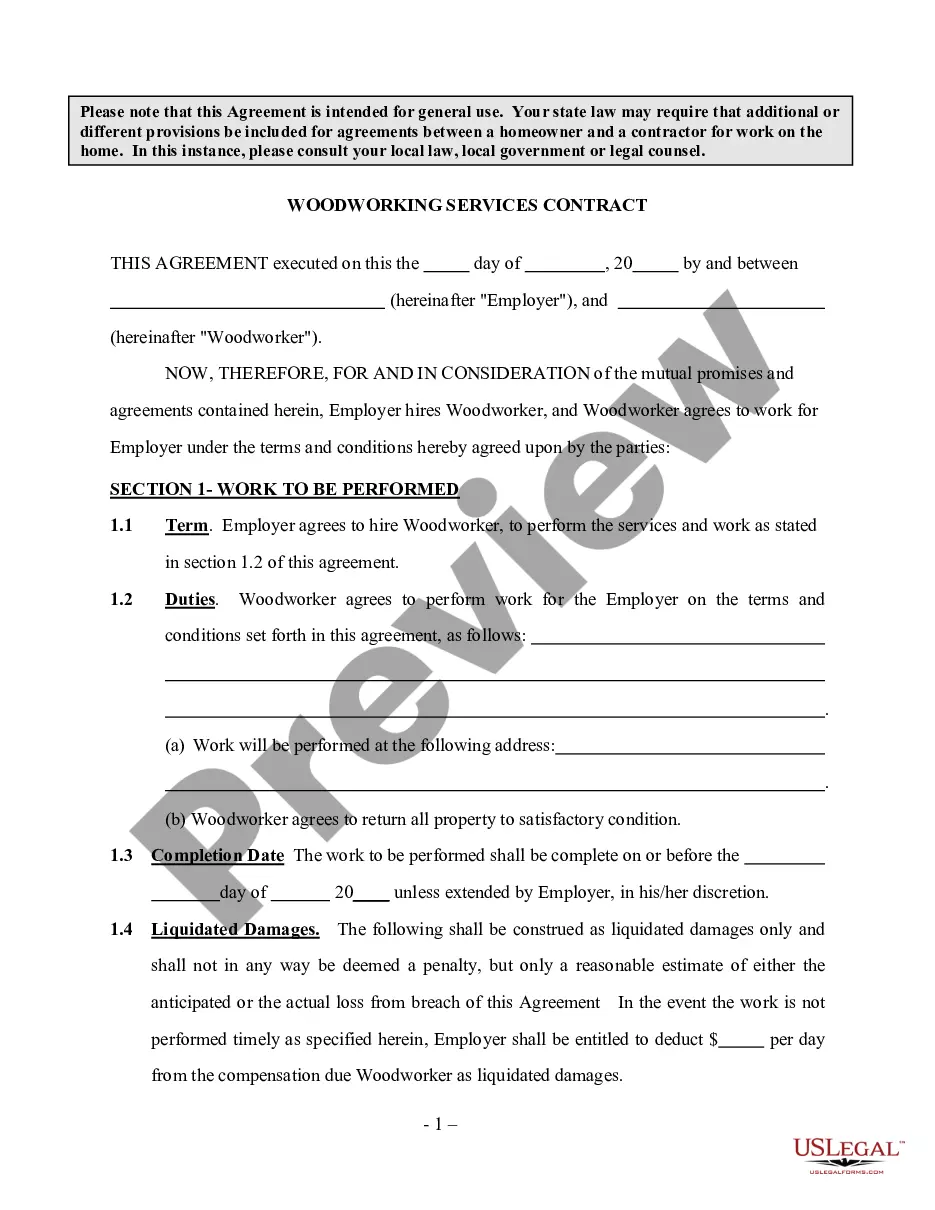
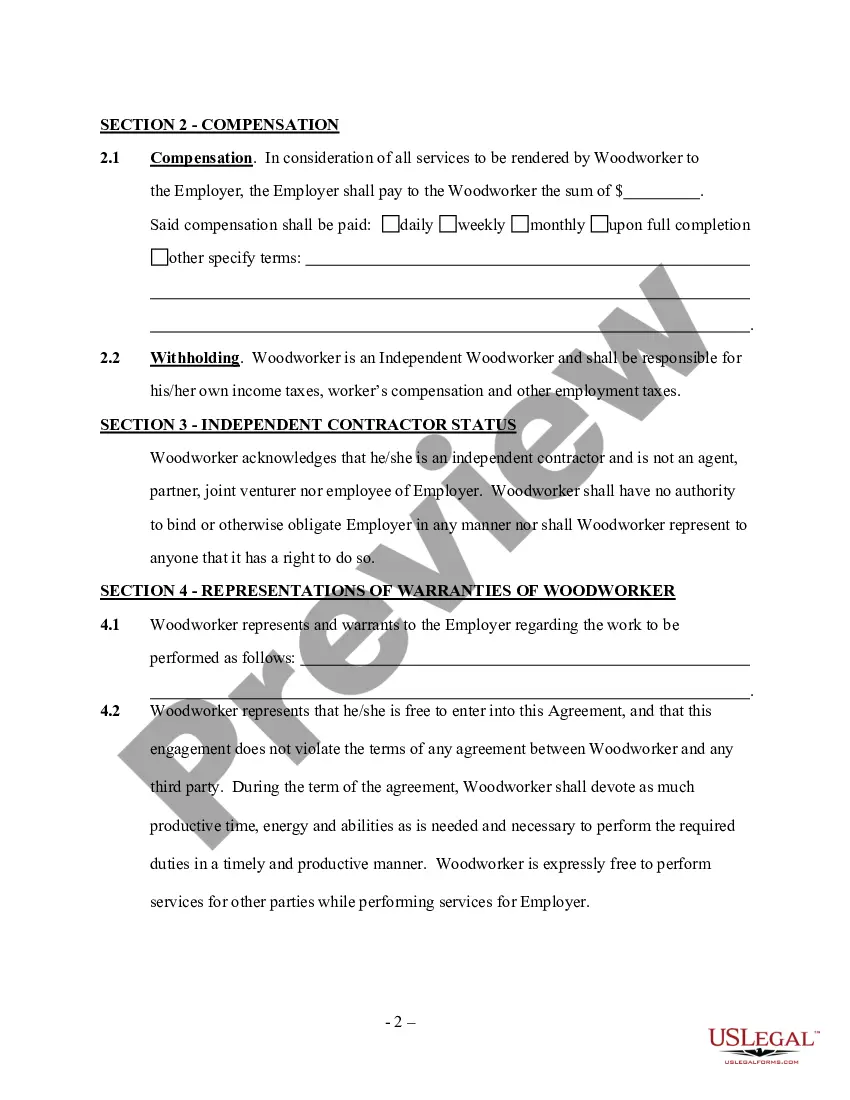
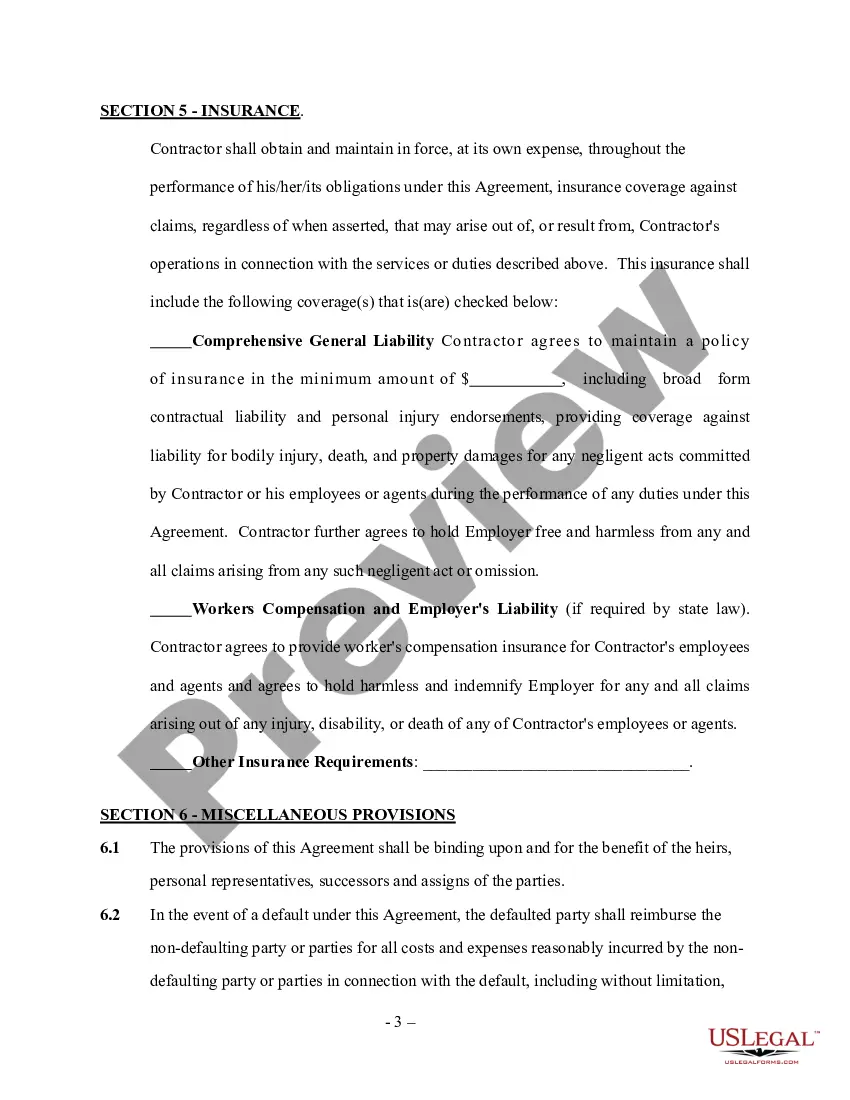
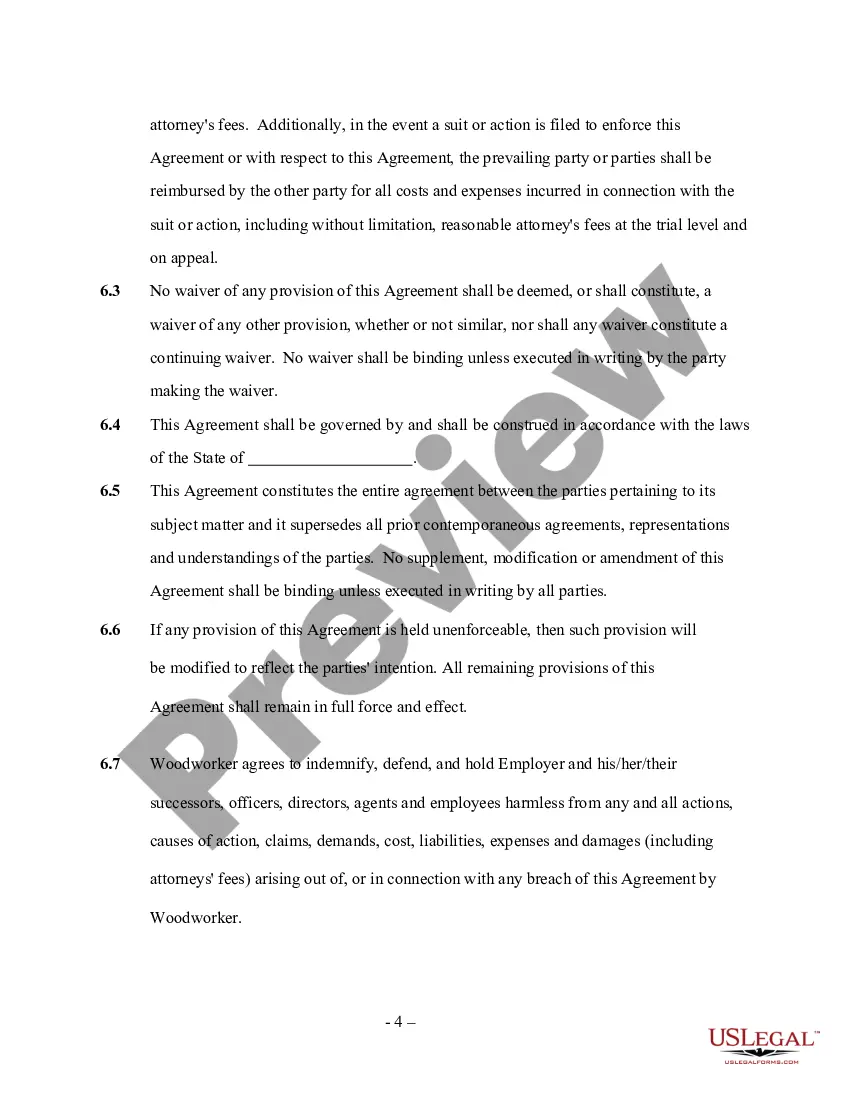
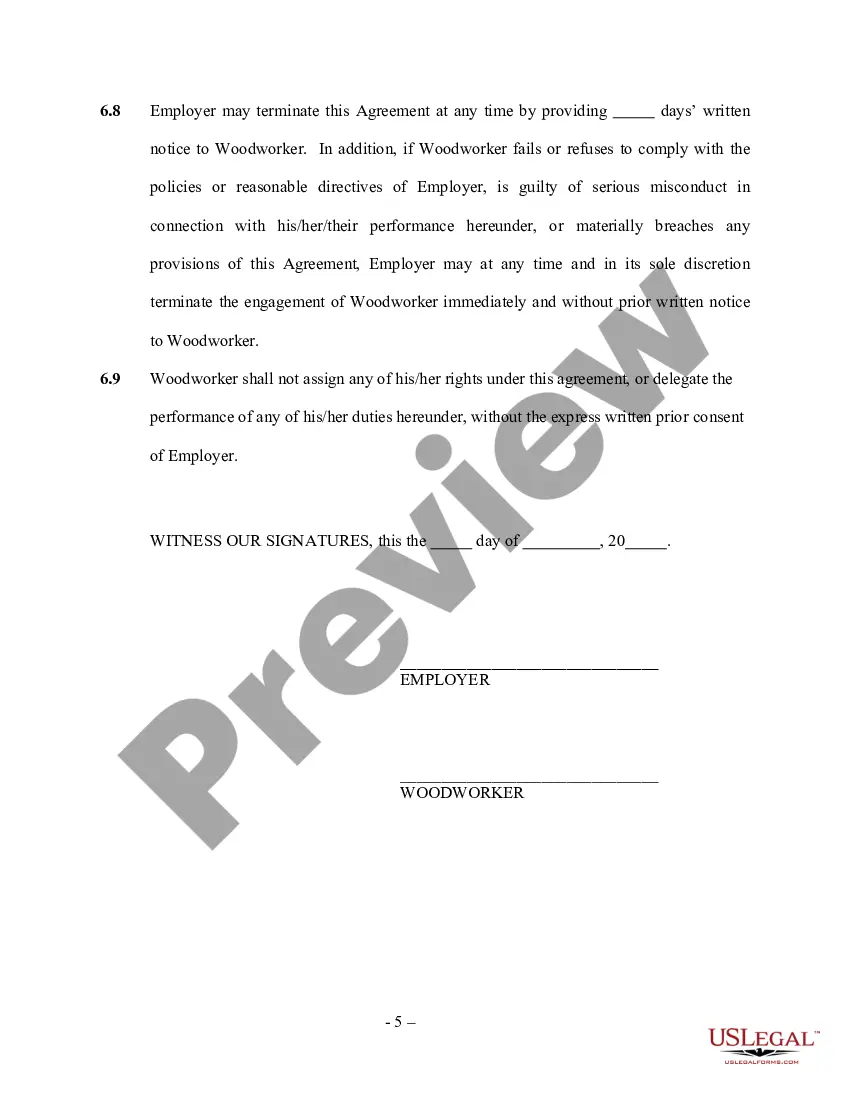
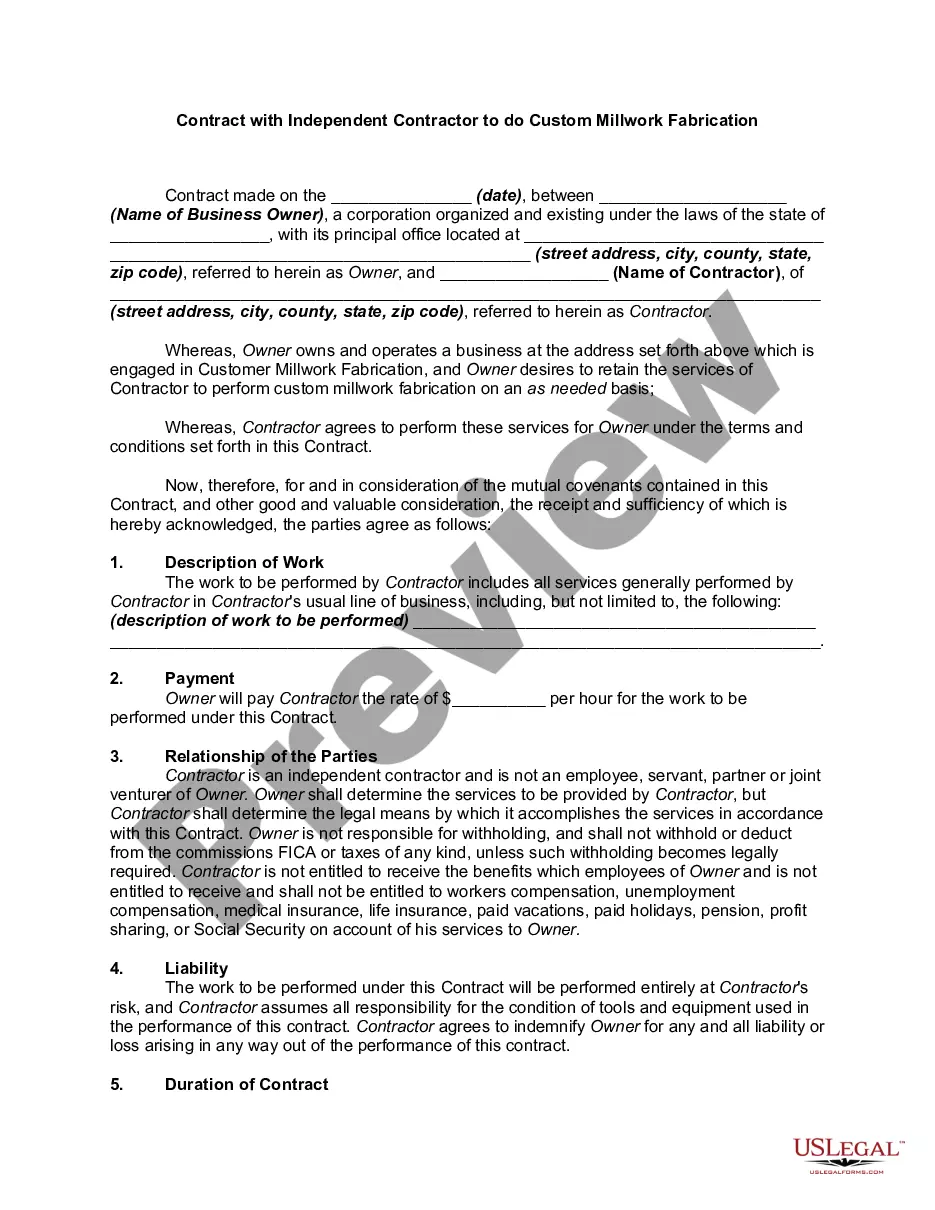
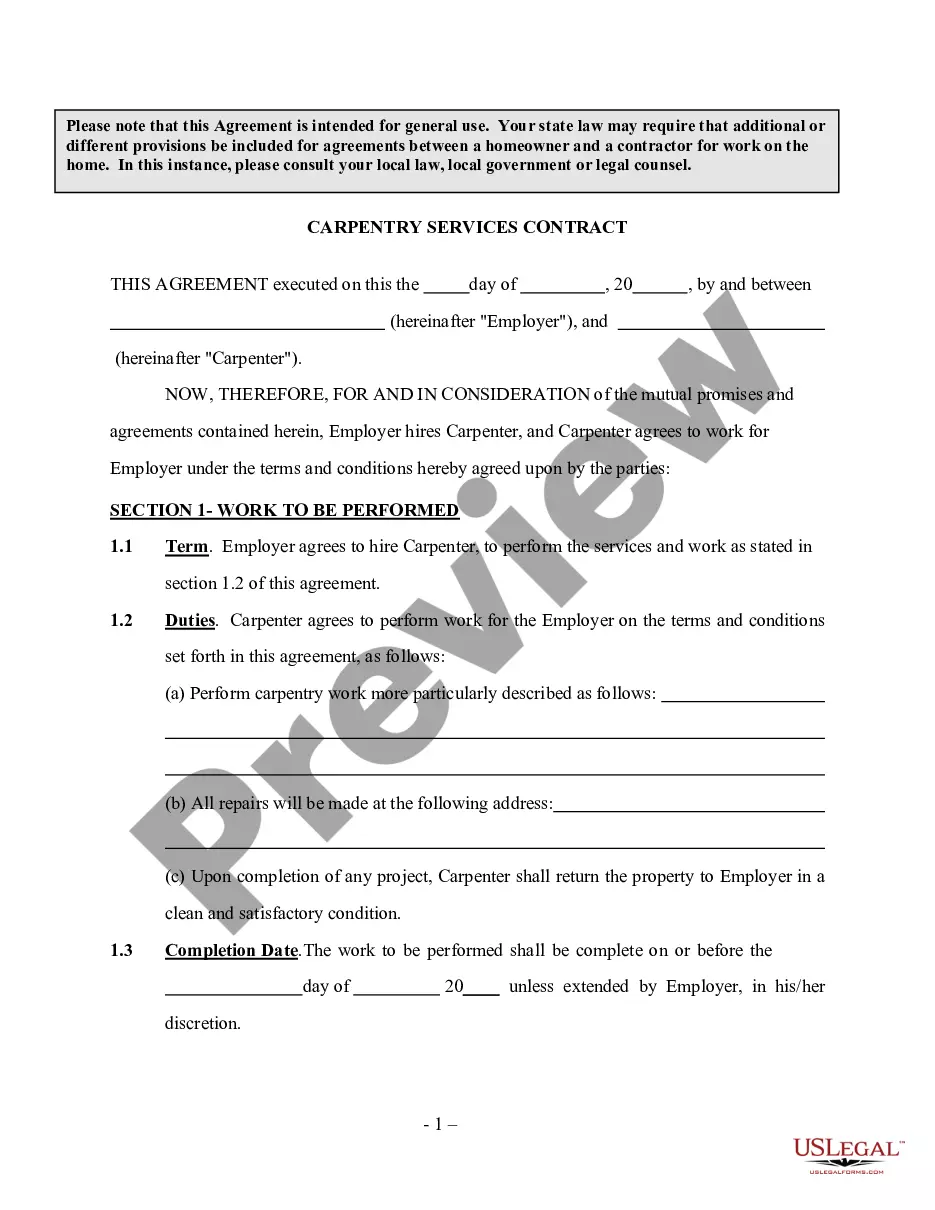
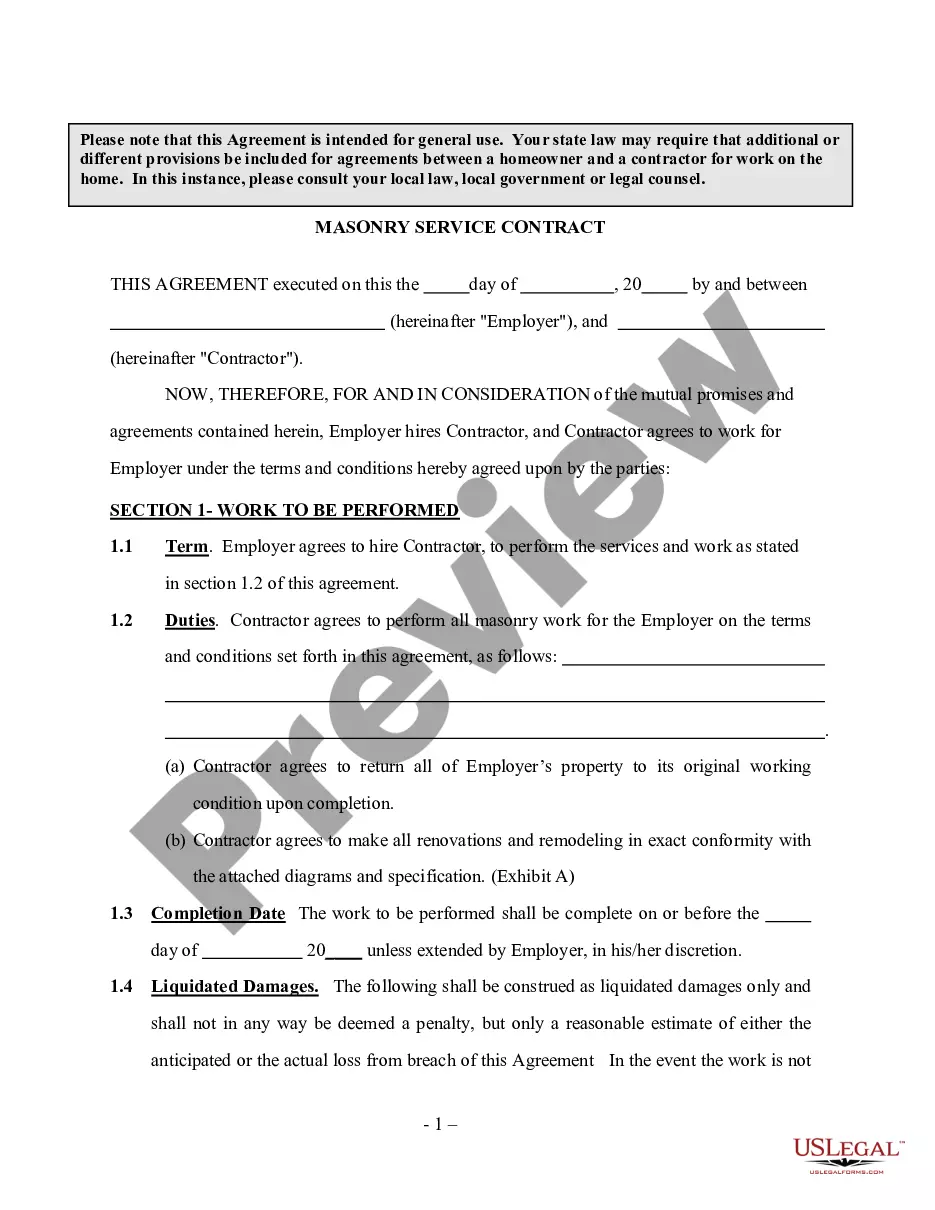
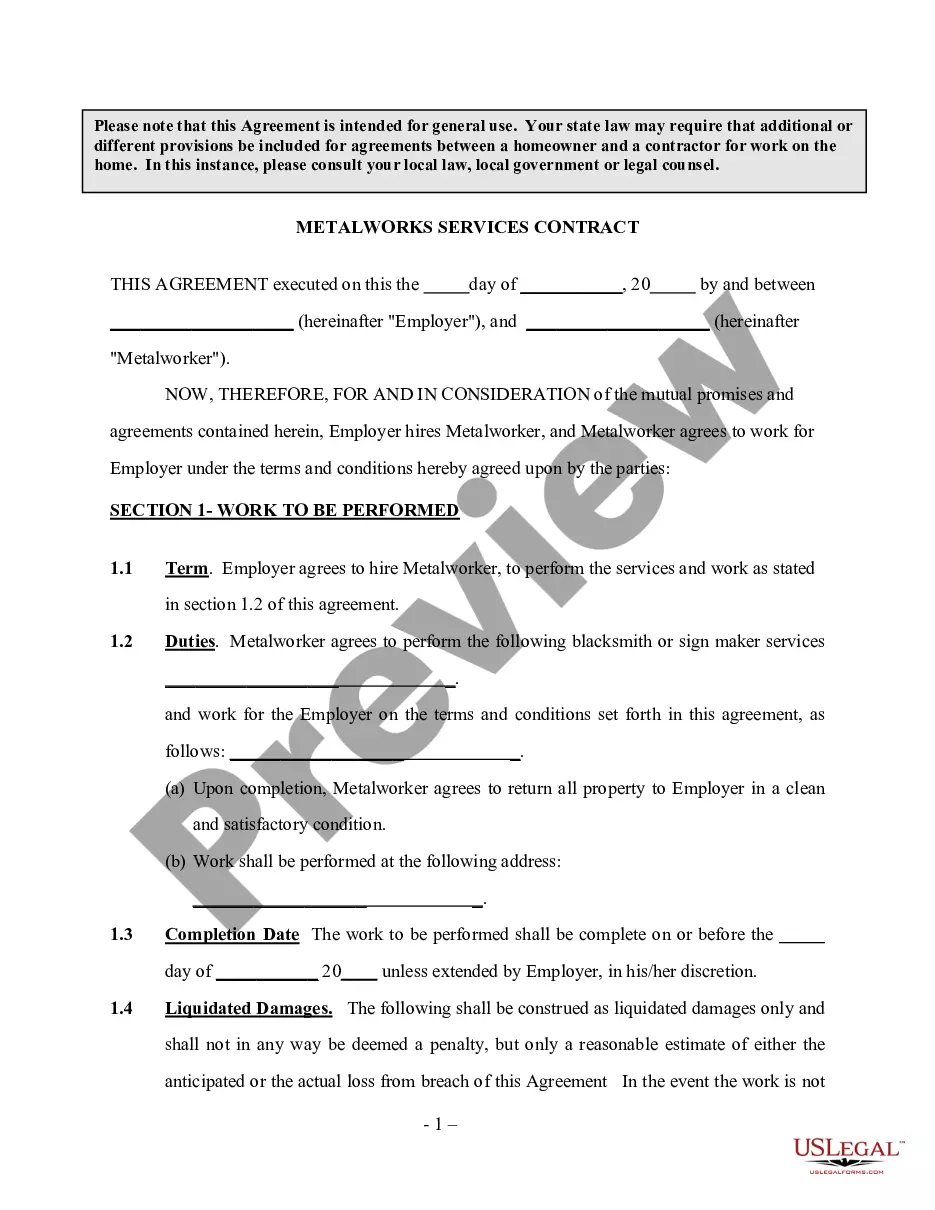
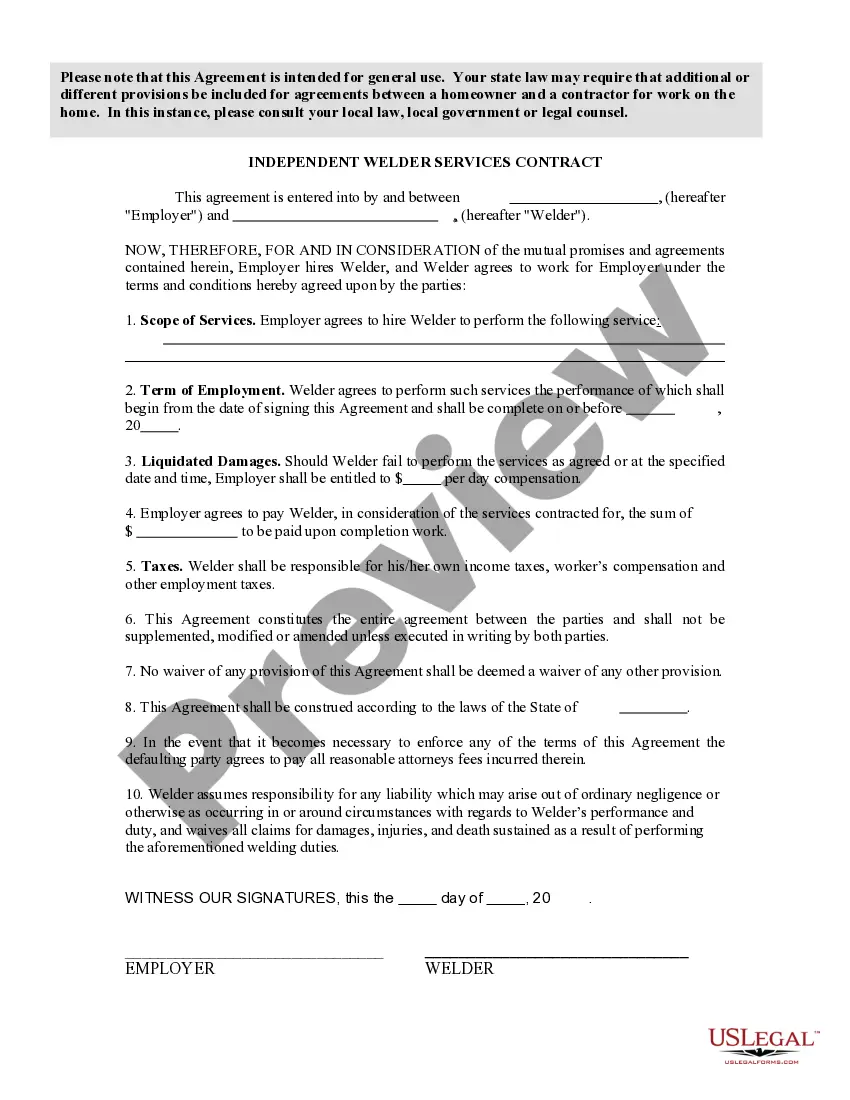
Employer hires a woodworker as an independent contractor to provide woodworking services for Employer as specified in the Agreement. Please note that this Agreement is intended for general use. Your state law may require that additional or different provisions be included for agreements between a homeowner and a contractor for work on the home. In this instance, please consult your local law, local government or legal counsel.
Vermont Woodworking Services Contract - Self-Employed
State:
Multi-State
Control #:
US-INDC-189
Format:
Word;
Rich Text
Instant download
Description
Free preview
Get your form ready online
Our built-in tools help you complete, sign, share, and store your documents in one place.
Built-in online Word editor
Make edits, fill in missing information, and update formatting in US Legal Forms—just like you would in MS Word.
Export easily
Download a copy, print it, send it by email, or mail it via USPS—whatever works best for your next step.
E-sign your document
Sign and collect signatures with our SignNow integration. Send to multiple recipients, set reminders, and more. Go Premium to unlock E-Sign.
Notarize online 24/7
If this form requires notarization, complete it online through a secure video call—no need to meet a notary in person or wait for an appointment.
Store your document securely
We protect your documents and personal data by following strict security and privacy standards.

Make edits, fill in missing information, and update formatting in US Legal Forms—just like you would in MS Word.

Download a copy, print it, send it by email, or mail it via USPS—whatever works best for your next step.

Sign and collect signatures with our SignNow integration. Send to multiple recipients, set reminders, and more. Go Premium to unlock E-Sign.

If this form requires notarization, complete it online through a secure video call—no need to meet a notary in person or wait for an appointment.

We protect your documents and personal data by following strict security and privacy standards.
Looking for another form?

How to fill out Woodworking Services Contract - Self-Employed?
Selecting the optimal legal document web template can be a challenge. Of course, there is a wide range of templates available online, but how do you find the legal form you need? Utilize the US Legal Forms website. This service offers a vast collection of templates, including the Vermont Woodworking Services Contract - Self-Employed, which you can utilize for both business and personal purposes. All forms are verified by professionals and comply with state and federal regulations.
If you are already registered, Log In to your account and click on the Download button to obtain the Vermont Woodworking Services Contract - Self-Employed. Use your account to browse through the legal forms you have previously purchased. Check the My documents section of your account to get another copy of the document you need.
If you are a new user of US Legal Forms, here are simple steps you should follow: First, ensure you have selected the correct form for your city/county. You can review the form using the Review button and read the form description to confirm it is suitable for you. If the form does not meet your requirements, make use of the Search field to find the appropriate form. Once you are sure that the form is correct, select the Buy now button to purchase the form. Choose the pricing plan you prefer and enter the necessary information. Create your account and pay for the transaction using your PayPal account or credit card. Select the file format and download the legal document template to your device. Complete, edit, print, and sign the acquired Vermont Woodworking Services Contract - Self-Employed.
By following these guidelines, you can easily navigate the US Legal Forms website and obtain the legal documents you need efficiently.
- US Legal Forms is the largest repository of legal forms where you can find numerous document templates.
- Utilize the service to download well-crafted paperwork that adhere to state regulations.
- Ensure that you are logged into your account to access your previously purchased forms.
- Review the descriptions carefully to confirm you have the right document.
- Use the search feature effectively to narrow down your options.
- Complete all necessary steps to finalize your document acquisition.
Form popularity
FAQ
The 183 day rule in Vermont relates to how the state defines residency for tax purposes. If you spend over 183 days in Vermont during the tax year, you may be considered a resident. This can impact whether your Vermont woodworking services contract as a self-employed individual will be subject to Vermont state taxes. Understanding this rule can help you manage your tax obligations effectively; using uslegalforms can guide you in drafting proper agreements that take residency into account.
In Vermont, taxable services include various personal services as well as certain business activities. This means that if you offer Vermont woodworking services as a self-employed individual, you may need to collect tax on your services. It's essential to understand the specifics of the Vermont Woodworking Services Contract - Self-Employed, as this will guide you on compliance with tax regulations. To ensure you meet all requirements, consider using platforms like uslegalforms for tailored contract templates.
To write a contract for a 1099 employee, include the worker's information, the nature of the work, and the payment terms. Make sure to clarify the independent contractor status, outlining that they are responsible for their own taxes. A Vermont Woodworking Services Contract - Self-Employed can serve as a robust guide to ensure that you cover all necessary elements in the contract.
Writing a self-employment contract involves outlining the agreement terms clearly and concisely. Start with the parties' names, define the scope of services, and specify payment details. It’s also crucial to include any relevant clauses, such as termination and confidentiality. Utilize a Vermont Woodworking Services Contract - Self-Employed framework for effective guidance.
Yes, you can write your own legally binding contract as long as it includes all necessary elements such as offer, acceptance, and consideration. Make sure to use clear language and lay out the terms explicitly. For peace of mind, consider using a Vermont Woodworking Services Contract - Self-Employed template, which can help you include all important details without missing anything.
You can demonstrate that you are self-employed by providing documents such as invoices, tax returns, or a business license. Additionally, a signed Vermont Woodworking Services Contract - Self-Employed can validate your status as an independent contractor. Ensure that your business activities are well-documented to support your self-employed claim.
To fill out an independent contractor agreement, start by clearly identifying the parties involved and their addresses. Next, specify the services to be provided, the payment terms, and the project timeline. Be sure to include language that outlines the responsibilities of both parties as well as any confidentiality agreements. Using a Vermont Woodworking Services Contract - Self-Employed can guide you through this process efficiently.
The key difference lies in their definitions and applications. Contract refers to an agreement for specific work, while self-employed refers to the status of running your own business. A self-employed individual might engage in various contracts throughout their career. Clarifying these terms with a Vermont Woodworking Services Contract - Self-Employed helps ensure everyone understands their role and responsibilities.
Subcontracting can be a form of self-employment. When you subcontract, you take on work for someone else but operate as an independent entity. This means you manage your own taxes and work assignments independently. For this arrangement, a Vermont Woodworking Services Contract - Self-Employed provides a clear framework and protects your interests.
Contract work is often synonymous with being self-employed, but distinctions exist. Self-employed individuals do not necessarily need to work on contracts; they can also run their businesses. Contract work is a specific type of self-employment focused on particular projects. If you're in the woodworking industry, using a Vermont Woodworking Services Contract - Self-Employed can communicate your terms effectively.