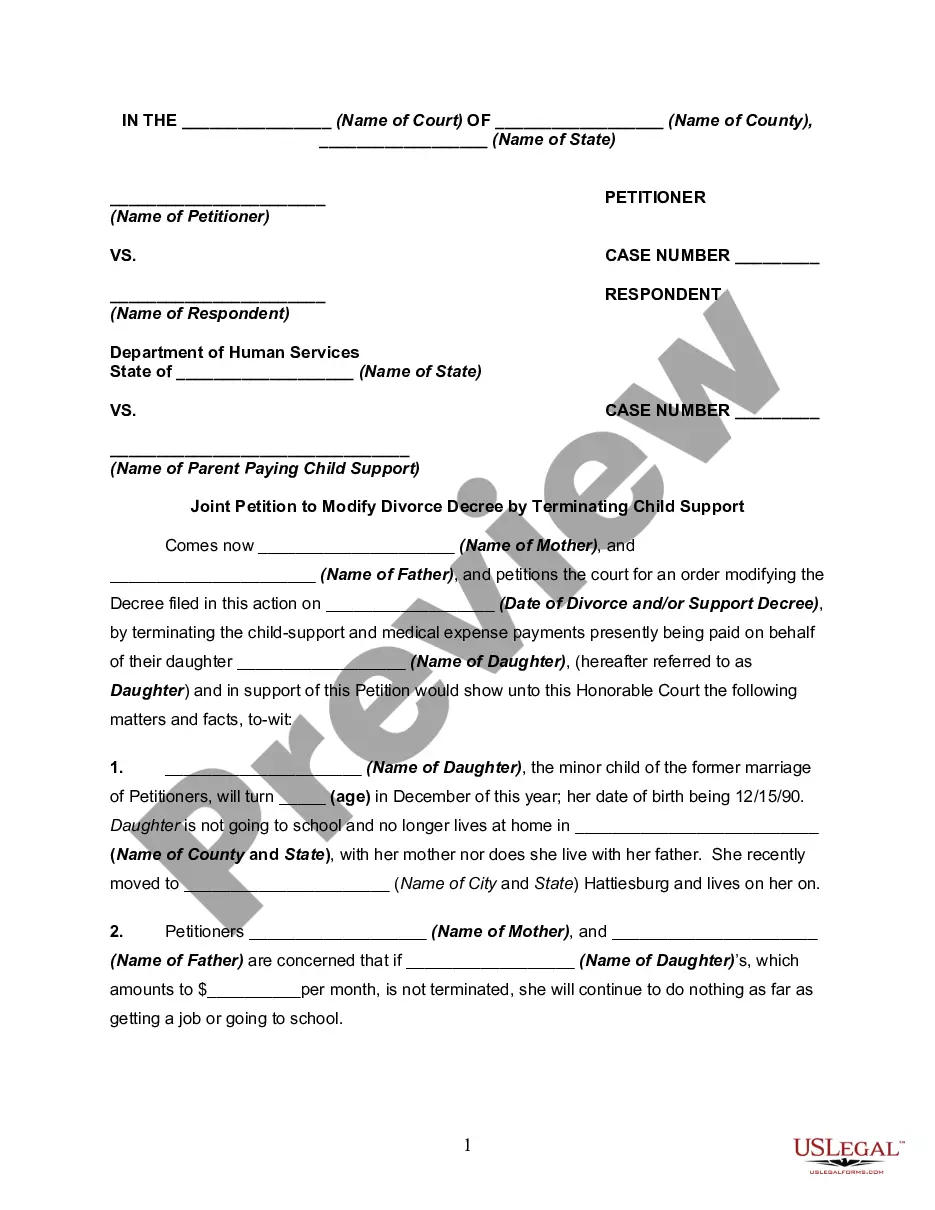
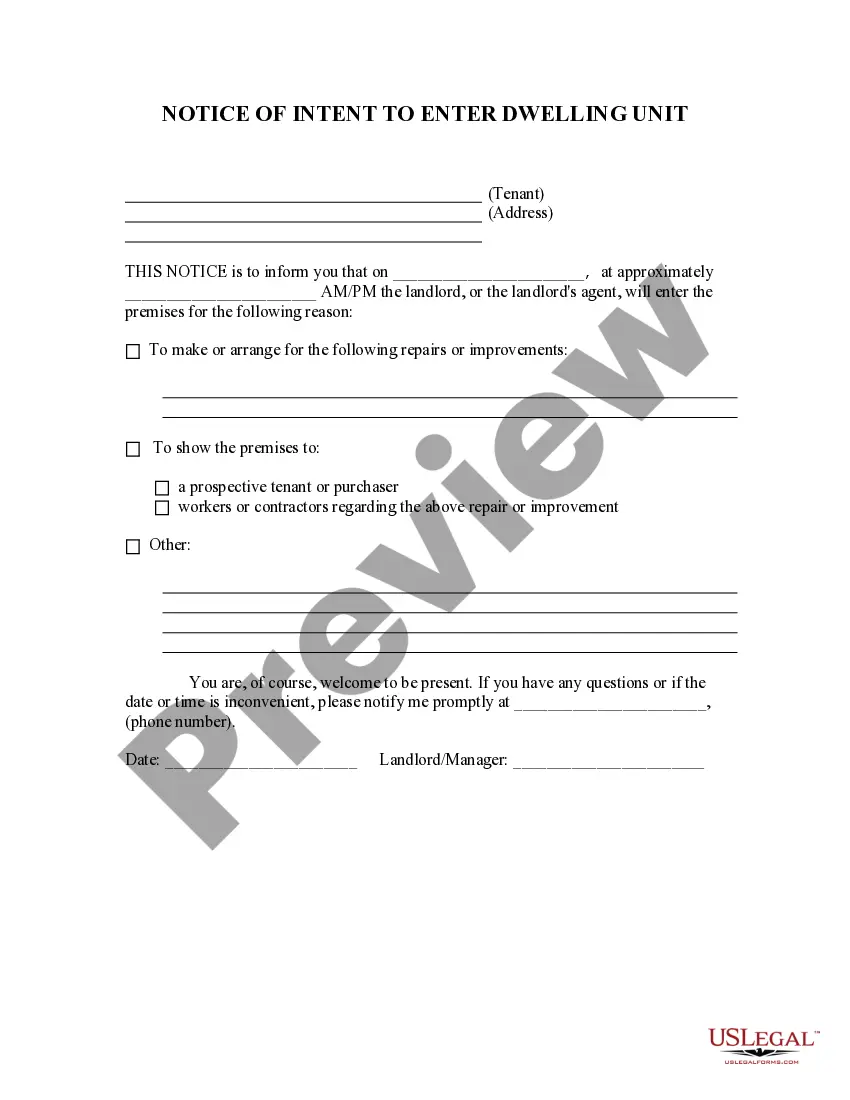
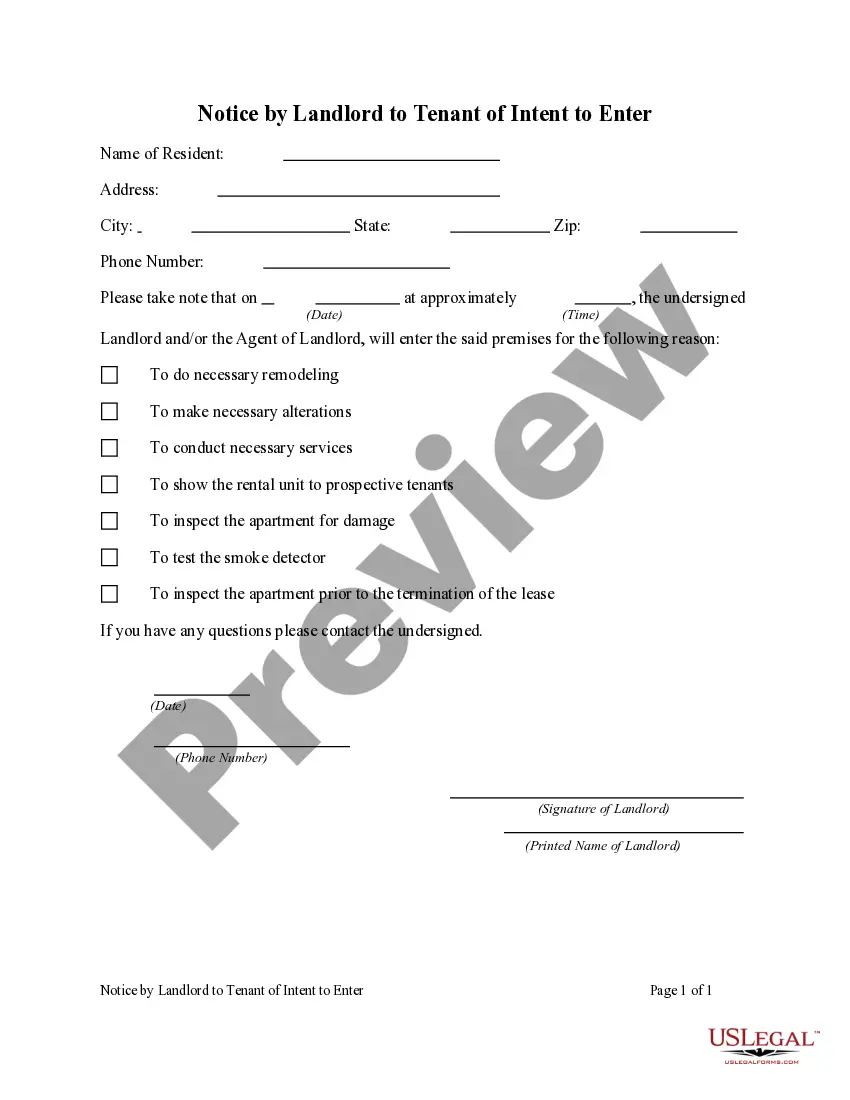
Vermont Landlord Notice of Intent to Enter Premises
Description


How to fill out Landlord Notice Of Intent To Enter Premises?
If you desire to finish, obtain, or produce legal document templates, utilize US Legal Forms, the largest selection of legal documents available online.
Leverage the site's straightforward and user-friendly search feature to discover the documents you require.
Various templates for business and personal purposes are organized by categories and states, or keywords. Use US Legal Forms to locate the Vermont Landlord Notice of Intent to Enter Premises in just a few clicks.
Every legal document template you acquire is yours indefinitely. You can access all forms you saved in your account. Visit the My documents section and choose a form to print or download again.
Complete, acquire, and print the Vermont Landlord Notice of Intent to Enter Premises with US Legal Forms. There are countless professional and state-specific forms you can employ for your business or personal needs.
- If you are currently a US Legal Forms user, Log In to your account and press the Download button to acquire the Vermont Landlord Notice of Intent to Enter Premises.
- You can also access forms you previously saved in the My documents section of your account.
- If you are utilizing US Legal Forms for the first time, follow the instructions below.
- Step 1. Ensure you have selected the form for the appropriate city/state.
- Step 2. Use the Preview option to review the content of the form. Always remember to read the description.
- Step 3. If the form does not meet your needs, use the Search area at the top of the screen to find alternative versions of the legal form template.
- Step 4. Once you have located the desired form, select the Buy now button. Choose the payment plan you prefer and enter your details to create an account.
- Step 5. Complete the payment process. You can use your credit card or PayPal account to finalize the transaction.
- Step 6. Download the format of the legal form and save it on your device.
- Step 7. Fill out, edit, and print or sign the Vermont Landlord Notice of Intent to Enter Premises.
Form popularity
FAQ
If you pay rent every week, you must give the landlord notice at least seven days before you move. If the landlord has given you a 60 day notice to end the tenancy but you want to leave sooner, you need to give notice one rental payment period in advance.
The minimum notice requirement is 28 days. If you have a monthly tenancy, you will have to give one month's notice. If you pay your rent at longer intervals you have to give notice equivalent to that rental period. For example, if you pay rent every three months, you would have to give three months' notice.
As a tenant you have certain legal rights including a legal right to live in your property undisturbed by your landlord or the letting agent. That means that your landlord and the letting agent cannot enter the tenanted property without your agreement or permission.
The Governor of Vermont let the state of emergency expire on June 15, 2021. This does not mean that you can be removed from your rental unit right away. You cannot be evicted from your home without a court process.
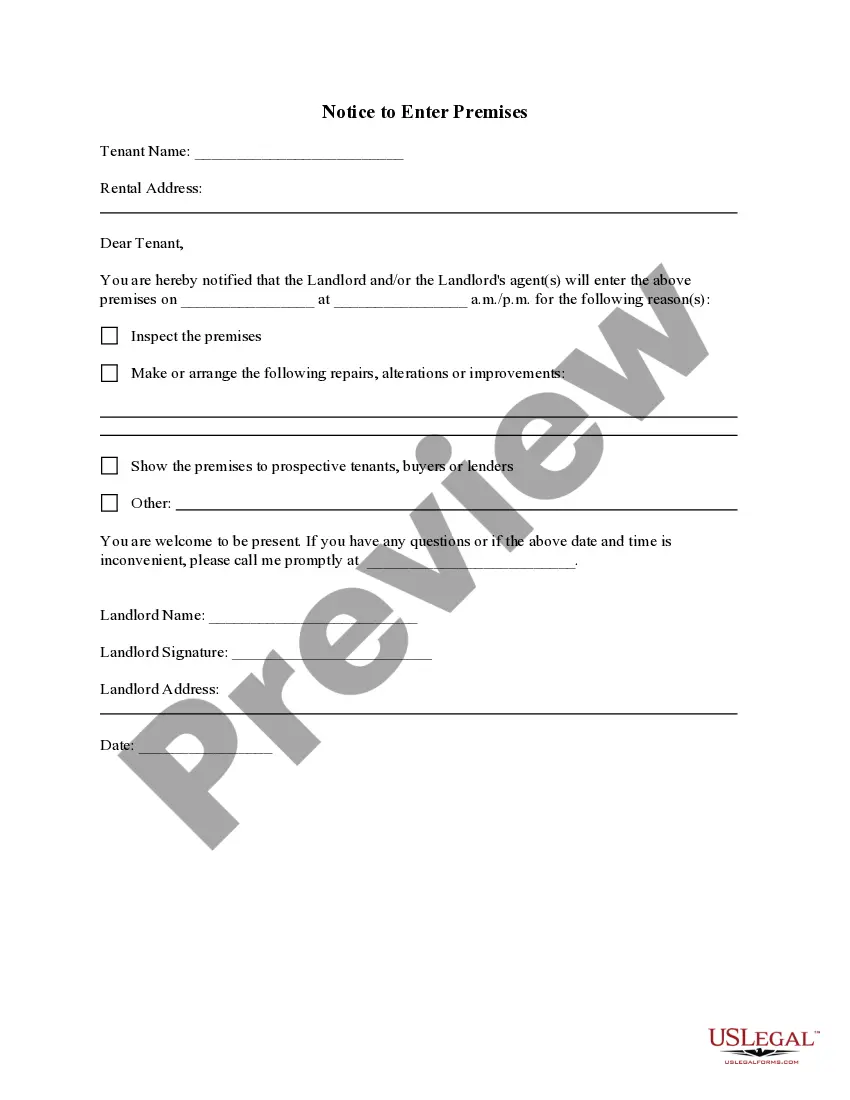
Your landlord can come in without consent or notice if the landlord has a reasonable belief that there is imminent danger to any person or to the property.
The big take-away is that in most circumstances a landlord cannot enter a property without agreement from the tenant. And If the landlord ignores the law and enters the property without permission, the tenant may be able to claim damages or gain an injunction to prevent the landlord doing it again.
§ 4456(d). This means you must give the landlord the same amount of notice as there are days between rent payments. So, if you pay rent monthly, you must give your landlord notice at least one month before you move. If you pay rent every week, you must give the landlord notice at least seven days before you move.
Can a tenant refuse entry to a landlord or letting agent? Yes, they can. In 99% of cases a tenant refusing entry to a landlord will usually boil down to convenience, or lack thereof. Simply adjusting the time and date will be enough to gain access to the property.
There's one golden rule you should always stick by: always provide your tenants with written notice at least 24 hours before any planned visits. What's more, you should try and visit when it's suitable for your tenants and be flexible with regards to time.
A landlord can enter a property to carry out reasonable repairs for which they are responsible, either under the tenancy agreement or by law. However, this right can only be exercised by a landlord who has given a tenant 24 hours notice.