Vermont Regulation D Accredited Investor Questionnaire

State:
Multi-State
Category:
Control #:
US-04344BG
Format:
Word; 
Rich Text
64 downloads

Description

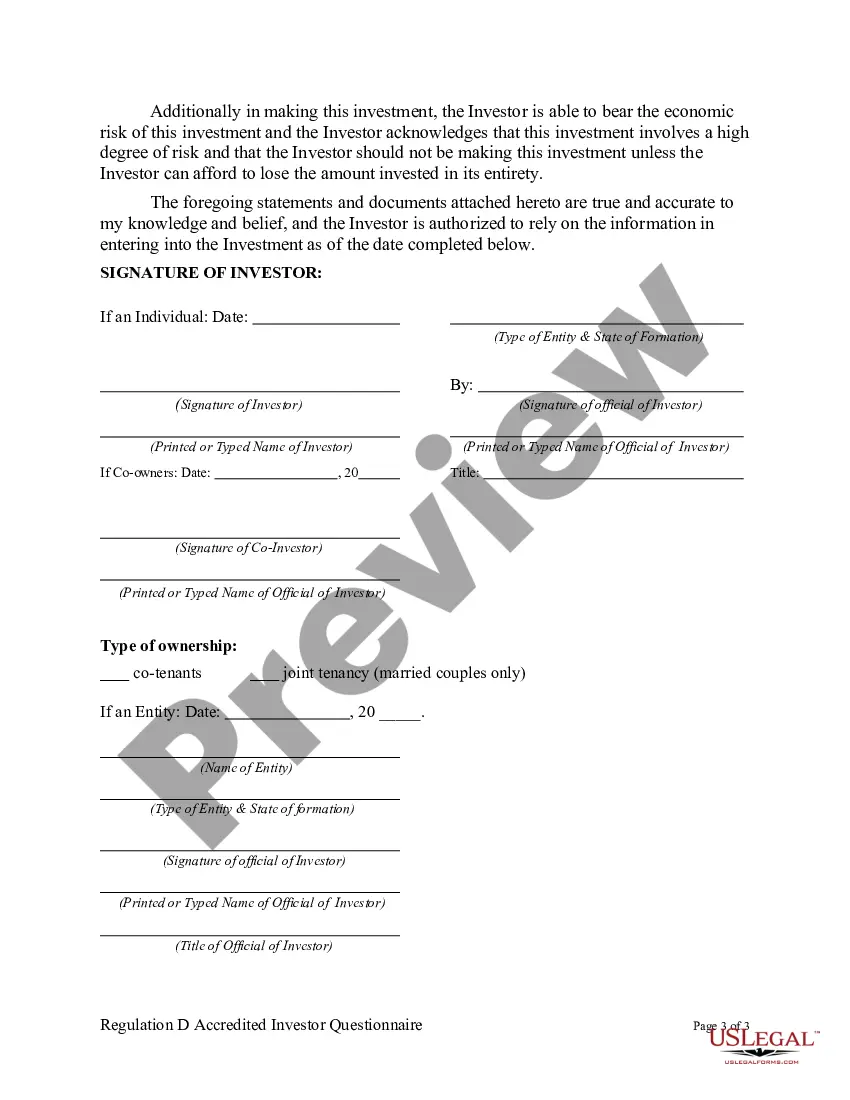
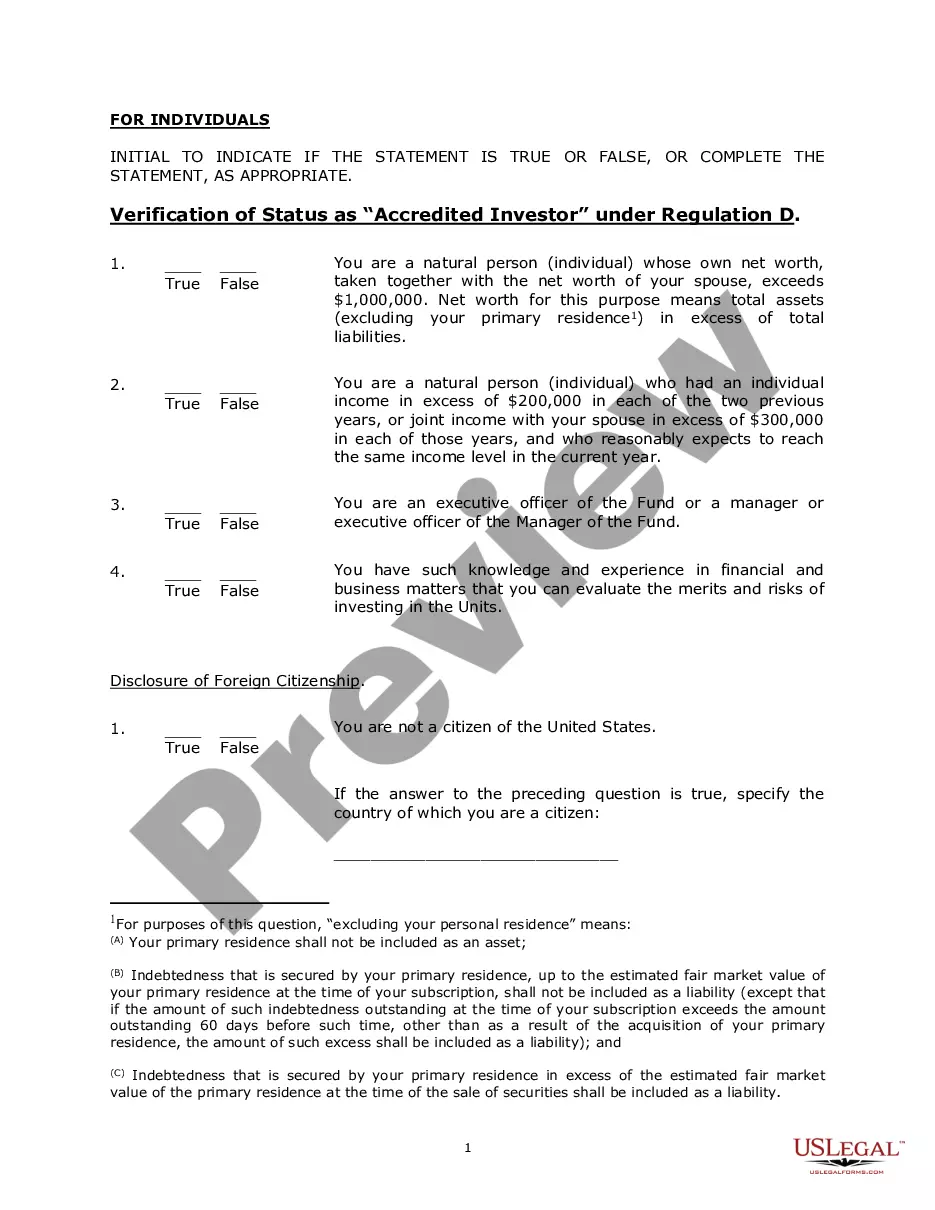
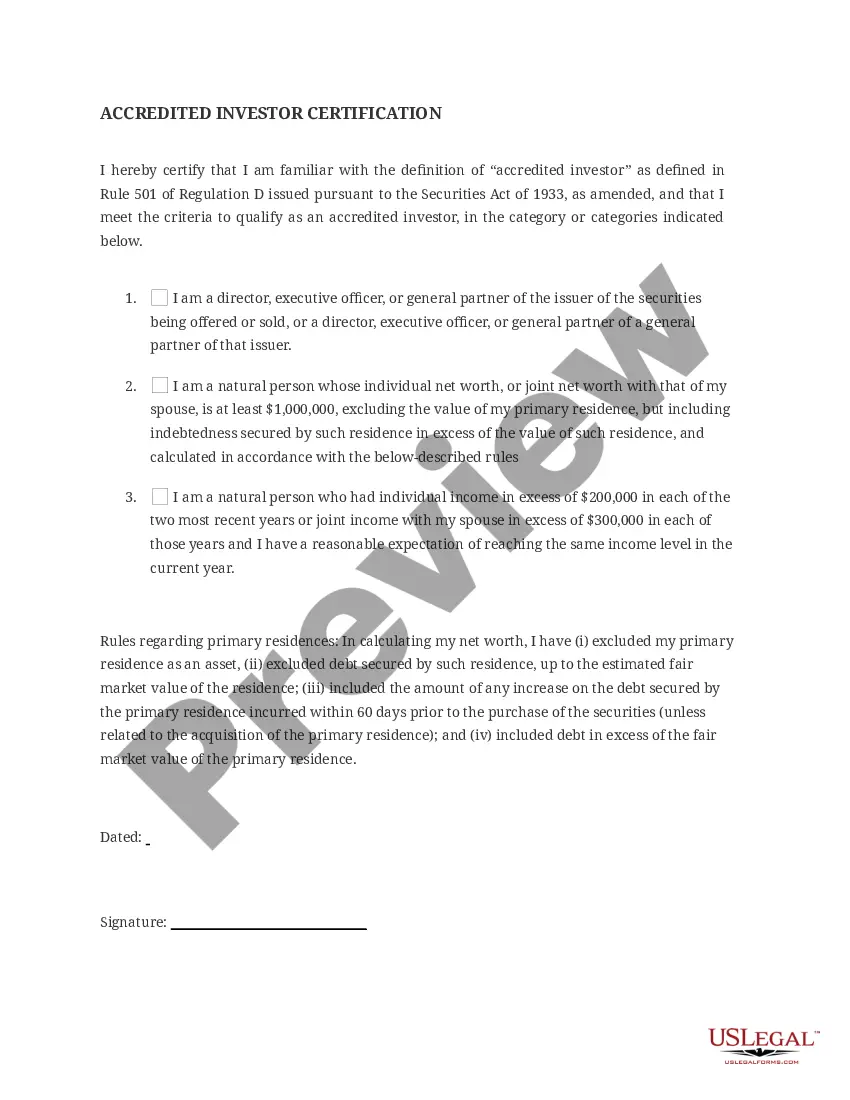
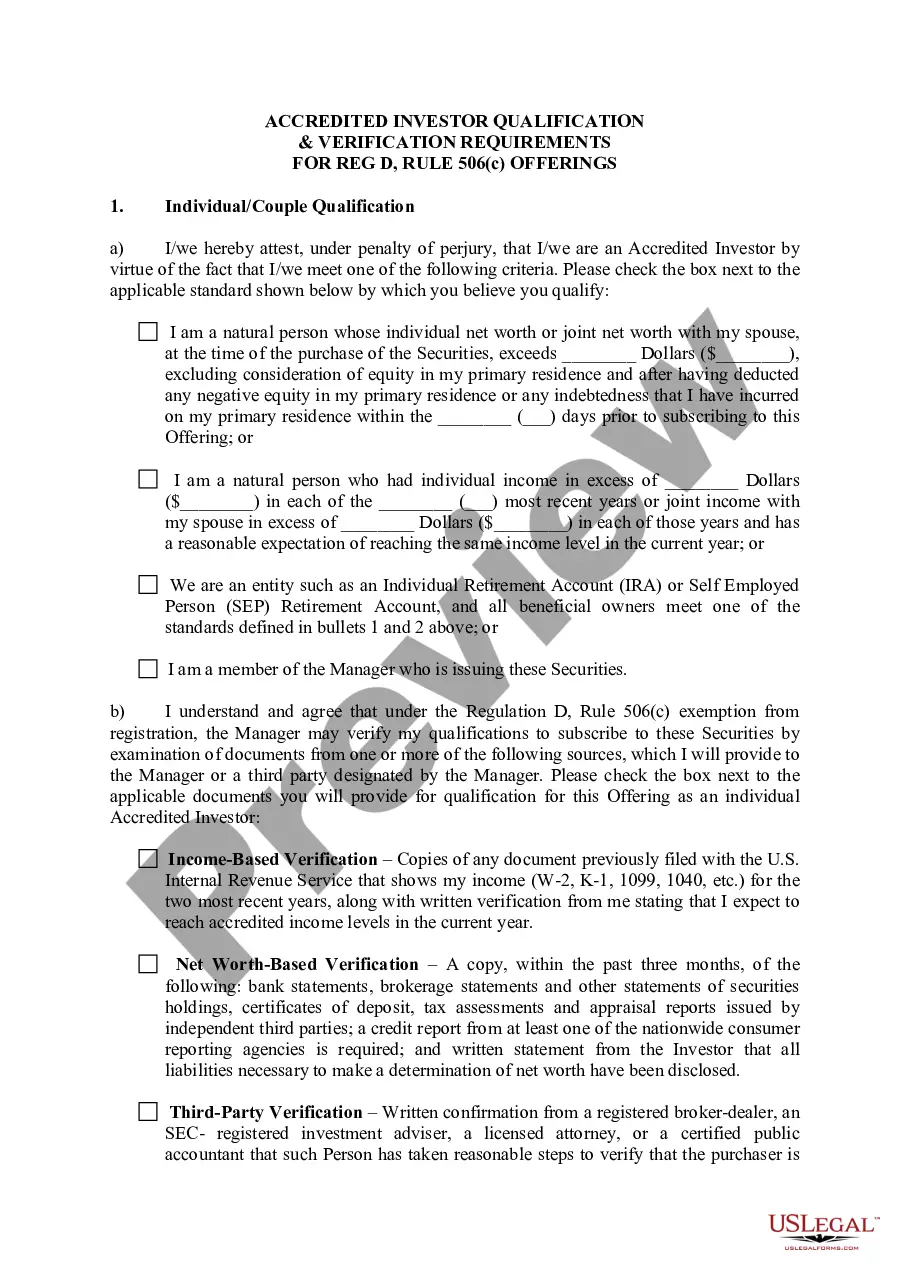
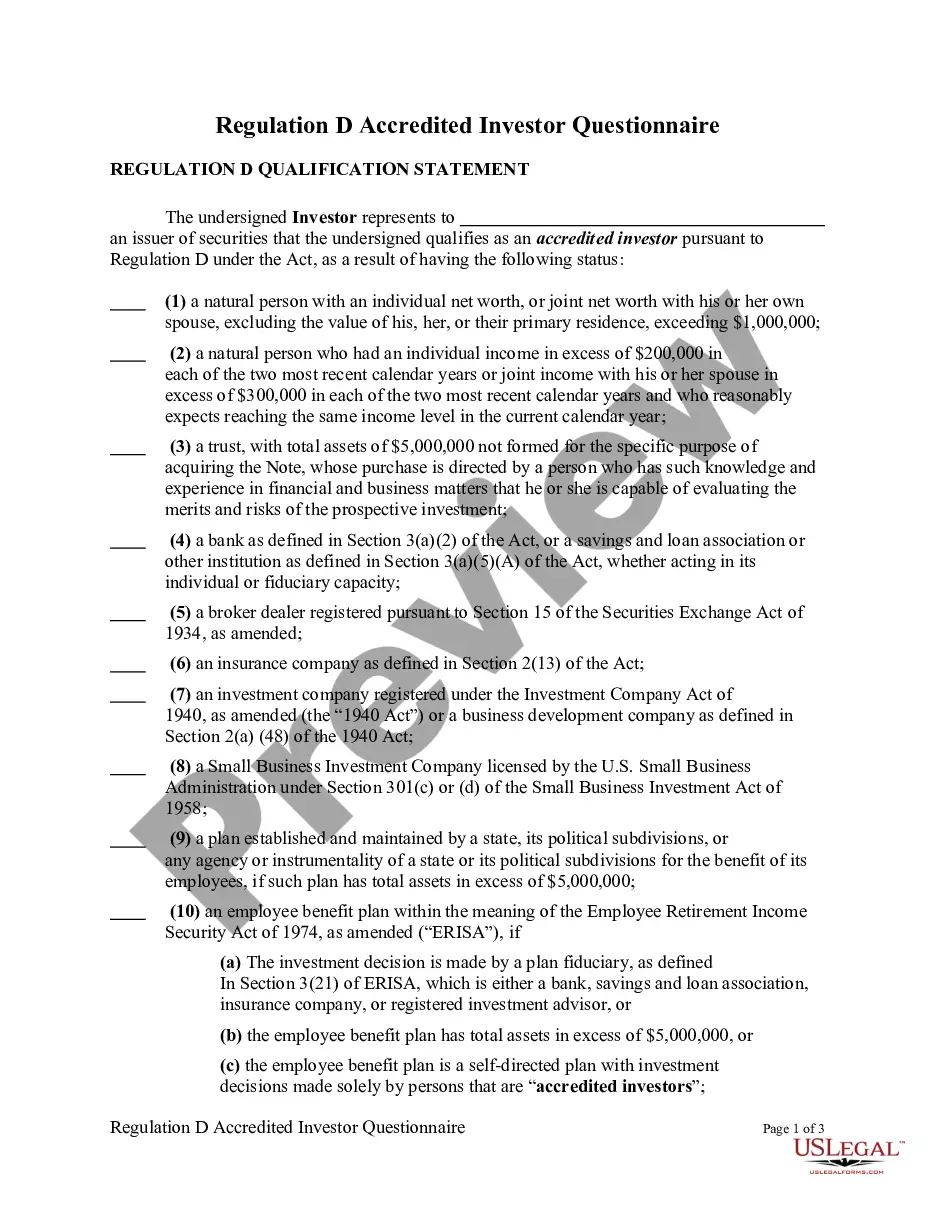
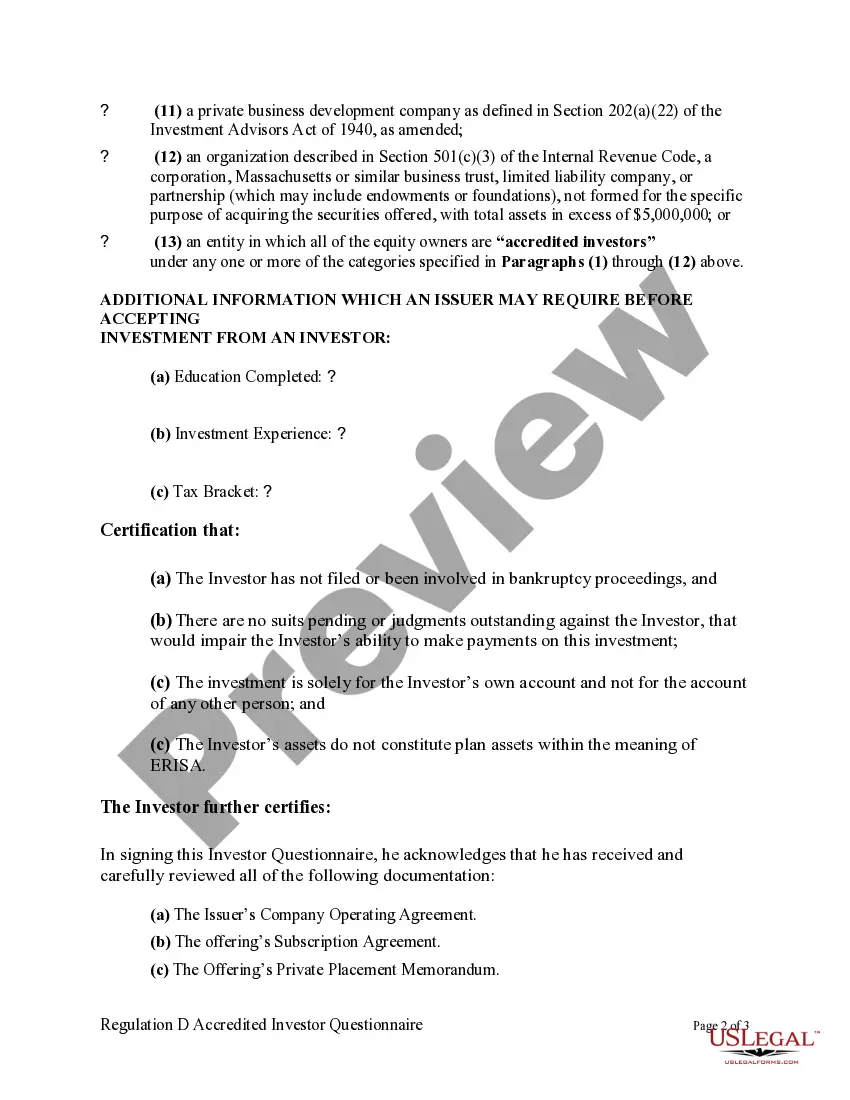
The information contained in this Questionnaire is being furnished by a potential investor in order to determine whether the prospective investor qualifies as an accredited investor as defined in Regulation D of the Securities Act of 1933.


Regulation D creates an exemption that permits sales of securities without registration with the U.S. Security and Exchange Commission. However, Sellers are required to file a Form D informational statement about the sale. The definition of accredited investor is important regarding this exemption as far as a limitation on the number of shareholders allowed (i.e., 35). Accredited investors do not have to be counted as far as the 35 limitation is concerned. An accredited investor includes any investor who at the time of the sale falls into any of the following categories:
" a private business development firm;
" directors, officers, and general partners of issuer;
" banks;
" purchasers of $150,000 or more of the securities;
" natural persons with a net worth greater than $1,000,000; or
" persons with an income of greater than or equal to $200,000 per year.
Free preview
  • Preview Regulation D Accredited Investor Questionnaire
  • Preview Regulation D Accredited Investor Questionnaire
  • Preview Regulation D Accredited Investor Questionnaire

Get your form ready online

Our built-in tools help you complete, sign, share, and store your documents in one place.

Built-in online Word editor

Make edits, fill in missing information, and update formatting in US Legal Forms—just like you would in MS Word.

Export easily

Download a copy, print it, send it by email, or mail it via USPS—whatever works best for your next step.

E-sign your document

Sign and collect signatures with our SignNow integration. Send to multiple recipients, set reminders, and more. Go Premium to unlock E-Sign.

Notarize online 24/7

If this form requires notarization, complete it online through a secure video call—no need to meet a notary in person or wait for an appointment.

Store your document securely

We protect your documents and personal data by following strict security and privacy standards.

Form selector

Make edits, fill in missing information, and update formatting in US Legal Forms—just like you would in MS Word.

Form selector

Download a copy, print it, send it by email, or mail it via USPS—whatever works best for your next step.

Form selector

Sign and collect signatures with our SignNow integration. Send to multiple recipients, set reminders, and more. Go Premium to unlock E-Sign.

Form selector

If this form requires notarization, complete it online through a secure video call—no need to meet a notary in person or wait for an appointment.

Form selector

We protect your documents and personal data by following strict security and privacy standards.

Looking for another form?

This field is required
Ohio
Select state

How to fill out Regulation D Accredited Investor Questionnaire?

If you wish to be thorough, obtain, or print authorized document templates, utilize US Legal Forms, the most significant collection of legal forms available on the internet.

Make use of the site's user-friendly and effective search feature to locate the documents you need.

Various templates for business and personal purposes are organized by categories and states, or keywords. Utilize US Legal Forms to find the Vermont Regulation D Accredited Investor Questionnaire in just a few clicks.

Every legal document template you obtain is yours forever. You can access any form you acquired within your account. Go to the My documents section and choose a form to print or download again.

Compete, download, and print the Vermont Regulation D Accredited Investor Questionnaire with US Legal Forms. There are millions of professional and state-specific forms you can utilize for your business or personal needs.

  1. If you are already a US Legal Forms customer, Log In to your account and click on the Download option to access the Vermont Regulation D Accredited Investor Questionnaire.
  2. You can also retrieve forms you previously acquired in the My documents section of your account.
  3. If this is your first time using US Legal Forms, follow the steps outlined below.
  4. Step 1. Ensure you have selected the form for the correct city/state.
  5. Step 2. Utilize the Review option to check the form's content. Be sure to read the description.
  6. Step 3. If you are dissatisfied with the form, use the Search field at the top of the screen to find different versions of the legal form template.
  7. Step 4. Once you have found the form you need, click on the Get now button. Choose your payment plan and enter your details to create an account.
  8. Step 5. Process the transaction. You may use your Visa or Mastercard or PayPal account to complete the payment.
  9. Step 6. Select the format of the legal form and download it to your device.
  10. Step 7. Complete, revise and print or sign the Vermont Regulation D Accredited Investor Questionnaire.

Form popularity

FAQ

To qualify as an accredited investor under the Vermont Regulation D Accredited Investor Questionnaire, you must meet one of the following criteria: have a net worth exceeding $1 million, have an annual income of more than $200,000 for the last two years, or hold a joint income of over $300,000. These criteria ensure that investors possess sufficient financial resources to engage in higher-risk investments. By understanding these requirements, you can confidently navigate the accredited investor landscape.

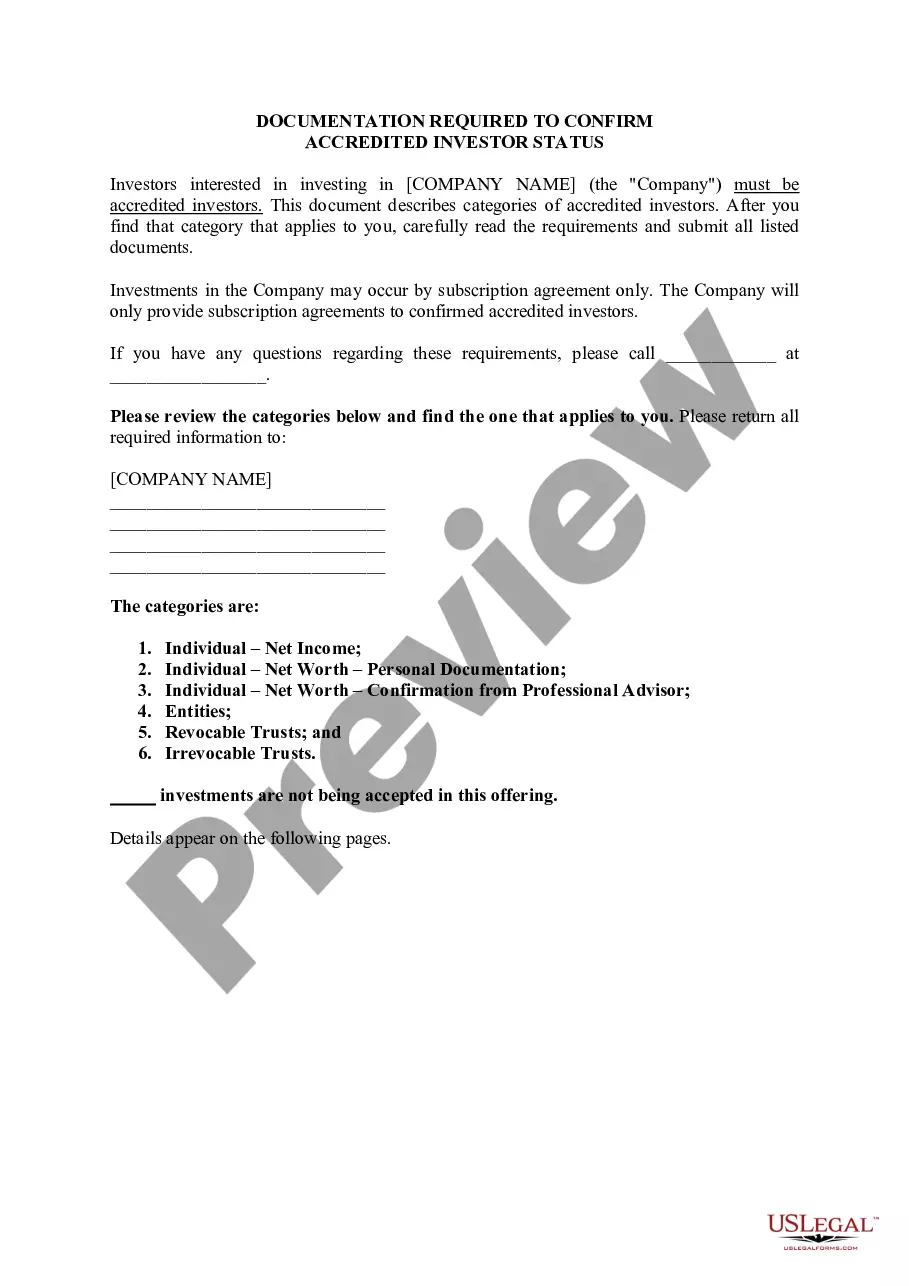
Some documents that can prove an investor's accredited status include:Tax filings or pay stubs;A letter from an accountant or employer confirming their actual and expected annual income; or.IRS Forms like W-2s, 1040s, 1099s, K-1s or other tax documentation that report income.

Generally, to qualify as an accredited investor under the net worth test, you must have a net worth that exceeds $1 million, either alone or with a spouse or spousal equivalent, at the time of the sale of the securities.

Syndication offering documents may require the investor to indemnify the Syndicator if they lie about their qualifications and it causes liability for the Syndicator later (ours do), so there could be repercussions against investors in those cases.

Regarding that last bullet point, an investor holding FINRA's Series 7, Series 65 or Series 82 designations qualifies as an accredited investor.

Some documents that can prove an investor's accredited status include:Tax filings or pay stubs;A letter from an accountant or employer confirming their actual and expected annual income; or.IRS Forms like W-2s, 1040s, 1099s, K-1s or other tax documentation that report income.

A private placement under Regulation D may be offered to an unlimited number of accredited investors. An accredited investor is defined as an institutional investor or a person with either a net worth of $1,000,000, or annual income of $200,000 (or $300,000 for a married couple).

Accredited investor questionnaires are used to determine whether potential investors meet the suitability requirements of Regulation D of the Securities Act of 1933, which may eliminate the need for the offering or issuance of such securities to be registered with the Securities and Exchange Commission.

The Investor Questionnaire suggests an asset allocation based on information you enter about your investment objectives and experience, time horizon, risk tolerance, and financial situation. Your asset allocation is how your portfolio is divided among stocks, bonds, and short-term reserves.

In short, one could now become accredited, regardless of financial means, if they held one of three financial licenses in good standing: the Series 7 (license for public securities brokers), the Series 65 (license for investment advisers), or the Series 82 (license for private securities brokers).

Trusted and secure by over 3 million people of the world’s leading companies

Vermont Regulation D Accredited Investor Questionnaire