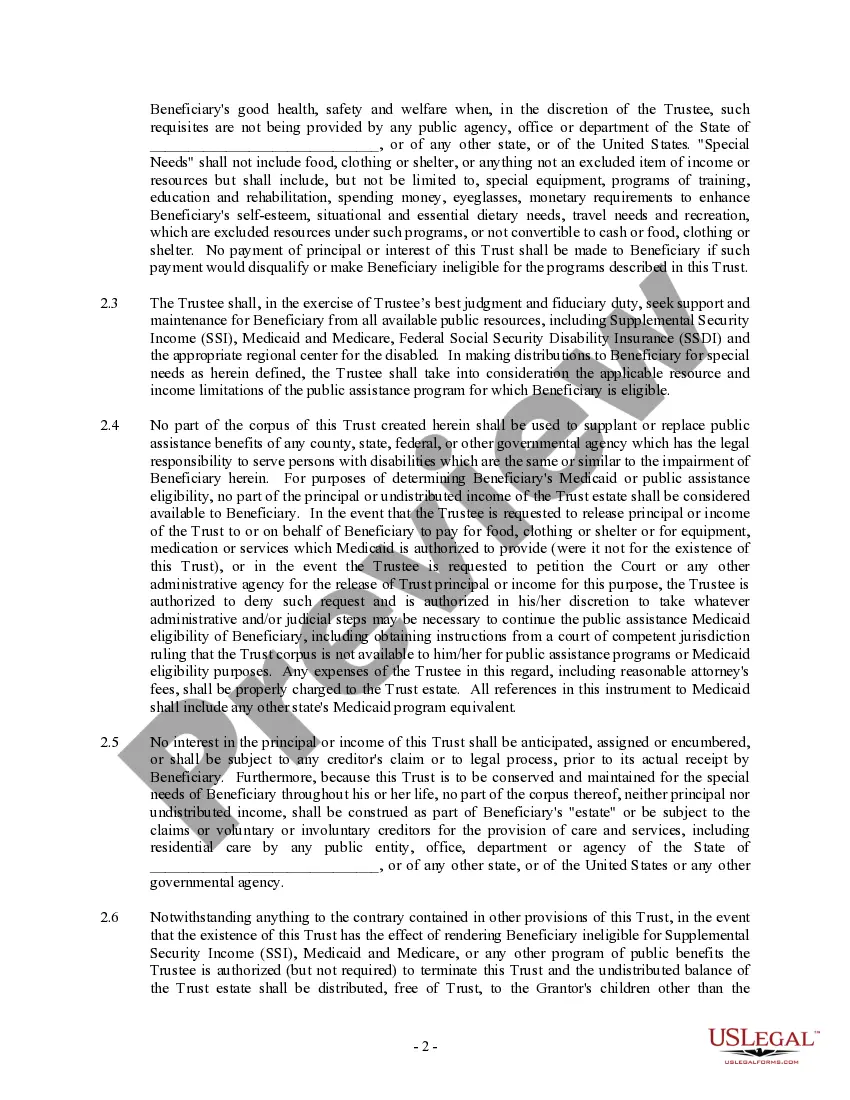
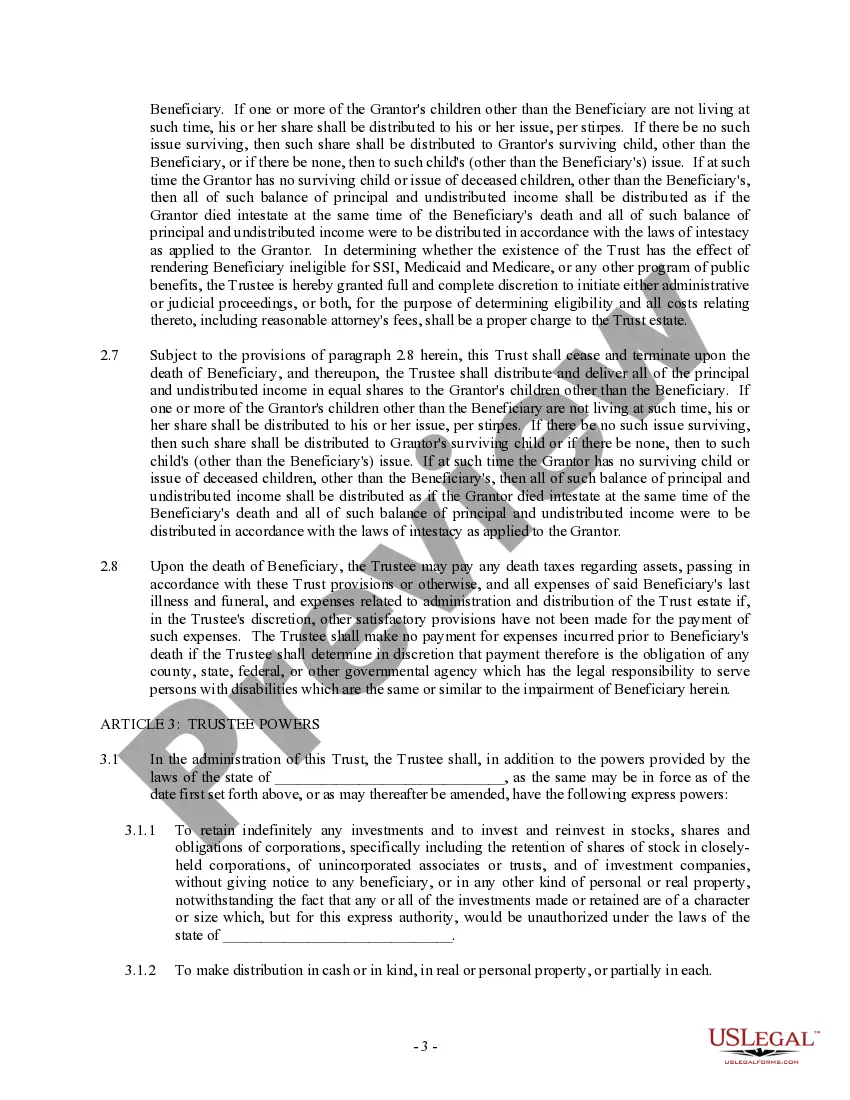
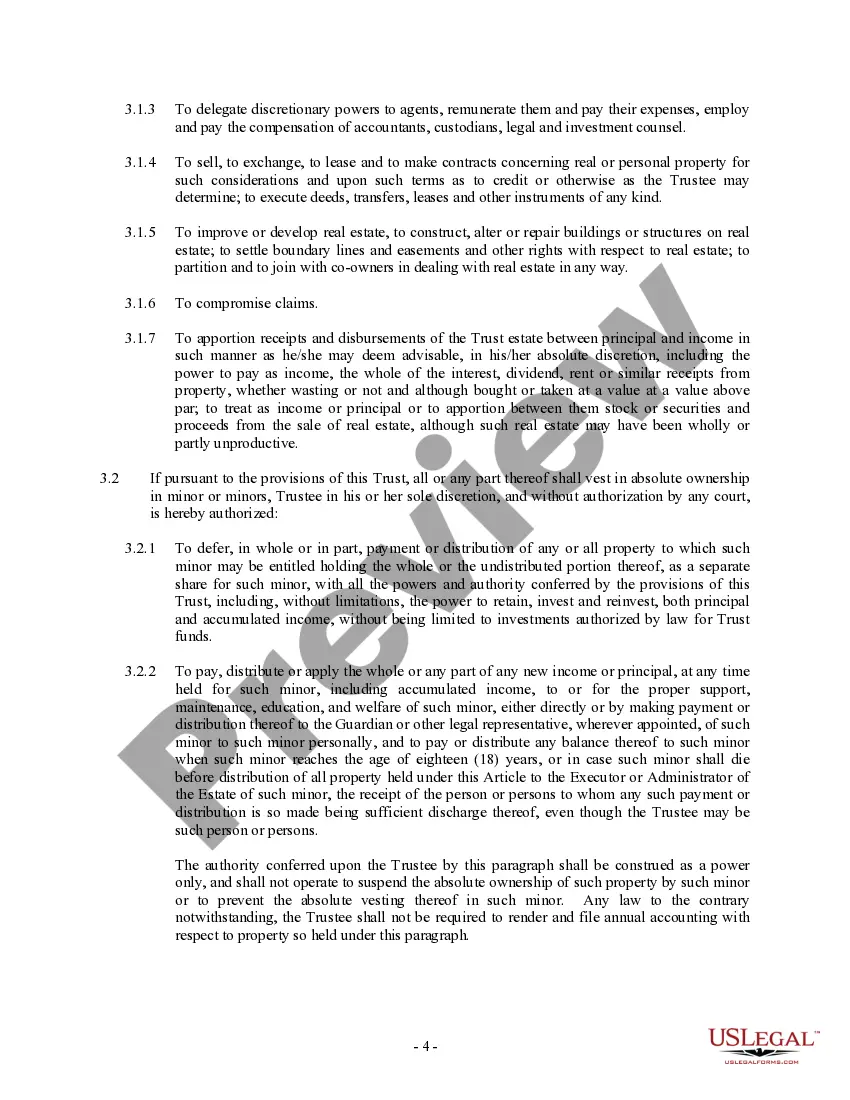
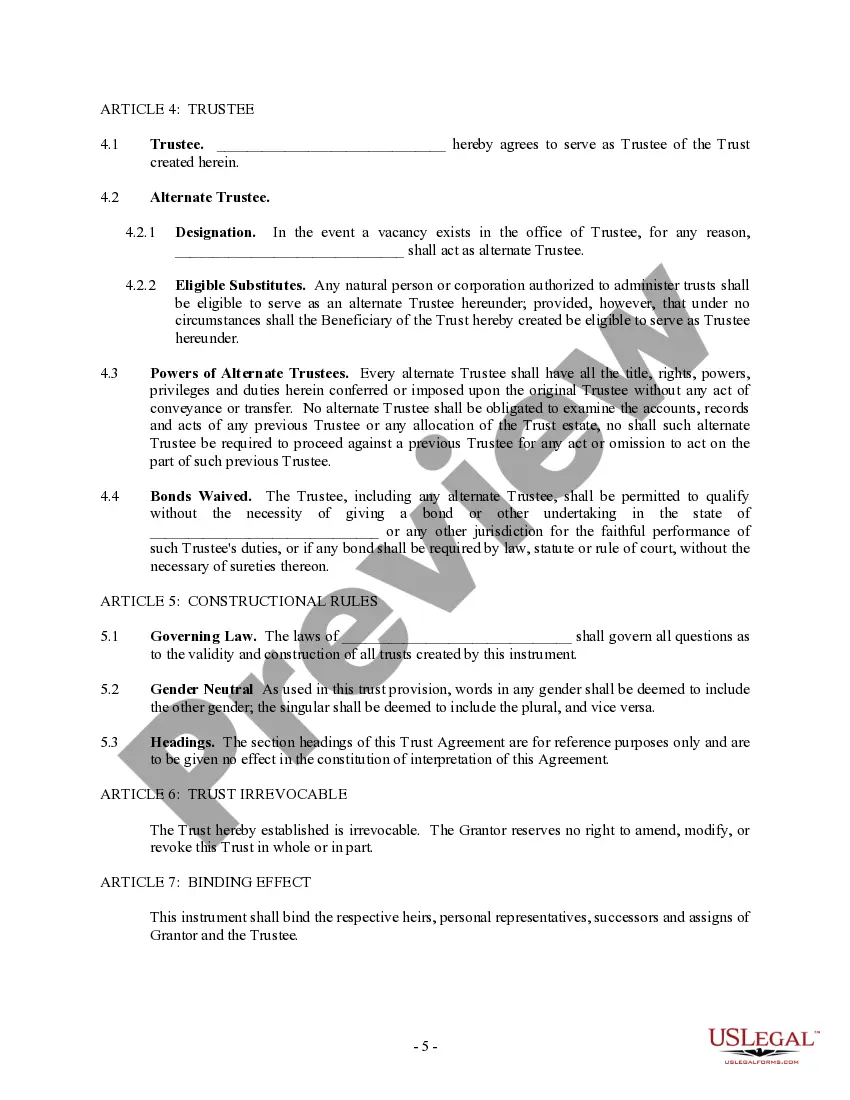
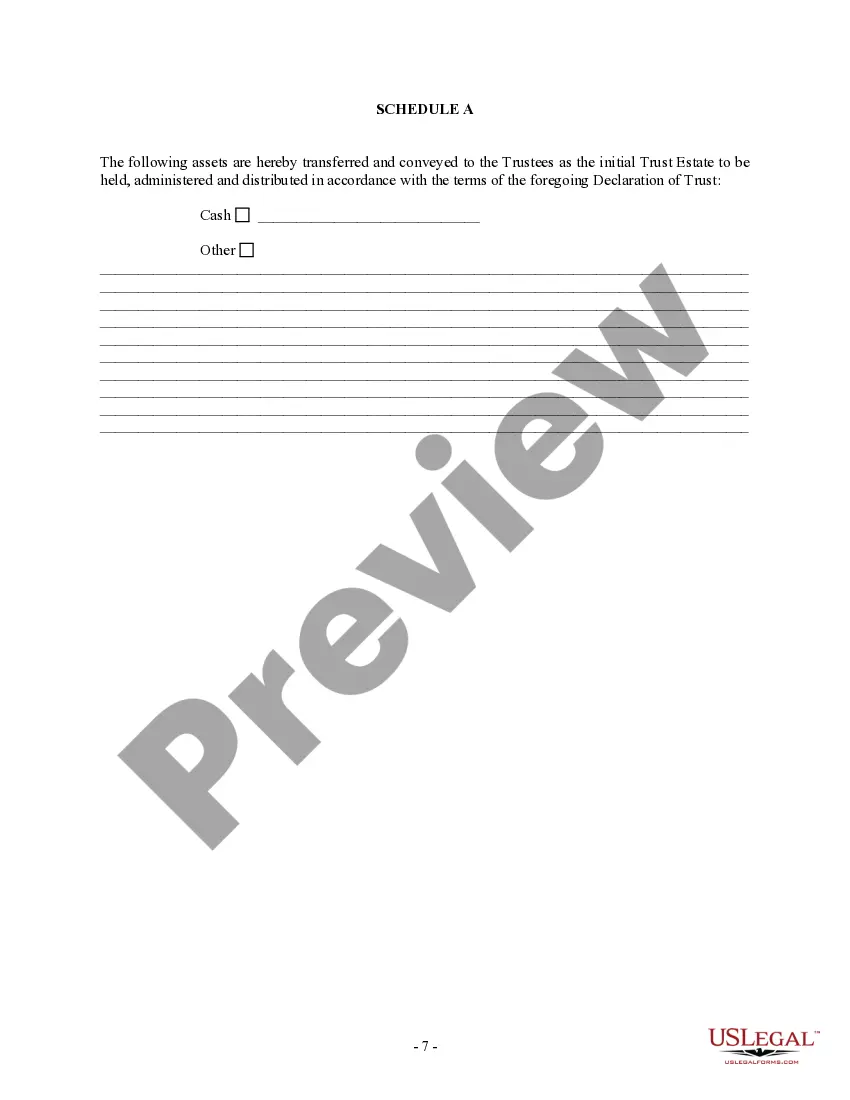
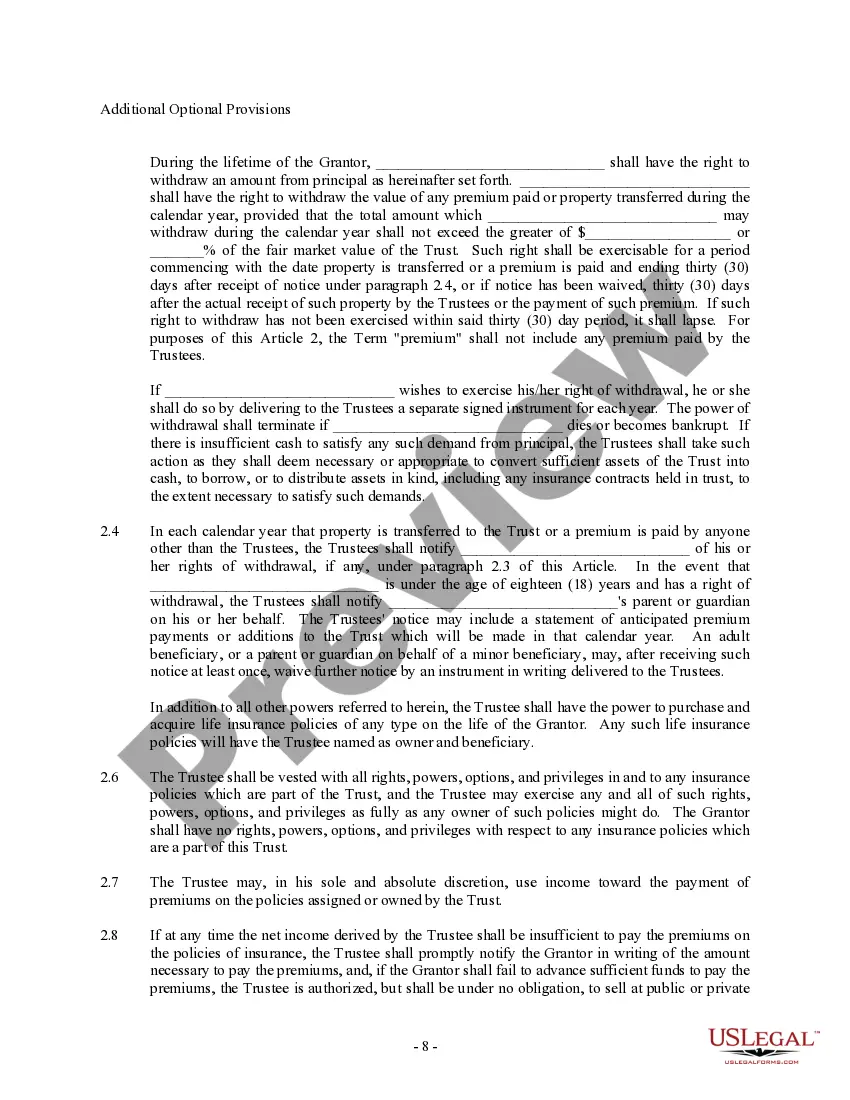
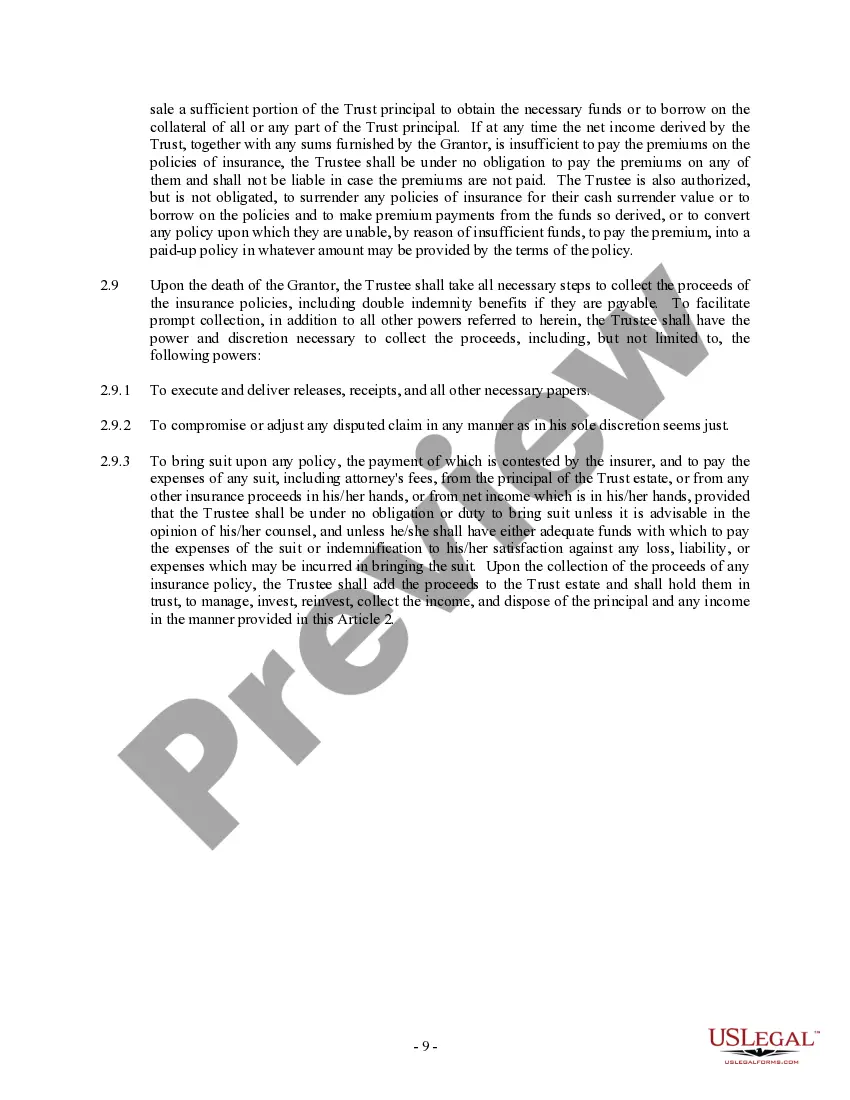
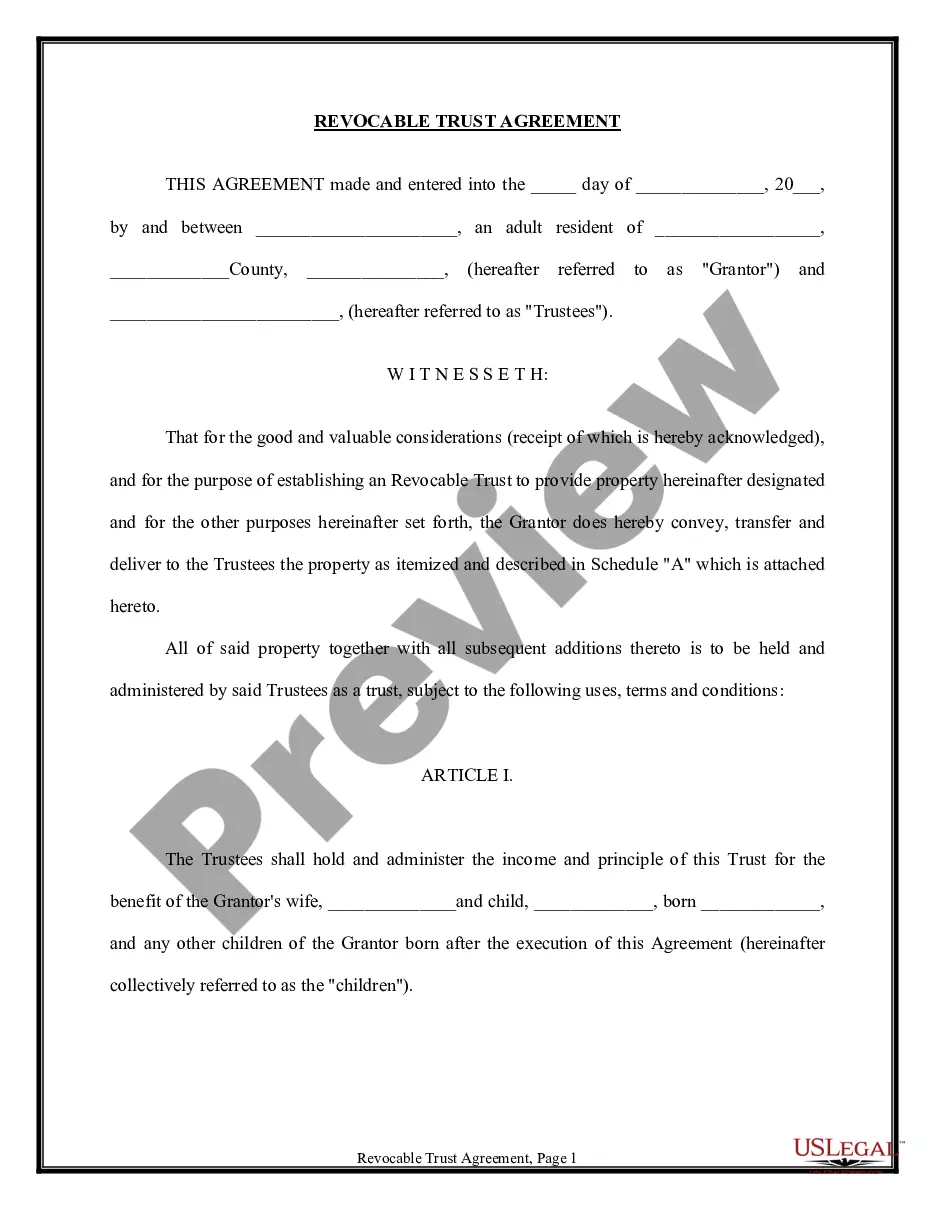
The grantor establishes an irrevocable trust and assigns, conveys, transfers and delivers to the trustee certain property and the trustee accepts such property as the initial trust estate. It is the grantor's primary concern that the trust continue in existence as a supplemental and emergency fund to public assistance for the sake of the beneficiary throughout his/her life. Other provisions of the trust agreement include: the management and disposition of the trust estate, trustee powers, and additional optional clauses.
Virgin Islands Trust Agreement - Family Special Needs
935 downloads

Reviewed by
Description
Free preview



Get your form ready online
Our built-in tools help you complete, sign, share, and store your documents in one place.
Built-in online Word editor
Make edits, fill in missing information, and update formatting in US Legal Forms—just like you would in MS Word.
Export easily
Download a copy, print it, send it by email, or mail it via USPS—whatever works best for your next step.
E-sign your document
Sign and collect signatures with our SignNow integration. Send to multiple recipients, set reminders, and more. Go Premium to unlock E-Sign.
Notarize online 24/7
If this form requires notarization, complete it online through a secure video call—no need to meet a notary in person or wait for an appointment.
Store your document securely
We protect your documents and personal data by following strict security and privacy standards.

Make edits, fill in missing information, and update formatting in US Legal Forms—just like you would in MS Word.

Download a copy, print it, send it by email, or mail it via USPS—whatever works best for your next step.

Sign and collect signatures with our SignNow integration. Send to multiple recipients, set reminders, and more. Go Premium to unlock E-Sign.

If this form requires notarization, complete it online through a secure video call—no need to meet a notary in person or wait for an appointment.

We protect your documents and personal data by following strict security and privacy standards.
Looking for another form?

How to fill out Trust Agreement - Family Special Needs?
You can invest hours online looking for the authentic document template that meets the state and federal requirements you need.
US Legal Forms provides a vast collection of authentic forms that have been evaluated by experts.
It is easy to obtain or print the Virgin Islands Trust Agreement - Family Special Needs from their service.
If available, use the Preview button to review the document template as well.
- If you already have a US Legal Forms account, you can Log In and click the Acquire button.
- Next, you can complete, edit, print, or sign the Virgin Islands Trust Agreement - Family Special Needs.
- Every authentic document template you obtain is yours forever.
- To get an additional copy of any acquired form, go to the My documents section and click the relevant button.
- If you are using the US Legal Forms website for the first time, follow the simple instructions below.
- First, make sure you have selected the correct document template for your area/town of preference.
- Check the form details to ensure you have chosen the right template.
Form popularity
FAQ
BVI succession law outlines how assets are passed on upon an individual's death, and it is closely related to the Virgin Islands Trust Agreement - Family Special Needs. This law ensures that the wishes of the deceased are honored, whether through a will or a trust. Proper planning under BVI succession law can help protect vulnerable family members, especially those with special needs. It's essential to consult with professionals who understand this law when establishing your trust.
The British Virgin Islands (BVI) has established laws that govern trusts, including the Virgin Islands Trust Agreement - Family Special Needs. These laws provide a framework for creating and managing trusts, ensuring clarity and protection for beneficiaries. Trusts in the BVI are designed to be flexible, allowing for various family structures. Understanding these laws is crucial for anyone seeking to establish a trust for special needs family members.
Anyone over the age of 18 can serve as a trustee for a trust fund, provided they have the capability to manage the responsibilities involved. In the framework of a Virgin Islands Trust Agreement - Family Special Needs, it is vital to select a trustee who possesses experience and integrity. Individuals, banks, or trust companies can act in this role. Choosing the right trustee can significantly influence the trust's performance and the well-being of the beneficiaries.
A trustee is the person or organization appointed to administer the trust. In the context of a Virgin Islands Trust Agreement - Family Special Needs, this role involves managing the trust assets for the benefit of the named beneficiaries. Importantly, the trustee must act impartially and responsibly, following the guidelines of the trust document. Understanding this role helps ensure that the trust operates smoothly and meets its intended objectives.
To set up a trust in the British Virgin Islands, you must draft a Virgin Islands Trust Agreement - Family Special Needs that clearly outlines the trust's purpose and terms. It is advisable to consult with a legal professional who understands local laws to ensure compliance. This process involves selecting a trustee, identifying beneficiaries, and funding the trust with assets. Once established, the trust can provide critical support to individuals with special needs.
The trustee is the individual or entity responsible for managing the trust according to the terms laid out in the Virgin Islands Trust Agreement - Family Special Needs. This person must act in the best interests of the beneficiaries and follow legal obligations. Importantly, the trustee handles finances, makes distributions, and ensures compliance with tax regulations. Selecting a trustworthy and capable trustee is crucial to effectively manage the trust.
The perpetuity period for a BVI trust typically lasts for 100 years, allowing for continued management and distribution of assets across generations. This aspect is crucial when setting up a Virgin Islands Trust Agreement - Family Special Needs, as it ensures long-term support for your family members. By understanding this period, you can craft a trust that aligns with your family's lasting needs and values.
Generally, trusts in the BVI can last for a maximum period of 110 years, but this may vary based on specific provisions in the trust agreement. For a Virgin Islands Trust Agreement - Family Special Needs, it is important to tailor the duration according to your family’s unique situations and needs. This flexibility allows for better financial planning and ensures the trust can adapt as your family evolves.
In the BVI, the period of trust can span from a fixed duration to a specific event, depending on the terms outlined in your trust agreement. For a Virgin Islands Trust Agreement - Family Special Needs, this period is crucial for ensuring that the trust serves its purpose effectively. It is always advisable to consult with a professional to clarify the structure and duration of your trust.
The trust period refers to the duration during which a trust remains effective and operational. In the context of a Virgin Islands Trust Agreement - Family Special Needs, it is vital to define this period clearly to ensure your family’s needs are met. Understanding the trust period helps you manage assets properly and ensure their distribution aligns with your family’s intentions.