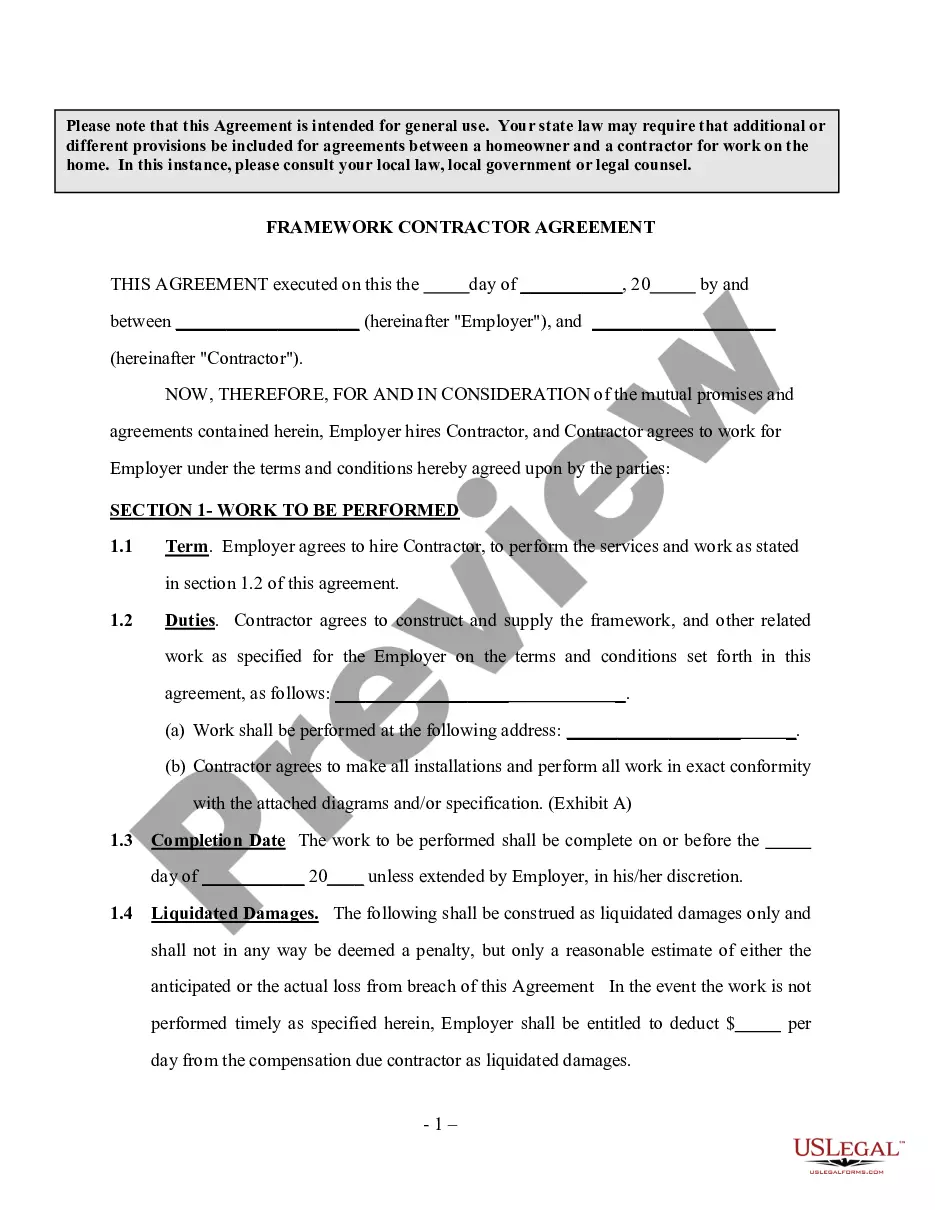
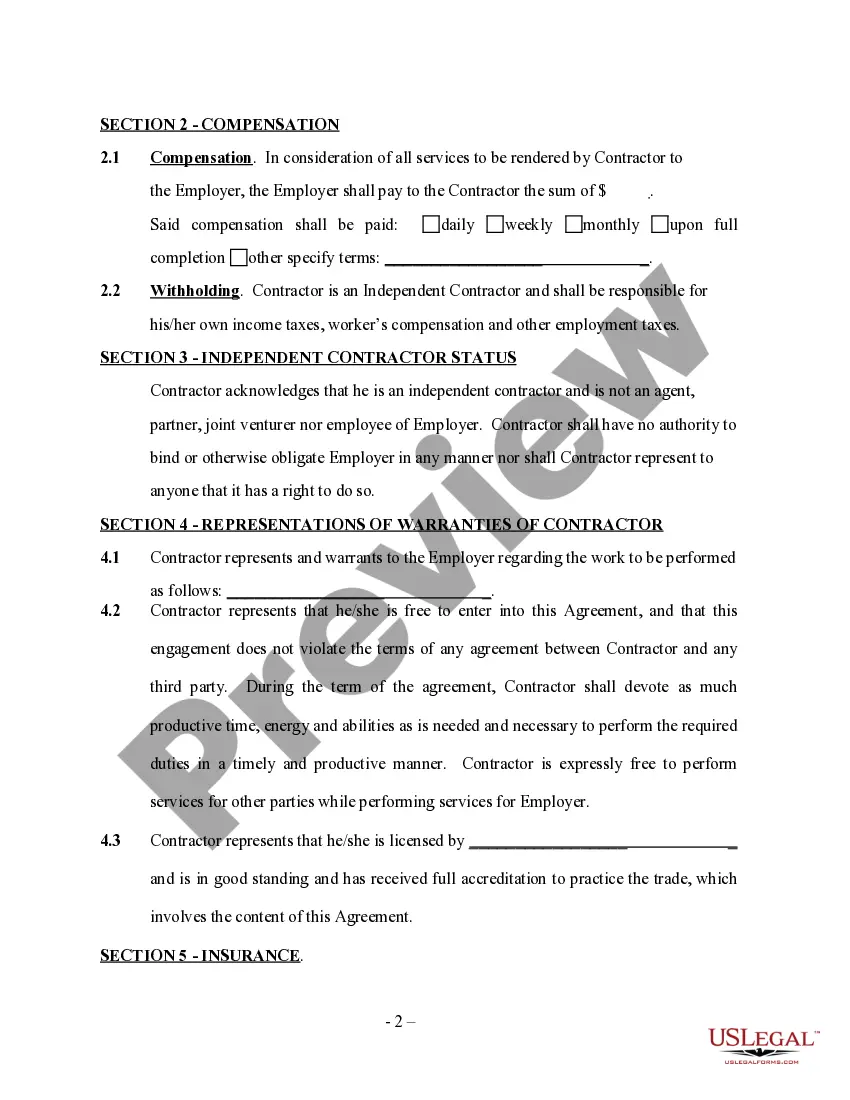
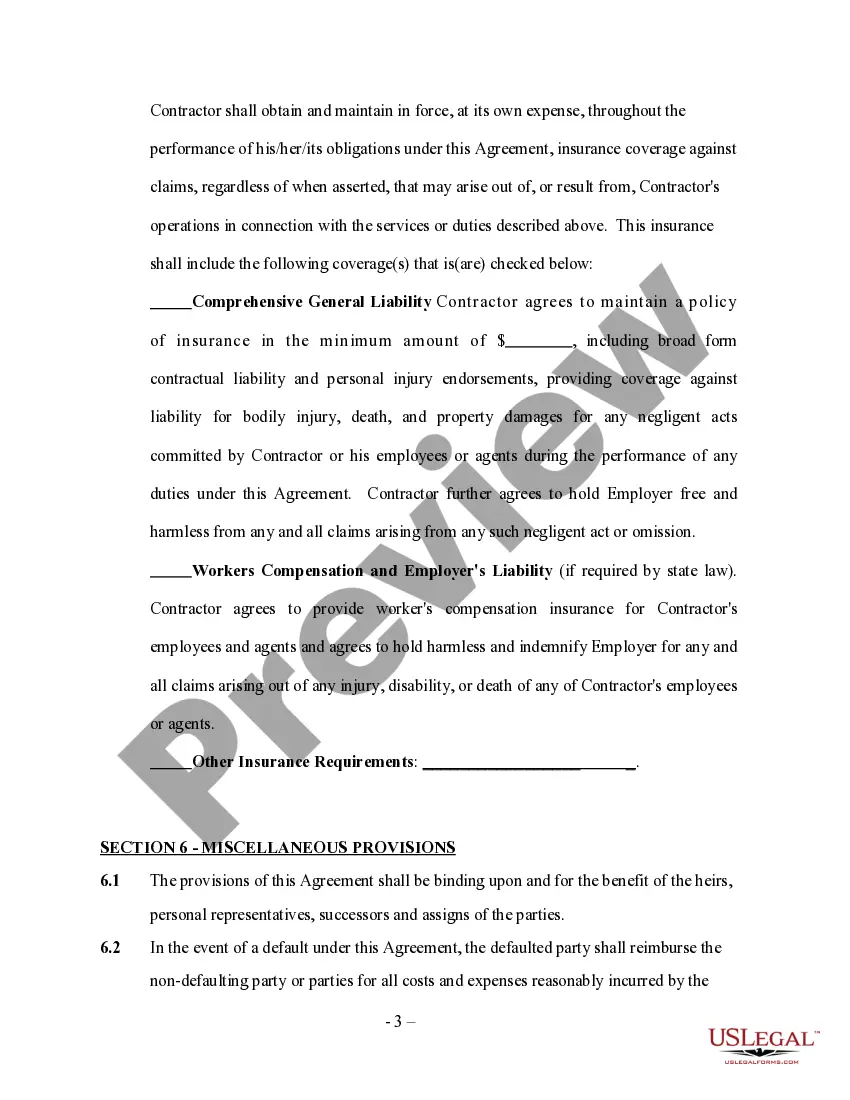
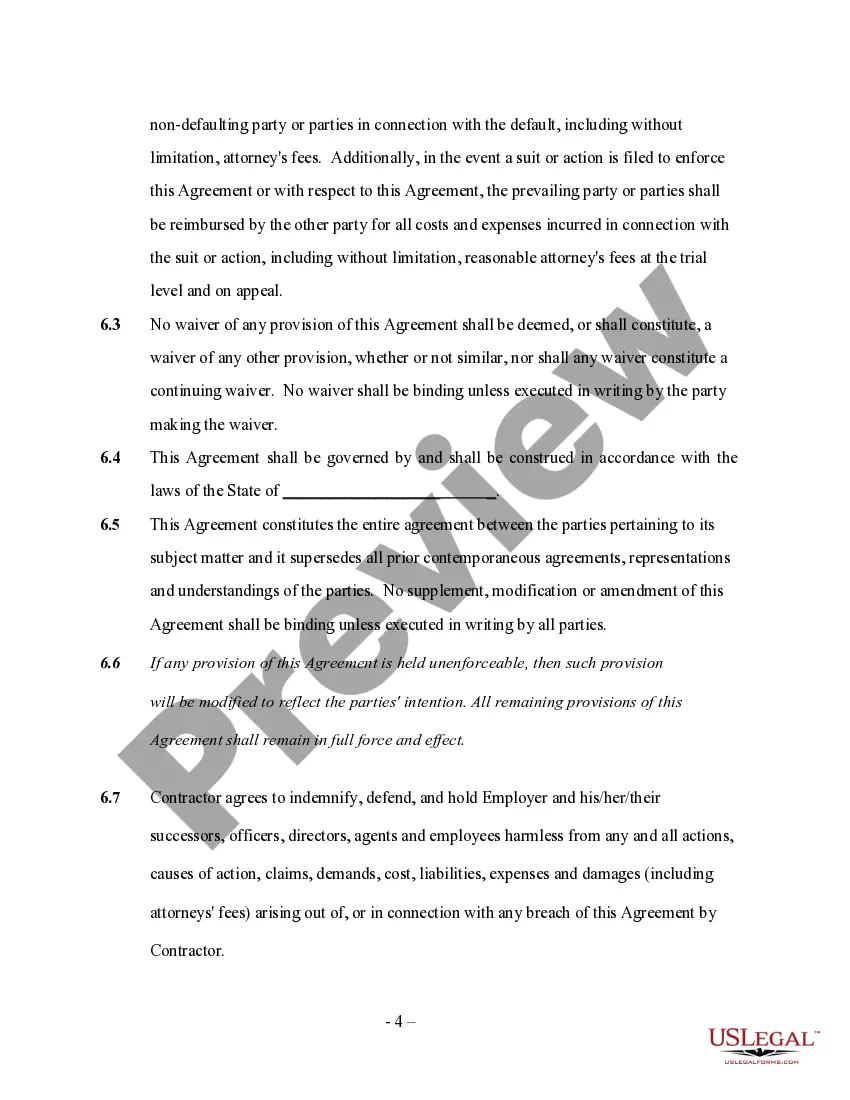
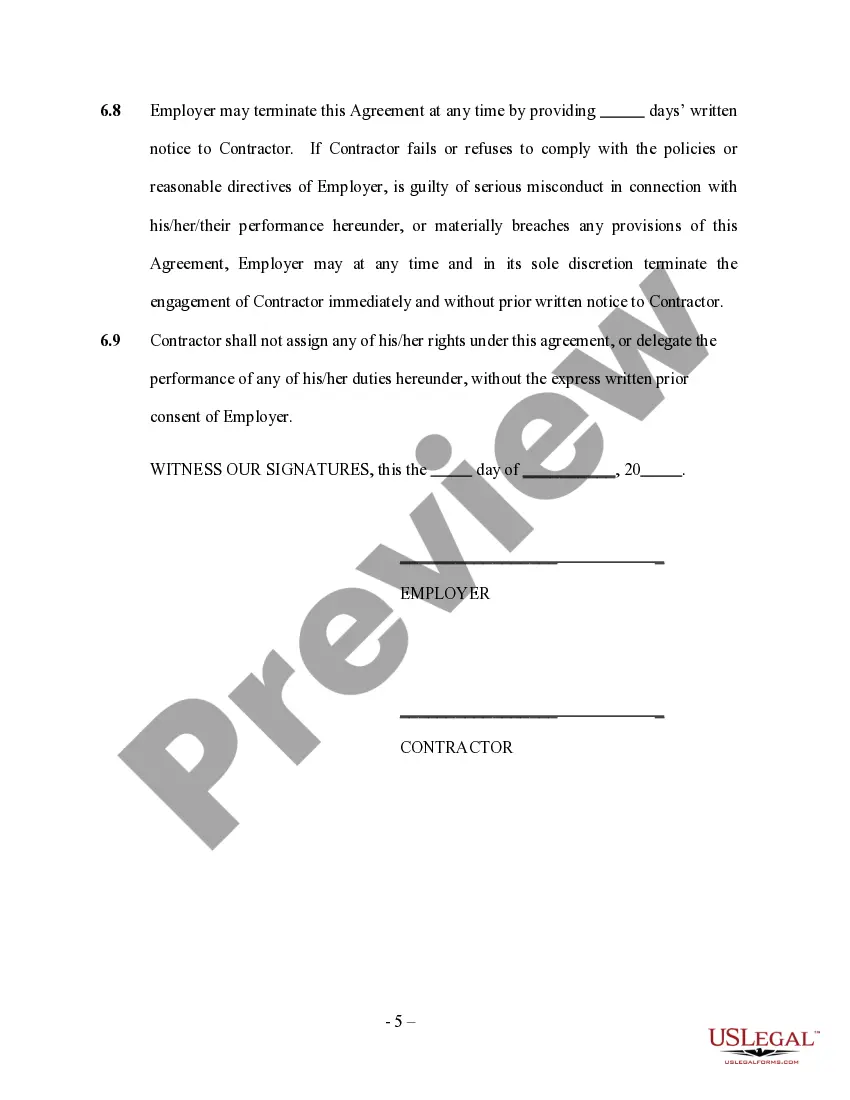
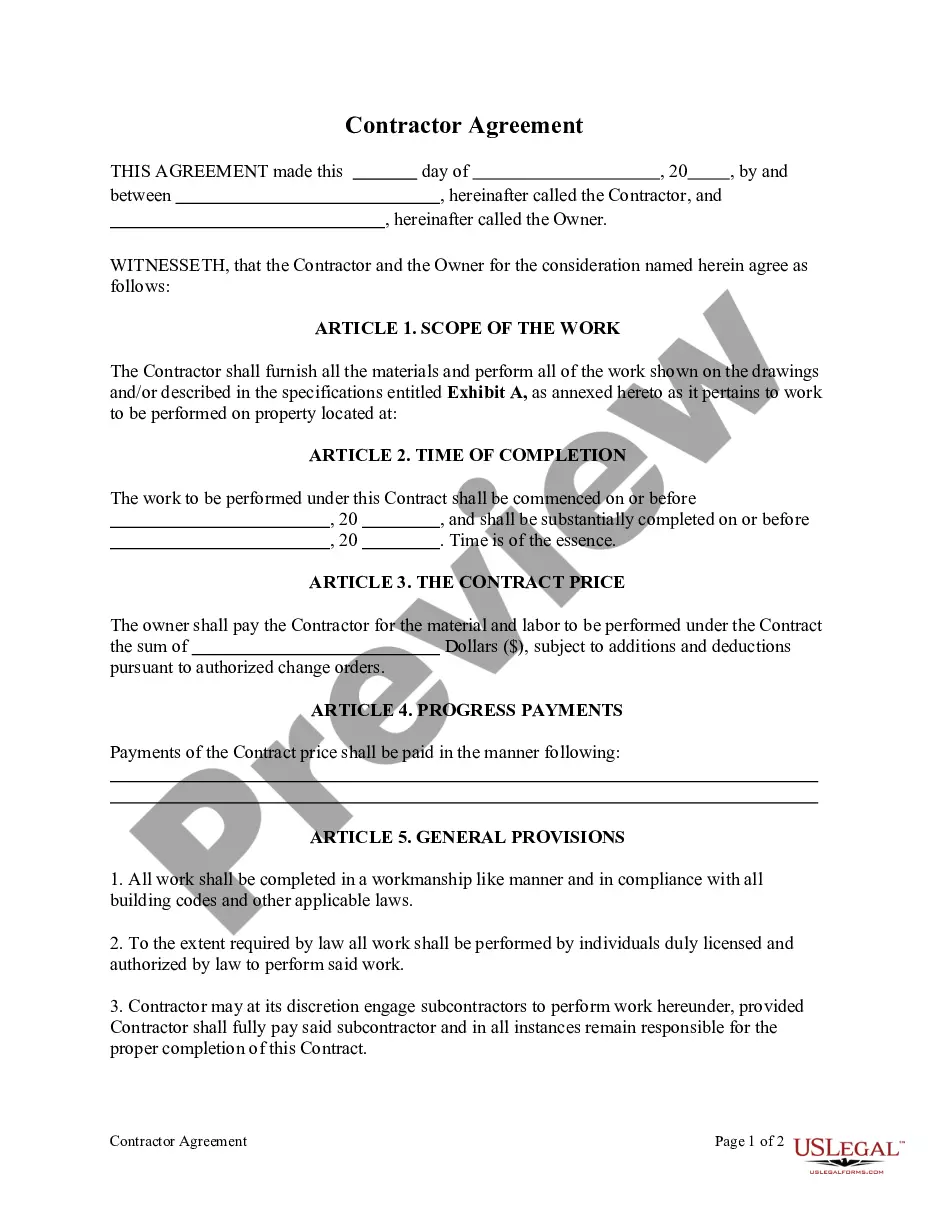
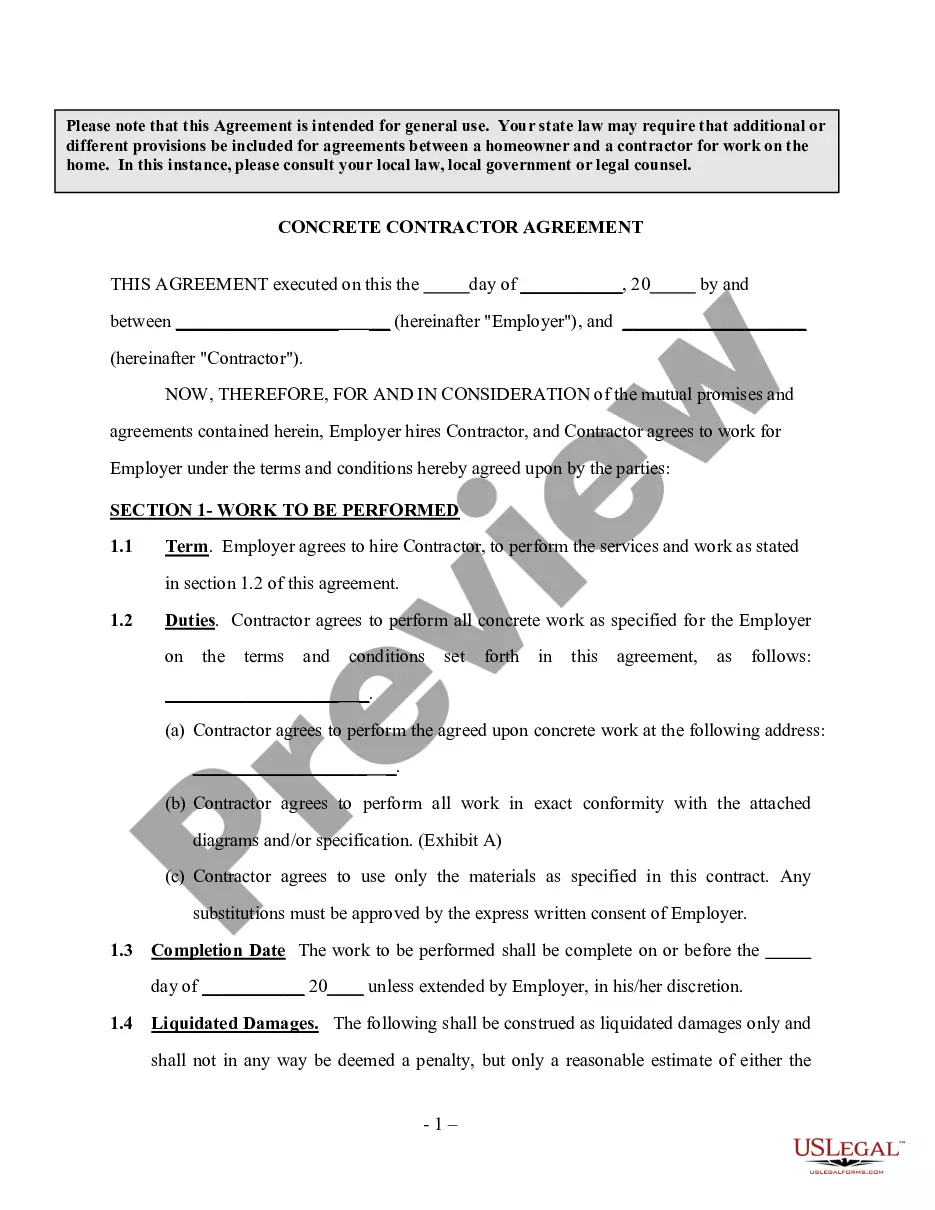
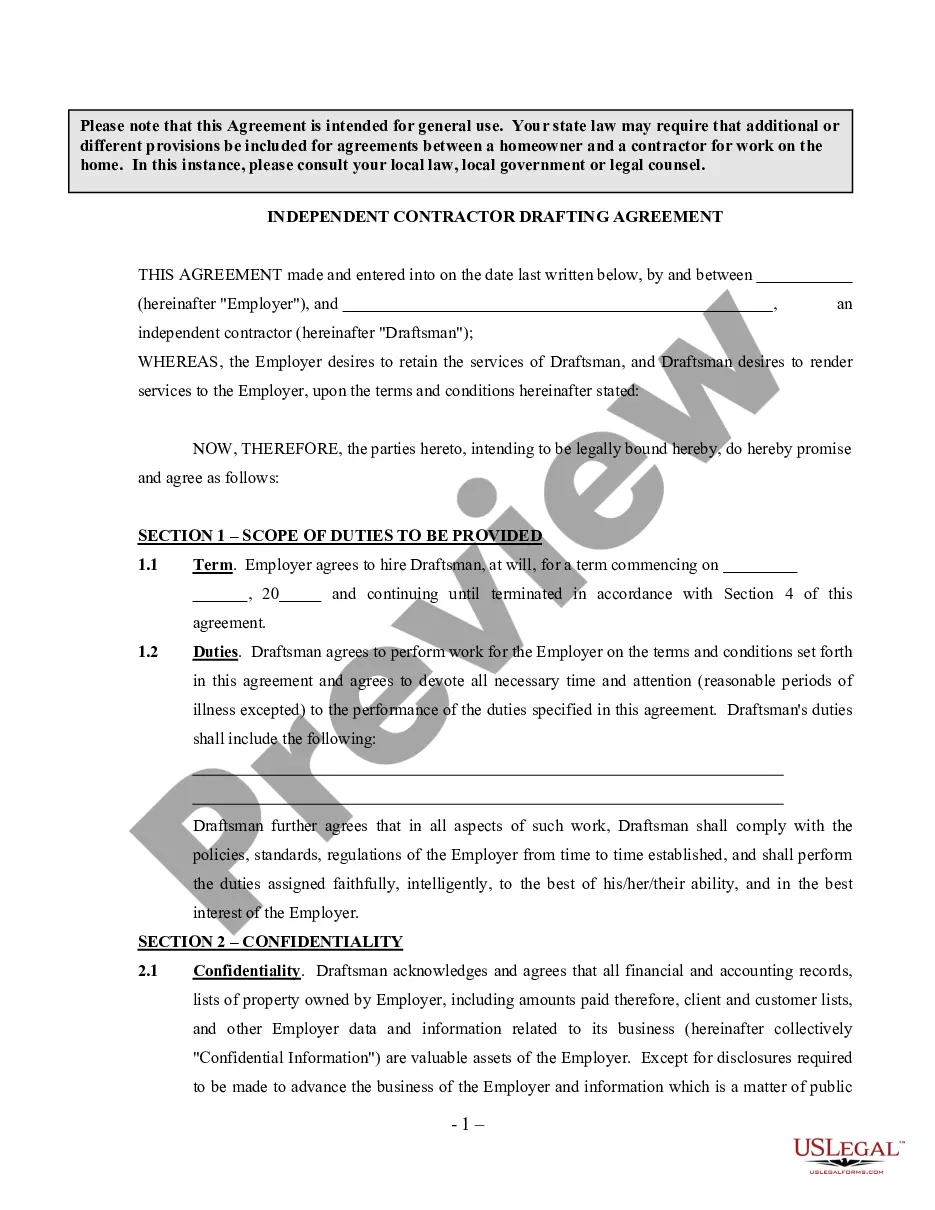
Employer contracts with an independent contractor to provide framework for a project as specified and agreed upon in the contract. Please note that this Agreement is intended for general use. Your state law may require that additional or different provisions be included for agreements between a homeowner and a contractor for work on the home. In this instance, please consult your local law, local government or legal counsel.
Virginia Framework Contractor Agreement - Self-Employed
State:
Multi-State
Control #:
US-INDC-121
Format:
Word;
Rich Text
108 downloads
Description
Free preview
Get your form ready online
Our built-in tools help you complete, sign, share, and store your documents in one place.
Built-in online Word editor
Make edits, fill in missing information, and update formatting in US Legal Forms—just like you would in MS Word.
Export easily
Download a copy, print it, send it by email, or mail it via USPS—whatever works best for your next step.
E-sign your document
Sign and collect signatures with our SignNow integration. Send to multiple recipients, set reminders, and more. Go Premium to unlock E-Sign.
Notarize online 24/7
If this form requires notarization, complete it online through a secure video call—no need to meet a notary in person or wait for an appointment.
Store your document securely
We protect your documents and personal data by following strict security and privacy standards.

Make edits, fill in missing information, and update formatting in US Legal Forms—just like you would in MS Word.

Download a copy, print it, send it by email, or mail it via USPS—whatever works best for your next step.

Sign and collect signatures with our SignNow integration. Send to multiple recipients, set reminders, and more. Go Premium to unlock E-Sign.

If this form requires notarization, complete it online through a secure video call—no need to meet a notary in person or wait for an appointment.

We protect your documents and personal data by following strict security and privacy standards.
Looking for another form?
How to fill out Framework Contractor Agreement - Self-Employed?
You can spend hours online searching for the proper document template that complies with the federal and state requirements you need.
US Legal Forms offers thousands of legal forms that have been reviewed by experts.
You can easily download or print the Virginia Framework Contractor Agreement - Self-Employed from our service.
If available, use the Preview option to review the document template as well. If you want to find another version of the form, use the Search field to locate the template that meets your needs and specifications. Once you have found the template you want, click Get now to proceed. Select the pricing plan you prefer, enter your details, and create an account on US Legal Forms. Complete the transaction. You can use your Visa, Mastercard, or PayPal account to pay for the legal document. Choose the format of the document and download it to your device. Make adjustments to the document as needed. You can complete, edit, sign, and print the Virginia Framework Contractor Agreement - Self-Employed. Download and print thousands of document templates using the US Legal Forms site, which offers the largest collection of legal forms. Utilize professional and state-specific templates to address your business or personal needs.
- If you already possess a US Legal Forms account, you can Log In and click the Download button.
- After that, you can complete, edit, print, or sign the Virginia Framework Contractor Agreement - Self-Employed.
- Each legal document template you purchase is yours indefinitely.
- To obtain another copy of any purchased form, visit the My documents section and click the appropriate option.
- If you are using the US Legal Forms site for the first time, follow the simple instructions below.
- First, ensure you have selected the correct document template for your chosen county/city.
- Read the form description to make sure you have chosen the right form.
Form popularity
FAQ
Filling out an independent contractor form requires clear information about your business and the services you provide. Start by including your contact details, business structure, and tax identification number. Next, accurately describe the work to be performed, the payment structure, and any deadlines. Resources like uslegalforms can provide you with suitable templates, including the Virginia Framework Contractor Agreement - Self-Employed, making this task easier and more efficient.
When writing an independent contractor agreement, introduce the purpose of the contract before detailing the services to be provided. Include the duration of the contract, payment schedule, and any materials or resources provided by either party. Additionally, it's crucial to define the terms of termination and any dispute resolution processes. Using the Virginia Framework Contractor Agreement - Self-Employed as a guide can streamline this process and help you cover all necessary aspects.
Filling out an independent contractor agreement starts with clearly identifying both parties involved, including names and addresses. Next, outline the scope of work, payment terms, and deadlines. Be sure to emphasize any specific clauses related to confidentiality or non-compete agreements. The Virginia Framework Contractor Agreement - Self-Employed provides a structured template that simplifies this process, ensuring all key elements are included.
To set up as a self-employed contractor under the Virginia Framework Contractor Agreement - Self-Employed, first, obtain your necessary licenses and permits based on your location and industry. Next, you will need to establish a business structure, such as a sole proprietorship or LLC. Additionally, consider setting up a separate business bank account to manage your finances. You can also explore platforms like uslegalforms to access templates and resources tailored for self-employed contractors.
Creating an independent contractor agreement involves several steps. First, identify the scope of work and specify the services provided by the contractor. Next, include payment terms, deadlines, and any necessary legal obligations to ensure clarity. For drafting a comprehensive and compliant contract, consider using the Virginia Framework Contractor Agreement - Self-Employed available on USLegalForms, which offers templates tailored to meet your needs.
Absolutely, a self-employed person can and should have a contract. Contracts provide clear expectations and protect the rights of both parties involved. The Virginia Framework Contractor Agreement - Self-Employed offers a solid foundation for such contracts, ensuring that all relevant details are covered. To create a reliable agreement, consider using uslegalforms, which provides customizable templates suitable for self-employed individuals.
Yes, an independent contractor is indeed considered self-employed. This classification allows them to work for themselves rather than being tied to a single employer. If you operate under the Virginia Framework Contractor Agreement - Self-Employed, you will find that this status provides certain flexibility and autonomy in your work. Educating yourself about self-employment can make a significant difference in your career path.
Virginia has introduced new laws to protect the rights of independent contractors while ensuring fair compensation and working conditions. This legislation aligns with the Virginia Framework Contractor Agreement - Self-Employed, helping clarify the obligations and benefits of contractors. Understanding these new laws can aid you in making informed decisions regarding your contracting work. For assistance, check out uslegalforms to find tailored legal documents for Virginia residents.
The new federal rule on independent contractors focuses on clarifying their classification under labor laws. It aims to ensure that the workforce has clear guidelines to determine an independent contractor status. This is especially important for those using the Virginia Framework Contractor Agreement - Self-Employed, as it helps define the rights and responsibilities of such contractors. For detailed information, consider exploring uslegalforms platform, which provides comprehensive legal resources.