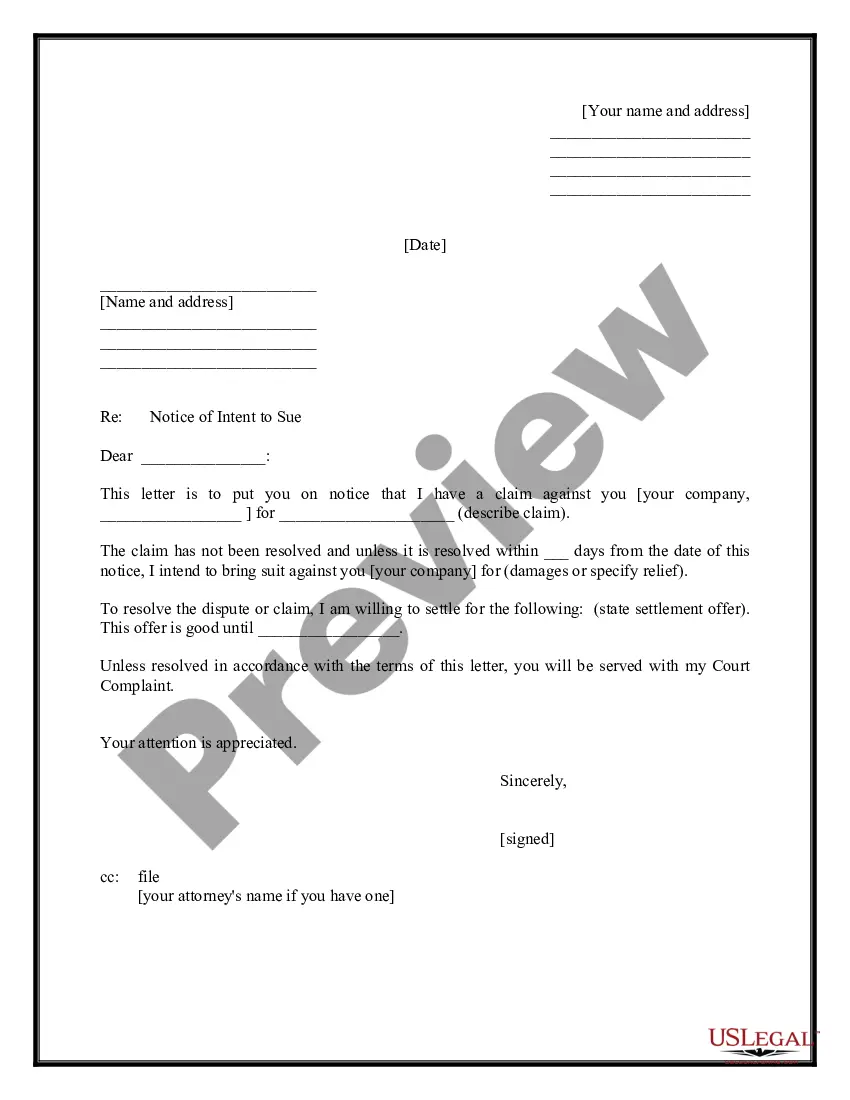
Virginia Letter of Intent to Sue
Description
Get your form ready online
Our built-in tools help you complete, sign, share, and store your documents in one place.
Make edits, fill in missing information, and update formatting in US Legal Forms—just like you would in MS Word.
Download a copy, print it, send it by email, or mail it via USPS—whatever works best for your next step.
Sign and collect signatures with our SignNow integration. Send to multiple recipients, set reminders, and more. Go Premium to unlock E-Sign.
If this form requires notarization, complete it online through a secure video call—no need to meet a notary in person or wait for an appointment.
We protect your documents and personal data by following strict security and privacy standards.

Make edits, fill in missing information, and update formatting in US Legal Forms—just like you would in MS Word.

Download a copy, print it, send it by email, or mail it via USPS—whatever works best for your next step.

Sign and collect signatures with our SignNow integration. Send to multiple recipients, set reminders, and more. Go Premium to unlock E-Sign.

If this form requires notarization, complete it online through a secure video call—no need to meet a notary in person or wait for an appointment.

We protect your documents and personal data by following strict security and privacy standards.
Looking for another form?
How to fill out Letter Of Intent To Sue?
Are you in the position where you require documents for both business or personal purposes almost every day? There are numerous legal document templates available online, but finding ones you can trust is challenging. US Legal Forms offers a vast collection of form templates, including the Virginia Letter of Intent to Sue, that are designed to meet federal and state requirements.
If you are already familiar with the US Legal Forms website and have an account, simply Log In. After that, you can download the Virginia Letter of Intent to Sue template.
If you do not have an account and want to start using US Legal Forms, follow these steps: Obtain the form you need and ensure it is for the correct area/county. Utilize the Review button to examine the form. Check the details to confirm you have selected the correct form. If the form is not what you`re searching for, use the Search feature to find the form that meets your needs and specifications. Once you locate the appropriate form, click Buy now. Choose the payment plan you prefer, complete the necessary information to create your account, and pay for your order using your PayPal or credit card. Select a convenient file format and obtain your copy. Access all the document templates you have purchased in the My documents menu. You can obtain an additional copy of the Virginia Letter of Intent to Sue anytime, if necessary. Click the required form to download or print the document template.
- Utilize US Legal Forms, the most extensive collection of legal forms, to save time and avoid errors.
- The service provides professionally crafted legal document templates that can be used for a variety of purposes.
- Create your account on US Legal Forms and start simplifying your life.
Form popularity
FAQ
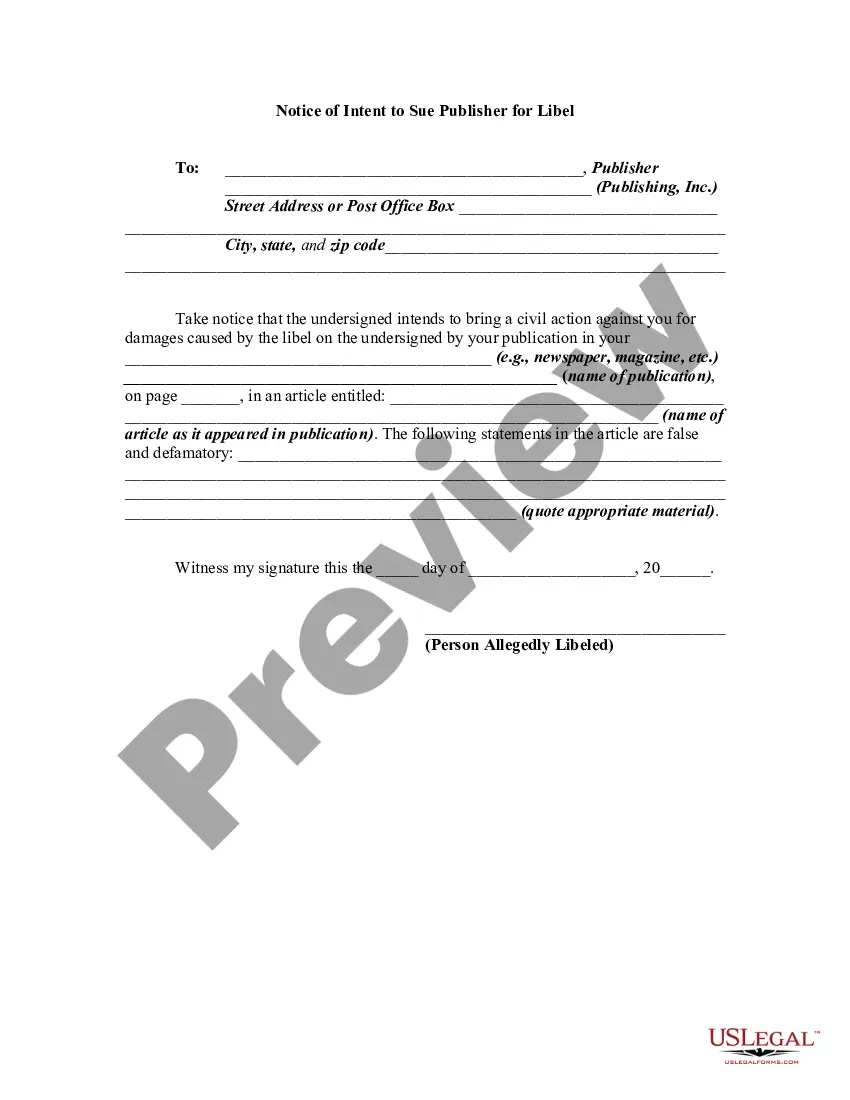
An intent to sue letter should have the addresses of both parties, a detailed description of the dispute, the settlement demand (e.g., payment amount, cease and desist, repair damages, etc.), the sender's contact information, and the deadline for the proposed settlement.
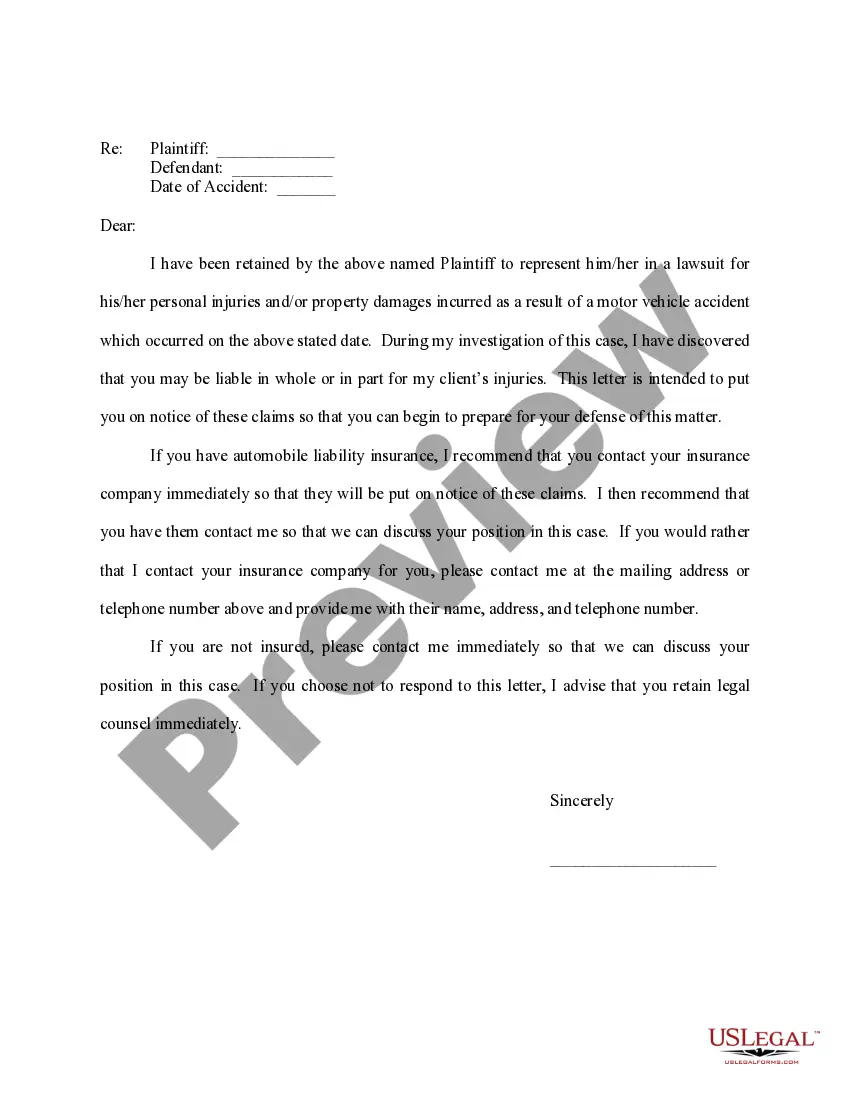
A letter of intent to sue is used to notify an individual or business that legal action may be taken against them if the demands included in the letter are not met. By sending an intent to sue letter, you may be able to resolve the dispute without having to initiate a costly lawsuit.
A letter of intent (LOI) is a written, nonbinding document that outlines an agreement in principle between two or more parties before a legal agreement is finalized. It is often used in business transactions, such as mergers and acquisitions, joint ventures and real estate leases.
What is a letter of intent? A letter of intent (LOI ) is a document drawn up when two parties come to a mutual agreement, but haven't worked out all the details yet. This letter is presented before the finalized legal agreement, which means that a letter of intent is not legally binding.
Be polite. Don't personally attack your adversary, even if you believe it's deserved, because it invites the other side to respond similarly. Calm people are more believable because it demonstrates their confidence in their position, including when presenting an argument in court.
Pursuant to [STATUTE / CONTRACTUAL PROVISION], you are hereby given notice that [CLIENT] intends to commence a lawsuit against you for [AMOUNT OF DAMAGES OR EQUITABLE RELIEF] due to [DESCRIBE CONDUCT OR INCIDENT THAT SERVES AS THE BASIS FOR THE LAWSUIT].
After you file your lawsuit, you have to let the defendant know that you are suing them. Usually, the defendant knows about the case a long time before it starts.
A letter of intent is a document outlining the intentions of two or more parties to do business together; it is often non-binding unless the language in the document specifies that the companies are legally bound to the terms.