Virginia Quitclaim Deed Pursuant to a Final Decree of Divorce - Two Individuals to One Individual
Understanding this form
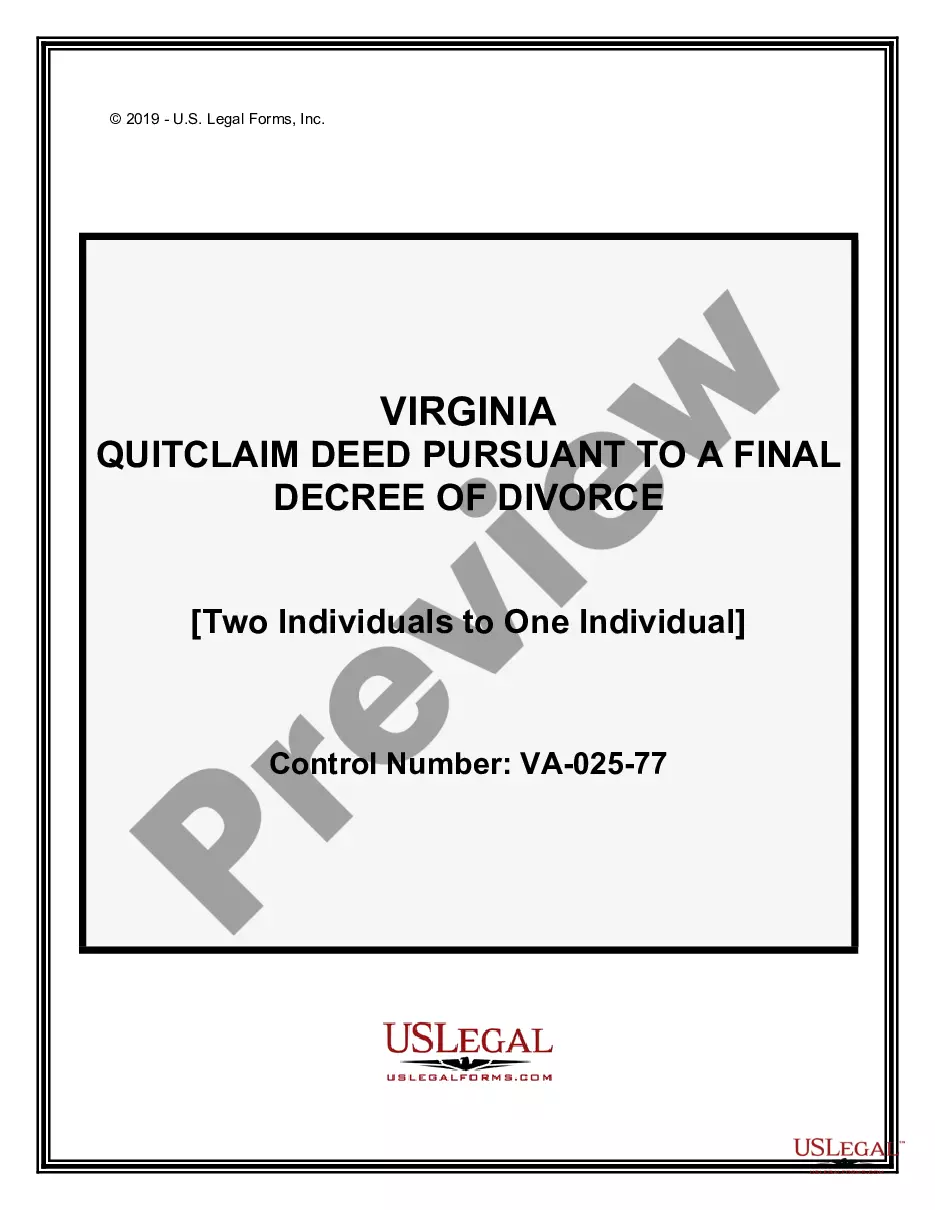
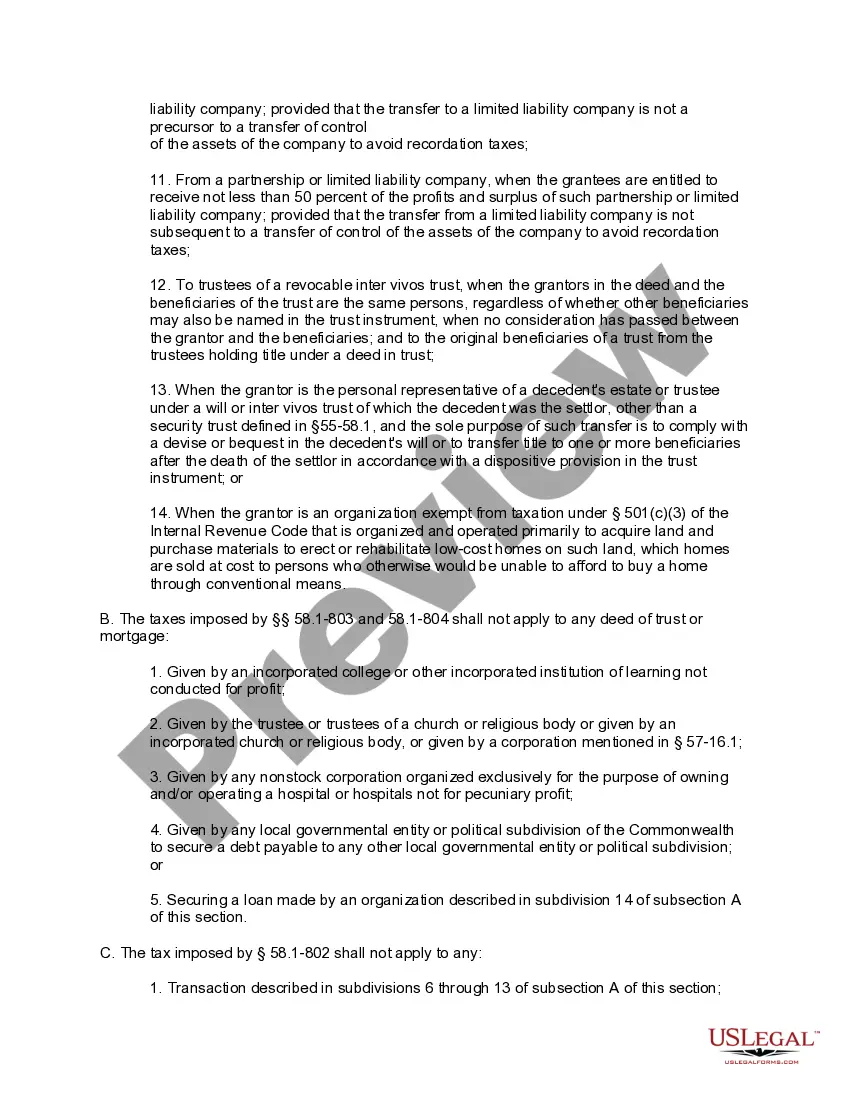
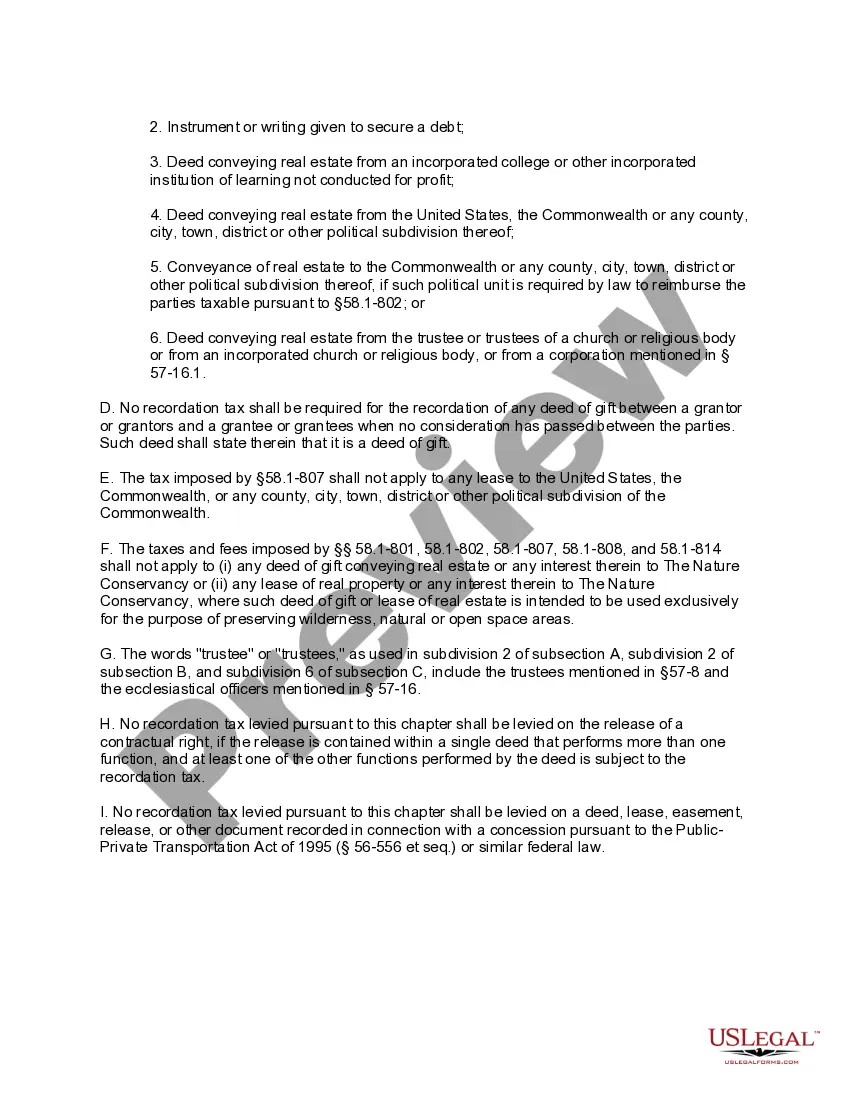
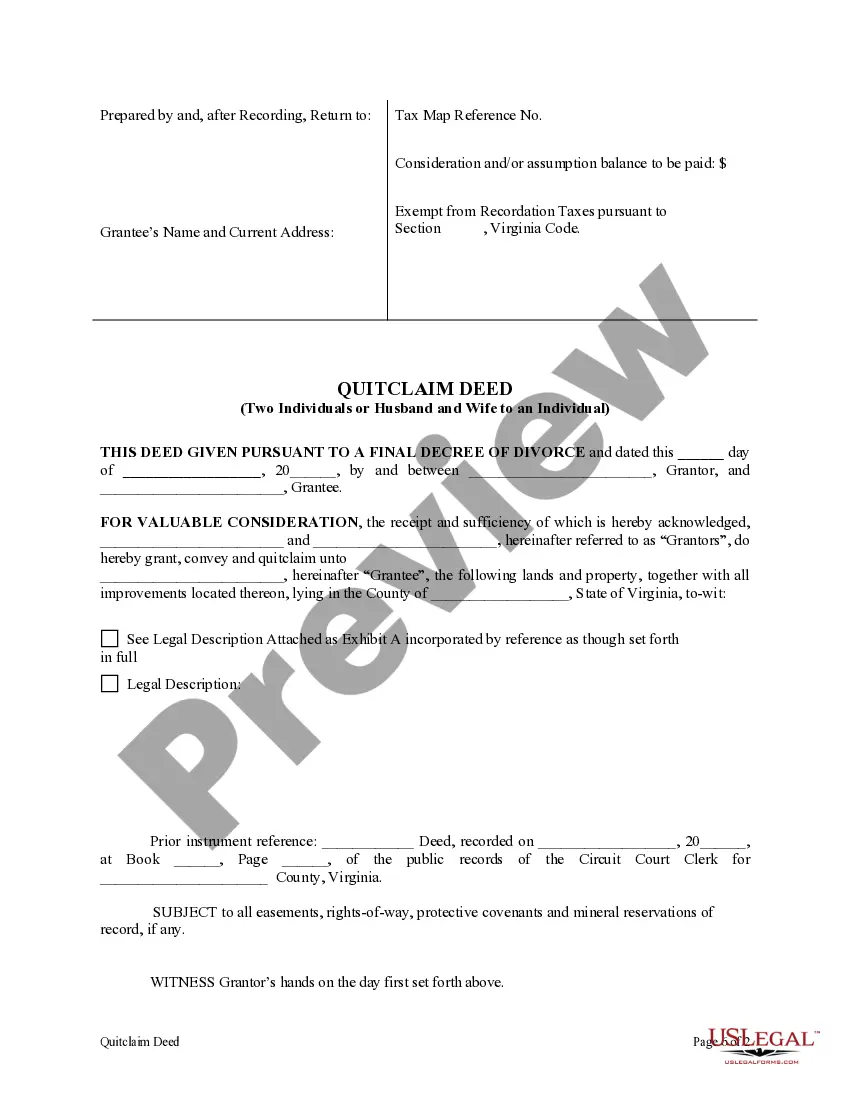
The Quitclaim Deed Pursuant to a Final Decree of Divorce allows two individuals (grantors) to transfer property ownership to one individual (grantee) as stipulated in a divorce decree. Unlike other types of deeds, a quitclaim deed does not offer any guarantee about the property's title, making it essential for situations where clarity of title is not a necessity, such as post-divorce property distributions.
Form components explained
- Parties involved: Names and addresses of the grantors and grantee.
- Property description: Detailed legal description of the property being transferred.
- Consideration: Statement acknowledging the receipt of valuable consideration, if applicable.
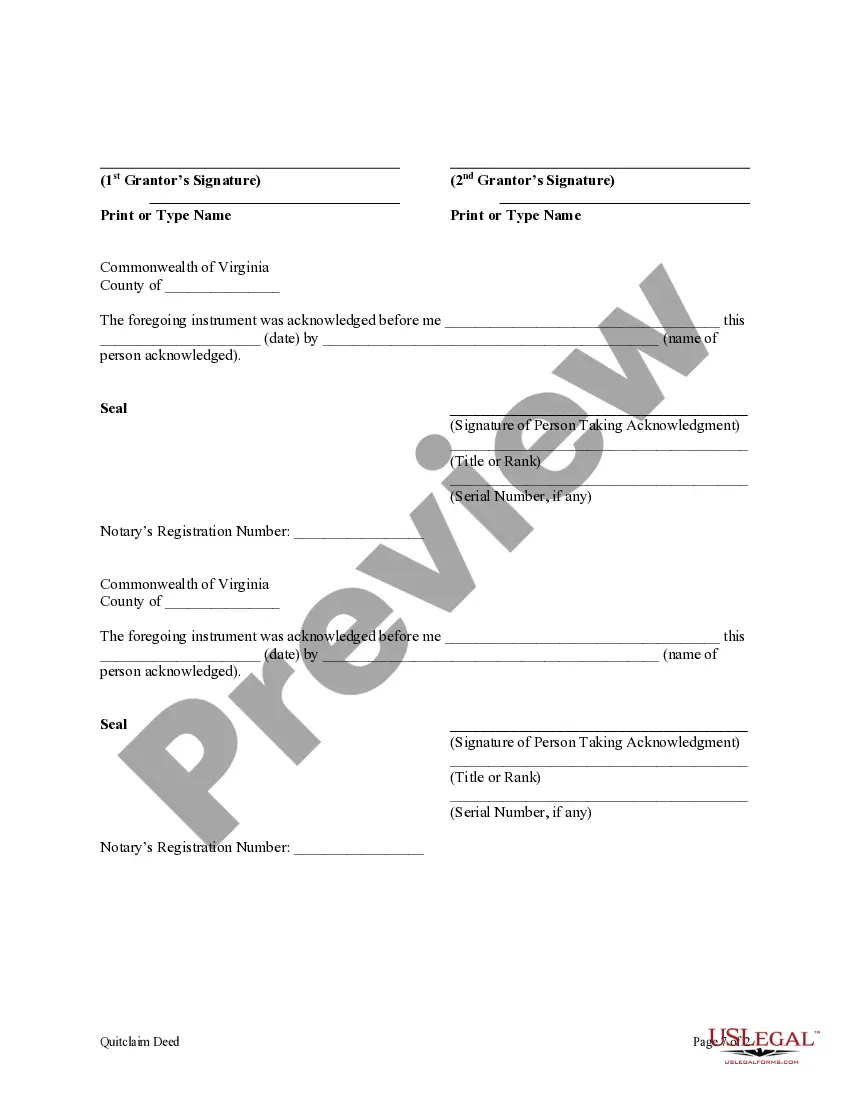
- Signatures: Signatures of both grantors, affirming the validity of the deed.
- Notary acknowledgment: Confirmation by a notary public specifying the date and location of notarization.

Common use cases
This form is used when a couple has undergone a divorce and needs to transfer ownership of a jointly-owned property to one party as dictated by their divorce settlement. Utilizing this quitclaim deed streamlines the process, ensuring that the remaining owner has full legal claim to the property, free of claims from the former spouse.
Who should use this form
This form is intended for:
- Divorced couples needing to finalize property transfers.
- Individuals receiving property as part of a divorce settlement.
- Those seeking a straightforward method to convey property rights without warranties.
- Homeowners looking to clear up title after a divorce.
Completing this form step by step
To complete this form, follow these steps:
- Identify the parties: Clearly include the names of both grantors and the grantee.
- Specify the property: Provide a detailed legal description of the property being conveyed.
- Enter consideration: If applicable, state the consideration received for the property transfer.
- Gather signatures: Both grantors must sign the deed in front of a notary public.
- Complete notarization: Ensure the notary public fills out their acknowledgment section correctly.
Does this form need to be notarized?
Yes, this form must be notarized to be legally valid. Notarization provides an official verification of the identities of the parties involved, ensuring that the transaction is legitimate. U.S. Legal Forms offers integrated online notarization services, making it easy and secure to complete this step without the need for in-person visits.
Get your form ready online
Our built-in tools help you complete, sign, share, and store your documents in one place.
Make edits, fill in missing information, and update formatting in US Legal Forms—just like you would in MS Word.
Download a copy, print it, send it by email, or mail it via USPS—whatever works best for your next step.
Sign and collect signatures with our SignNow integration. Send to multiple recipients, set reminders, and more. Go Premium to unlock E-Sign.
If this form requires notarization, complete it online through a secure video call—no need to meet a notary in person or wait for an appointment.
We protect your documents and personal data by following strict security and privacy standards.

Make edits, fill in missing information, and update formatting in US Legal Forms—just like you would in MS Word.

Download a copy, print it, send it by email, or mail it via USPS—whatever works best for your next step.

Sign and collect signatures with our SignNow integration. Send to multiple recipients, set reminders, and more. Go Premium to unlock E-Sign.

If this form requires notarization, complete it online through a secure video call—no need to meet a notary in person or wait for an appointment.

We protect your documents and personal data by following strict security and privacy standards.
Typical mistakes to avoid
- Entering incorrect legal property descriptions, which may result in disputes.
- Failing to obtain notarization, making the deed potentially invalid.
- Not including relevant details about the transfer, such as consideration.
- Not ensuring both grantors sign the document, which could invalidate the deed.
Advantages of online completion
- Convenient online access: Download the form from anywhere, anytime.
- Editability: Fill out the form digitally, ensuring clarity and legibility.
- Drafted by attorneys: Forms are prepared in compliance with state laws.
- Clear instructions: Guidance is included to help you accurately complete the form.
Looking for another form?
Form popularity
FAQ
If the quitclaim deed requires the signature of all co-owners, the deed is invalid unless all co-owners have signed it and the deed is then delivered to the grantee.If one individual owns real estate and desires to add a co-owner such as a spouse, a quitclaim deed might be used.
But you might be wondering if an owner can transfer a deed to another person without a real estate lawyer. The answer is yes. Parties to a transaction are always free to prepare their own deeds.A quitclaim deed, for example, is far simpler than a warranty deed.
It's usually a very straightforward transaction, but it's possible for a quitclaim deed to be challenged. If a quitclaim deed is challenged in court, the issue becomes whether the property was legally transferred and if the grantor had the legal right to transfer the property.
A quitclaim deed is a deed (proof of ownership) that is passed from a grantor (the existing property owner) to a grantee (the new property owner) that does not have a warranty.A quitclaim deed has no guarantees for the grantor or grantee.
A quitclaim deed will remove the out-spouse (or departing spouse) from the title to the property, effectively relinquishing their equity or ownership in the home. The execution of a quitclaim deed is typically a requirement of a divorce settlement in order to complete the division of assets.
To use a Quitclaim Deed to add someone to a property deed or title, you would need to create a Quitclaim Deed and list all of the current owners in the grantor section. In the grantee section, you would list all of the current owners as well as the person you would like to add.
Ex said he can do loan modification but lender requires I sign a quit claim deed before it can be modified and decree will need amendment removing clause that house is to be sold.Ex said Quit Claim will supersede decree and no amendment needs to be done.