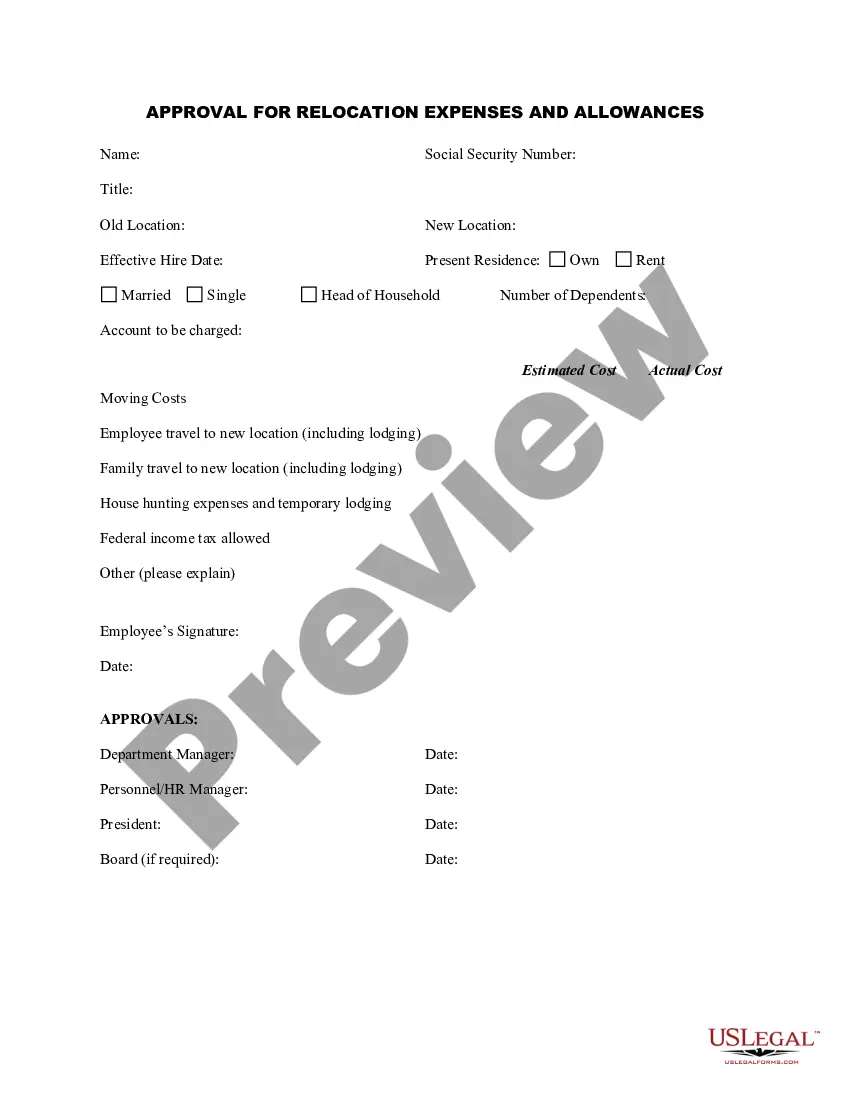
Utah Approval for Relocation Expenses and Allowances
Description
Get your form ready online
Our built-in tools help you complete, sign, share, and store your documents in one place.
Make edits, fill in missing information, and update formatting in US Legal Forms—just like you would in MS Word.
Download a copy, print it, send it by email, or mail it via USPS—whatever works best for your next step.
Sign and collect signatures with our SignNow integration. Send to multiple recipients, set reminders, and more. Go Premium to unlock E-Sign.
If this form requires notarization, complete it online through a secure video call—no need to meet a notary in person or wait for an appointment.
We protect your documents and personal data by following strict security and privacy standards.

Make edits, fill in missing information, and update formatting in US Legal Forms—just like you would in MS Word.

Download a copy, print it, send it by email, or mail it via USPS—whatever works best for your next step.

Sign and collect signatures with our SignNow integration. Send to multiple recipients, set reminders, and more. Go Premium to unlock E-Sign.

If this form requires notarization, complete it online through a secure video call—no need to meet a notary in person or wait for an appointment.

We protect your documents and personal data by following strict security and privacy standards.
Looking for another form?



How to fill out Approval For Relocation Expenses And Allowances?
If you seek extensive, download, or printing valid document templates, utilize US Legal Forms, the foremost selection of legal forms available online.
Employ the site's user-friendly and convenient search to locate the documents you desire.
Numerous templates for business and personal purposes are categorized by types and jurisdictions, or keywords.
Step 4. After finding the form you need, click the Get now button. Choose the pricing plan you prefer and enter your information to create an account.
Step 5. Complete the payment process. You may use your credit card or PayPal account to finalize the transaction.
- Use US Legal Forms to access the Utah Approval for Relocation Expenses and Allowances with just a few clicks.
- If you are an existing US Legal Forms customer, Log In to your account and click the Acquire button to obtain the Utah Approval for Relocation Expenses and Allowances.
- You can also retrieve forms you previously obtained in the My documents section of your account.
- If this is your first time using US Legal Forms, follow the instructions below.
- Step 1. Ensure you have selected the form for the correct city/state.
- Step 2. Use the Review feature to assess the form's content. Be sure to read the overview.
- Step 3. If you are not satisfied with the form, use the Search field at the top of the screen to find other versions of the legal form template.
Form popularity
FAQ
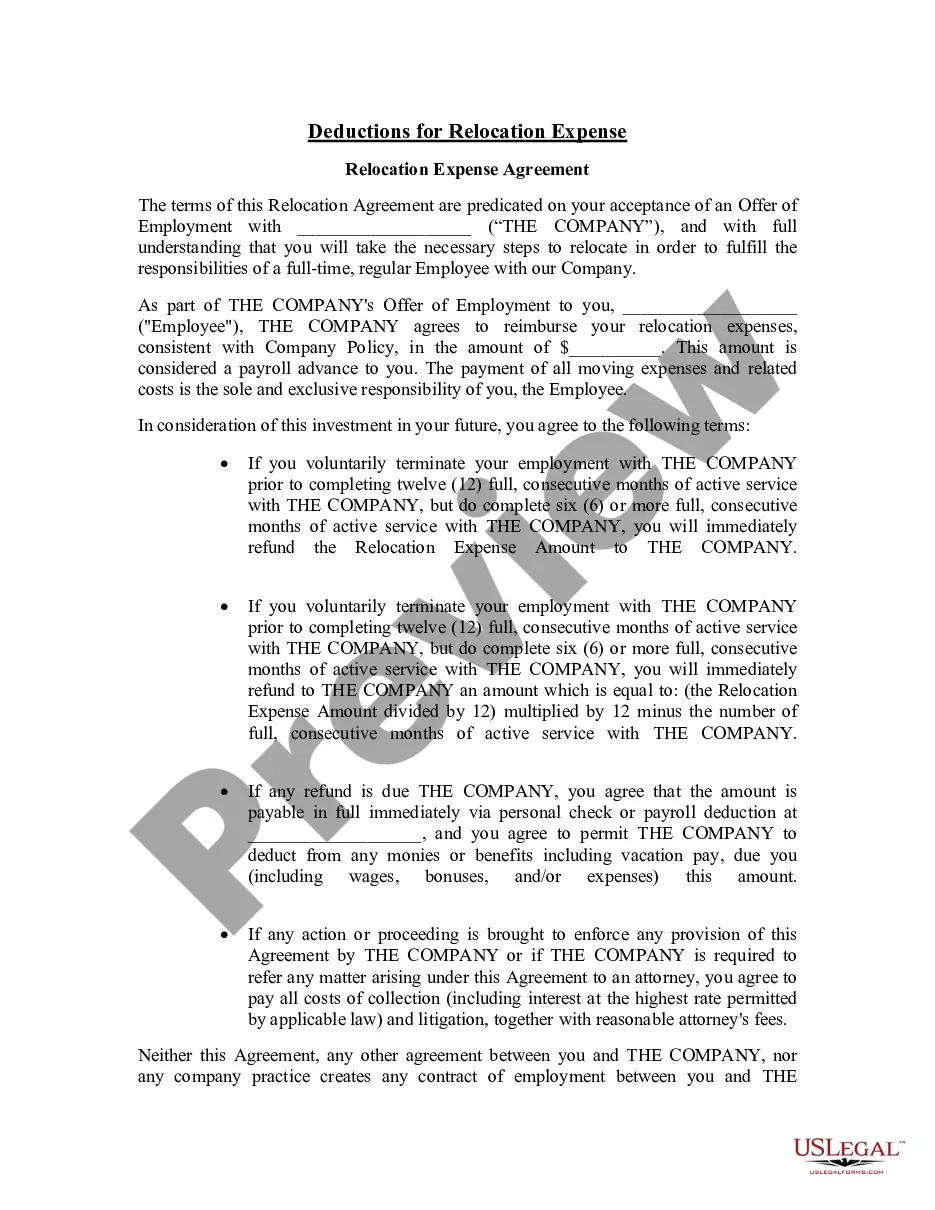
To qualify, reimbursements or payments must be for work-related moving expenses that would have been deductible by the employee if the employee had directly paid them before Jan. 1, 2018.
You can deduct certain expenses associated with moving your household goods and personal effects. Examples of these expenses include the cost of packing, crating, hauling a trailer, in-transit storage, and insurance.
Put the limit in writing with an offer of relocation reimbursement. The offer details the amount of money you will refund, the types of expenses that qualify, and any other stipulations that you want set on the reimbursement. Make sure you and the job candidate both sign the relocation offer.
A typical relocation package usually covers the costs of moving and storing furnishings, household goods, assistance with selling an existing home, costs incurred with house-hunting, temporary housing, and all travel costs by the employee and family to the new location.
Relocation costs can include: buying or selling a home. moving. buying certain things for a new home.
These include: The cost of packing, crating and transporting household goods of the employee and family. This includes cars and pets. The cost of connecting or disconnecting utilities.
The most common relocation repayment requires repayment in full if termination of employment is within 12 months after relocation or a prorated amount for up to 2 years. If a move is in process when employment ends, unused benefits typically cease immediately.
These costs may also cover services such as cleaning, electrical, heating, telephone and broadband set-up. Home sale/lease break costs: Relocation allowances may cover the cost of arranging for the rental or sale of the expat's property in the home country, or cover the costs of terminating a lease.
Relocation expenses for employees paid by an employer (aside from BVO/GBO homesale programs) are all considered taxable income to the employee by the IRS and state authorities (and by local governments that levy an income tax).
All moving-expense payments made to an employee or on an employee's behalf are taxable income to the employee and will be reported on the employee's Form W-2. For taxable reimbursements, federal and state income taxes, social security and Medicare taxes must be withheld.