Utah Fiduciary - Estate or Trust - Tax Return Engagement Letter

Category:
State:
Multi-State
Control #:
US-01957BG
Format:
Word
Instant download

Description

Generally, a contract to employ a certified public accountant need not be in writing. However, such contracts often call for services of a highly complex and technical nature, and hence they should be explicit in their terms, and they should be in writing. In particular, a written employment contract is necessary in order to avoid misunderstanding with the employer regarding the amount of the accountant's fee or compensation and the nature of its computation.


This form is a generic example that may be referred to when preparing such a form for your particular state. It is for illustrative purposes only. Local laws should be consulted to determine any specific requirements for such a form in a particular jurisdiction.
Free preview
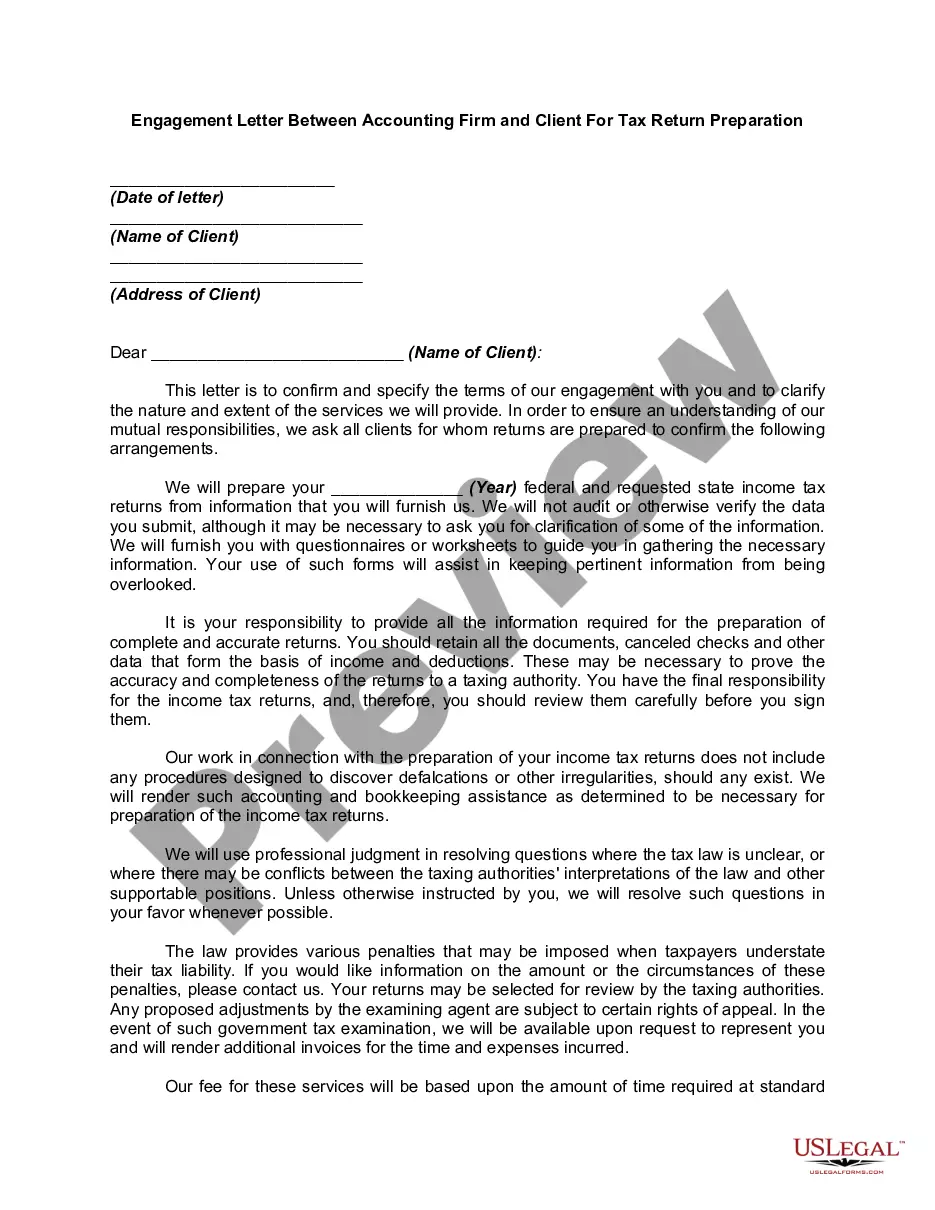
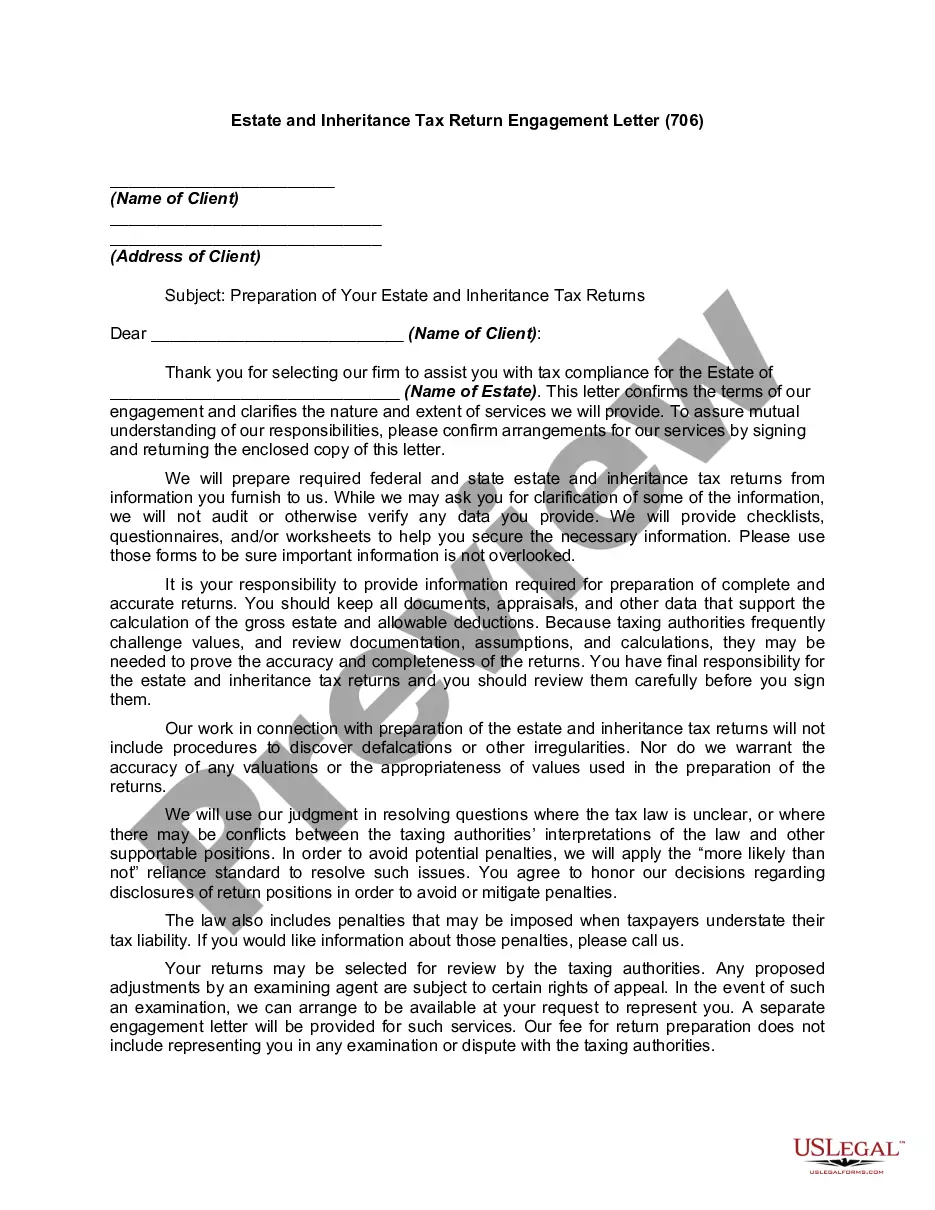
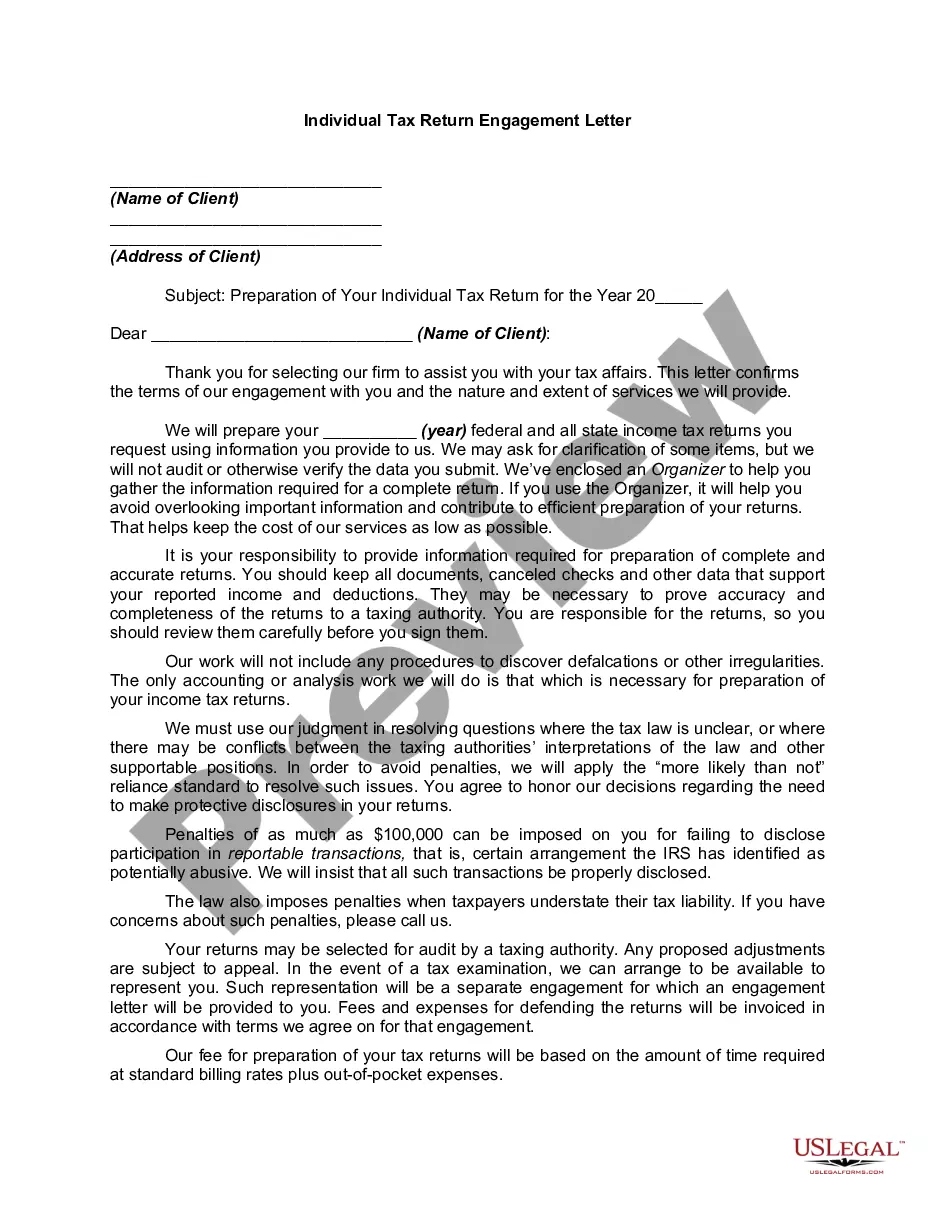
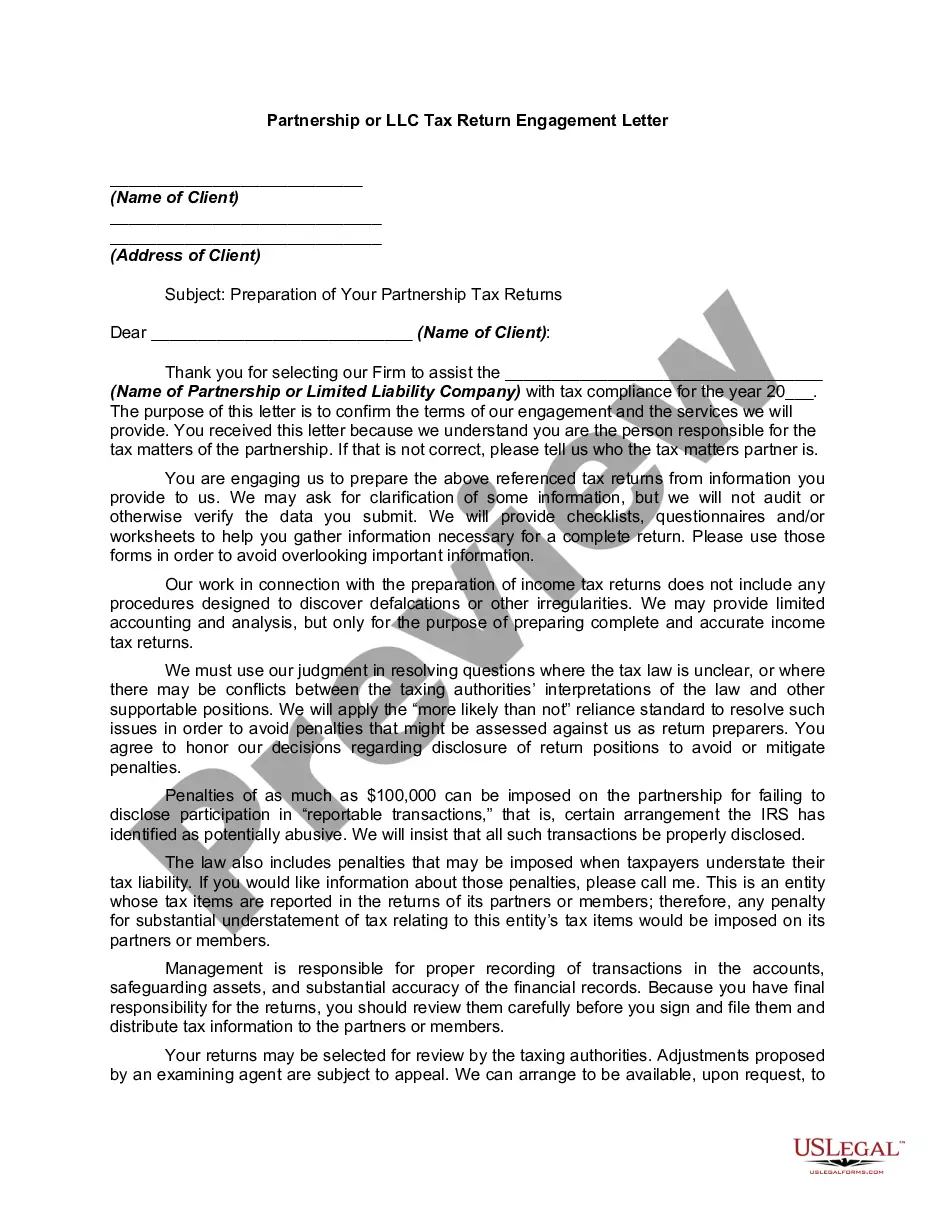
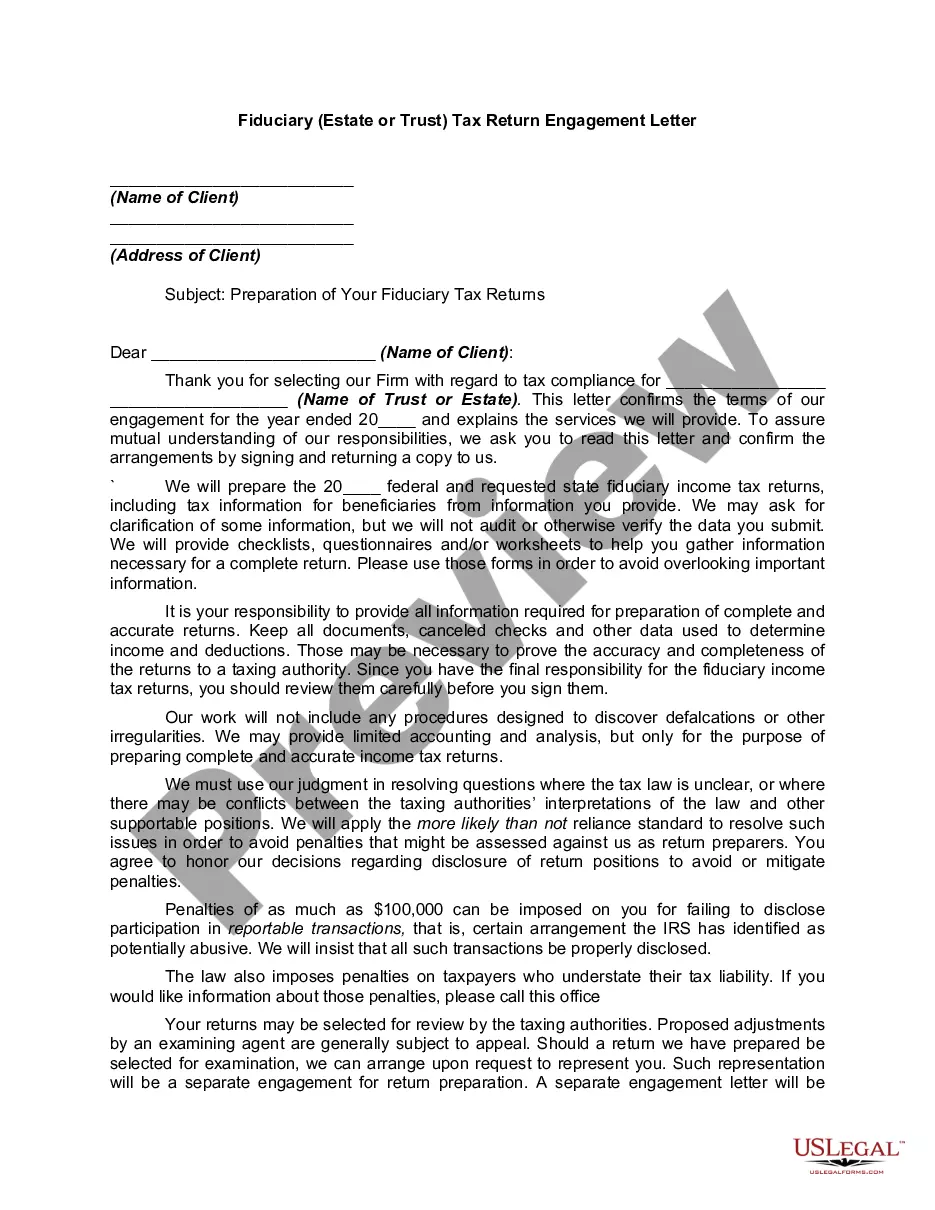
  • Preview Fiduciary - Estate or Trust - Tax Return Engagement Letter
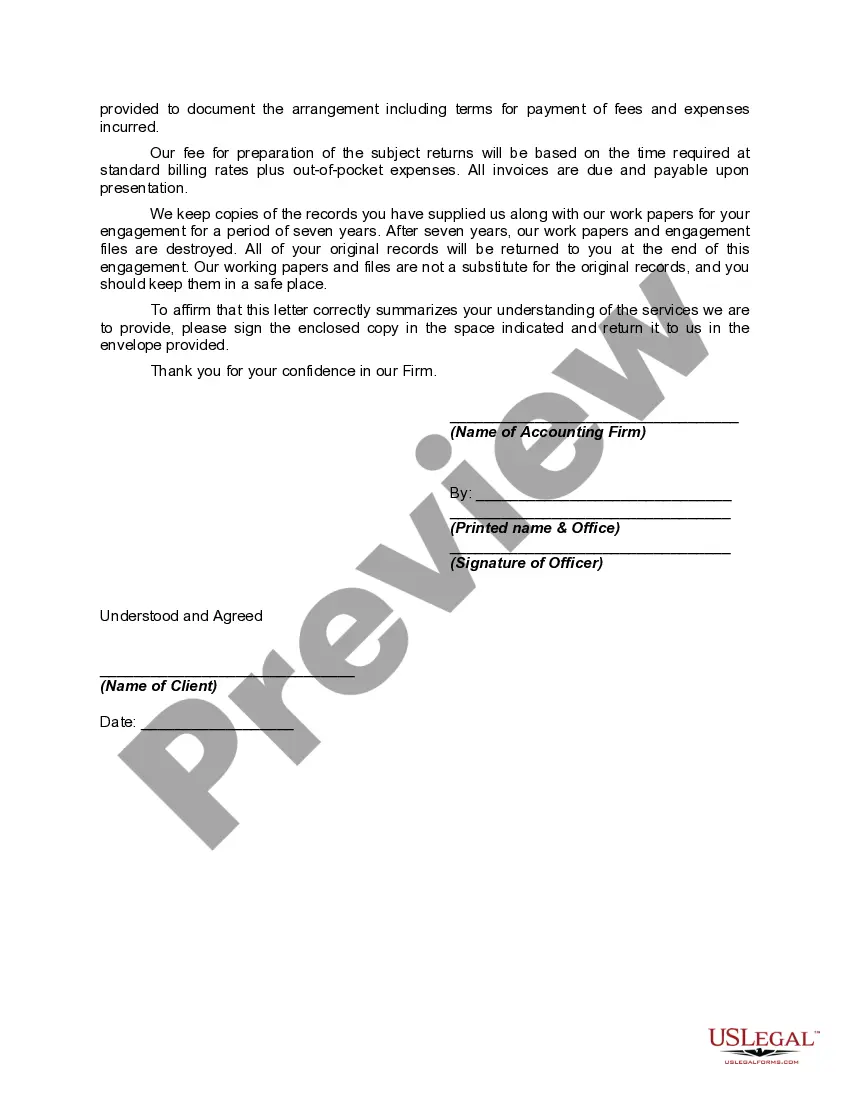
  • Preview Fiduciary - Estate or Trust - Tax Return Engagement Letter

How to fill out Fiduciary - Estate Or Trust - Tax Return Engagement Letter?

It is feasible to allocate time online attempting to locate the legal document template that aligns with the federal and state requirements you need.

US Legal Forms provides numerous legal forms that can be reviewed by experts.

You can effortlessly download or print the Utah Fiduciary - Estate or Trust - Tax Return Engagement Letter from our service.

If available, utilize the Preview button to review the document template as well.

  1. If you already possess a US Legal Forms account, you can Log In and click the Obtain button.
  2. Afterward, you may complete, modify, print, or sign the Utah Fiduciary - Estate or Trust - Tax Return Engagement Letter.
  3. Every legal document template you obtain is yours indefinitely.
  4. To acquire an additional copy of any purchased form, go to the My documents section and click the appropriate button.
  5. If this is your first time using the US Legal Forms website, follow the simple instructions outlined below.
  6. First, ensure that you have chosen the correct document template for your selected region/city.
  7. Review the form summary to confirm you have selected the appropriate document.

Form popularity

FAQ

Yes, trusts in Utah are subject to state income tax if they generate taxable income. This obligation can affect overall tax liabilities and planning strategies. Seeking assistance with a Utah Fiduciary - Estate or Trust - Tax Return Engagement Letter can provide clarity on these tax responsibilities and ensure proper compliance.

No, a fiduciary tax return focuses on the income generated by the estate or trust, while an estate tax return centers on the value of the estate upon death. Both forms serve different purposes and have different filing requirements. Engaging a professional through a Utah Fiduciary - Estate or Trust - Tax Return Engagement Letter will help in navigating these complexities.

The purpose of an estate tax return is to report the total value of a deceased person's estate to determine tax liabilities. This return assesses whether the estate is subject to federal or state estate taxes. For clarity and compliance, using a Utah Fiduciary - Estate or Trust - Tax Return Engagement Letter ensures all aspects are addressed.

A tax audit engagement letter outlines the terms of the relationship between a taxpayer and a tax professional during an audit process. It defines responsibilities and expectations, providing clarity for both parties. For trust and estate matters, a Utah Fiduciary - Estate or Trust - Tax Return Engagement Letter also serves a similar purpose by establishing the scope of engagement.

An estate tax return primarily addresses the taxes owed on the overall estate's value at the time of death, while a trust tax return focuses on the income generated by assets held in the trust. Both are essential for proper financial management and tax compliance. Engaging a professional through a Utah Fiduciary - Estate or Trust - Tax Return Engagement Letter ensures both returns are accurately filed.

Yes, many trusts are required to file tax returns, particularly if they generate taxable income. Filing a tax return ensures compliance with tax obligations and prevents penalties. The use of a Utah Fiduciary - Estate or Trust - Tax Return Engagement Letter can help simplify the filing process.

An estate return is not the same as a fiduciary return. The estate return focuses on estate taxes owed, while a fiduciary return tracks income generated by the trust or estate’s assets. Clarifying this distinction is essential as it affects the types of taxes that may be due, which can be detailed in a Utah Fiduciary - Estate or Trust - Tax Return Engagement Letter.

A fiduciary tax return (Form 1041) reports income earned by the estate or trust, while estate tax returns (Form 706) deal with the value of the deceased's estate at death. Both returns play significant roles in tax reporting and compliance. Engaging a professional for a Utah Fiduciary - Estate or Trust - Tax Return Engagement Letter can simplify these processes.

Form 1041 is used to report income for estates and trusts, while Form 706 is specifically for reporting estate taxes owed. Understanding which form to file is crucial for compliance and can significantly impact tax liabilities. Utilizing a Utah Fiduciary - Estate or Trust - Tax Return Engagement Letter ensures accurate reporting of the proper forms.

An estate refers to all the assets and liabilities owned by an individual at the time of their death. A trust, on the other hand, is a legal arrangement where a trustee manages assets on behalf of beneficiaries, often established during a person's lifetime. Understanding the distinction is essential for effective estate planning, especially in relation to the Utah Fiduciary - Estate or Trust - Tax Return Engagement Letter.

Trusted and secure by over 3 million people of the world’s leading companies

Utah Fiduciary - Estate or Trust - Tax Return Engagement Letter