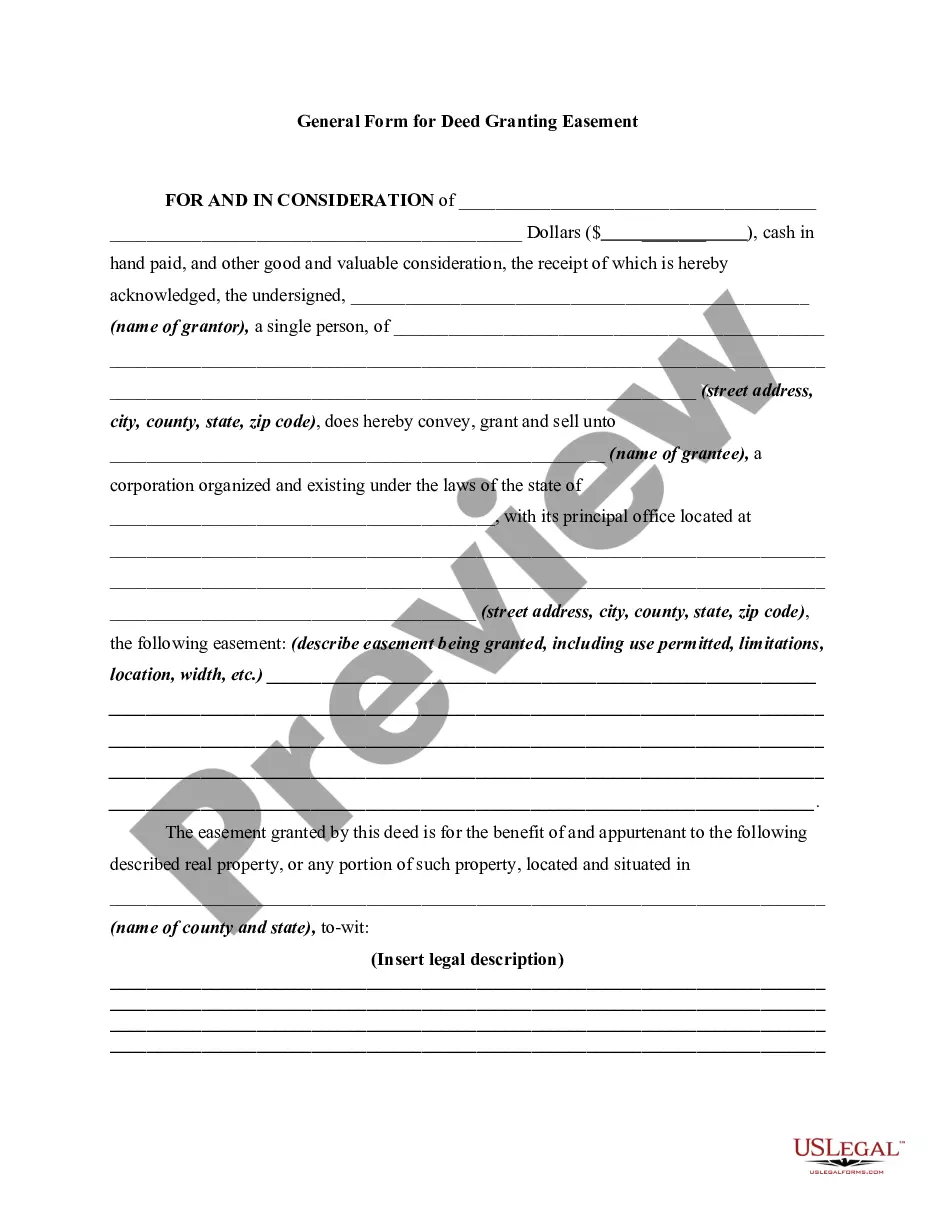
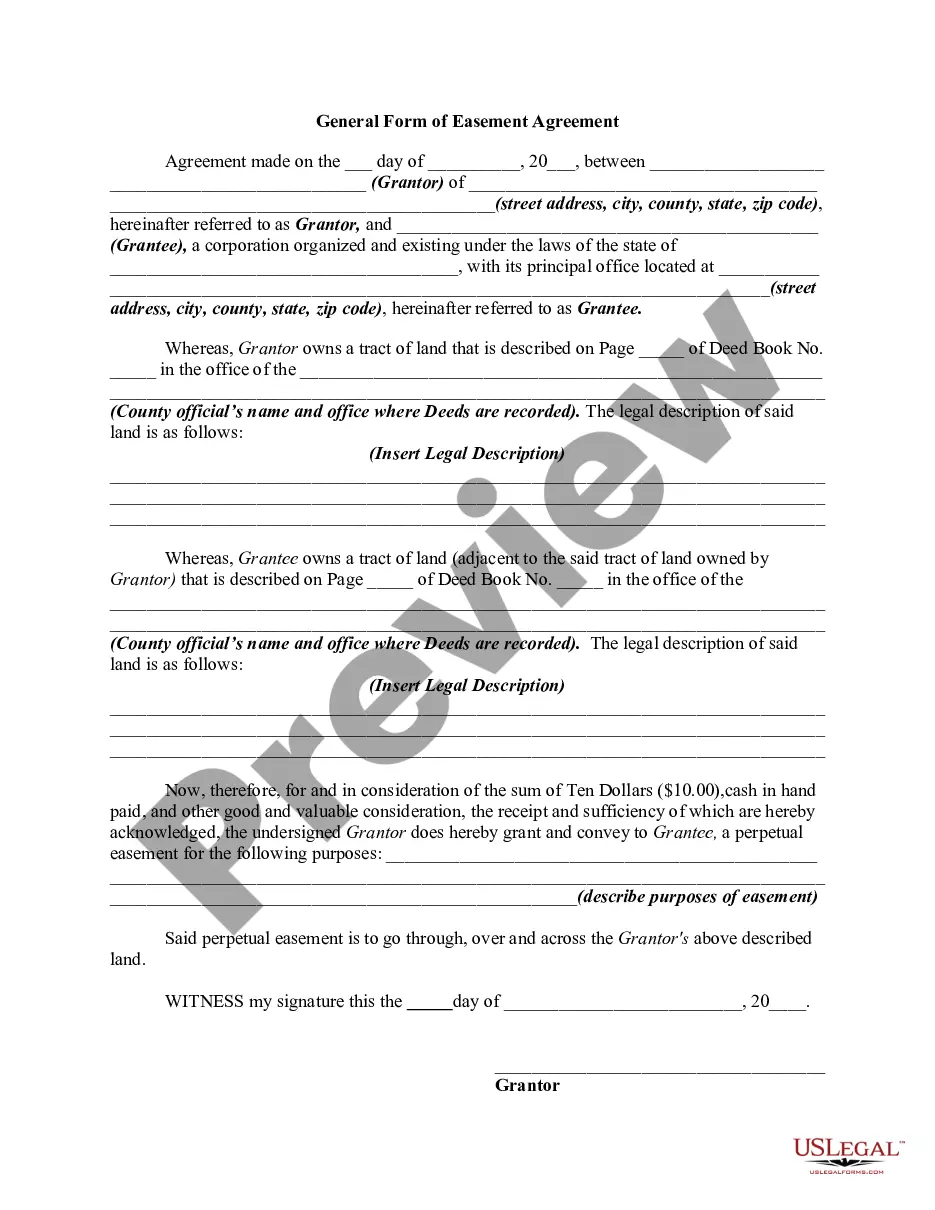
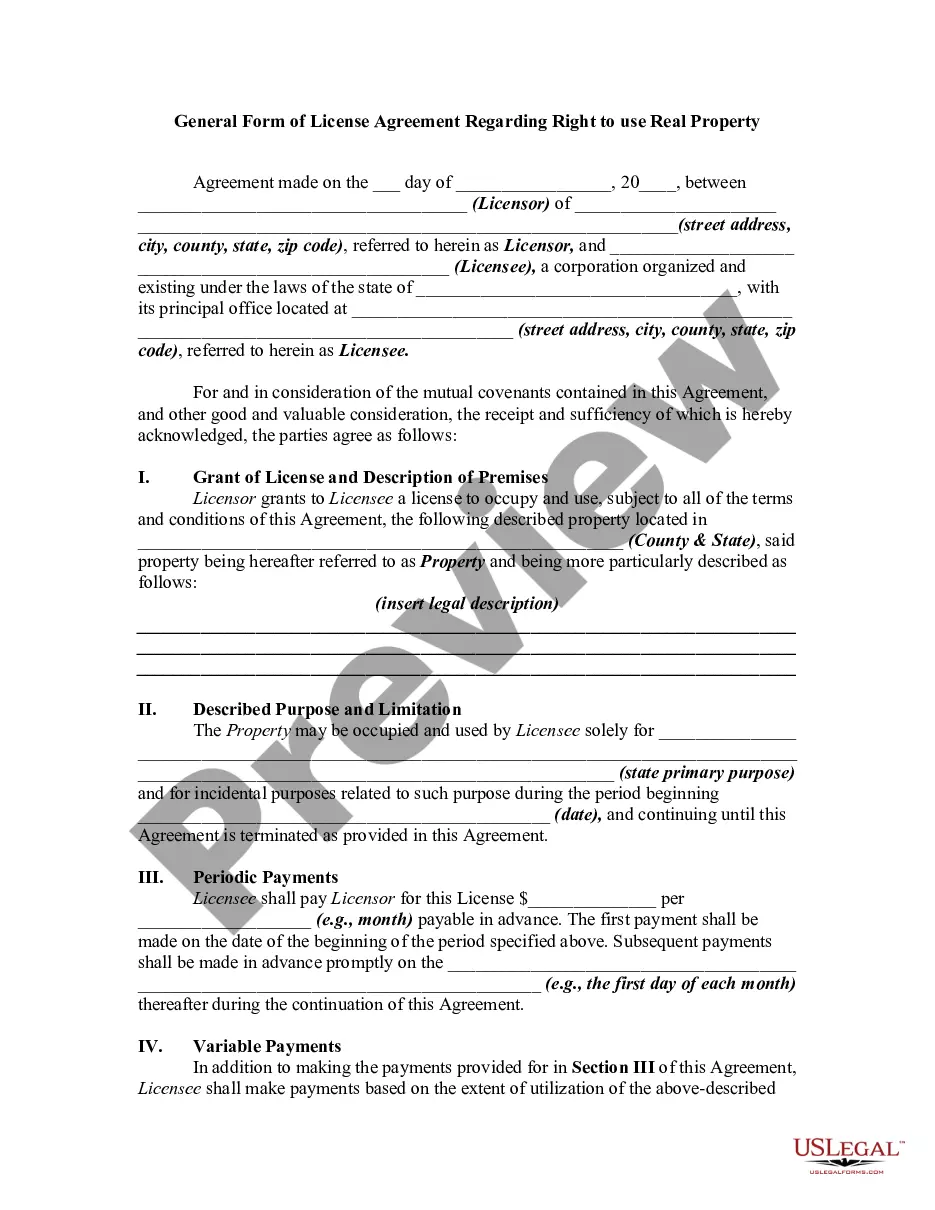
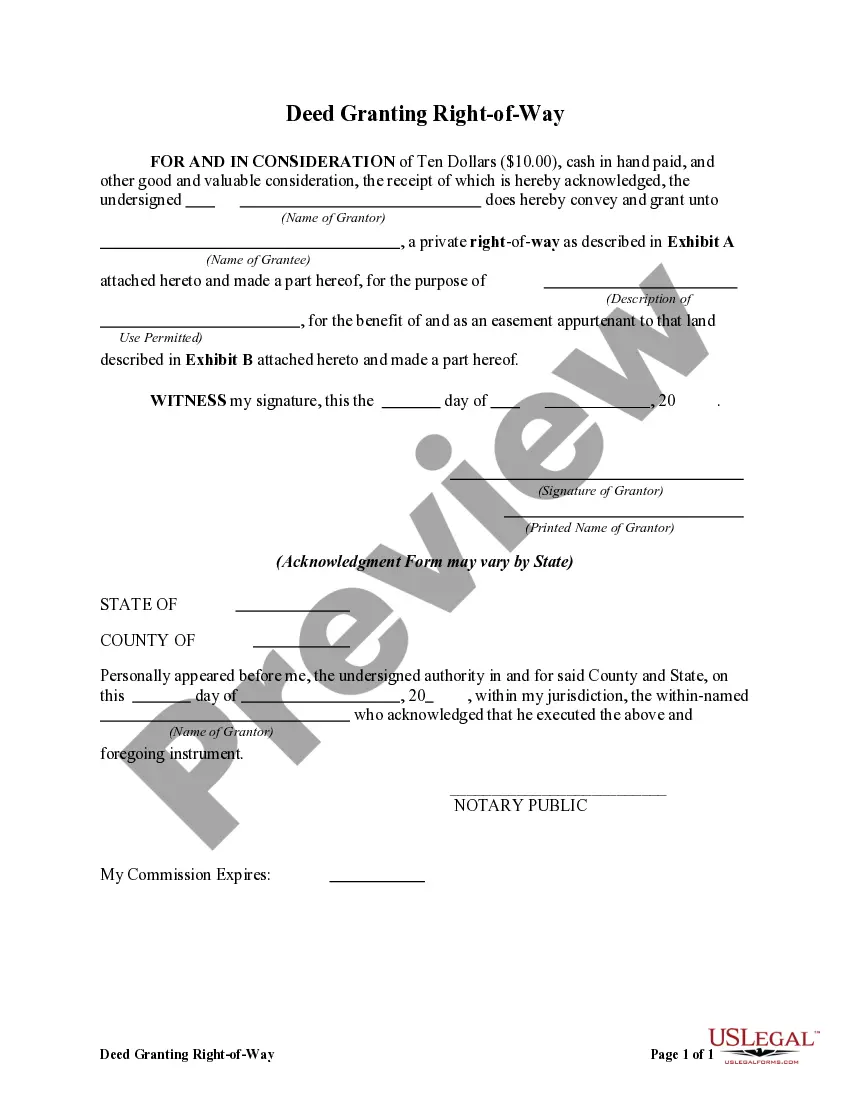
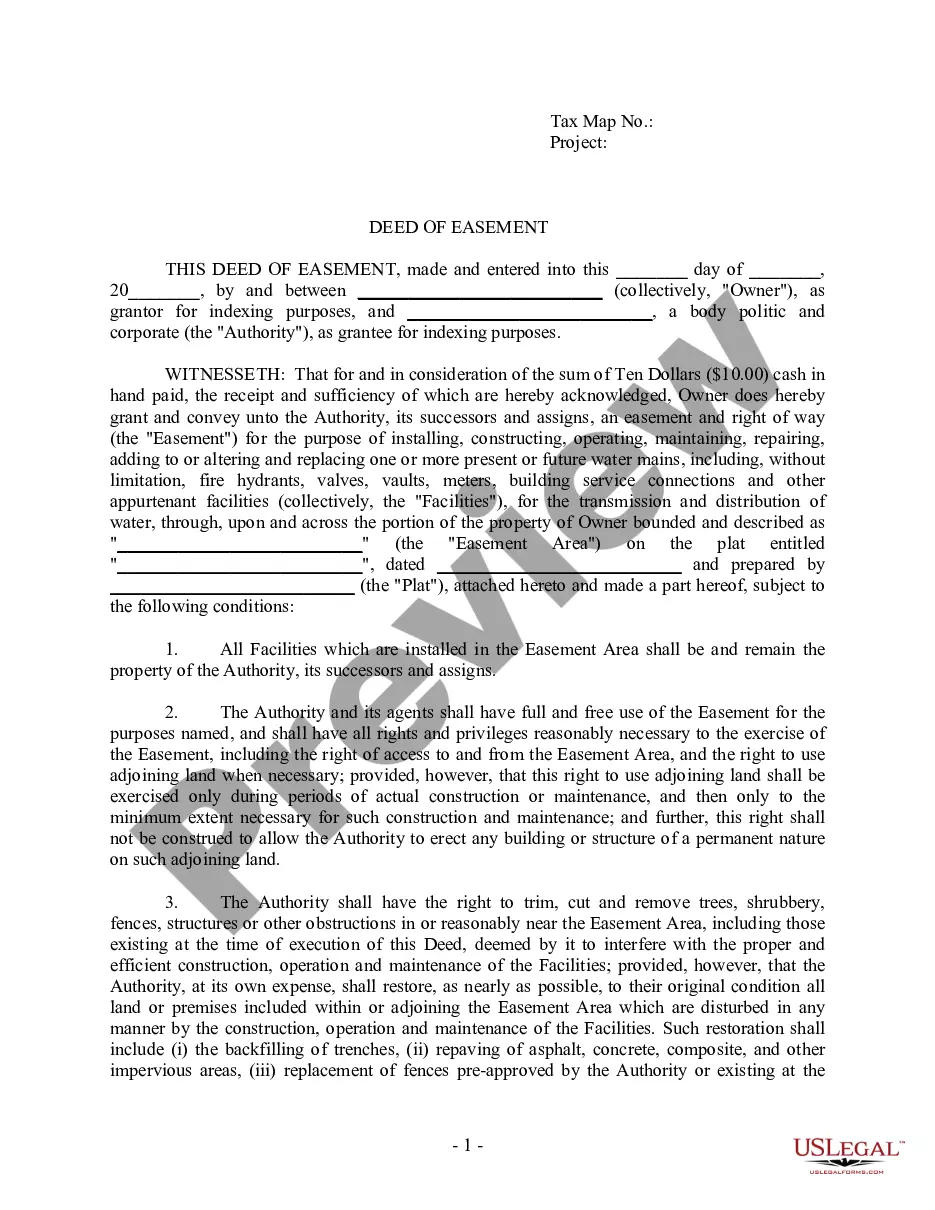
An easement is a right in the land of another. The right is often described as the right to use the land of another for a special purpose. An easement gives one party the right to go onto another party's property. An easement is a real property interest, but separate from the legal title of the owner of the underlying land. This form is a generic example that may be referred to when preparing such a form for your particular state. It is for illustrative purposes only. Local laws should be consulted to determine any specific requirements for such a form in a particular jurisdiction.
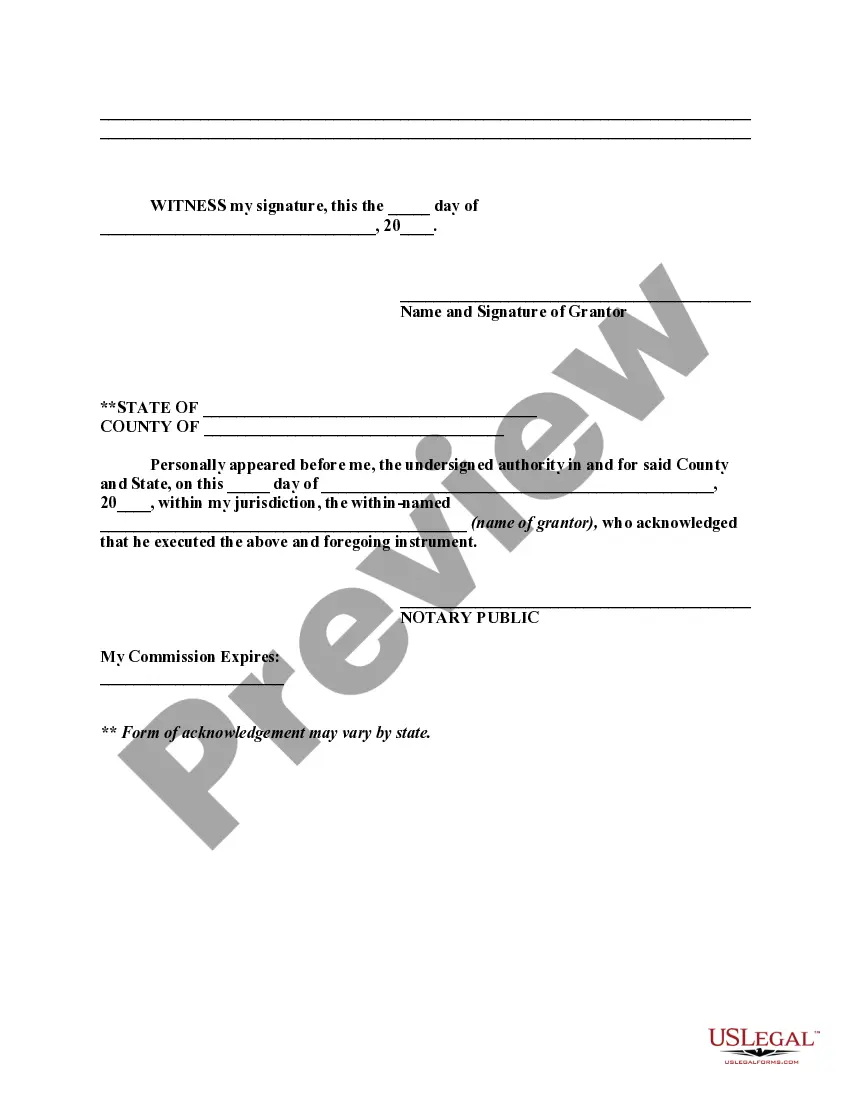
Utah General Form for Deed Granting Easement
State:
Multi-State
Control #:
US-01176BG
Format:
Word;
Rich Text
Instant download
Description
Free preview
Get your form ready online
Our built-in tools help you complete, sign, share, and store your documents in one place.
Built-in online Word editor
Make edits, fill in missing information, and update formatting in US Legal Forms—just like you would in MS Word.
Export easily
Download a copy, print it, send it by email, or mail it via USPS—whatever works best for your next step.
E-sign your document
Sign and collect signatures with our SignNow integration. Send to multiple recipients, set reminders, and more. Go Premium to unlock E-Sign.
Notarize online 24/7
If this form requires notarization, complete it online through a secure video call—no need to meet a notary in person or wait for an appointment.
Store your document securely
We protect your documents and personal data by following strict security and privacy standards.

Make edits, fill in missing information, and update formatting in US Legal Forms—just like you would in MS Word.

Download a copy, print it, send it by email, or mail it via USPS—whatever works best for your next step.

Sign and collect signatures with our SignNow integration. Send to multiple recipients, set reminders, and more. Go Premium to unlock E-Sign.

If this form requires notarization, complete it online through a secure video call—no need to meet a notary in person or wait for an appointment.

We protect your documents and personal data by following strict security and privacy standards.
Looking for another form?
How to fill out General Form For Deed Granting Easement?
Are you currently in a situation where you frequently require documents for various business or personal activities almost every workday.
There are numerous legal document templates accessible online, but finding reliable ones can be challenging.
US Legal Forms provides a vast array of form templates, including the Utah General Form for Deed Granting Easement, designed to satisfy both federal and state regulations.
Once you find the appropriate form, click Get now.
Choose the pricing plan you prefer, complete the required information to create your account, and pay for the order using your PayPal or credit card.
- If you are already familiar with the US Legal Forms website and possess an account, simply Log In.
- Then, you can download the Utah General Form for Deed Granting Easement template.
- If you do not have an account and wish to start using US Legal Forms, follow these instructions.
- Locate the form you need and ensure it pertains to your specific area/state.
- Utilize the Review feature to examine the form.
- Read the description to confirm you have selected the correct form.
- If the form isn't what you're looking for, use the Search box to find the form that meets your needs.
Form popularity
FAQ
Here is an example of an implied easement by existing use: A farm has a barn accessible only by a private road on the neighboring property. The farmer uses this road to access the barn indefinitely, but there is no easement written into the deed of the neighbor.
The easement application should be accompanied by a cover letter, map, and legal description prepared by a licensed land surveyor. Upon receipt of the application, Trust Lands will conduct a preliminary review of the application and determine whether to accept or reject the application.
Giving a landowner right-of-way over an adjoining parcel of land in order to access a public road is the most common example of an easement by necessity. Imagine a piece of farmland that has been divided in two. The first parcel lies along a county road and has a driveway leading up to a home.
An easement usually is written so that it lasts forever. This is known as a perpetual easement. Where state law allows, an easement may be written for a specified period of years; this is known as a term easement. Only gifts of perpetual easement, however, can qualify a donor for income- and estate-tax benefits.
Because implied easements by necessity are not recorded, bona fide purchasers may not be aware that the land they are purchasing is burdened by an easement. Alternatively, implied easements by necessity can be seen as advantageous because they allow people to make use of their land.
An implied easement is one that is not written down. It is created by the circumstances of a particular configuration of land. Generally, for an implied easement to exist, there must be a need for it; if there is no need for an easement, there is no need for a property owner to give rights to access his land to others.
Section 57-13a-102 - Prescriptive easement for water conveyance (1) A prescriptive easement may be established if a water user has maintained a water conveyance for a period of 20 years during which the use has been: (a) continuous; (b) open and notorious; and (c) adverse.
Buyers assume they will be able to use the property. Buyers also assume they can enter and exit the property. But, the rights to enter and exit the property may be separate from the ownership of the property. Ingress is defined as the right to enter the property and egress is defined as the right to exit the property.