Subscription Agreement - A Section 3C1 Fund
Overview of this form
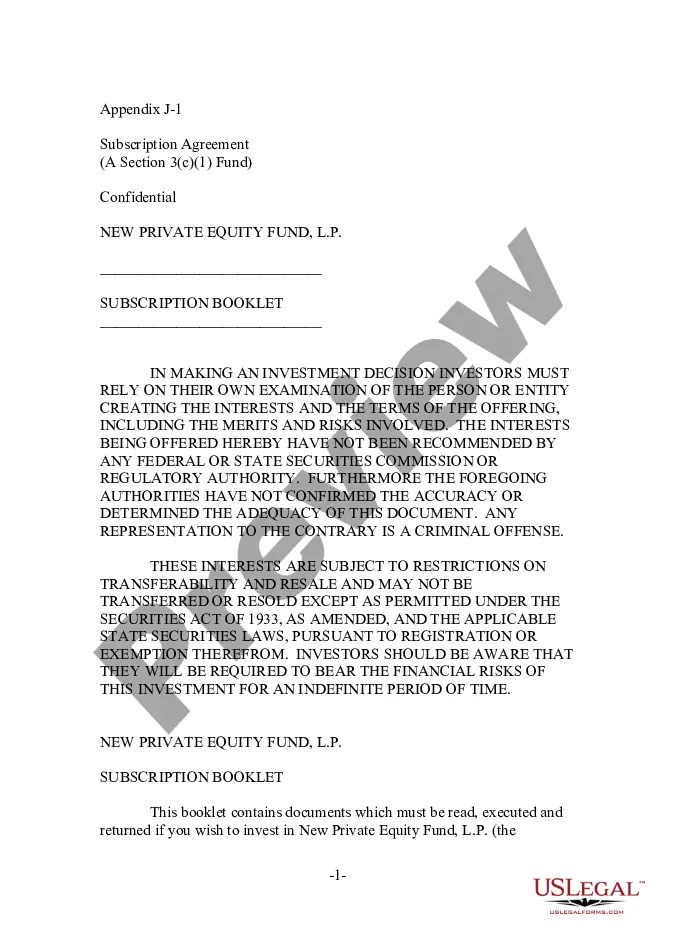
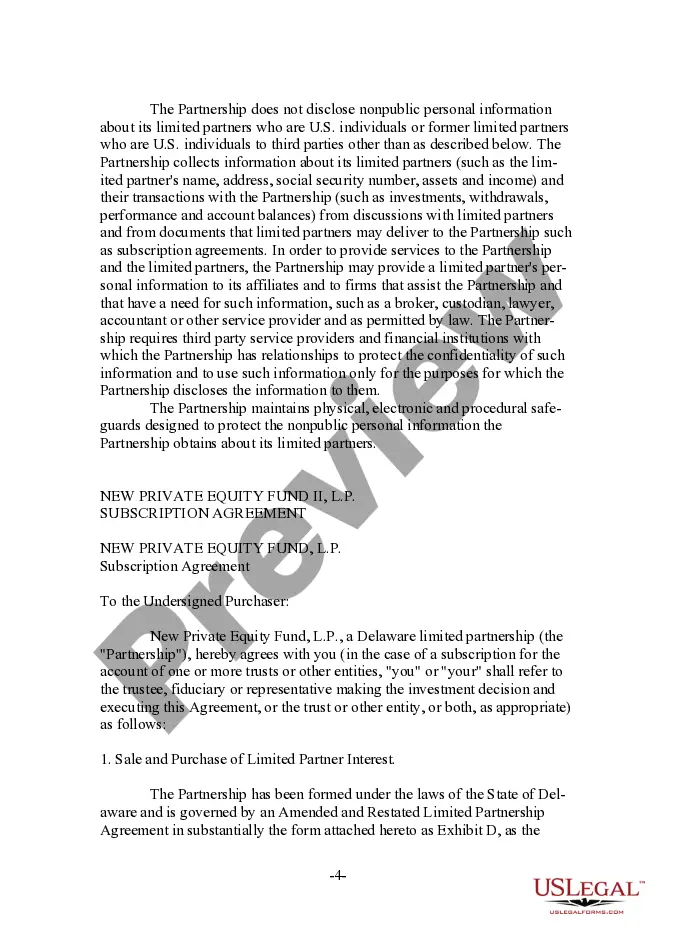
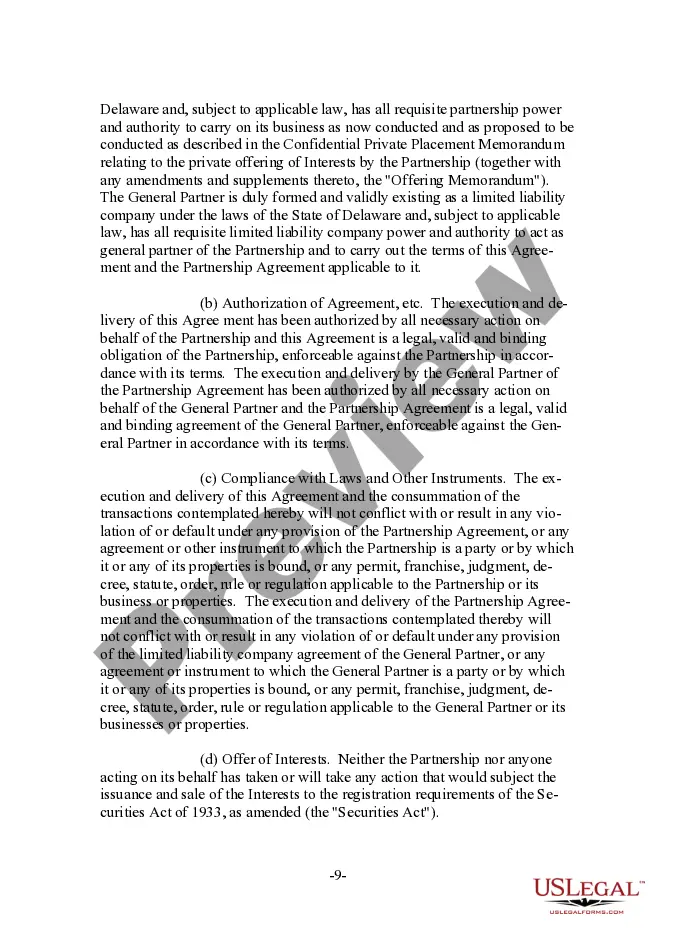
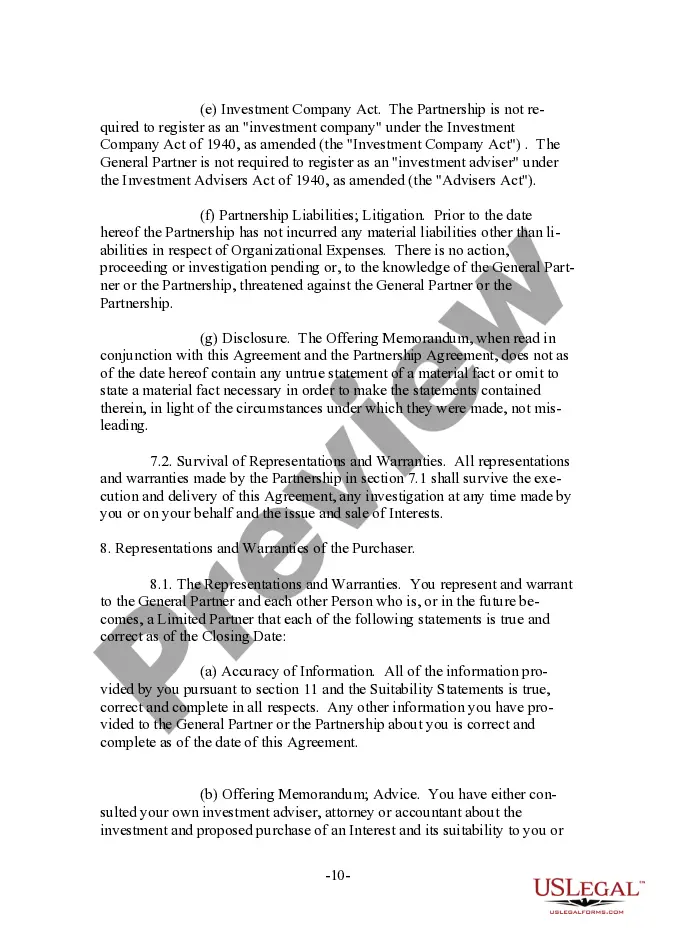
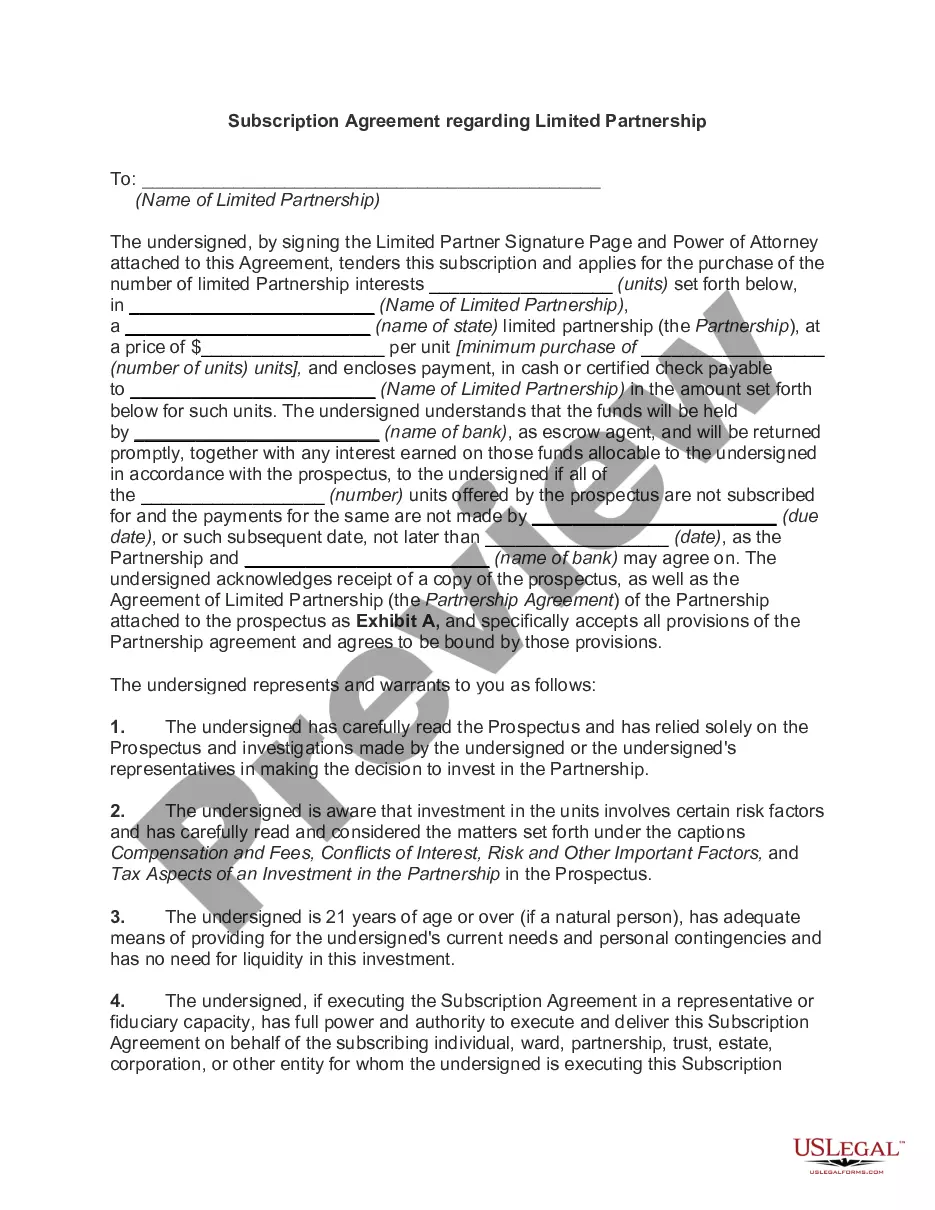
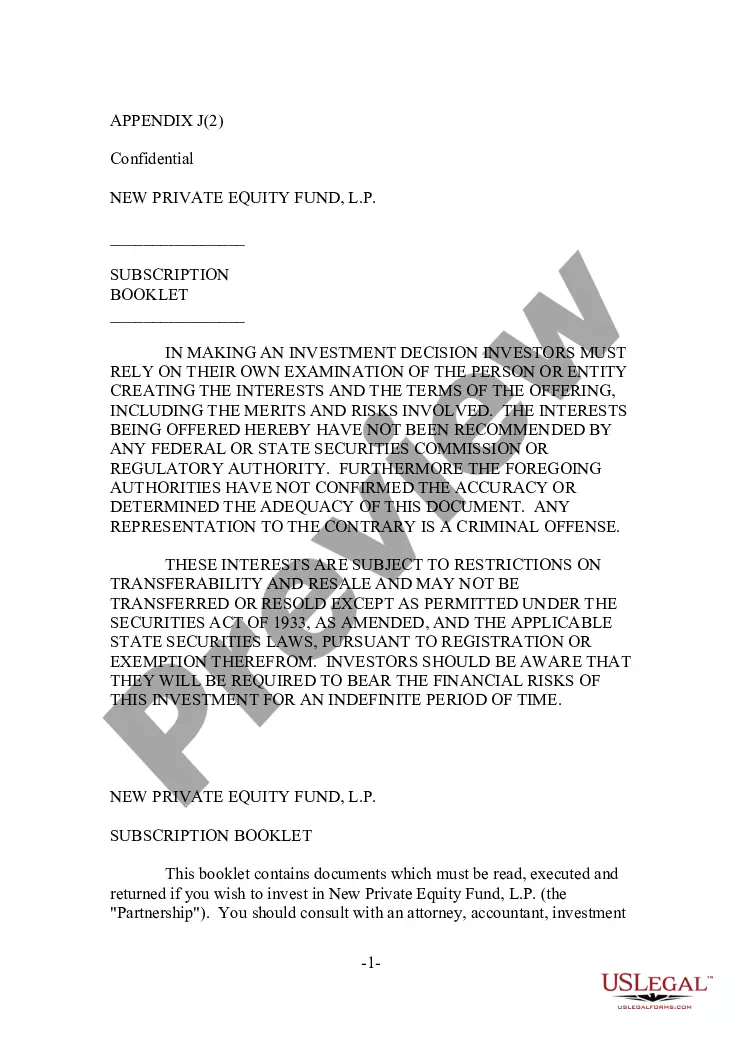
The Subscription Agreement for a Section 3(c)(1) Fund is a legal document used by investors to subscribe for limited partnership interests in a private equity fund. This form differs from standard investment agreements by specifically addressing the regulatory requirements applicable to Section 3(c)(1) Funds, which are often only available to accredited investors. The agreement outlines the subscription process and the terms under which investors commit capital, making it essential for formal investment in the fund.
What’s included in this form
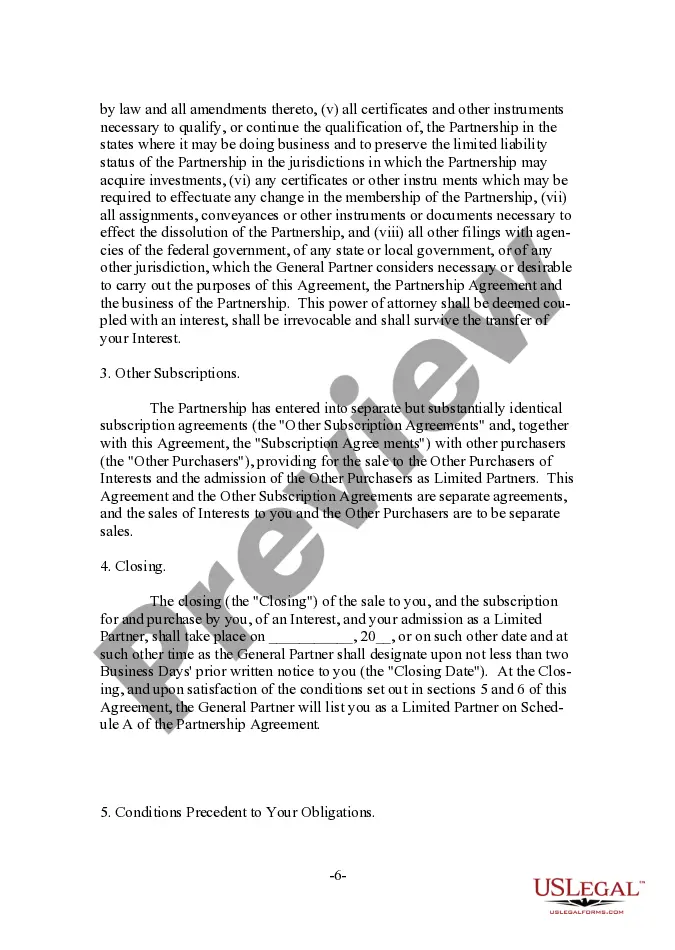
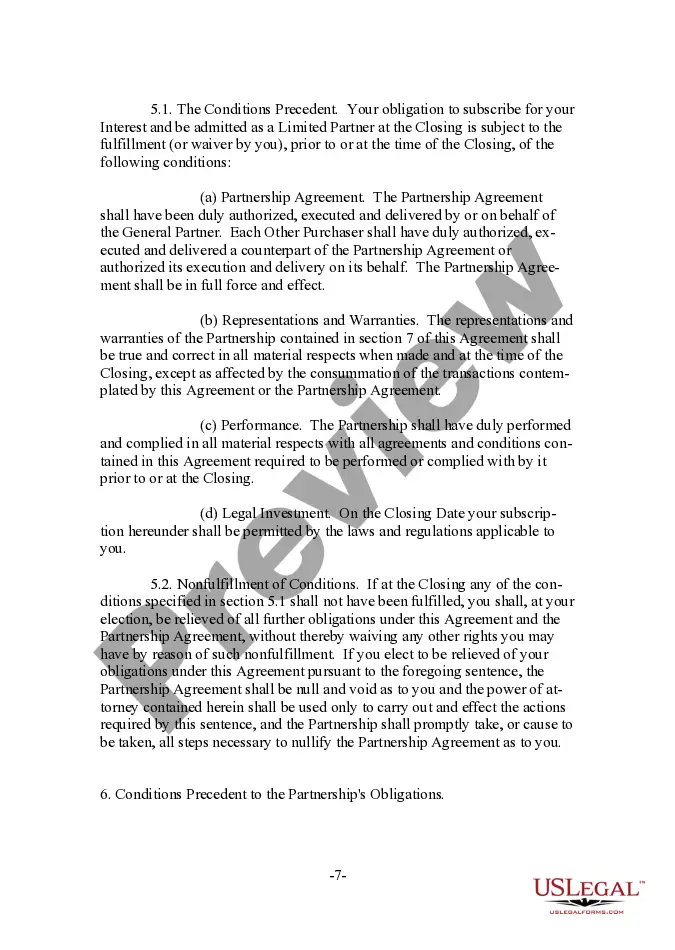
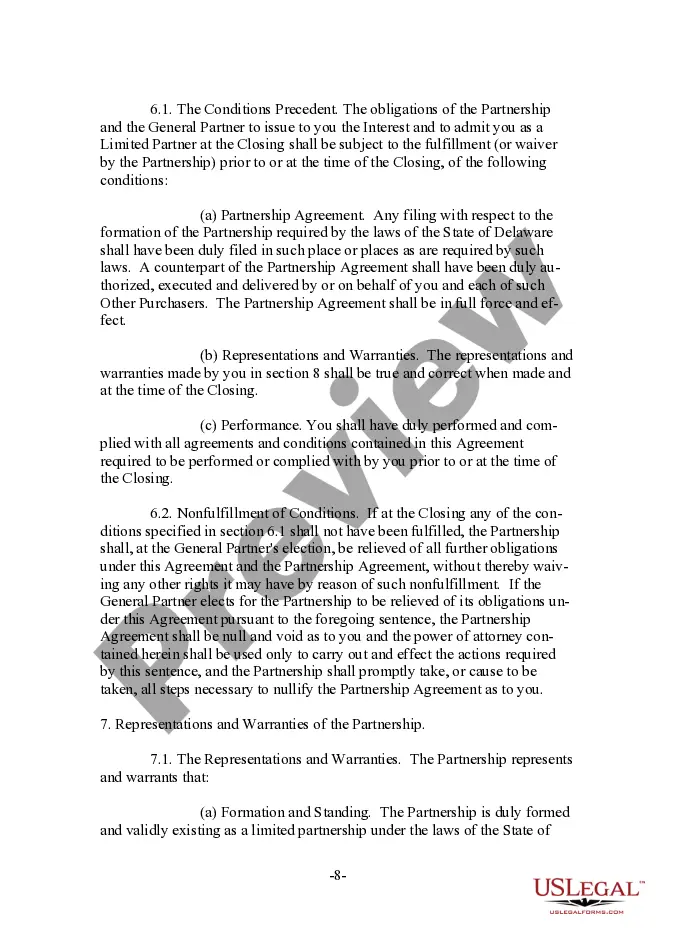
- Subscription Agreement: Document outlining the agreement between the investor and the partnership for purchasing limited partnership interests.
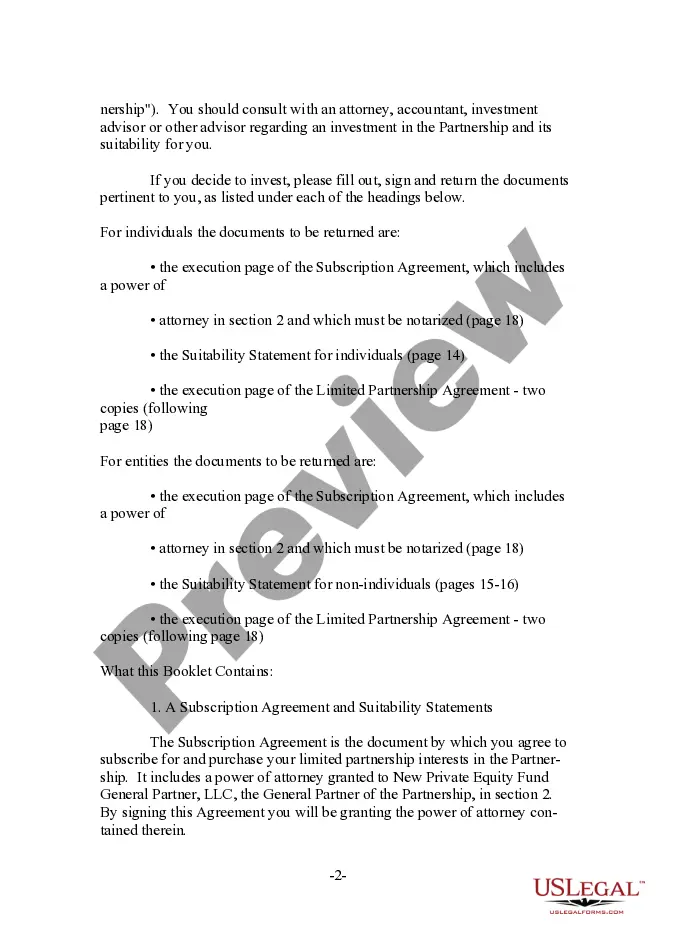
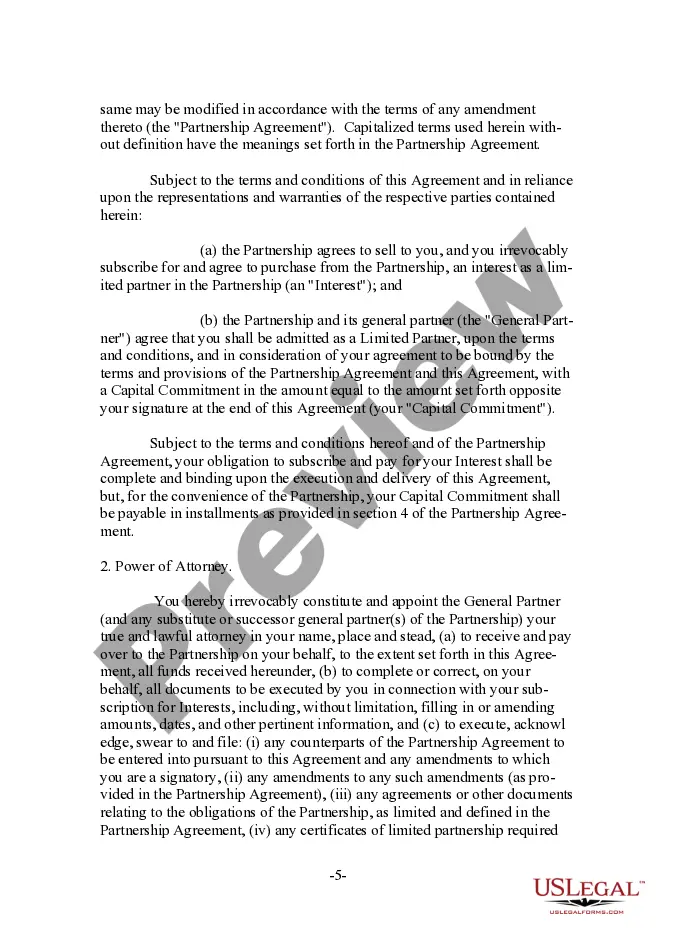
- Power of Attorney: Grants the general partner authority to act on behalf of the investor regarding related documentation.
- Suitability Statement: A declaration that assesses the investor's financial status and investment suitability.
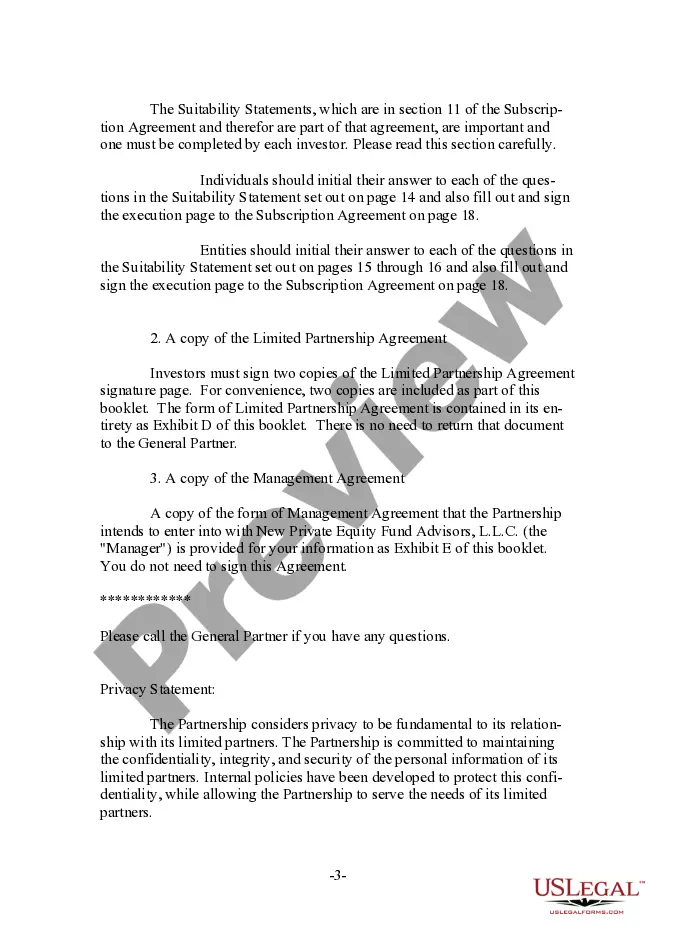
- Limited Partnership Agreement: A separate document that governs the relationship between partners, which must be signed in duplicate.
- Management Agreement: Includes details about the management of the fund, provided for informational purposes.


Situations where this form applies
This Subscription Agreement should be used when an accredited investor is interested in purchasing a limited partnership interest in a private equity fund structured under Section 3(c)(1) of the Investment Company Act. It's applicable in scenarios such as capital raising for private equity investments, participation in venture capital funds, or any investment decisions involving substantial financial commitments that require legal documentation to ensure compliance with federal and state securities laws.
Who should use this form
- Accredited individual investors seeking to invest in the private equity fund.
- Entities such as corporations, partnerships, or trusts formed for investment purposes.
- Financial advisors or intermediaries acting on behalf of investors making a substantial investment decision.
Steps to complete this form
- Identify the parties involved: Enter the investor's and the fund's details accurately.
- Complete the Subscription Agreement: Fill in the executed Subscription, including the power of attorney reserved for the General Partner.
- Fill out the Suitability Statement: Answer all questions truthfully and initial as required to confirm suitability for investment.
- Sign the Limited Partnership Agreement: Ensure that you sign two copies of the signature page as mandated.
- Notarize the agreement: For individual investors, the execution page must be notarized.
Is notarization required?
To make this form legally binding, it must be notarized. Our online notarization service, powered by Notarize, lets you verify and sign documents remotely through an encrypted video session.
Get your form ready online
Our built-in tools help you complete, sign, share, and store your documents in one place.
Make edits, fill in missing information, and update formatting in US Legal Forms—just like you would in MS Word.
Download a copy, print it, send it by email, or mail it via USPS—whatever works best for your next step.
Sign and collect signatures with our SignNow integration. Send to multiple recipients, set reminders, and more. Go Premium to unlock E-Sign.
If this form requires notarization, complete it online through a secure video call—no need to meet a notary in person or wait for an appointment.
We protect your documents and personal data by following strict security and privacy standards.

Make edits, fill in missing information, and update formatting in US Legal Forms—just like you would in MS Word.

Download a copy, print it, send it by email, or mail it via USPS—whatever works best for your next step.

Sign and collect signatures with our SignNow integration. Send to multiple recipients, set reminders, and more. Go Premium to unlock E-Sign.

If this form requires notarization, complete it online through a secure video call—no need to meet a notary in person or wait for an appointment.

We protect your documents and personal data by following strict security and privacy standards.
Mistakes to watch out for
- Failing to properly complete the Suitability Statement can disqualify the investment.
- Omitting signatures or initials on necessary pages may lead to invalidation of the subscription.
- Not having documents notarized if required, especially for individual investor sections.
- Misunderstanding eligibility criteria for accredited investor status can lead to issues with compliance.
Benefits of using this form online
- Convenience of completing the form from any location, saving time and travel-related costs.
- Editable format allows for easy corrections and adjustments before final submission.
- Access to legal expertise ensures that the document aligns with current legal standards.
- Integrated online notarization options streamline the process and enhance legal validity.
Looking for another form?
Form popularity
FAQ
3C1 funds are also referred to as 3C1 companies or 3(c)(1) funds. The result of 3C1 is that it allows hedge fund companies to avoid the SEC scrutiny that other investment funds, such as mutual funds, must adhere to under the Act.
In other words, 3C1 allows private funds with 100 or fewer investors and no plans for an initial public offering to sidestep SEC registration and other requirements, including ongoing disclosure and restrictions on derivatives trading. 3C1 funds are also referred to as 3C1 companies or 3(c)(1) funds.
What Is 3C7? 3C7 refers to a portion of the Investment Company Act of 1940 that allows private funds meeting specific criteria an exemption from some Securities and Exchange Commission (SEC) regulation. 1 3C7 is shorthand for the 3(c)(7) exemption.
Q: CAN THE 3C7 FUND EXCLUSION AND THE 3C1 FUND EXCLUSION BE COMBINED IN A SINGLE FUND IN WHICH THE INVESTORS CONSIST OF QUALIFIED PURCHASERS PLUS UP TO 100 OTHERS? A: No, except in the case of a fund that was in existence on September 1, 1996 and satisfies certain additional requirements.
What's the definition of a hedge fund? Well, simply put, a hedge fund is nothing more than an investment company that invests its clients' money in alternative investments to either beat the market or provide a hedge against unforeseen market changes. Obviously, though, there is much more to it than that.
The key differentiator here is that qualified purchasers are a relevant classification for funds who want to maximize their assets under management. By contrast, accredited investors are a relevant classification for the ability to invest in certain types of assets (namely, private market securities).
To be an accredited investor, a person must have an annual income exceeding $200,000 ($300,000 for joint income) for the last two years with the expectation of earning the same or a higher income in the current year.