Consent to Variance (By Adjacent Landowner)
Overview of this form
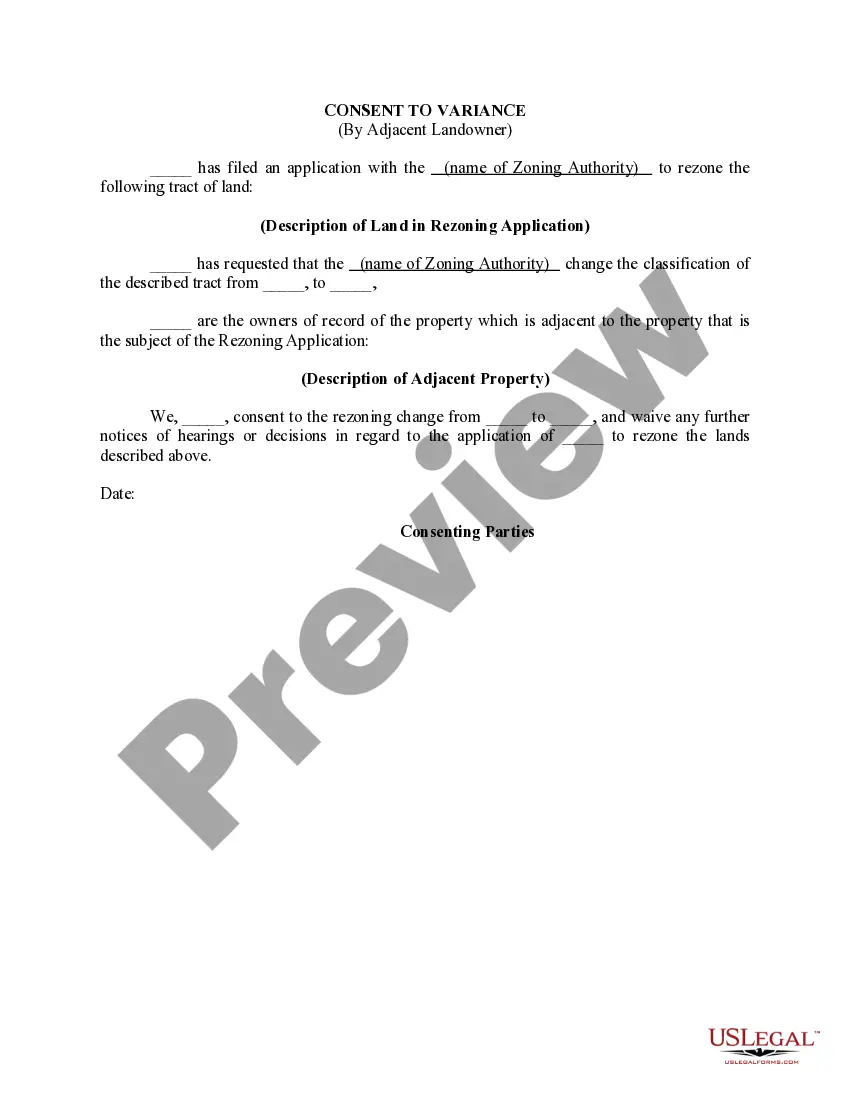
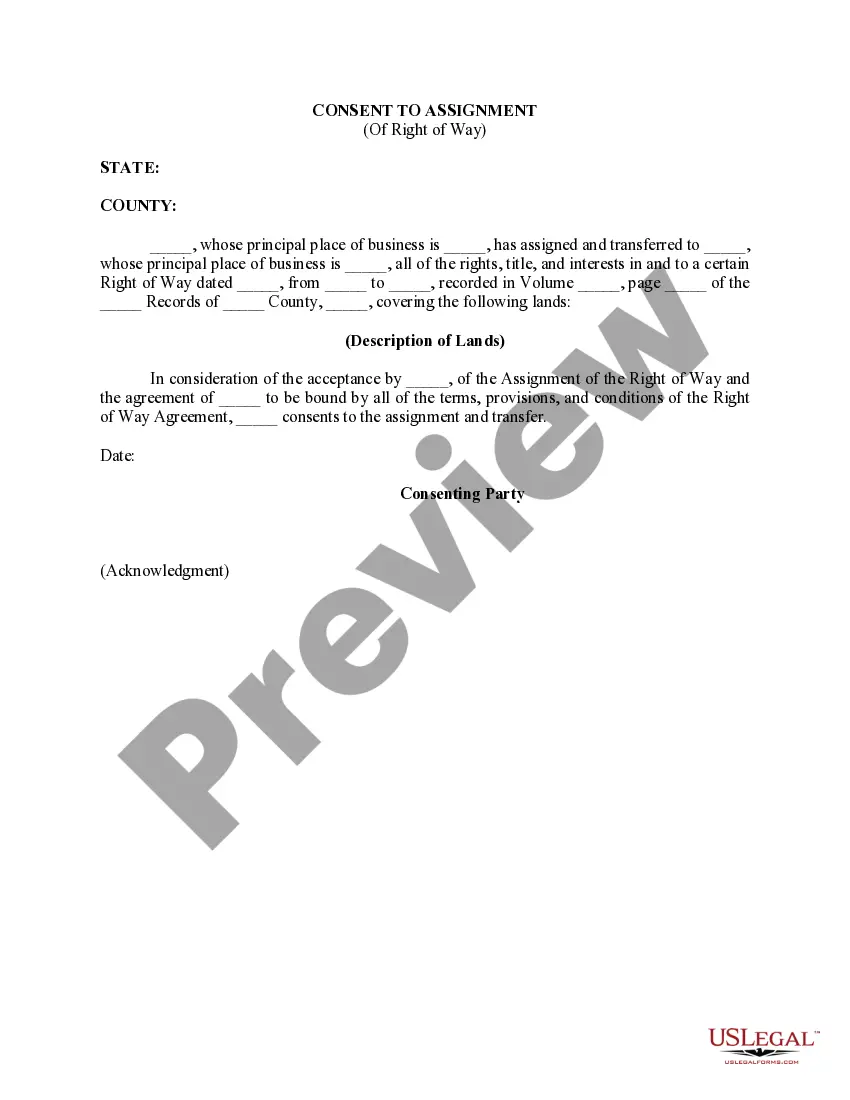
The Consent to Variance (By Adjacent Landowner) is a legal document in which owners of adjacent properties agree to support a variance request submitted to a zoning authority. This form serves as a formal statement indicating consent to changes requested by a neighboring property owner regarding the zoning classification of their property, thus differing from other forms that may involve disputes or objections.
Key components of this form
- Applicant's name and details of the land for rezoning.
- Description of the adjacent property owners providing consent.
- Statement of consent to the requested zoning change.
- Waiver of further notices related to the application.
- Signature lines for consenting parties and the date of consent.
Common use cases
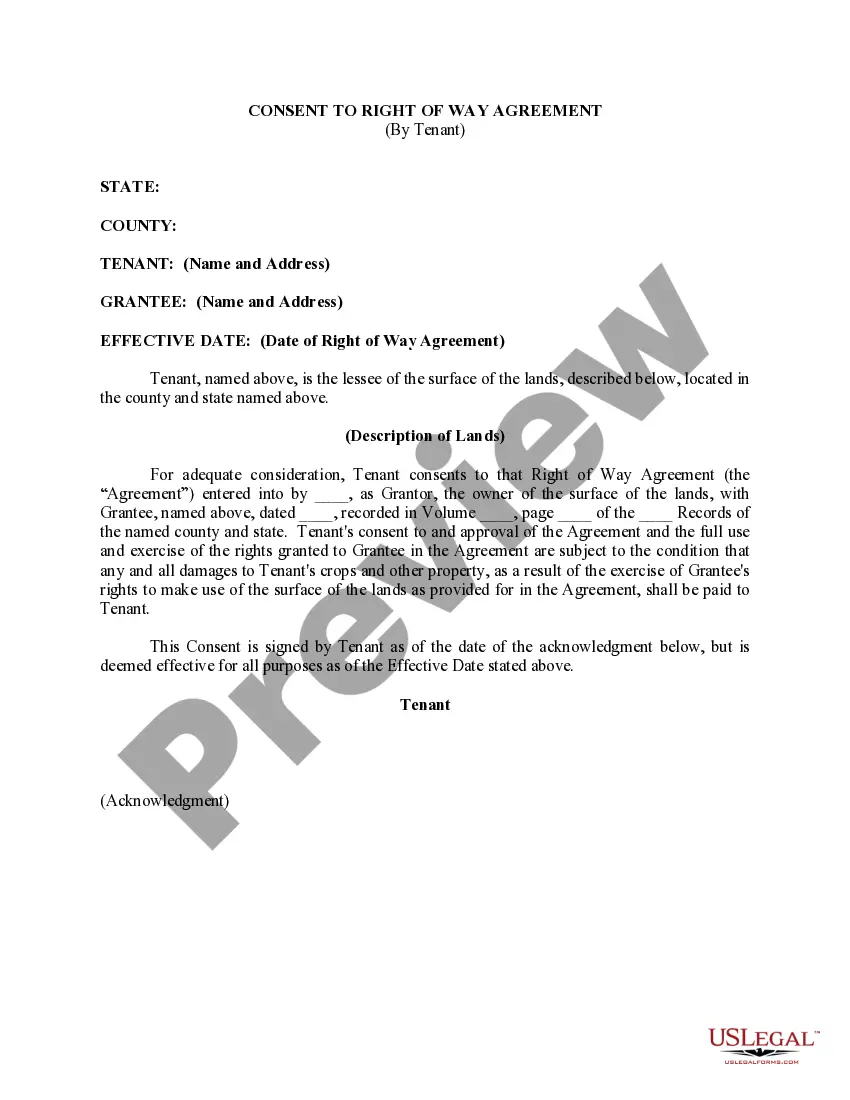
This form is utilized when an adjacent property owner wishes to formally consent to a zoning variance application made by another property owner. This situation may arise when a landowner seeks to change the zoning classification of their property for development or other purposes, and the adjacent landowner agrees with this change, thereby waiving their right to further notifications regarding the application process.
Who should use this form
- Adjacent property owners involved in zoning variance requests.
- Individuals or entities seeking to simplify zoning applications.
- Landowners who wish to ensure a clear and documented agreement regarding zoning changes in their vicinity.
How to prepare this document
- Identify the applicant's name and the zoning authority involved.
- Provide a detailed description of the land subject to rezoning.
- List the names and addresses of the adjacent property owners providing consent.
- Clearly state the current and proposed zoning classifications.
- Have all consenting parties sign the document and note the date.
Notarization guidance
Notarization is not commonly needed for this form. However, certain documents or local rules may make it necessary. Our notarization service, powered by Notarize, allows you to finalize it securely online anytime, day or night.
Get your form ready online
Our built-in tools help you complete, sign, share, and store your documents in one place.
Make edits, fill in missing information, and update formatting in US Legal Forms—just like you would in MS Word.
Download a copy, print it, send it by email, or mail it via USPS—whatever works best for your next step.
Sign and collect signatures with our SignNow integration. Send to multiple recipients, set reminders, and more. Go Premium to unlock E-Sign.
If this form requires notarization, complete it online through a secure video call—no need to meet a notary in person or wait for an appointment.
We protect your documents and personal data by following strict security and privacy standards.

Make edits, fill in missing information, and update formatting in US Legal Forms—just like you would in MS Word.

Download a copy, print it, send it by email, or mail it via USPS—whatever works best for your next step.

Sign and collect signatures with our SignNow integration. Send to multiple recipients, set reminders, and more. Go Premium to unlock E-Sign.

If this form requires notarization, complete it online through a secure video call—no need to meet a notary in person or wait for an appointment.

We protect your documents and personal data by following strict security and privacy standards.
Common mistakes to avoid
- Failing to include complete legal descriptions of the properties involved.
- Not obtaining all required signatures from consenting parties.
- Omitting the names of the zoning authority or relevant parties.
- Not indicating the correct current and proposed zoning classifications.
Benefits of using this form online
- Convenience of accessing the form at any time, from anywhere.
- Editable fields allow for precise customization to fit individual needs.
- Reliability of documents drafted by licensed attorneys ensuring legal compliance.
Summary of main points
- The Consent to Variance is essential for adjacent landowners to express their agreement to a rezoning application.
- Properly completing this form can help streamline the rezoning process.
- Always be aware of specific state and local requirements when using this form.
Looking for another form?
Form popularity
FAQ
Usually, the land owner seeking the variance files a request or written application for a variance and pays a fee. Normally, the requests go first to a zoning board. The zoning board notifies nearby and adjacent property owners. The zoning examiner may then hold a hearing to determine if the variance should be granted.
The standard of approval for a dimensional variance is practical difficulty, which the courts have defined to mean that strict compliance is unnecessarily burdensome and granting the variance would do substantial justice to the owner. The undue hardship standard for a use variance is much more difficult to meet
If you receive a notice that a neighbor or some property owner nearby to you proposes to build something that would require a zoning change or variance and you object to the purpose, you have the right to voice your opinion and try to prevent this change.
Present a (real) hardship. Be Respectful. Be Prepared. Create exhibits. Practice your argument. Review with the ZEO.
Find the mean of the data set. Add all data values and divide by the sample size n. Find the squared difference from the mean for each data value. Subtract the mean from each data value and square the result. Find the sum of all the squared differences. Calculate the variance.
Some examples of area variances might include: A request to put a fence up along your property line. A request to build a property closer than normally permitted to a roadway. A request to build a structure higher than usually permitted by the local zoning ordinance.
Essentially, a property owner requests a variance when their planned use of their property deviates from local zoning laws designed to protect property values. If granted, a variance acts as a waiver to some aspect of the zoning law or regulations.