Affidavit That Primary Term of Lease Not Extended by Additional Bonus Payment by Lessor
What is this form?
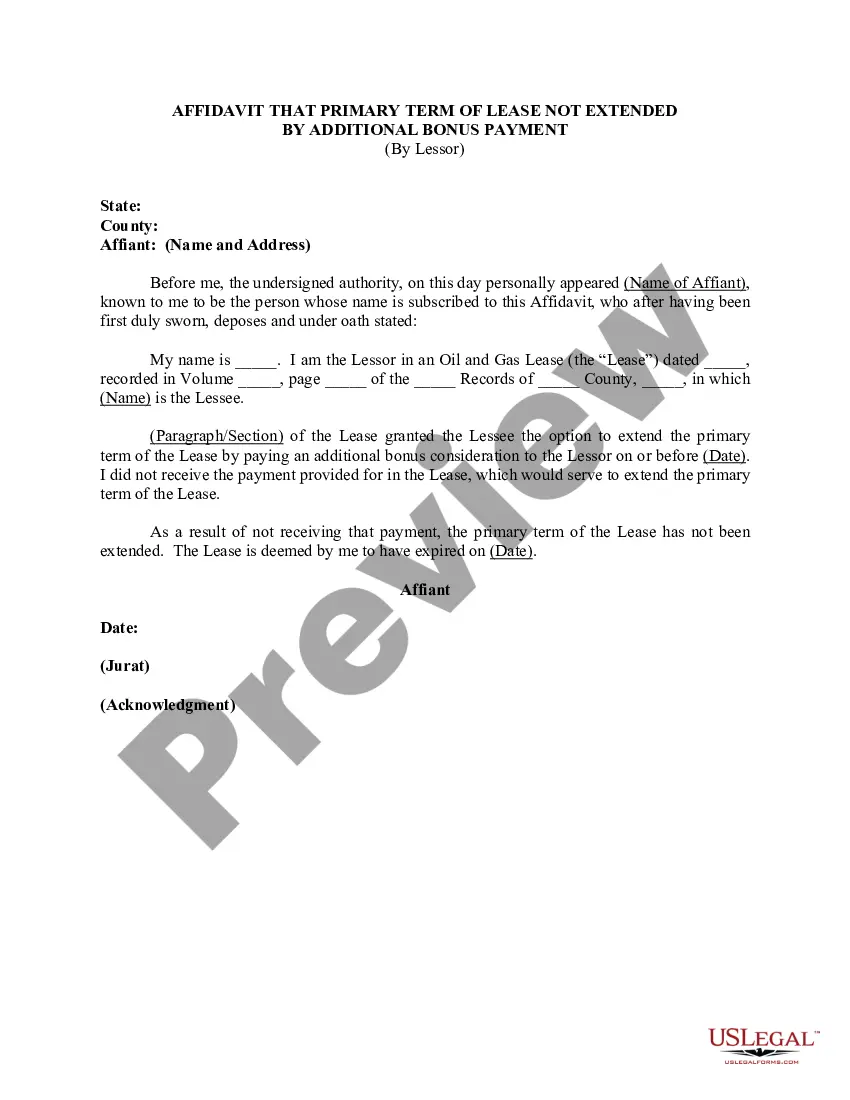
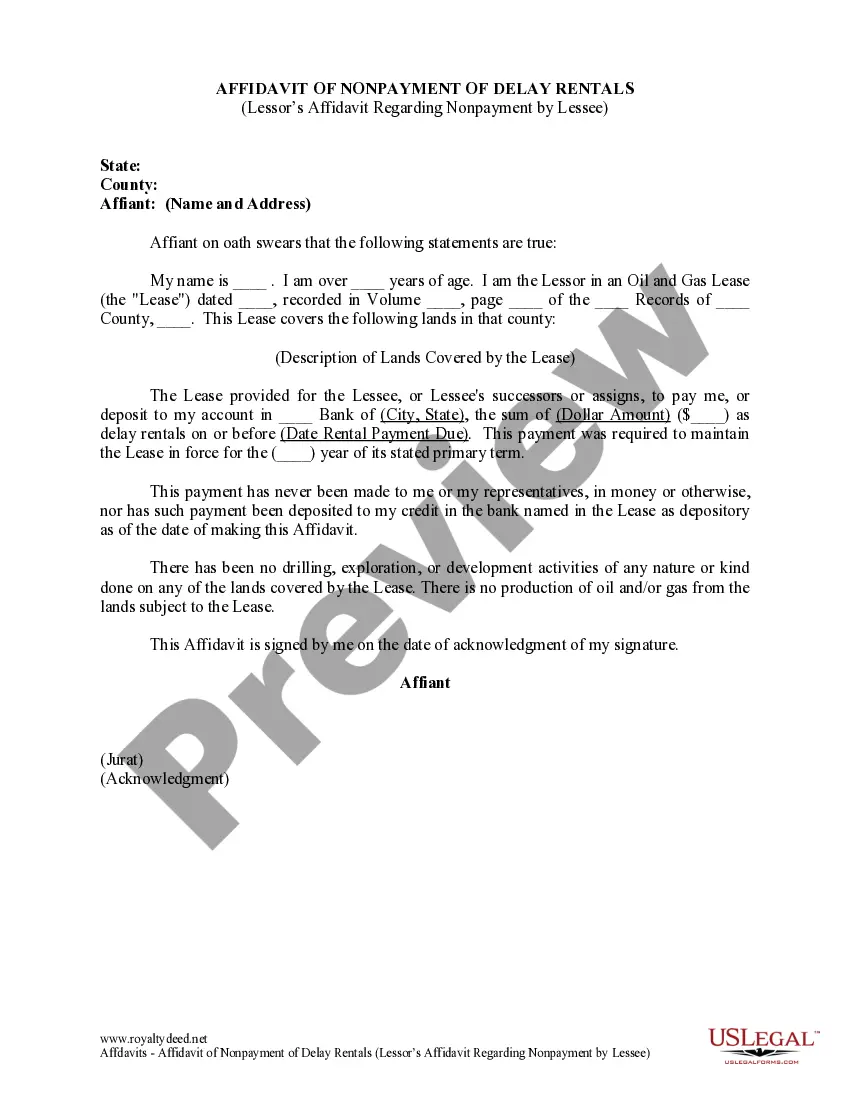
The Affidavit That Primary Term of Lease Not Extended by Additional Bonus Payment is a legal document used by lessors to declare that the primary term of a lease has not been extended due to the absence of an additional bonus payment from the lessee. This affidavit is essential for clarifying the lease's status and establishing that the tenancy has expired, distinguishing it from other lease-related forms by focusing specifically on bonus payments and lease extensions.
Key components of this form
- Identification of the affiant (the lessor) and their address.
- Details about the original oil and gas lease, including record volume and page.
- Declaration of the absence of the required bonus payment.
- Stating the expiration date of the lease based on the non-receipt of payment.
- Signature of the affiant and acknowledgment by the notary public.

Common use cases
This affidavit is typically used when a lessor needs to affirm that a lease's primary term has not been extended because the lessee failed to make a required bonus payment. This situation may arise when the lessee has missed the deadline for the additional payment needed to extend the lease, and it becomes necessary to clarify the status of the lease formally.
Intended users of this form
- Lessors involved in oil and gas leases.
- Property owners seeking to document the status of their lease agreements.
- Individuals who need to assert and prove that a lease has expired due to non-payment of bonuses.
How to complete this form
- Identify the parties involved, including the affiant (lessor) and the lessee.
- Specify the original lease details, including dates and recording information.
- Clearly state that the additional bonus payment was not received.
- Declare that the lease has expired and provide the expiration date.
- Sign the affidavit in front of a notary public for validation.
Does this document require notarization?
Yes, this form must be notarized to be legally valid. Notarization confirms the identity of the affiant and their understanding of the contents of the affidavit. US Legal Forms offers integrated online notarization services, allowing users to complete this step securely and conveniently without needing to travel.
Get your form ready online
Our built-in tools help you complete, sign, share, and store your documents in one place.
Make edits, fill in missing information, and update formatting in US Legal Forms—just like you would in MS Word.
Download a copy, print it, send it by email, or mail it via USPS—whatever works best for your next step.
Sign and collect signatures with our SignNow integration. Send to multiple recipients, set reminders, and more. Go Premium to unlock E-Sign.
If this form requires notarization, complete it online through a secure video call—no need to meet a notary in person or wait for an appointment.
We protect your documents and personal data by following strict security and privacy standards.

Make edits, fill in missing information, and update formatting in US Legal Forms—just like you would in MS Word.

Download a copy, print it, send it by email, or mail it via USPS—whatever works best for your next step.

Sign and collect signatures with our SignNow integration. Send to multiple recipients, set reminders, and more. Go Premium to unlock E-Sign.

If this form requires notarization, complete it online through a secure video call—no need to meet a notary in person or wait for an appointment.

We protect your documents and personal data by following strict security and privacy standards.
Avoid these common issues
- Failing to include all required identification details of the parties involved.
- Not specifying the correct lease information, such as dates and recording details.
- Omitting the expiration date of the lease.
- Not having the affidavit notarized, if required by state law.
Benefits of using this form online
- Convenient access to generate and download the form anytime.
- Easy customization to fit specific lease agreements and terms.
- Reliable templates drafted by licensed attorneys to ensure legal validity.
What to keep in mind
- This affidavit is used to confirm that the primary lease term has not been extended.
- Properly completing the form preserves the lessor's rights under the lease agreement.
- Ensure that all details are accurate and that you understand your stateâs specific regulations.
Looking for another form?
Form popularity
FAQ
Bonus pay is additional pay given to an employee on top of their regular earnings; it's used by many organizations as a thank-you to employees or a team that achieves significant goals. Bonus pay is also offered to improve employee morale, motivation, and productivity.
In accordance with the terms of the Principal Act, every employee who draws a salary of INR 10,000 or below per month and who has worked for not less than 30 days in an accounting year, is eligible for bonus (calculated as per the methodology provided under the Principal Act) with the floor of 8.33% of the salary
THE PAYMENT OF BONUS ACT, 1965 The minimum bonus of 8.33% is payable by every industry and establishment under section 10 of the Act. The maximum bonus including productivity linked bonus that can be paid in any accounting year shall not exceed 20% of the salary/wage of an employee under the section 31 A of the Act. 1.
It means Bonus is paid for the previous year. It can be paid as part of monthly salary. Bonus has to be paid for the previous financial year. That has been prescribed because profit is declared for previous financial year.
In accordance with the terms of the Principal Act, every employee who draws a salary of INR 10,000 or below per month and who has worked for not less than 30 days in an accounting year, is eligible for bonus (calculated as per the methodology provided under the Principal Act) with the floor of 8.33% of the salary
Definition: A monetary payment made to an employee over and above their standard salary or compensation package. Bonuses are one of the ways employers reward their employees for a job well done. And offering regular, significant bonuses is a way to keep your best people from looking elsewhere for a job.
10,000 per month who has worked for not less than 30 days in an accounting year, shall be eligible for bonus for minimum of 8.33% of the salary/wages even if there is loss in the establishment whereas a maximum of 20% of the employee's salary/wages is payable as bonus in an accounting year.
Objective: The objective of the Payment of Bonus Act is to reward the employee of the organization by sharing the profits earned and is linked to productivity. Applicable to: The Payment of Bonus Act is applicable to any establishment with 20 or more employees or any factory with 10 or more employees.
Bonus is a reward that is paid to an employee for his good work towards the organisation. The basic objective to give bonus is to share the profit earned by the organisation amongst the employees and staff members.10,000 per month for the purpose of payment of bonus, their salaries/wages would be deemed to be Rs.