Mineral Owner Consent Agreement (to Underground Storage Lease and Agreement)
What this document covers
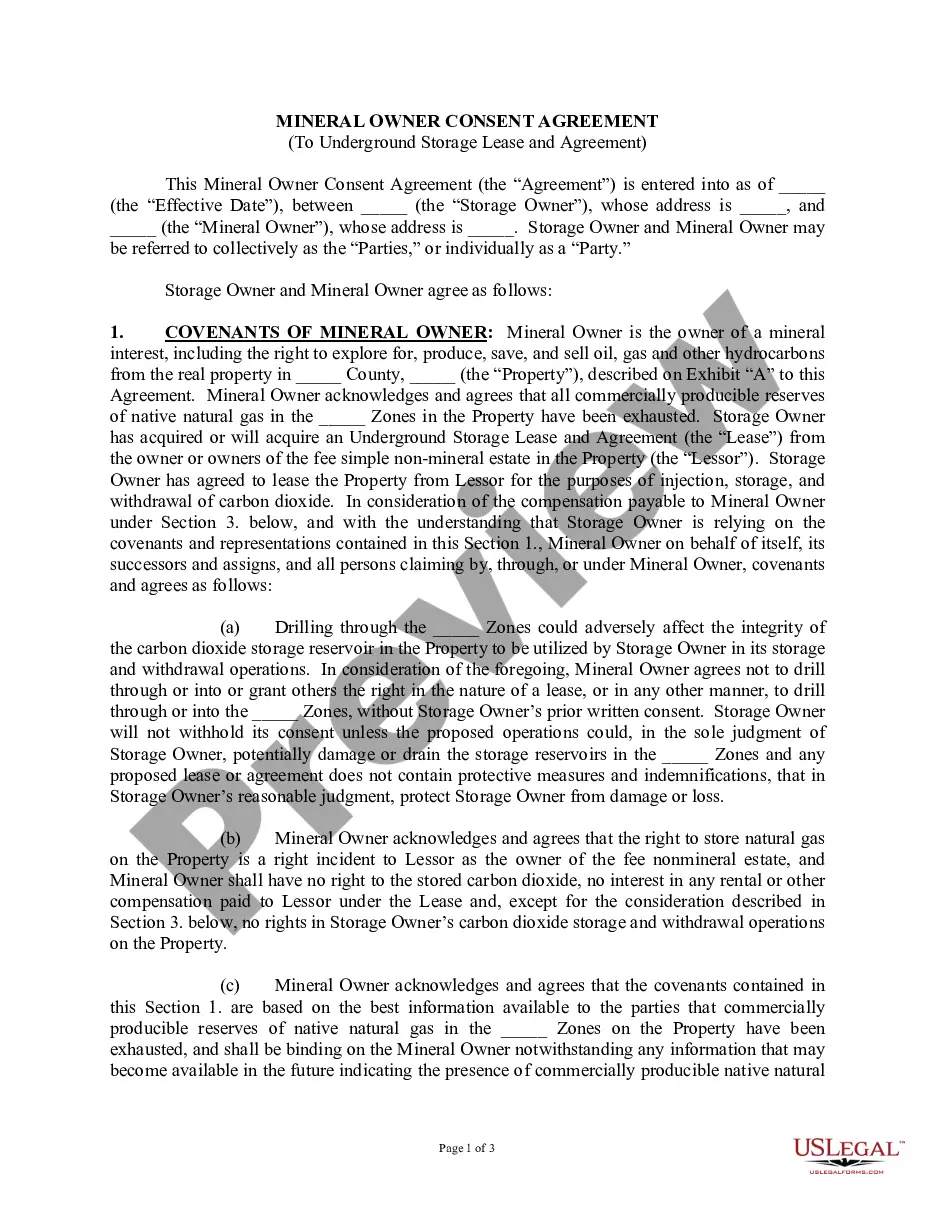
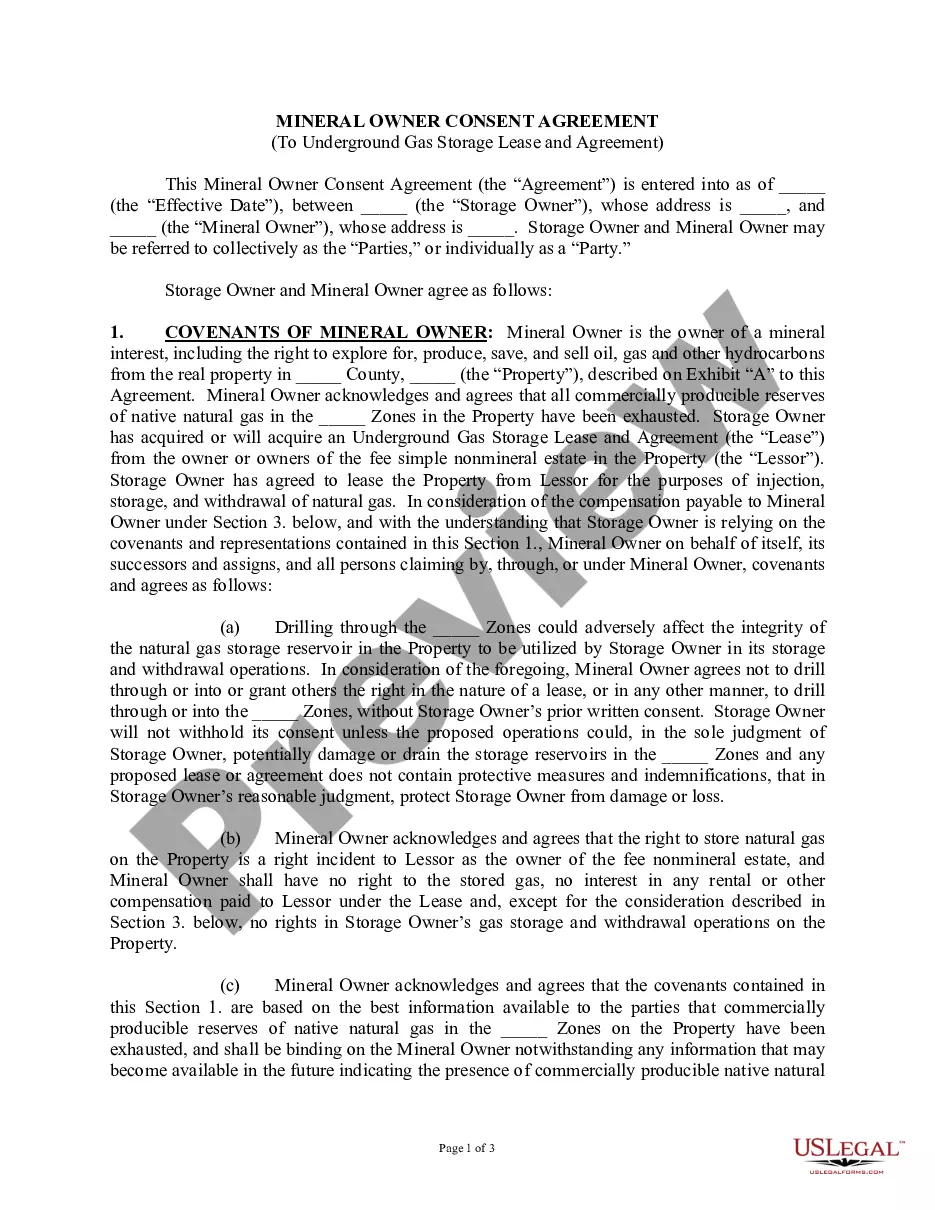
The Mineral Owner Consent Agreement is a legal document that enables mineral owners to provide consent for an underground storage lease and agreement. This form is particularly important when the mineral owner wishes to allow a storage owner to utilize the property for carbon dioxide storage. It specifies the rights and responsibilities of both parties, setting clear terms for operations on the land while protecting the interests of the mineral owner. This agreement is distinct from other types of leases, as it focuses specifically on underground storage rather than the extraction or sale of minerals.
Key parts of this document
- Effective Date: Indicates when the agreement becomes active.
- Parties Involved: Identifies the storage owner and the mineral owner, including their addresses.
- Covenants of Mineral Owner: Details the obligations of the mineral owner, including restrictions on drilling in certain zones.
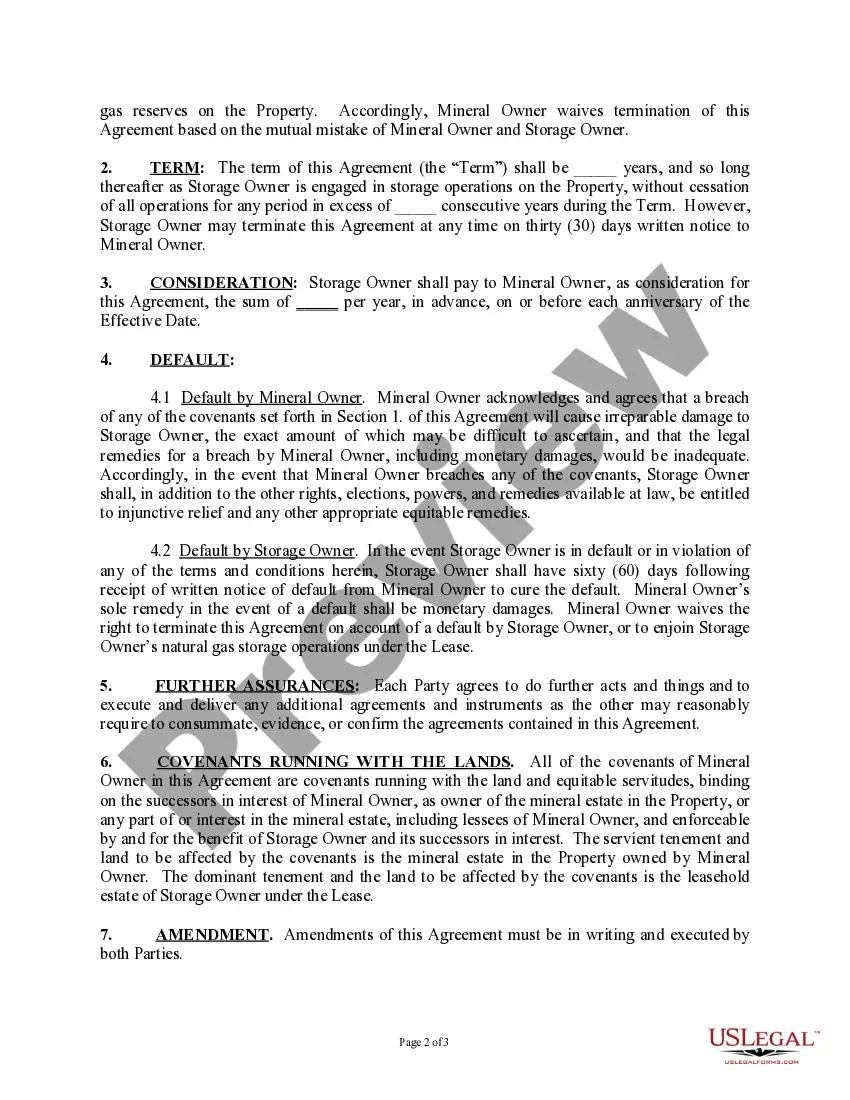
- Term of Agreement: Specifies the duration of the contract and conditions for termination.
- Consideration: Outlines the compensation due to the mineral owner for consenting to the agreement.
- Default Provisions: Provides remedies and conditions relating to breaches by either party.
Common use cases
This form should be utilized when a mineral owner consents to an underground storage lease, particularly for the storage of carbon dioxide. It is necessary when the storage owner requires permission to conduct operations that may affect the mineral rights associated with the property. Scenarios for its use include when an underground storage project is planned in a previously mined area, or when a mineral owner wants to ensure their rights are preserved while allowing for storage activities to take place on their property.
Who this form is for
- Mineral owners who wish to enter into a consent agreement for underground storage.
- Storage owners looking to establish legal terms for carbon dioxide storage operations.
- Landowners interested in retaining clear rights regarding mineral interests while allowing underground storage.
Steps to complete this form
- Identify the parties involved by entering the names and addresses of the storage owner and mineral owner.
- Specify the effective date of the agreement to establish when it takes effect.
- Fill in the property description as outlined in Exhibit A of the agreement.
- Insert the term of the agreement and any specific conditions related to its termination.
- Indicate the annual consideration amount to be paid to the mineral owner.
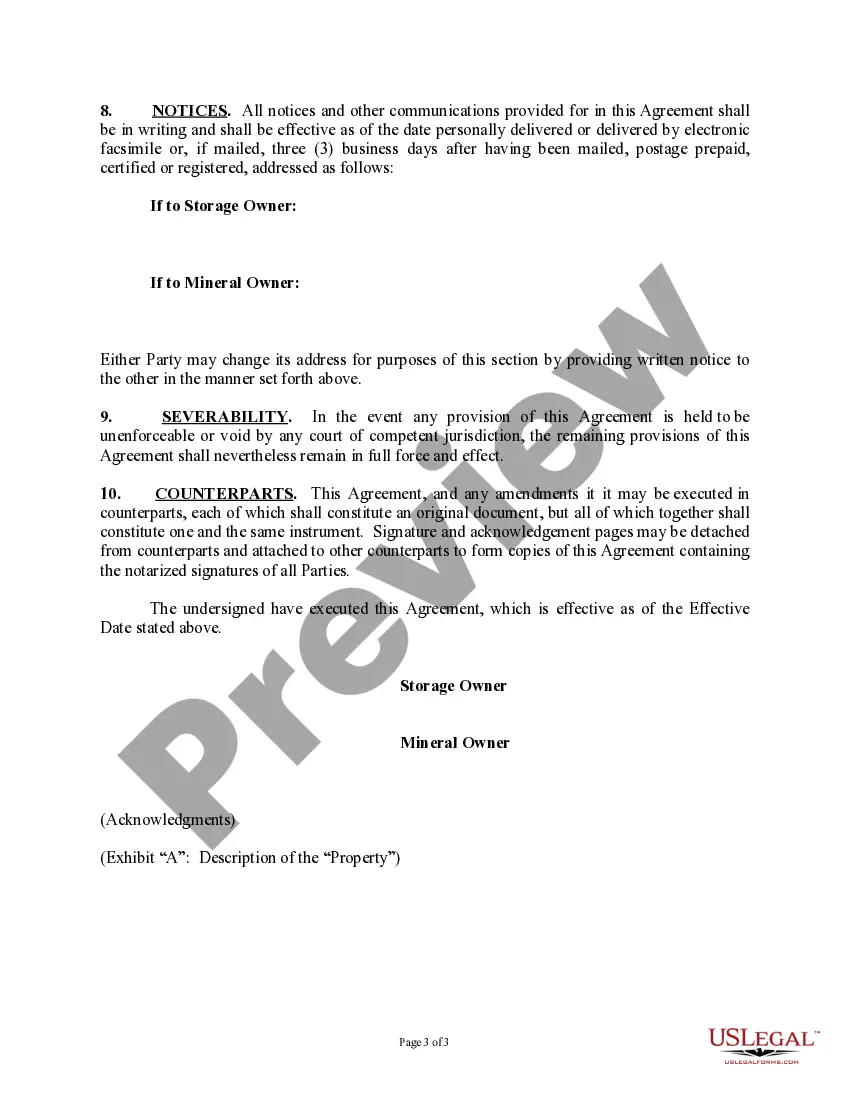
- Ensure both parties sign and date the agreement to make it legally binding.
Notarization requirements for this form
This form does not typically require notarization unless specified by local law. However, it is advisable to consult local regulations to ensure that all legal requirements are met.
Get your form ready online
Our built-in tools help you complete, sign, share, and store your documents in one place.
Make edits, fill in missing information, and update formatting in US Legal Forms—just like you would in MS Word.
Download a copy, print it, send it by email, or mail it via USPS—whatever works best for your next step.
Sign and collect signatures with our SignNow integration. Send to multiple recipients, set reminders, and more. Go Premium to unlock E-Sign.
If this form requires notarization, complete it online through a secure video call—no need to meet a notary in person or wait for an appointment.
We protect your documents and personal data by following strict security and privacy standards.

Make edits, fill in missing information, and update formatting in US Legal Forms—just like you would in MS Word.

Download a copy, print it, send it by email, or mail it via USPS—whatever works best for your next step.

Sign and collect signatures with our SignNow integration. Send to multiple recipients, set reminders, and more. Go Premium to unlock E-Sign.

If this form requires notarization, complete it online through a secure video call—no need to meet a notary in person or wait for an appointment.

We protect your documents and personal data by following strict security and privacy standards.
Common mistakes to avoid
- Failing to accurately identify the parties involved, which can lead to disputes.
- Not specifying the property description clearly, leaving room for ambiguity.
- Overlooking the inclusion of all necessary terms, hindering enforceability.
- Neglecting to have both parties sign the agreement, which is essential for validity.
Why complete this form online
- Convenience: Download the form anytime from anywhere without needing to visit a legal office.
- Editability: Easily customize the document to fit specific needs before finalizing.
- Reliability: Ensure that the form is drafted by licensed attorneys, increasing legal confidence.
Legal use & context
- This agreement is legally binding and serves to protect the interests of both the mineral owner and the storage owner.
- Ensures that all parties are aware of their rights and responsibilities concerning underground storage operations on the property.
- Protects the mineral owner's interests by limiting actions that could disrupt the integrity of the storage site.
What to keep in mind
- The Mineral Owner Consent Agreement is essential for legal underground gas storage operations.
- This form clarifies the roles and rights of both mineral and storage owners.
- Proper completion of the form ensures clarity and legal enforceability.
Looking for another form?
Form popularity
FAQ
All parties must agree about an offer made by one party and accepted by the other. Something of value must be exchanged for something else of value. This can include goods, cash, services, or a pledge to exchange these items.
The most basic rule of contract law is that a legal contract exists when one party makes an offer and the other party accepts it. For most types of contracts, this can be done either orally or in writing.
Drafting a contract. Provide details of the parties. Describe services or results. Set out payment details. Assign intellectual property rights. Explain how to treat confidential information. Identify who is liable indemnity. Provide insurance obligations.
Writing the Contract Include information about the exchange of consideration, and write clearly as to which party delivers and what the other agrees in exchange. Use short sentences and provide a numbered heading for each paragraph. This makes it easier to reference information.
For a written agreement to be legally binding, it must contain an acceptance of the terms in the document. The most common way to accept is through a signature.If your written agreement is not signed, it might still be enforceable if the parties have clearly accepted the terms through conduct or otherwise.
Include the name and title of the recipient. Employ the appropriate formal salutations and closings. State the date clearly and mention any document that is enclosed with the letter. Close the letter on a positive note and sign it off with your name and title.
Begin your letter by clearly indicating the parties involved in the agreement. Clearly state the reason for your agreement in your first paragraph giving description of all details such as stake holder ratio, payment period etc.
Essential Elements These required elements include: Consideration: Something of value must be exchanged between each party. Offer and acceptance: Both parties must agree to the offer and accept the contract terms. Mutual assent: Both parties must have a mutual agreement.
A legal business contract between two parties is a promise made by one party to another.Each party in the agreement expects the other to keep their promise in the contract. There is an expectation by both parties that if one of them fails to keep their promise, there will be legal repercussions.