Software Trial License Agreement
Overview of this form
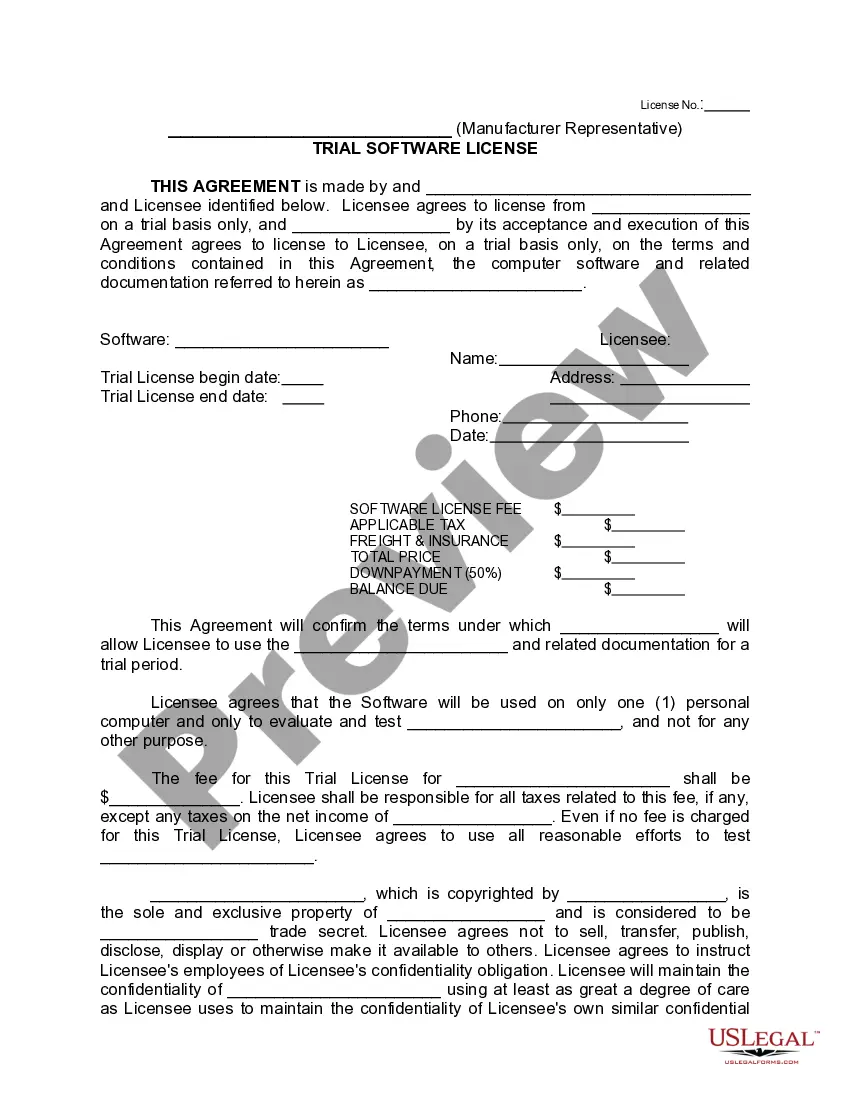
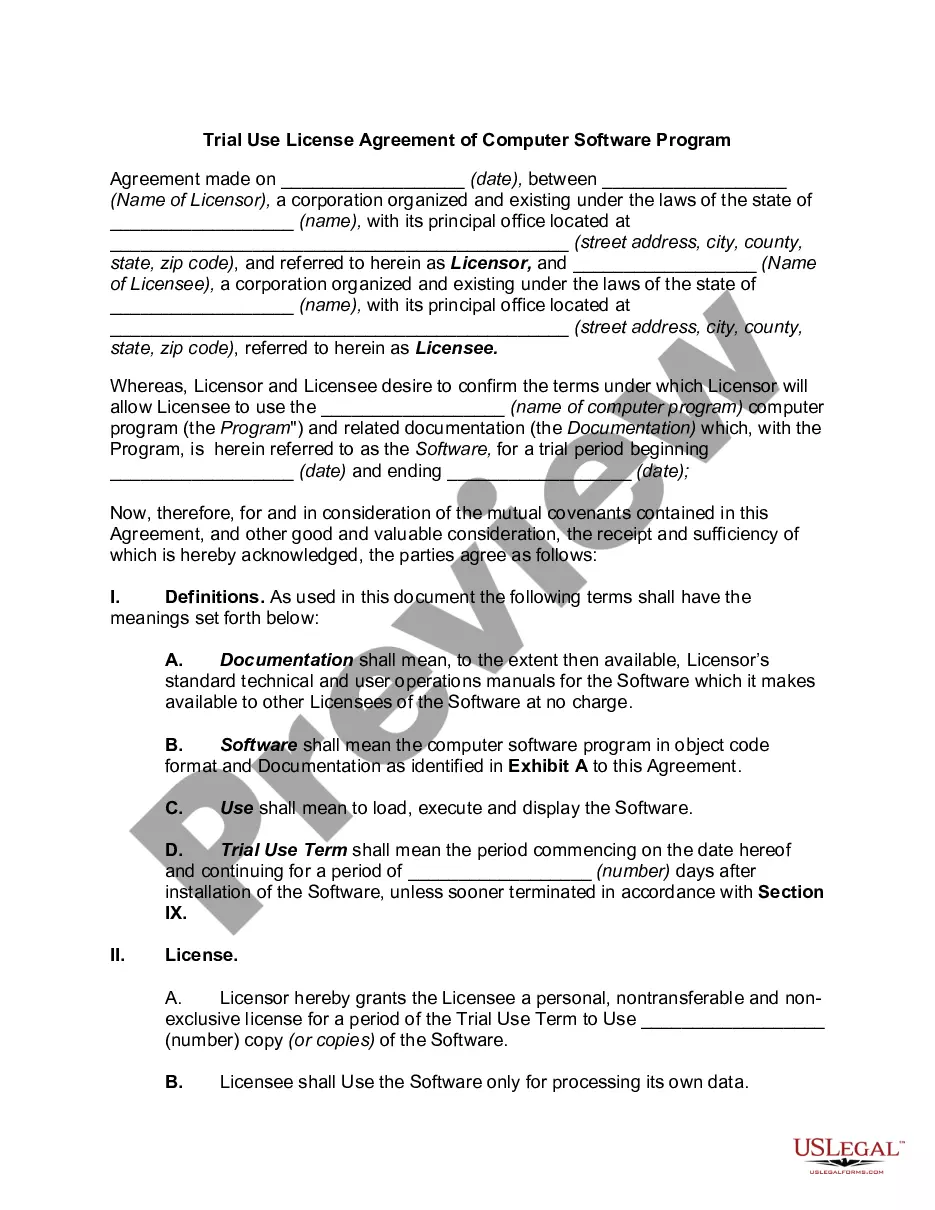
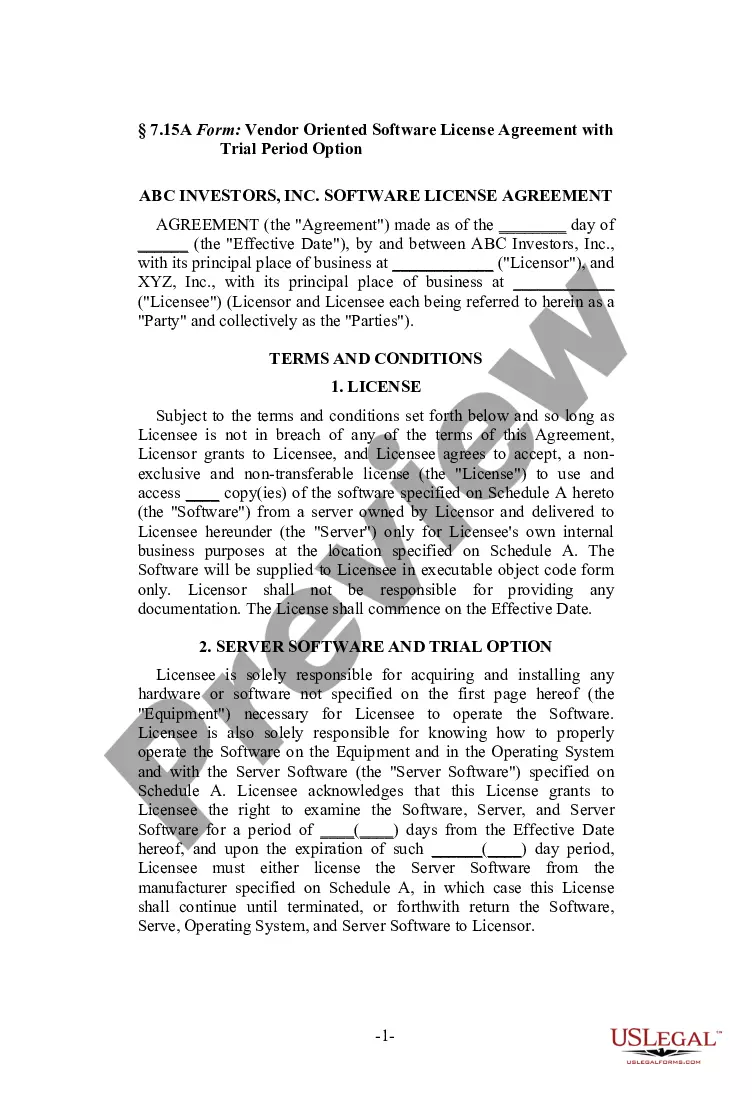
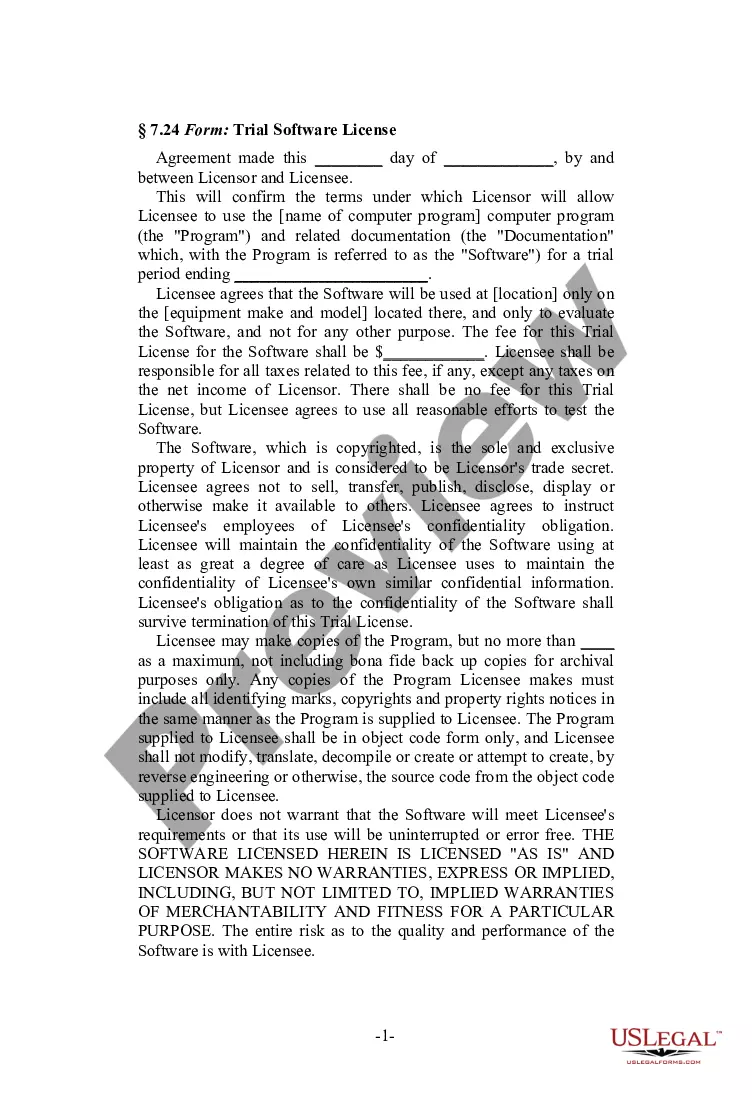
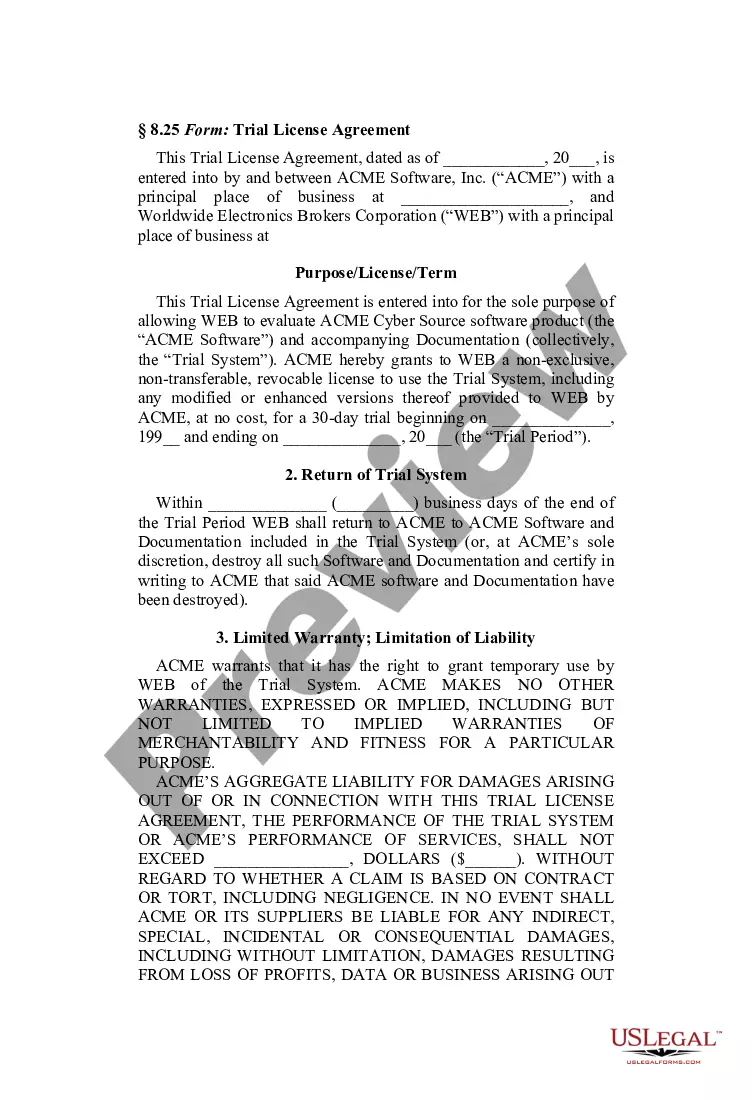
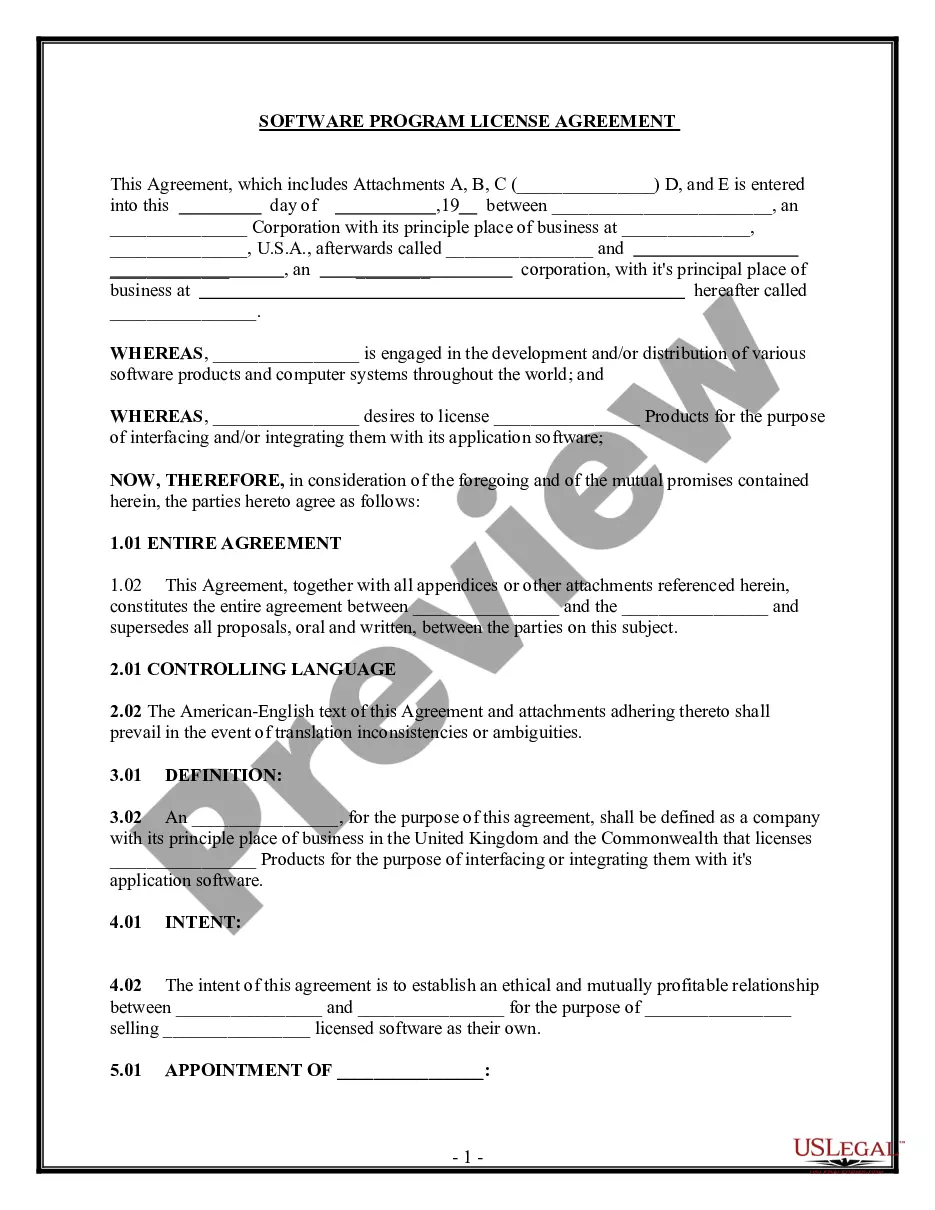
The Software Trial License Agreement is a legal document that outlines the terms under which a software manufacturer grants a temporary license to utilize their software for evaluation purposes. This agreement allows the licensee to test the software "as is," meaning the manufacturer makes no warranties regarding its performance or quality. Unlike regular software licenses, this trial version is time-limited and contains specific limitations on its use.
Key components of this form
- Identification of the licensor and licensee.
- Specific software details, including name and version.
- Trial license duration (start and end dates).
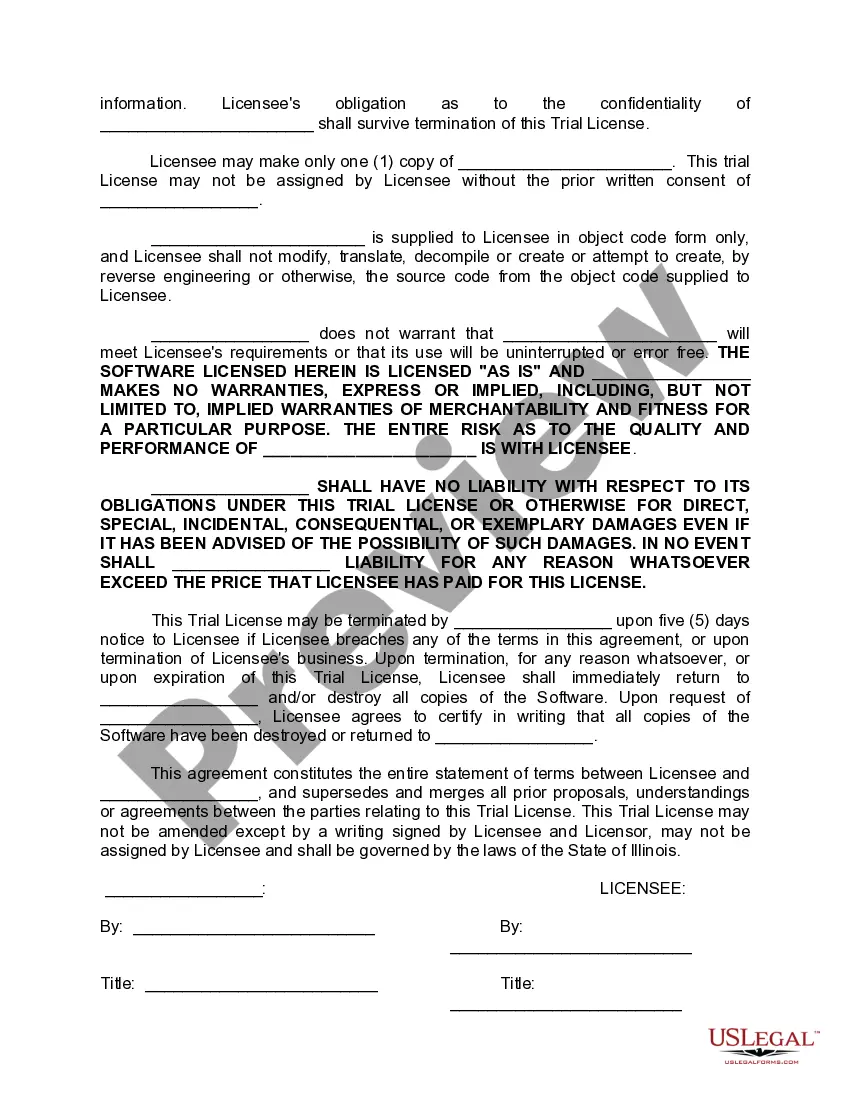
- Confidentiality obligations regarding the software.
- Fee structure, including total price and downpayment details.
- Conditions under which the trial license may be terminated.

When to use this document
This form should be used when a software manufacturer wishes to allow potential customers to trial their software for a limited time. It is commonly utilized in scenarios where a business seeks to assess the software's capabilities before making a financial commitment or where developers need to test software before full implementation.
Who this form is for
- Software manufacturers looking to license their products on a trial basis.
- Businesses or individuals evaluating software for potential purchase.
- Legal representatives involved in drafting or reviewing software agreements.
Instructions for completing this form
- Identify the parties involved by filling in the names of the licensor and licensee.
- Specify the software details, including the name and version.
- Enter the start and end dates of the trial period.
- Complete the fee section, including any applicable taxes and downpayment details.
- Both parties must sign and date the agreement to finalize it.
Notarization requirements for this form
In most cases, this form does not require notarization. However, some jurisdictions or signing circumstances might. US Legal Forms offers online notarization powered by Notarize, accessible 24/7 for a quick, remote process.
Get your form ready online
Our built-in tools help you complete, sign, share, and store your documents in one place.
Make edits, fill in missing information, and update formatting in US Legal Forms—just like you would in MS Word.
Download a copy, print it, send it by email, or mail it via USPS—whatever works best for your next step.
Sign and collect signatures with our SignNow integration. Send to multiple recipients, set reminders, and more. Go Premium to unlock E-Sign.
If this form requires notarization, complete it online through a secure video call—no need to meet a notary in person or wait for an appointment.
We protect your documents and personal data by following strict security and privacy standards.

Make edits, fill in missing information, and update formatting in US Legal Forms—just like you would in MS Word.

Download a copy, print it, send it by email, or mail it via USPS—whatever works best for your next step.

Sign and collect signatures with our SignNow integration. Send to multiple recipients, set reminders, and more. Go Premium to unlock E-Sign.

If this form requires notarization, complete it online through a secure video call—no need to meet a notary in person or wait for an appointment.

We protect your documents and personal data by following strict security and privacy standards.
Common mistakes to avoid
- Failing to clearly specify the software name and version.
- Not entering the correct trial license duration, leading to confusion.
- Overlooking confidentiality obligations and how to enforce them.
- Missing signatures, making the agreement unenforceable.
Why use this form online
- Accessibility to download and complete the form anytime, from anywhere.
- Editable fields that allow for customization according to specific needs.
- Guidance provided with each step to ensure proper completion.
Legal use & context
- The Software Trial License Agreement allows users to test software while protecting the licensor's intellectual property.
- Failure to adhere to the terms may result in legal consequences for the licensee, including potential liabilities.
- This agreement clarifies limitations on the use of the software and the licensor's liability.
Main things to remember
- The Software Trial License Agreement is crucial for defining trial use of software.
- It is important to understand obligations regarding confidentiality and usage limitations.
- Using this form helps protect both the licensor and licensee during a software trial period.
Looking for another form?

Form popularity
FAQ
What is a Licensing Agreement? A licensing agreement is a contract between two parties (the licensor and licensee) in which the licensor grants the licensee the right to use the brand name, trademark, patented technology, or ability to produce and sell goods owned by the licensor.
An example of a licensing agreement is a contract between the copyright holders of software and another company, allowing the latter to use the computer software for their daily business operations.
A software license is a contract between the entity that created and supplied an application, underlying source code, or related product and its end user.
Due Diligence-General. Due Diligence-Cost. Due Diligence-Performance. Due Diligence-Know Your Counterparty. Source Code Escrow and Escrow Agreements. Installation, Implementation and Training. Customizations. Entire Agreement; Changes to the Terms.
User agreements like EULAs are legally binding contracts between the software author and the end-user. End User License Agreements are enforceable as long as it is clear that it is a contract and both parties can understand the terms.
Exclusive or non-exclusive. In an exclusive license, the intellectual property holder is licensing the work only to one person, for that particular use/territory. Territory. Use. Attribution. Derivative works. Confidentiality. Time frame. Termination.
A software license agreement gives a licensee a non-exclusive, non-transferable right to use software. A software license agreement defines how that software can be used and what happens in the event of breach.
A software license agreement typically has broad-form confidentiality provisions that also provide that certain items fall into the bucket of one or the other party (e.g., the software for a licensor, certain data for a licensee, etc.).
A free software license agreement gives the purchaser the rights to modify and redistribute the software and related components, while a proprietary software license agreement forbids this.License agreements generally also contain warranty provisions and patent information.