Misprision of felony (18 U.S.C. Sec. 4) is a federal crime which occurs when a person has knowledge of the commission of a felony by another person and fails to notify a law enforcement officer or other person of authority. This offense is a misdemeanor and is punishable by up to three years in prison. There are five distinct types of misprision of felony: 1) Concealing knowledge of a felony: This occurs when a person has knowledge of the commission of a felony by another person and conceals this knowledge from authorities. 2) Aiding and abetting the commission of a felony: This occurs when a person assists another in the commission of a felony, such as providing financial or material support. 3) Participating in a conspiracy to commit a felony: This occurs when a person conspires with another to commit a felony. 4) Concealing evidence of a felony: This occurs when a person has knowledge of the commission of a felony and conceals evidence of the crime from the authorities. 5) Encouraging a person to commit a felony: This occurs when a person knowingly encourages another to commit a felony. Misprision of felony is a serious offense that carries serious penalties, including up to three years in prison. It is important to understand the different types of misprision of felony in order to avoid committing this offense.
8.0A Misprision of Felony (18 U.S.C. Sec. 4)
Description

How to fill out 8.0A Misprision Of Felony (18 U.S.C. Sec. 4)?
Preparing legal paperwork can be a real burden if you don’t have ready-to-use fillable templates. With the US Legal Forms online library of formal documentation, you can be certain in the blanks you obtain, as all of them comply with federal and state regulations and are verified by our experts. So if you need to fill out 8.0A Misprision of Felony (18 U.S.C. Sec. 4), our service is the perfect place to download it.
Obtaining your 8.0A Misprision of Felony (18 U.S.C. Sec. 4) from our service is as simple as ABC. Previously registered users with a valid subscription need only log in and click the Download button after they locate the correct template. Later, if they need to, users can get the same blank from the My Forms tab of their profile. However, even if you are new to our service, signing up with a valid subscription will take only a few moments. Here’s a quick guideline for you:
- Document compliance check. You should attentively examine the content of the form you want and make sure whether it suits your needs and complies with your state law requirements. Previewing your document and reviewing its general description will help you do just that.
- Alternative search (optional). If there are any inconsistencies, browse the library through the Search tab on the top of the page until you find an appropriate template, and click Buy Now when you see the one you need.
- Account creation and form purchase. Sign up for an account with US Legal Forms. After account verification, log in and select your preferred subscription plan. Make a payment to continue (PayPal and credit card options are available).
- Template download and further usage. Choose the file format for your 8.0A Misprision of Felony (18 U.S.C. Sec. 4) and click Download to save it on your device. Print it to fill out your papers manually, or take advantage of a multi-featured online editor to prepare an electronic version faster and more efficiently.
Haven’t you tried US Legal Forms yet? Subscribe to our service now to get any formal document quickly and easily any time you need to, and keep your paperwork in order!
Form popularity
FAQ
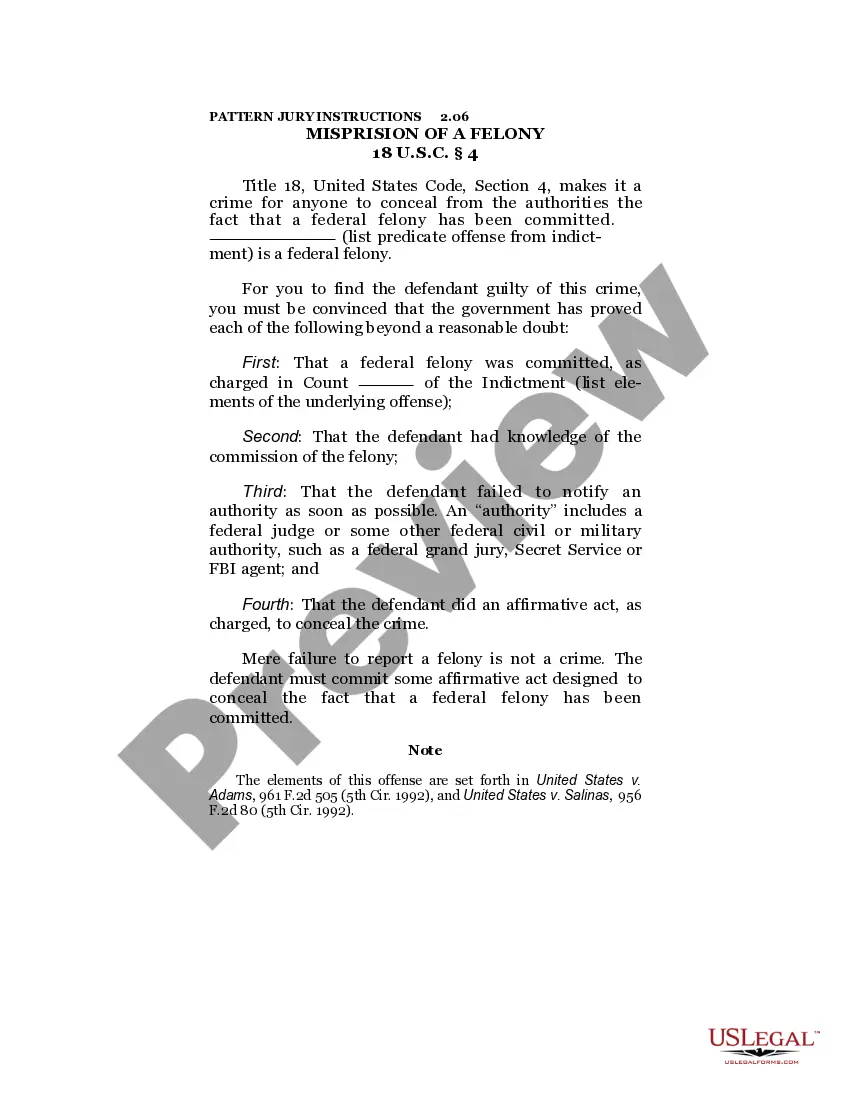
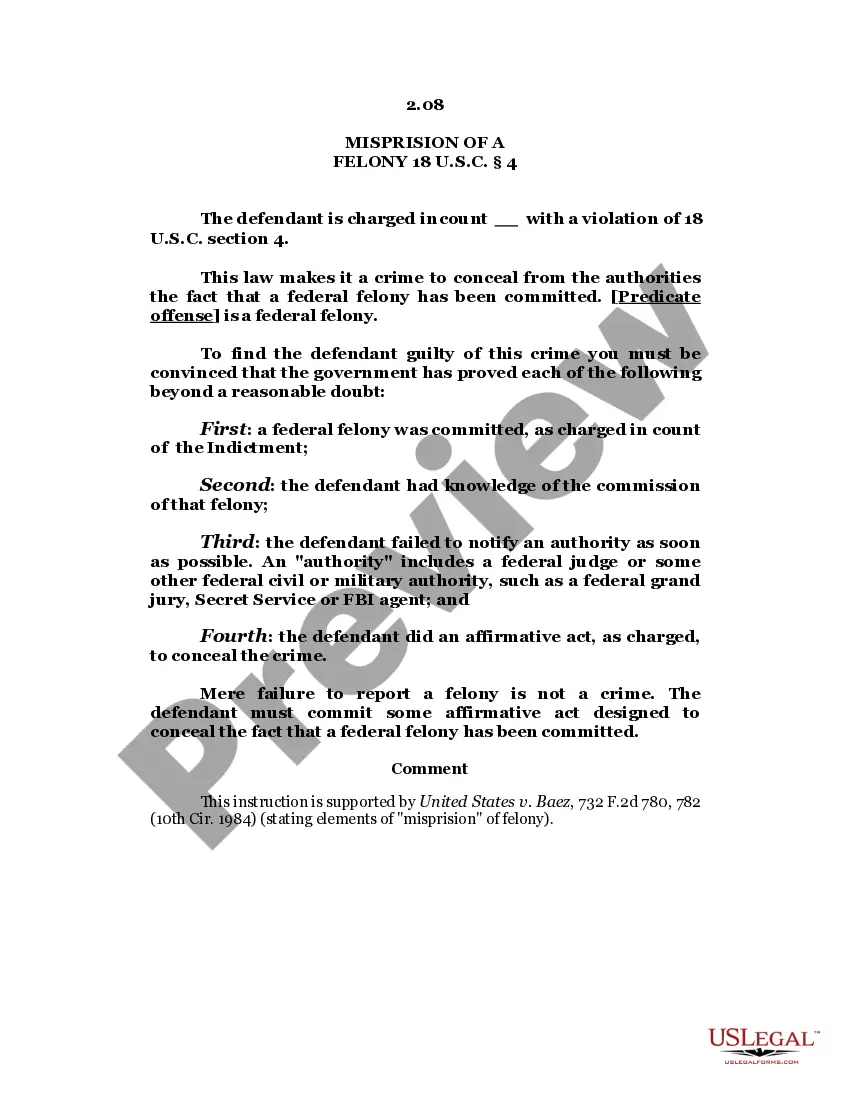
Misprision of a felony consists of concealing a felony.25 A defendant convicted of misprision has unlawfully covered up a crime.
§ 4 has the following elements: (1) that the principal committed and completed the felony alleged; (2) that the defendant had full knowledge of that fact; (3) that he failed to notify the authorities; and (4) that he took affirmative steps to conceal the crime of the principal.
Misprision of felony is a crime committed when a person knows that someone has been involved in a felony but fails to report it to law enforcement authorities. The crime of misprision of felony originated in the common law of Great Britain. In the U.S., however, it has never been adopted as a crime by most states.
Concealment of a serious crime by one who knows of its commission but was not a party to it is misprision. Similarly, the failure of a citizen to attempt to prevent the perpetration of an offense can be characterized as misprision. (See also accomplice; accessory; and abettor.)
-The defendant, having knowledge of the commission of the offense of armed robbery, failed to make a disclosure of this felony to the proper authorities and did nothing toward the apprehension of the persons guilty of the crime.
First enacted into U.S. law in 1789, misprision of a felony in the federal system is a felony punishable by a fine and up to three years in prison.
Whoever, having knowledge of the actual commission of a felony cognizable by a court of the United States, conceals and does not as soon as possible make known the same to some judge or other person in civil or military authority under the United States, shall be fined under this title or imprisoned not more than three