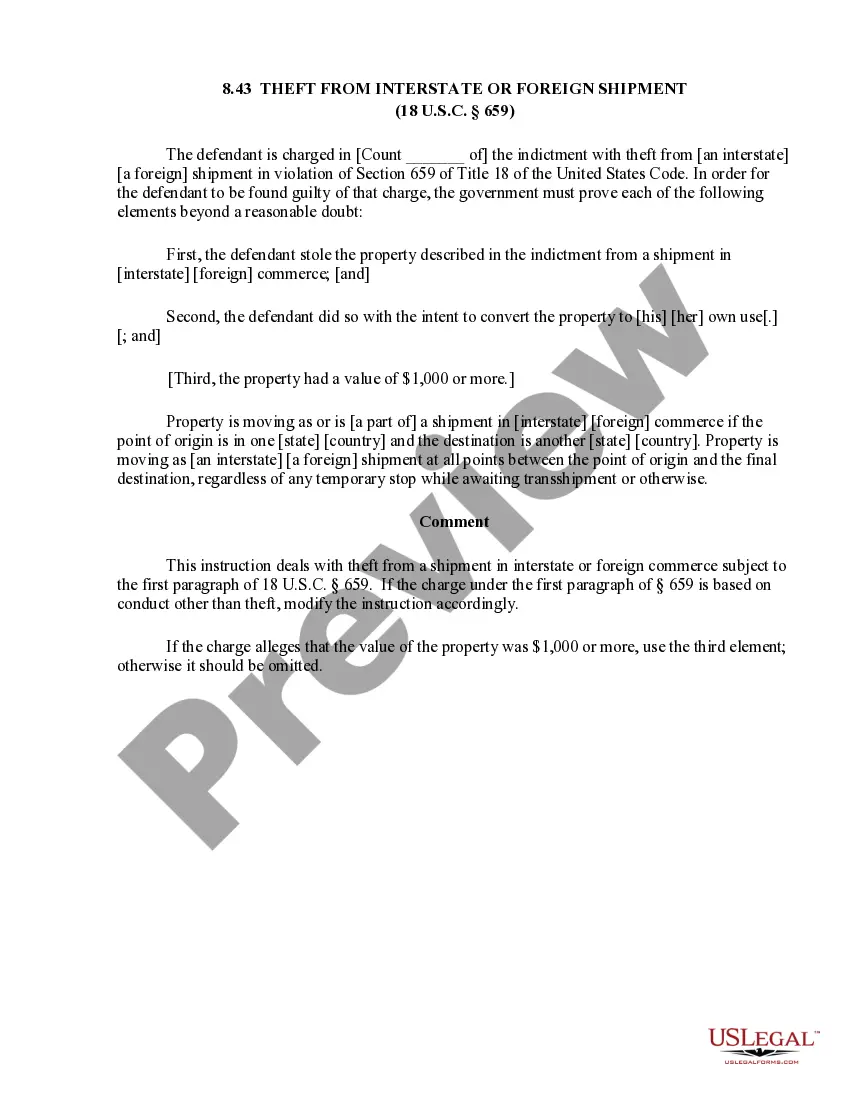
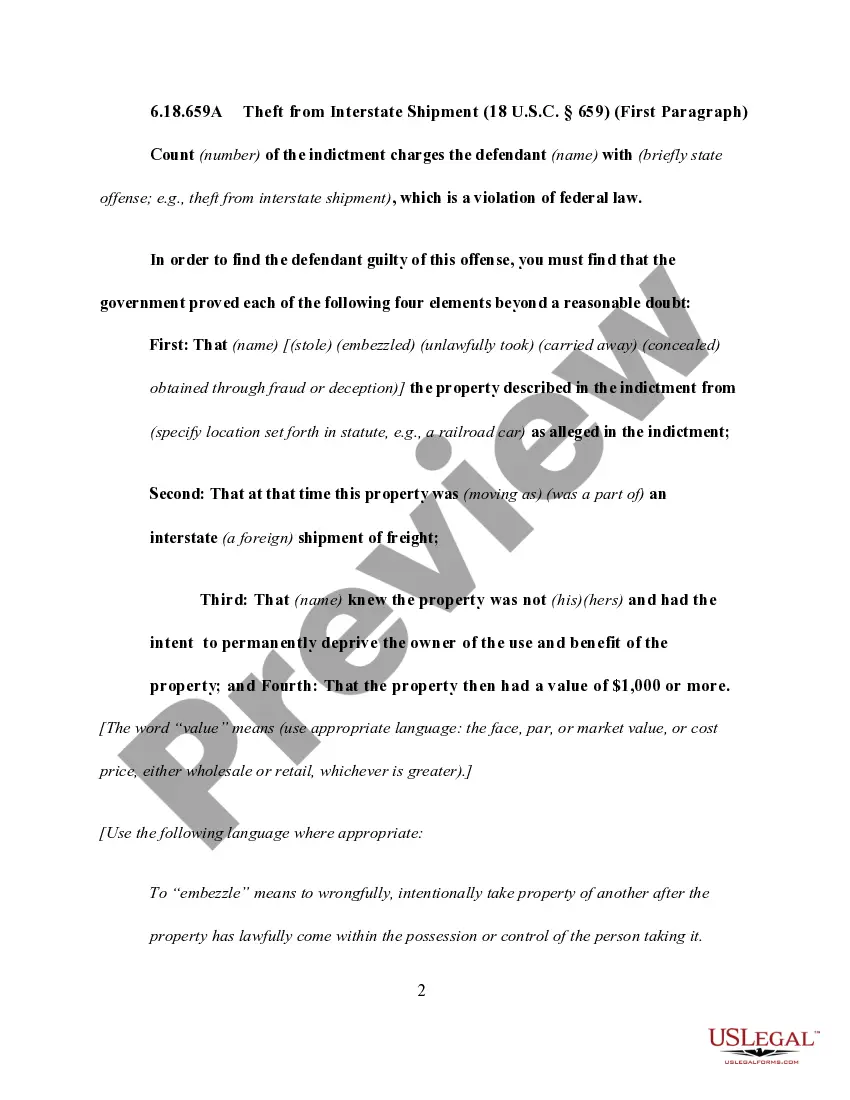
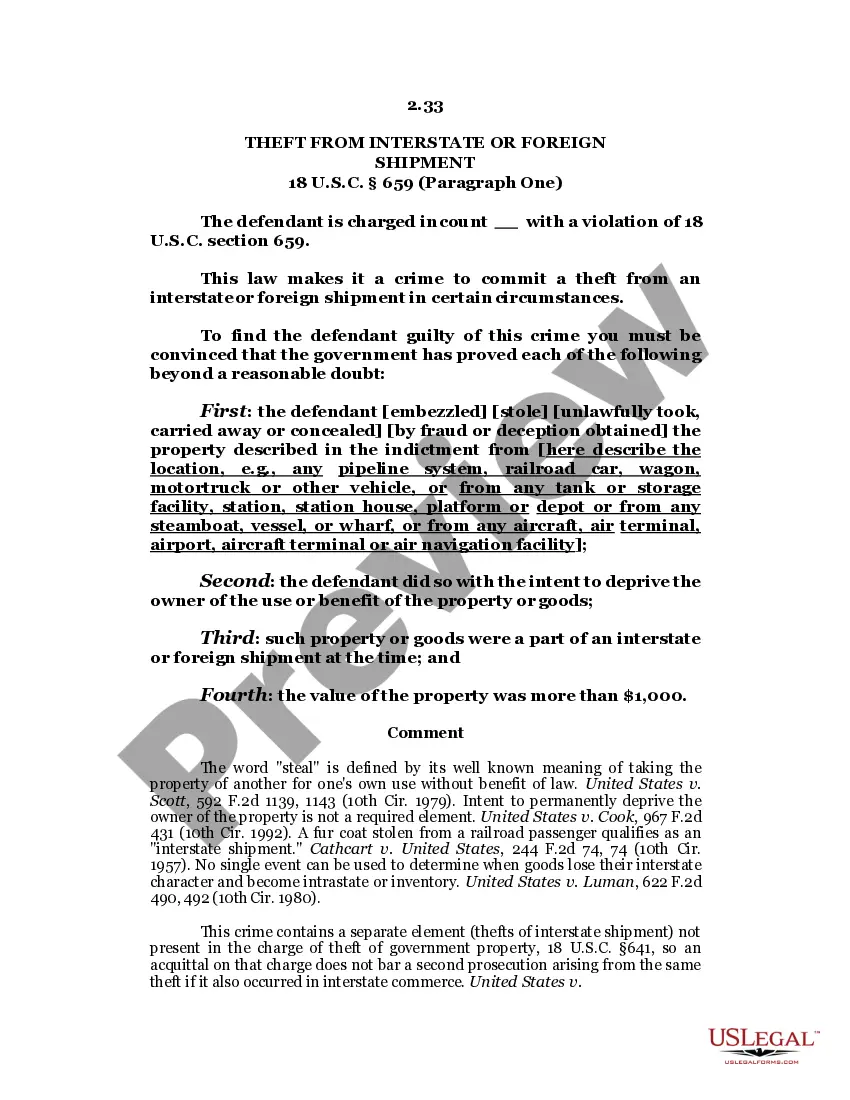
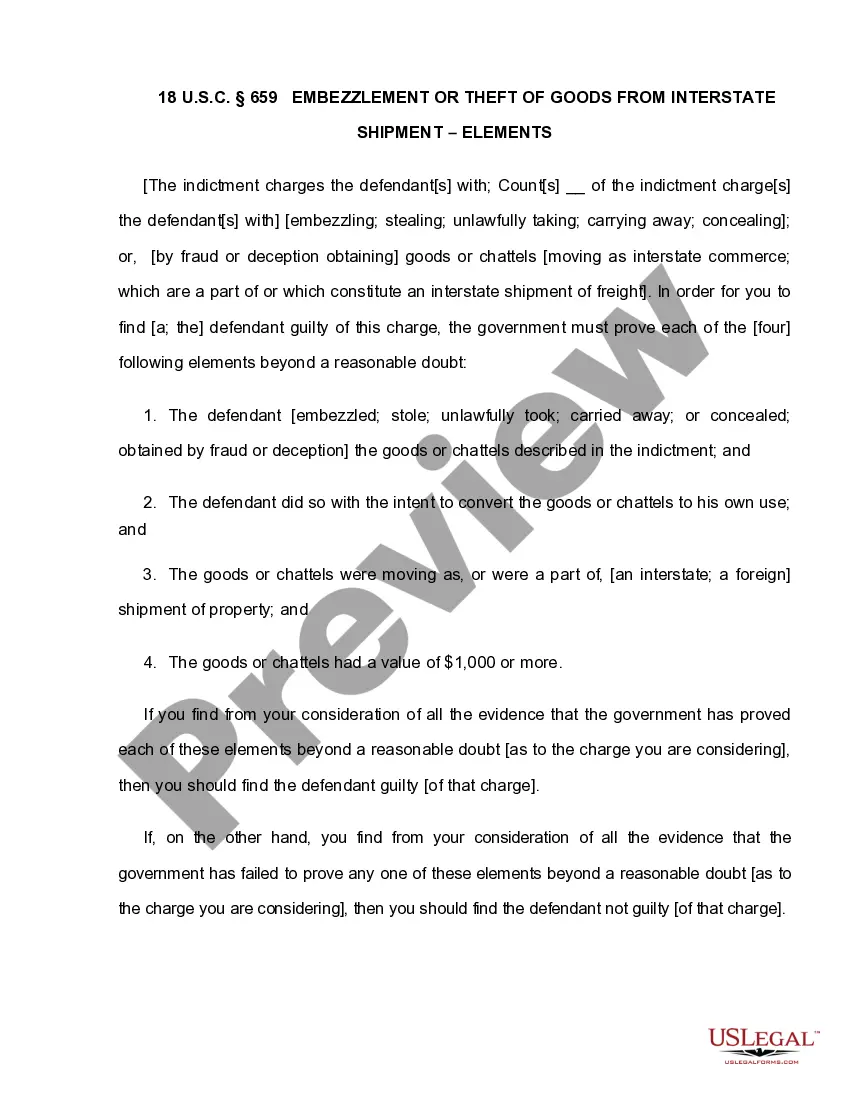
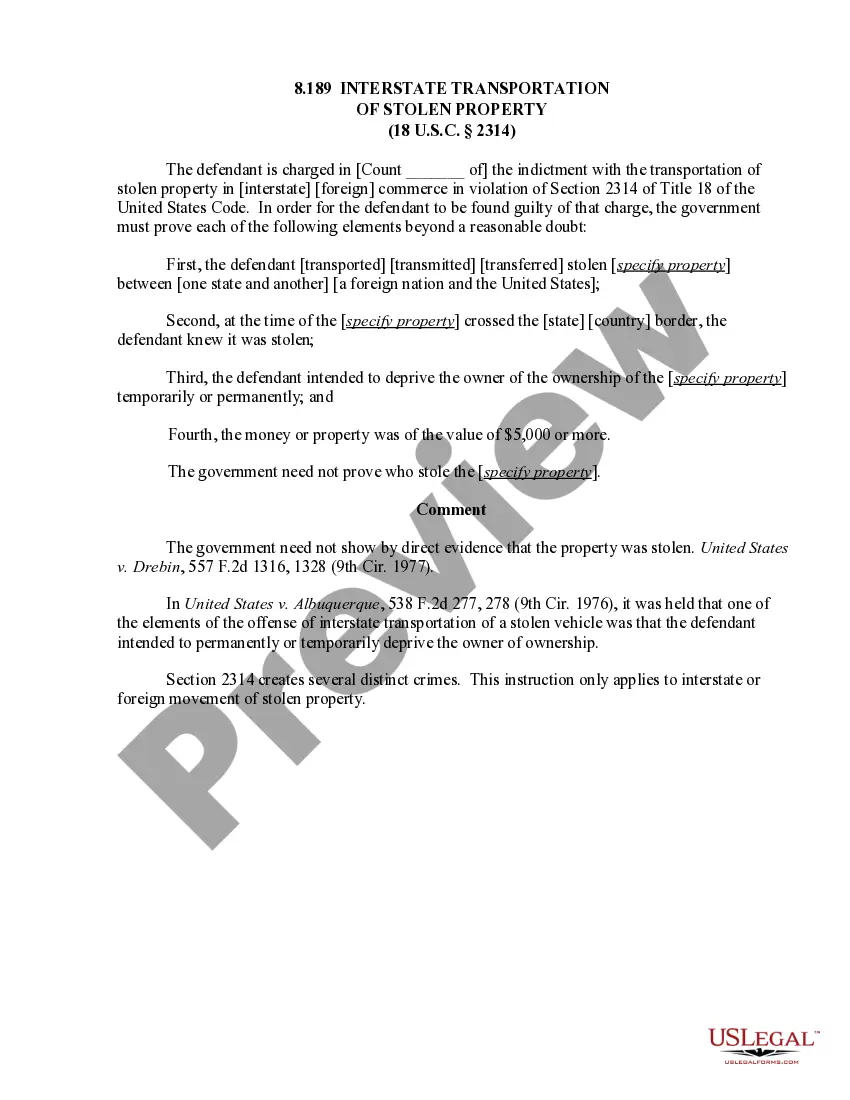
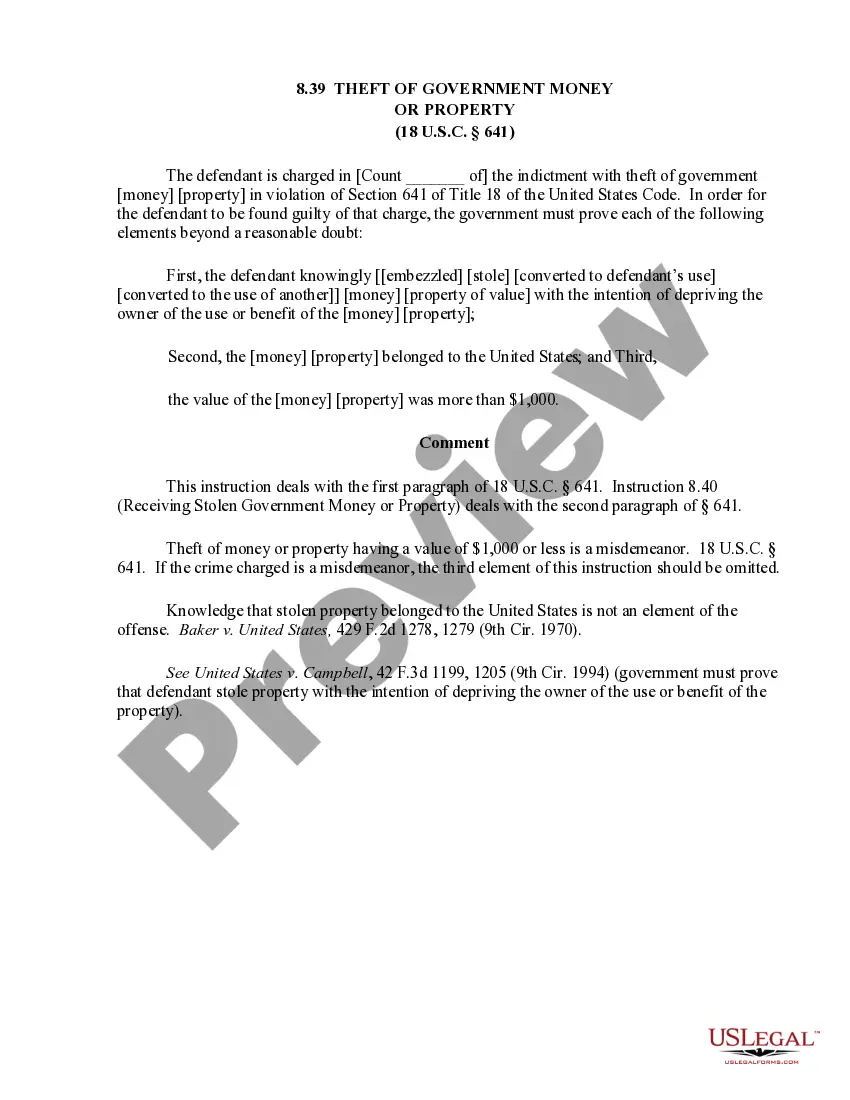
8.43 Theft from Interstate or Foreign Shipment (18 U.S.C. Sec. 659)
Does this document require notarization?
This form does not typically require notarization to be legally valid. However, some jurisdictions or document types may still require it. US Legal Forms provides secure online notarization powered by Notarize, available 24/7 for added convenience.
Get your form ready online
Our built-in tools help you complete, sign, share, and store your documents in one place.
Make edits, fill in missing information, and update formatting in US Legal Forms—just like you would in MS Word.
Download a copy, print it, send it by email, or mail it via USPS—whatever works best for your next step.
Sign and collect signatures with our SignNow integration. Send to multiple recipients, set reminders, and more. Go Premium to unlock E-Sign.
If this form requires notarization, complete it online through a secure video call—no need to meet a notary in person or wait for an appointment.
We protect your documents and personal data by following strict security and privacy standards.

Make edits, fill in missing information, and update formatting in US Legal Forms—just like you would in MS Word.

Download a copy, print it, send it by email, or mail it via USPS—whatever works best for your next step.

Sign and collect signatures with our SignNow integration. Send to multiple recipients, set reminders, and more. Go Premium to unlock E-Sign.

If this form requires notarization, complete it online through a secure video call—no need to meet a notary in person or wait for an appointment.

We protect your documents and personal data by following strict security and privacy standards.
Looking for another form?
Form popularity
FAQ
Penalties for 18 U.S.C. A violation of Section 641 subjects the defendant to a potential maximum of 10 years in federal prison and a fine, though if the property is valued at less than $1,000, the maximum term of imprisonment decreases to one year plus a fine.
A violation of 18 U.S.C. § 659 is a ten-year felony where the value of the stolen goods, chattels, money or baggage is $1,000 or more; otherwise the maximum penalty is three years.
It prohibits the theft or fraudulent acquisition of goods that are part of an interstate or international shipment, whether from the carrier or a holding area, and also the wilful buying, selling or possession of goods obtained in this way.
Examples are thefts of bicycles, thefts of motor vehicle parts and accessories, shoplifting, pocket-picking, or the stealing of any property or article that is not taken by force and violence or by fraud. Attempted larcenies are included. Embezzlement, confidence games, forgery, check fraud, etc., are excluded.
Misprision of felony is a crime committed when a person knows that someone has been involved in a felony but fails to report it to law enforcement authorities. The crime of misprision of felony originated in the common law of Great Britain. In the U.S., however, it has never been adopted as a crime by most states.
But Section 641 also states that, if the value of the stolen property is $1000 or less, that person shall be fined and imprisoned for no longer than 1 year. The $1000 threshold, therefore, is necessary to make a Section 641 offense into a felony; smaller theft from the government is only a misdemeanor.
Section 641 protects "any record, voucher, money, or thing of value of the United States or any department or agency thereof, or any property made or being made under contract for the United States or any department or agency thereof."
Theft of government property under 18 U.S.C. § 641 makes it a crime to steal, embezzle, or knowing convert with intent for your own personal gain the property, or to sell, convey, or dispose of any record, voucher, money, or something of value issued by a department of the United States government.