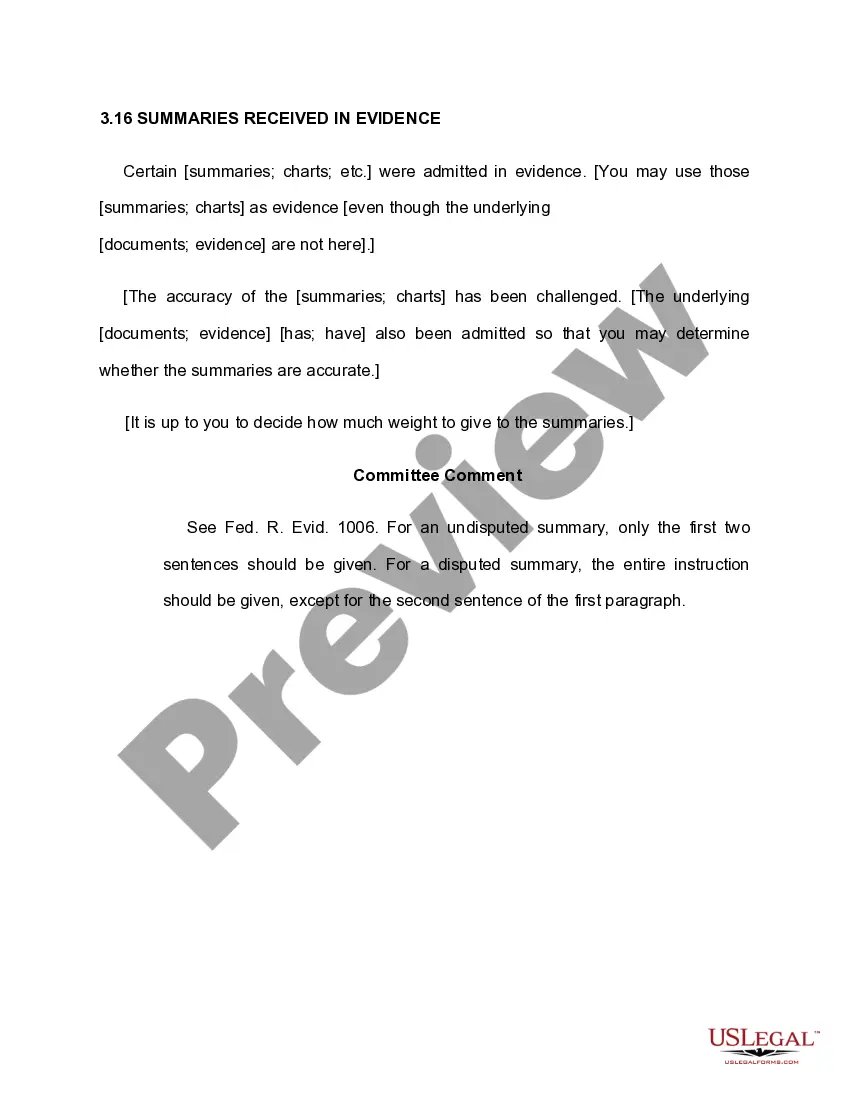
3.16 SUMMARIES RECEIVED IN EVIDENCE
About this form
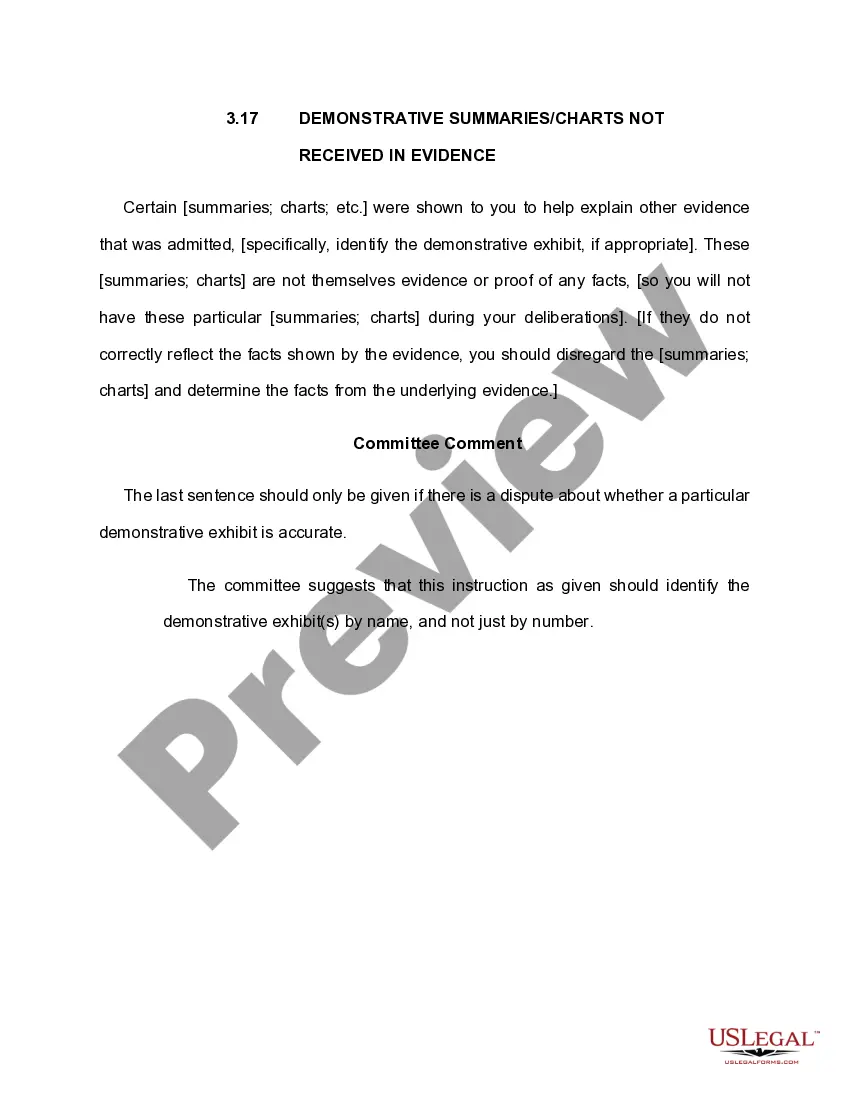
The 3.16 Summaries Received in Evidence form is an official pattern jury instruction adopted by the Federal 7th Circuit Court. This form provides guidance on how jurors may use summaries or charts presented as evidence during a trial. It clarifies that jurors can consider these summaries even if the underlying evidence is not available, and it instructs jurors on their responsibility to evaluate the accuracy of these summaries. This differs from similar forms in that it directly addresses the treatment of summaries specifically within trial contexts.
What’s included in this form
- Instructions for using summaries and charts as evidence.
- Clarification on the acceptance of summaries despite the absence of underlying documents.
- Guidance on addressing challenges to summary accuracy.
- Procedures for jurors to assess the weight of the summaries presented.
- Committee comments detailing the appropriate context for using the instructions.
Common use cases
This form is used in jury trials when summaries, charts, or similar aids are presented as evidence. It is applicable in cases where the underlying documents are unavailable, yet jurors need to evaluate the evidence based on the summaries provided. Situations might include complex litigation involving extensive documentation that has been condensed into accessible formats for juror comprehension.
Who can use this document
- Judges presiding over jury trials.
- Legal professionals preparing jury instructions.
- Jurors needing guidance on the use of summarized evidence.
Instructions for completing this form
- Identify the specific summaries or charts being admitted as evidence.
- Assess if the underlying documents are available or have been admitted.
- Consider any challenges to the accuracy of the summaries.
- Determine the appropriate weight to assign to the summaries based on their accuracy and context.
- Provide jurors with clear instructions on evaluating the summaries presented.
Is notarization required?
Notarization is generally not required for this form. However, certain states or situations might demand it. You can complete notarization online through US Legal Forms, powered by Notarize, using a verified video call available anytime.
Get your form ready online
Our built-in tools help you complete, sign, share, and store your documents in one place.
Make edits, fill in missing information, and update formatting in US Legal Forms—just like you would in MS Word.
Download a copy, print it, send it by email, or mail it via USPS—whatever works best for your next step.
Sign and collect signatures with our SignNow integration. Send to multiple recipients, set reminders, and more. Go Premium to unlock E-Sign.
If this form requires notarization, complete it online through a secure video call—no need to meet a notary in person or wait for an appointment.
We protect your documents and personal data by following strict security and privacy standards.

Make edits, fill in missing information, and update formatting in US Legal Forms—just like you would in MS Word.

Download a copy, print it, send it by email, or mail it via USPS—whatever works best for your next step.

Sign and collect signatures with our SignNow integration. Send to multiple recipients, set reminders, and more. Go Premium to unlock E-Sign.

If this form requires notarization, complete it online through a secure video call—no need to meet a notary in person or wait for an appointment.

We protect your documents and personal data by following strict security and privacy standards.
Common mistakes
- Failure to properly explain the context in which summaries can be used.
- Not addressing potential challenges to the accuracy of the summaries beforehand.
- Omitting necessary instructions for jurors on how to weight the evidence presented.
Why use this form online
- Easy accessibility allows for quick downloading and use during trials.
- Editable format enables customization to fit specific case needs.
- Reliable content drafted by licensed attorneys ensures legal accuracy.
Looking for another form?


Form popularity
FAQ
?Preponderance of the evidence? means evidence that has more convincing force than that opposed to it. If the evidence is so evenly balanced that you are unable to say that the evidence on either side of an issue preponderates, your finding on that issue must be against the party who had the burden of proving it.
In other words, the jury must be virtually certain of the defendant's guilt in order to render a guilty verdict. This standard of proof is much higher than the civil standard, called ?preponderance of the evidence,? which only requires a certainty greater than 50 percent. Related Terms: Preponderance of the evidence.
To meet this standard of proof on a preponderance of the evidence, the plaintiff must show that their allegations have more than a 50% chance of being true. You can understand this as the ?more likely than not? principle.
The preponderance of evidence standard applies primarily to civil law cases. For example, if Linda sues Tom due to injuries she sustained in a car crash, Linda must convince the courts that it is more probable than not that Tom caused the crash resulting in her injuries.
For a statement to be actionable as defamation, it must have a provably false factual connotation and thus be capable of being proven true or false.
Preponderance of the evidence is a standard of proof that requires the party with the burden of proof to show that it is more likely than not that their version of events is true.