18 U.S.C. Sec. Sec. 1512 and 1515(a)(3) define misleading conduct as any action taken by a person, either intentionally or knowingly, with the aim of creating or maintaining a false impression in order to mislead or deceive another person. This is commonly used in the context of a criminal investigation, where the accused may be accused of attempting to manipulate or mislead the investigators. This law applies to any type of communication, including verbal, written, or electronic. The two main types of misleading conduct recognized under this law are obstruction of justice and witness tampering. Obstruction of justice involves any action taken by a person that is intended to impede the progress or outcome of a criminal investigation. This can include destroying evidence, withholding or fabricating information, or otherwise obstructing the legal process. Witness tampering is any action taken by a person to influence the testimony of a witness in a criminal investigation. This can include bribery, intimidation, or otherwise influencing the witness in order to alter their testimony.
18 U.S.C. Sec.Sec. 1512 AND 1515(A)(3) DEFINITION OF MISLEADING CONDUCT
Description

How to fill out 18 U.S.C. Sec.Sec. 1512 AND 1515(A)(3) DEFINITION OF MISLEADING CONDUCT?
Handling official documentation requires attention, precision, and using properly-drafted blanks. US Legal Forms has been helping people across the country do just that for 25 years, so when you pick your 18 U.S.C. Sec.Sec. 1512 AND 1515(A)(3) DEFINITION OF MISLEADING CONDUCT template from our library, you can be sure it meets federal and state laws.
Working with our service is simple and quick. To get the necessary paperwork, all you’ll need is an account with a valid subscription. Here’s a brief guide for you to find your 18 U.S.C. Sec.Sec. 1512 AND 1515(A)(3) DEFINITION OF MISLEADING CONDUCT within minutes:
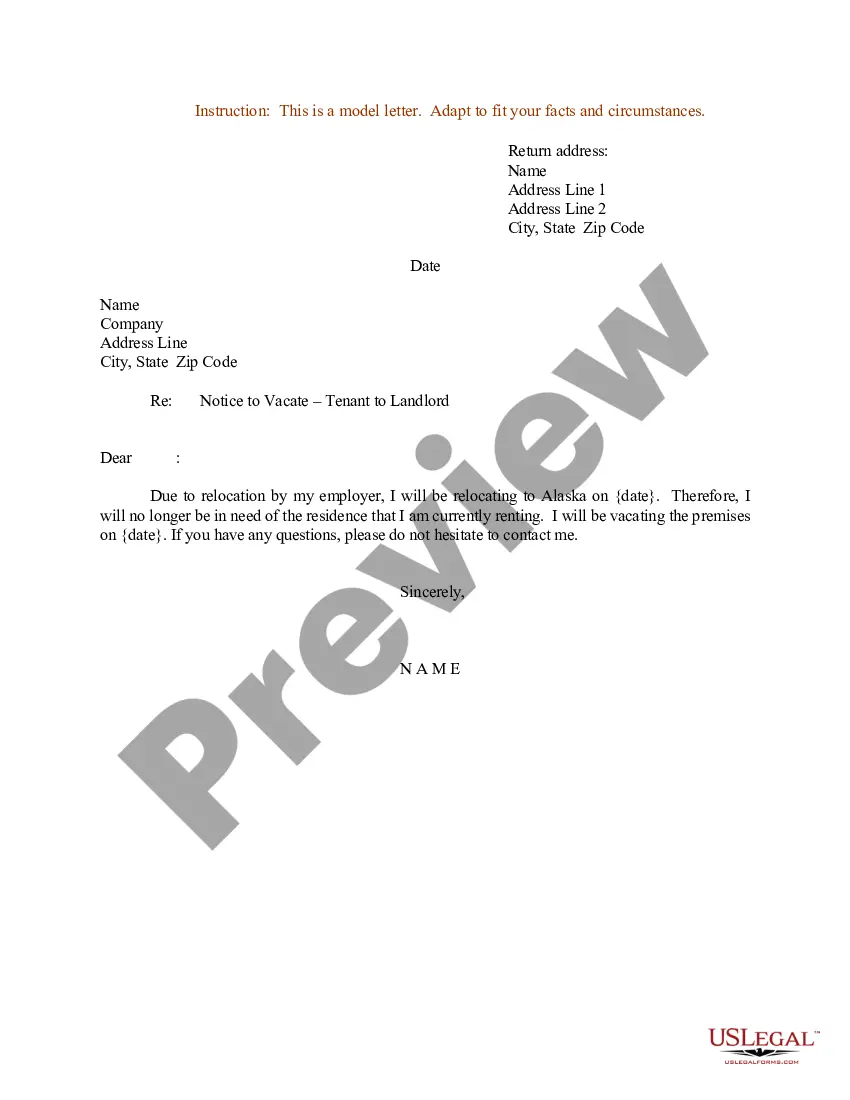
- Make sure to attentively examine the form content and its correspondence with general and law requirements by previewing it or reading its description.
- Search for an alternative official template if the previously opened one doesn’t match your situation or state regulations (the tab for that is on the top page corner).
- Log in to your account and download the 18 U.S.C. Sec.Sec. 1512 AND 1515(A)(3) DEFINITION OF MISLEADING CONDUCT in the format you need. If it’s your first time with our service, click Buy now to proceed.
- Create an account, select your subscription plan, and pay with your credit card or PayPal account.
- Decide in what format you want to obtain your form and click Download. Print the blank or add it to a professional PDF editor to prepare it electronically.
All documents are created for multi-usage, like the 18 U.S.C. Sec.Sec. 1512 AND 1515(A)(3) DEFINITION OF MISLEADING CONDUCT you see on this page. If you need them in the future, you can fill them out without re-payment - simply open the My Forms tab in your profile and complete your document whenever you need it. Try US Legal Forms and prepare your business and personal paperwork rapidly and in total legal compliance!
Form popularity
FAQ
18 U.S.C. § 1512(f) provides: For the purposes of this section - (1) an official proceeding need not be pending or about to be instituted at the time of the offense; and (2) the testimony, or the record, document, or other object need not be admissible in evidence or free of a claim of privilege.
Causing a criminal prosecution, or a parole or probation revocation proceeding, to be sought or instituted, or assisting in such prosecution or proceeding; or attempts to do so, shall be fined under this title or imprisoned not more than 3 years, or both.
Using physical force to intimidate a federal witness results in a federal prison sentence of up to 30 years. State witness tampering without physical force is punishable by up to 10 years in state prison and a $4,000 fine.
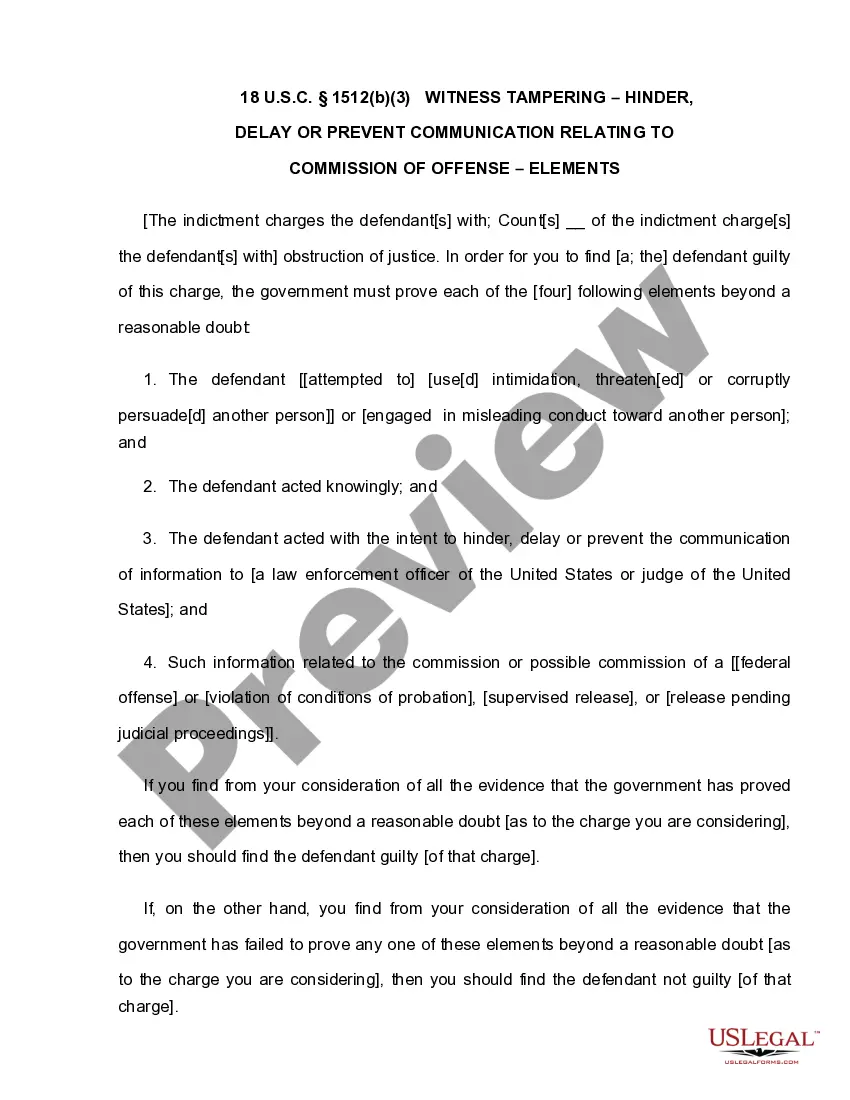
§ 1512(b)(3) proscribes interference with "the communication to a (Federal) law enforcement officer . . . of information relating to the commission or possible commission of a Federal offense." There is nothing to indicate that Congress intended to depart from the generally accepted meaning of "law enforcement" as
Accusations and Charges of Witness Tampering To prove the charge, the prosecutor will have to show beyond a reasonable doubt that the accused intended to influence the witness's testimony. They'll also have to prove any other elements that are listed in their state's witness tampering statute.
Witness tampering is a ?wobbler? crime that can be charged as either a misdemeanor or a felony, depending on the circumstances under which it occurred. Being convicted of felony dissuading a witness carries penalties of up to two, three, or four years in state prison.
It includes conduct that is likely to mislead or deceive a person. Misleading conduct is conduct that leads a person into error. Deceptive conduct suggests intention to deceive, although intention is not relevant. The person misled or deceived does not need to prove loss or damage.
: possessing the capacity or tendency to create a mistaken understanding or impression compare deceptive, fraudulent.