Use of Depositions
Understanding this form
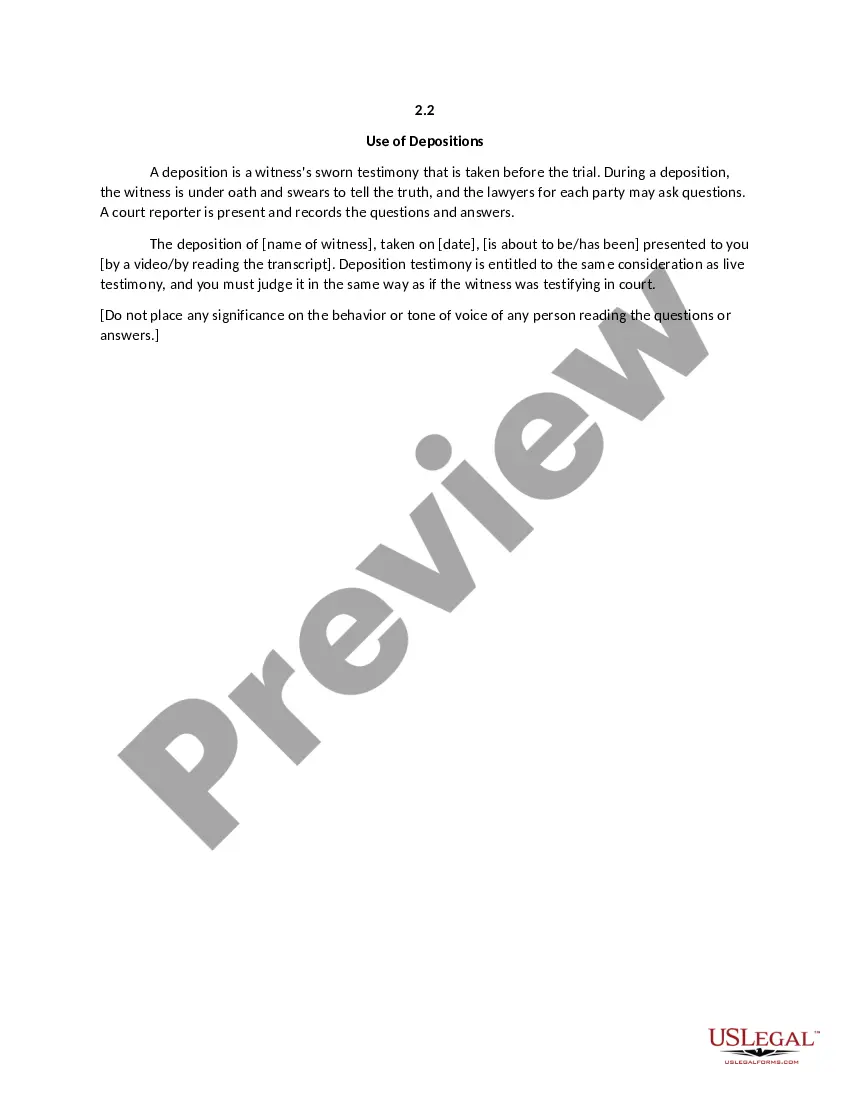
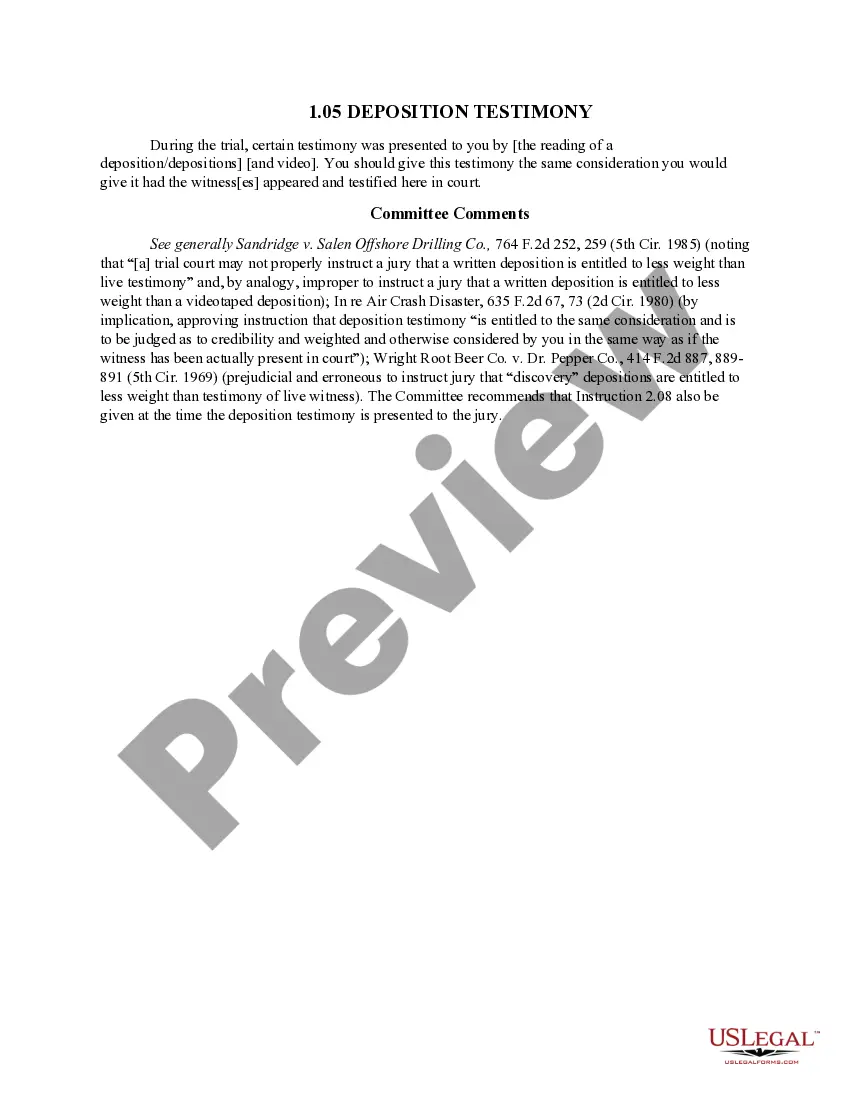
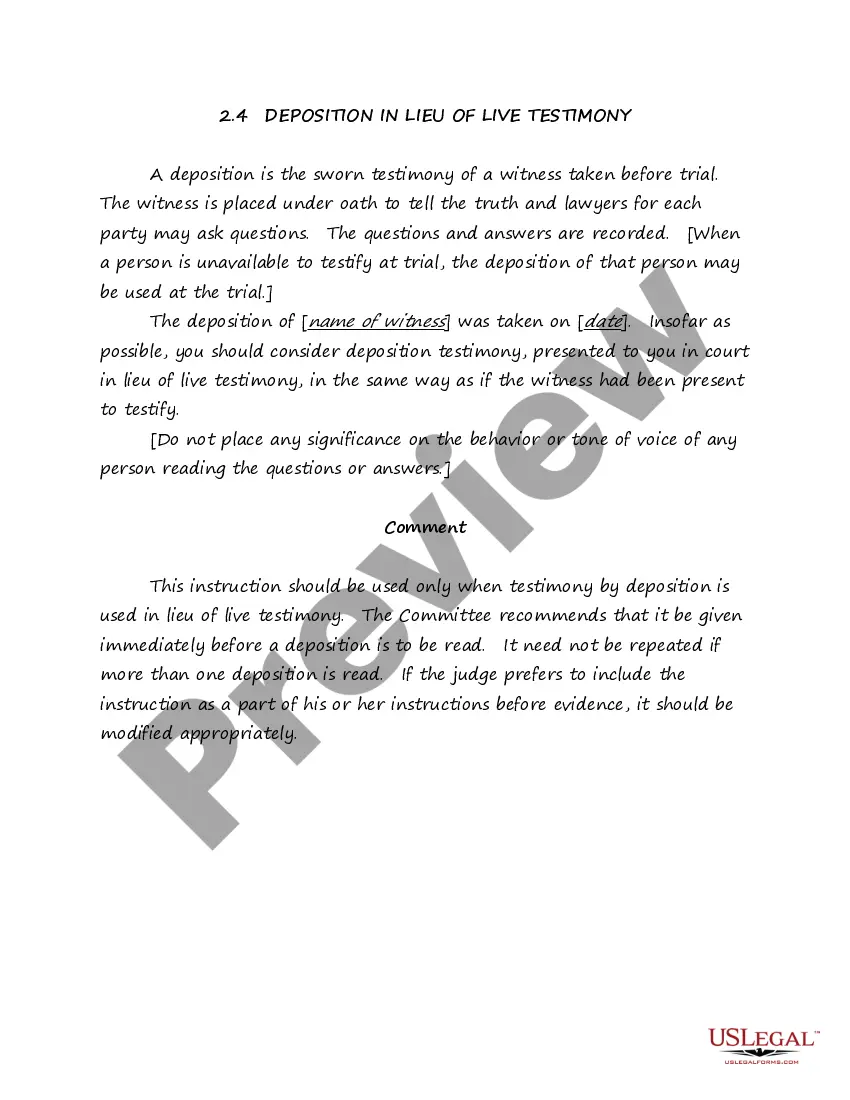
The Use of Depositions form captures sworn testimony from witnesses before a trial. This legal document differs from other forms of testimony as it occurs outside the courtroom, allowing attorneys to prepare for trial. Depositions help in gathering essential information, preserving witness statements, and aiding in the trial's fact-finding process. It is crucial for legal practitioners, as deposition testimony is treated with the same weight as live testimony in court.
Main sections of this form
- Identification of the witness and date of deposition.
- Statement affirming that the witness is under oath to tell the truth.
- Record of questions posed by attorneys and the corresponding answers.
- Acknowledgment that deposition testimony holds equal validity to live testimony in court.
- Emphasis on disregarding the method of presentation (video or transcript reading) during assessment.
Situations where this form applies
This form is used when attorneys need to document witness statements prior to a trial. Common scenarios include gathering testimony from individuals who may be unable to attend court, collecting evidence for complex cases, or clarifying witness accounts to prepare for cross-examination. Depositions are particularly vital in civil litigation and can aid in settlement negotiations or trial strategy development.
Intended users of this form
- Attorneys representing clients in a legal dispute.
- Legal assistants responsible for case preparation.
- Parties involved in a lawsuit who wish to gather information from witnesses.
- Individuals looking to document vital witness testimony before trial proceedings.
How to prepare this document
- Identify the witness by full name and provide the date of the deposition.
- Indicate that the witness is under oath to provide truthful testimony.
- Record the questions to be asked and prepare corresponding answers.
- Specify how the deposition will be presented (video or transcript).
- Ensure all parties review and acknowledge mutual understanding of the deposition's purpose and validity.
Notarization guidance
This form does not typically require notarization to be legally valid. However, some jurisdictions or document types may still require it. US Legal Forms provides secure online notarization powered by Notarize, available 24/7 for added convenience.
Get your form ready online
Our built-in tools help you complete, sign, share, and store your documents in one place.
Make edits, fill in missing information, and update formatting in US Legal Forms—just like you would in MS Word.
Download a copy, print it, send it by email, or mail it via USPS—whatever works best for your next step.
Sign and collect signatures with our SignNow integration. Send to multiple recipients, set reminders, and more. Go Premium to unlock E-Sign.
If this form requires notarization, complete it online through a secure video call—no need to meet a notary in person or wait for an appointment.
We protect your documents and personal data by following strict security and privacy standards.

Make edits, fill in missing information, and update formatting in US Legal Forms—just like you would in MS Word.

Download a copy, print it, send it by email, or mail it via USPS—whatever works best for your next step.

Sign and collect signatures with our SignNow integration. Send to multiple recipients, set reminders, and more. Go Premium to unlock E-Sign.

If this form requires notarization, complete it online through a secure video call—no need to meet a notary in person or wait for an appointment.

We protect your documents and personal data by following strict security and privacy standards.
Common mistakes to avoid
- Failing to properly identify the witness or record the deposition date.
- Neglecting to ensure that the witness fully understands the oath before testifying.
- Using unclear or overly complex questions that may confuse the witness.
- Forgetting to consider how the depositions will be presented to the court.
Benefits of completing this form online
- Convenient access to legal forms that can be downloaded at any time.
- Editable templates that allow customization to fit specific case needs.
- Reliable legal resources drafted by licensed attorneys to ensure accuracy.
- Secure handling of sensitive information and reliable documentation processes.
Legal use & context
- Depositions are a standard procedure in civil litigation, aiding the discovery process.
- Testimony collected through depositions can be used in court, so accuracy is critical.
- Legal regulations regarding depositions can vary by state, affecting how they are conducted and utilized.
Quick recap
- The Use of Depositions form is essential for capturing witness testimony outside court.
- Accurate completion is vital to ensuring legitimacy in legal proceedings.
- This form can be utilized across multiple states, but local rules should always be confirmed.
Looking for another form?
Form popularity
FAQ
There are 3 kinds of depositional environments, they are continental, marginal marine, and marine environments. Each environments have certain characteristic which make each of them different than others. And different depositional environment, will have different structure and texture of sediments.
Depositions enable a party to know in advance what a witness will say at the trial. Depositions can also be taken to obtain the testimony of important witnesses who can t appear during the trial. In that case, they re read into evidence at the trial.
A deposition is a witness's sworn out-of-court testimony. It is used to gather information as part of the discovery process and, in limited circumstances, may be used at trial.
A deposition may be used by any party to contradict or impeach the testimony given by the deponent as a witness or for any other purpose allowed by the Federal Rules of Evidence. Fed. R. Civ.
A deposition taken without leave of court pursuant to a notice under Rule 30(a)(2)(C) shall not be used against a party who demonstrates that, when served with the notice, it was unable through the exercise of diligence to obtain counsel to represent it at the taking of the deposition; nor shall a deposition be used
JF: A deposition is an opportunity for parties in a civil lawsuit to obtain testimony from a witness under oath prior to trial. It's part of the discovery process by which parties gather facts and information so they can be better prepared at trial to present their claims and defenses.
JF: A deposition is an opportunity for parties in a civil lawsuit to obtain testimony from a witness under oath prior to trial. It's part of the discovery process by which parties gather facts and information so they can be better prepared at trial to present their claims and defenses.
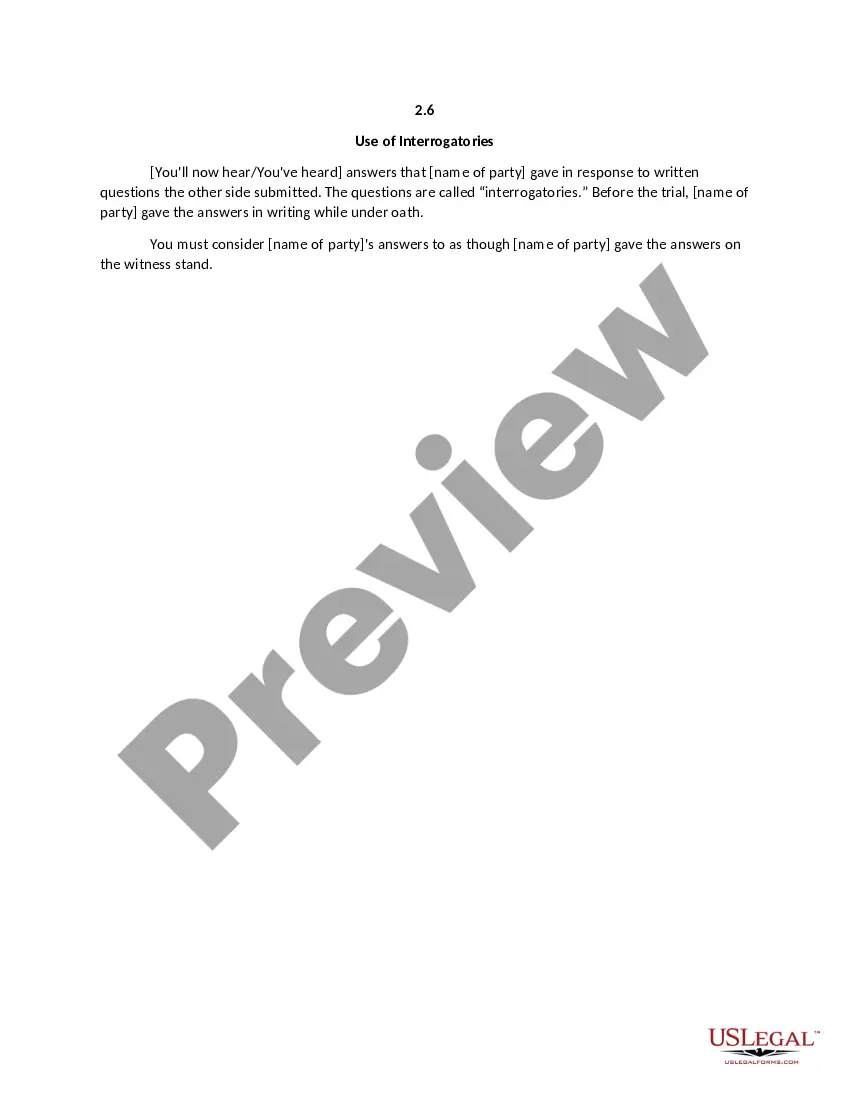
Whereas depositions are useful for obtaining candid responses from a party and answers not prepared in advance, interrogatories are designed to obtain accurate information about specific topics. Interrogatories can be quicker, less costly, and less complicated than depositions, but there are downsides.