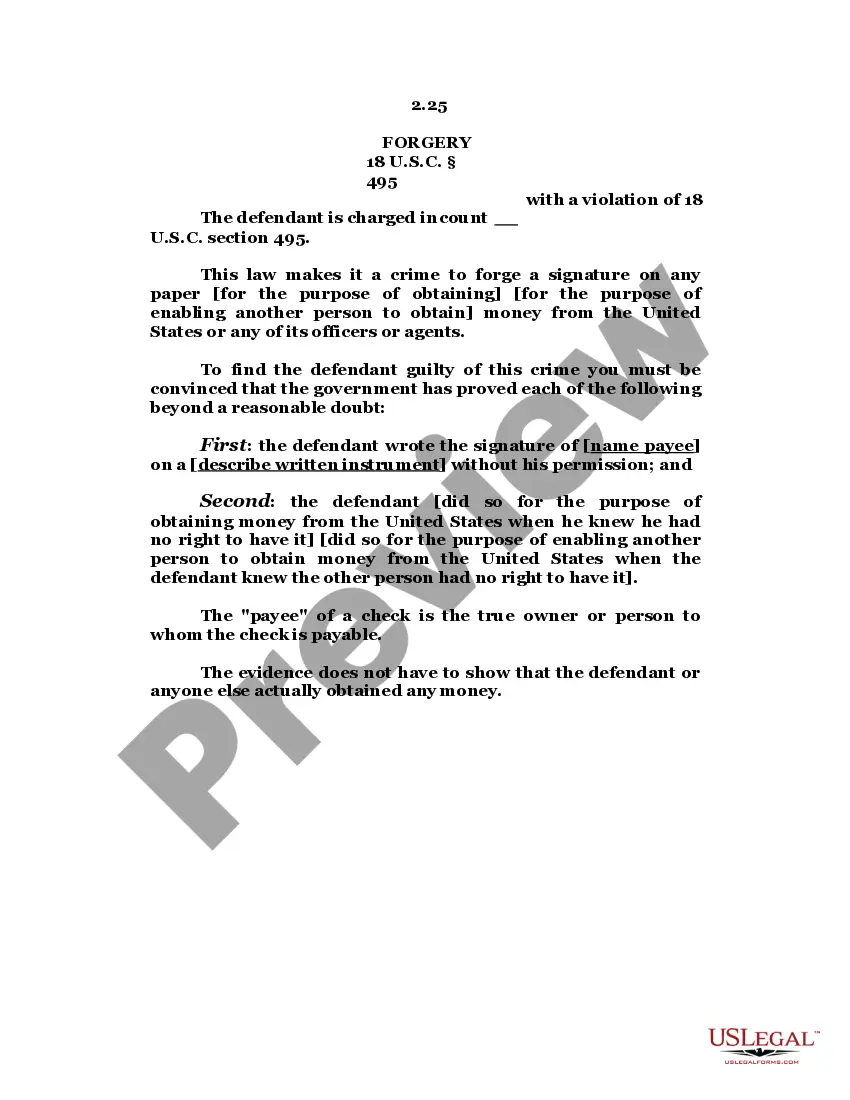
FORGERY / 18 U.S.C. Sec. 495
Overview of this form
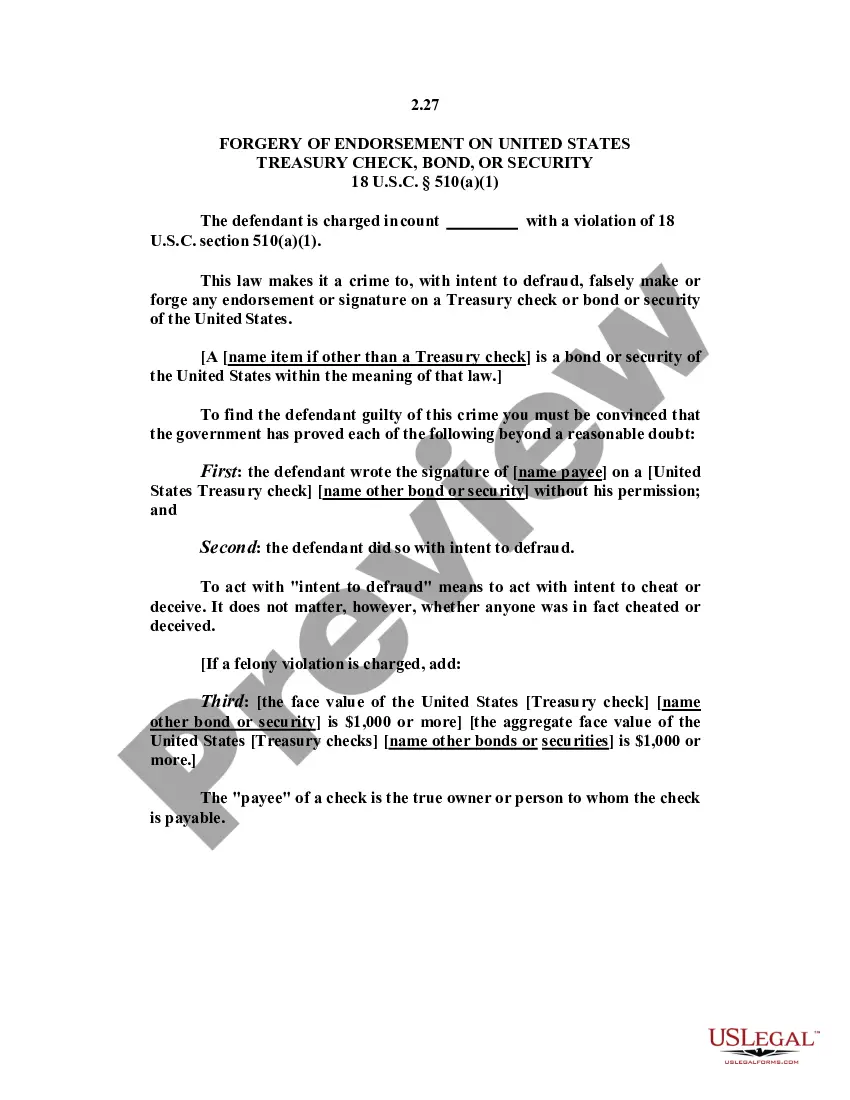
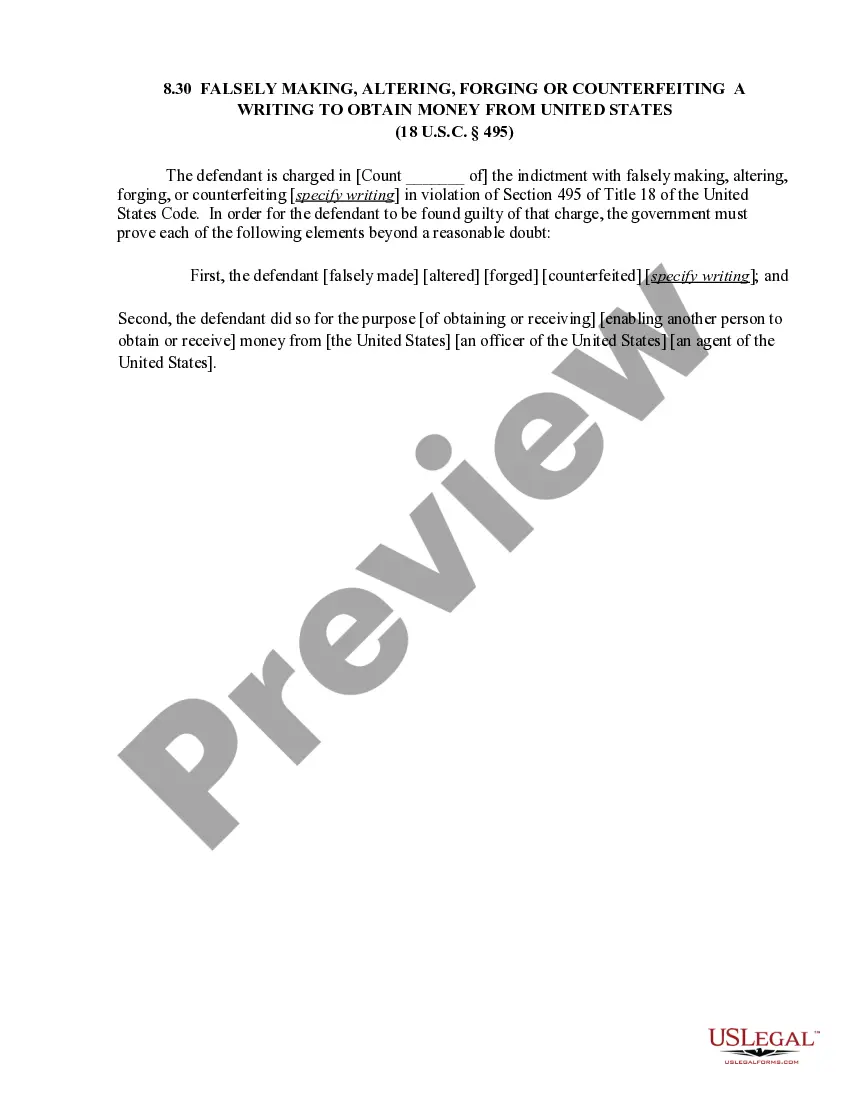
The Forgery form under 18 U.S.C. Sec. 495 is a legal document used to address the crime of forging a signature for the purpose of obtaining money from the United States. This form establishes the legal basis for prosecution by outlining the elements of forgery, including the unauthorized act of signing someone else's name on a financial instrument. The document is crucial for ensuring accountability when fraudulent actions threaten the integrity of financial transactions with government entities.
Form components explained
- Charges outlined under 18 U.S.C. Sec. 495 for forgery.
- Definition of the payee, the rightful owner of the check or financial document.
- Conditions required for establishing guilt, including lack of permission and intent to obtain money unlawfully.
- Clarification that actual money need not be obtained for a conviction.
When to use this form
This form is applicable in cases where an individual is accused of forging a signature on a financial instrument to defraud the U.S. government or its agents. It is typically used in legal proceedings to provide evidence of fraudulent activity, particularly when it involves attempts to receive money unlawfully. Situations may include forging a government check or a warranty deed to deceive an agency.
Who can use this document
- Individuals accused of forgery under federal law.
- Legal representatives handling cases of forgery for their clients.
- Prosecutors seeking to validate charges of forgery against defendants.
Steps to complete this form
- Identify the name of the payee whose signature was forged.
- Describe the written instrument that was falsified.
- Ensure you provide evidence of the intent to obtain money unlawfully.
- Document the specific circumstances under which the forgery occurred.
Notarization requirements for this form
This form usually doesn’t need to be notarized. However, local laws or specific transactions may require it. Our online notarization service, powered by Notarize, lets you complete it remotely through a secure video session, available 24/7.
Get your form ready online
Our built-in tools help you complete, sign, share, and store your documents in one place.
Make edits, fill in missing information, and update formatting in US Legal Forms—just like you would in MS Word.
Download a copy, print it, send it by email, or mail it via USPS—whatever works best for your next step.
Sign and collect signatures with our SignNow integration. Send to multiple recipients, set reminders, and more. Go Premium to unlock E-Sign.
If this form requires notarization, complete it online through a secure video call—no need to meet a notary in person or wait for an appointment.
We protect your documents and personal data by following strict security and privacy standards.

Make edits, fill in missing information, and update formatting in US Legal Forms—just like you would in MS Word.

Download a copy, print it, send it by email, or mail it via USPS—whatever works best for your next step.

Sign and collect signatures with our SignNow integration. Send to multiple recipients, set reminders, and more. Go Premium to unlock E-Sign.

If this form requires notarization, complete it online through a secure video call—no need to meet a notary in person or wait for an appointment.

We protect your documents and personal data by following strict security and privacy standards.
Common mistakes
- Failing to accurately identify the payee, which can weaken the case.
- Not detailing the method of forgery clearly, leaving room for misinterpretation.
- Neglecting to provide context for the intent behind the forgery.
Benefits of using this form online
- Convenient access to critical legal forms without the need for in-person visits to legal offices.
- Editable format allowing you to customize the document according to your specific case.
- Immediate download ensures you can start the process quickly and efficiently.
Legal use & context
- This form is essential for prosecuting forgery under federal law.
- Successfully demonstrating forgery requires rigorous evidence and understanding of legal definitions.
- Ignorance of these legal stipulations can jeopardize the case outcome.
Looking for another form?
Form popularity
FAQ
Forgery punishment is up to 10 years in prison, for example, when a person forges a patent document, whereas forgery punishment is up to 5 years for forging postage stamps. The potential prison punishment is worse under the Federal Crime of Counterfeiting Money, 18 US Code Section 471.
§471. Obligations or securities of United States. Whoever, with intent to defraud, falsely makes, forges, counterfeits, or alters any obligation or other security of the United States, shall be fined under this title or imprisoned not more than 20 years, or both.
Whoever, with intent to defraud, falsely makes, forges, counterfeits, or alters any obligation or other security of the United States, shall be fined under this title or imprisoned not more than 20 years, or both.
§ 1071, the government must establish the following four essential elements: (1) a federal warrant has been issued for the fugitive's arrest; (2) the defendant had knowledge that a warrant had been issued for the fugitive's arrest; (3) the defendant actually harbored or concealed the fugitive; and (4) the defendant
§ 495 set forth three separate offenses: forgery, uttering a forged instrument, and presentation of a false writing to an officer of the United States in support of a claim against the government. The second and third paragraphs specifically contain "intent to defraud the United States" as an element of those offenses.
The federal crime of 18 U.S.C. § 471 forgery can be defined as the making, altering, using, or possession of a false document or material with the specific intent of committing fraud.
The federal crime of 18 U.S.C. § 471 forgery can be defined as the making, altering, using, or possession of a false document or material with the specific intent of committing fraud.
Whoever, with intent to defraud, falsely makes, forges, counterfeits, or alters any obligation or other security of the United States, shall be fined under this title or imprisoned not more than 20 years, or both.