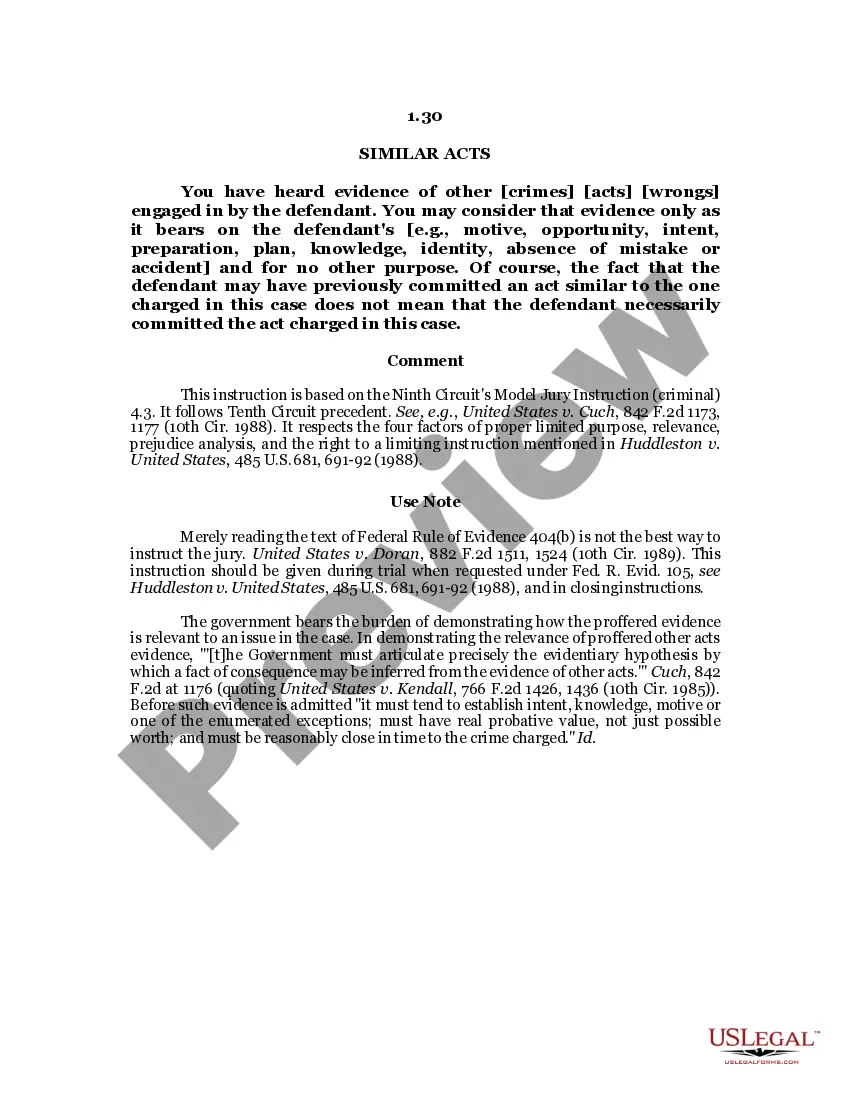
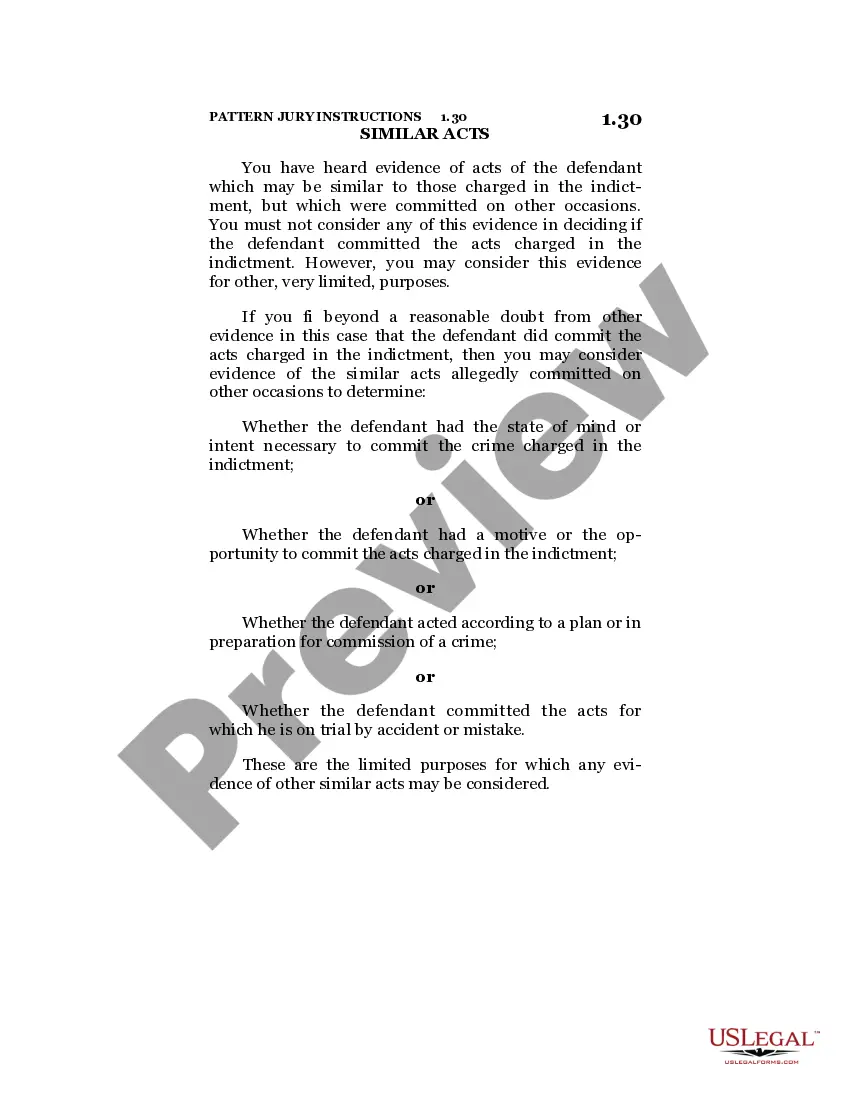
SIMILAR ACTS
What is this form?
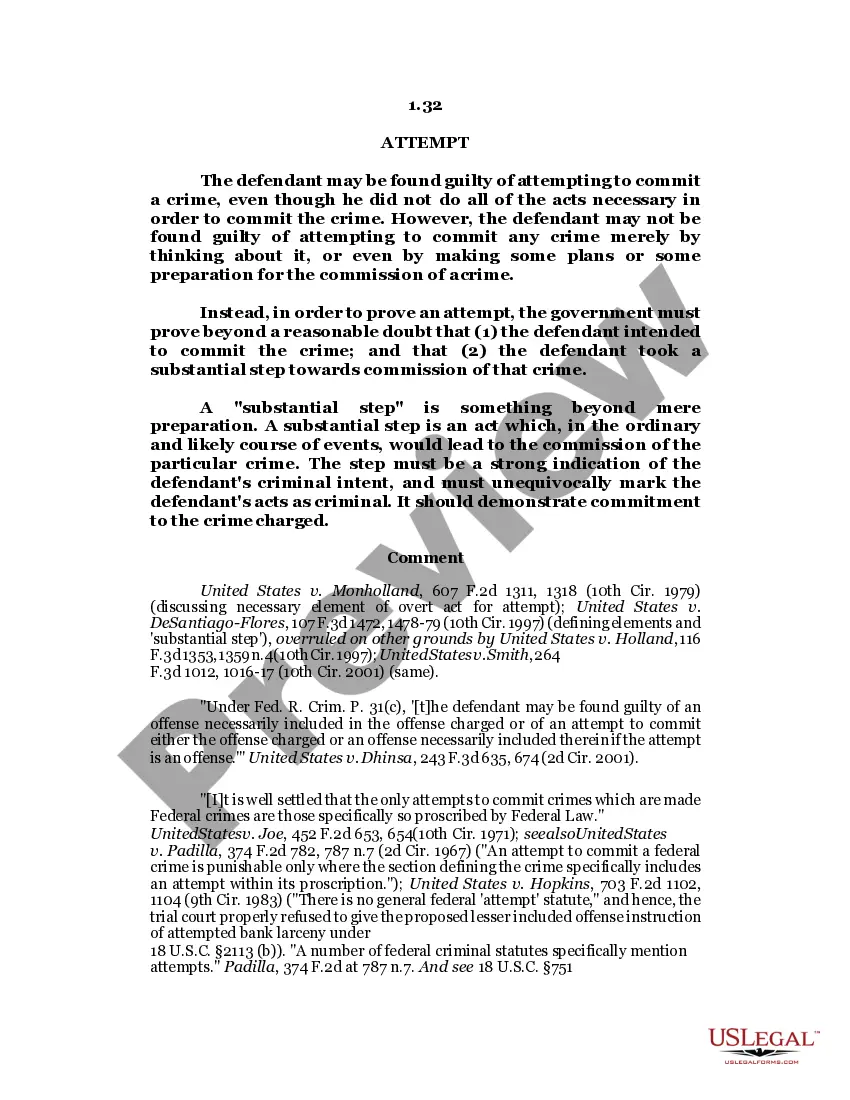
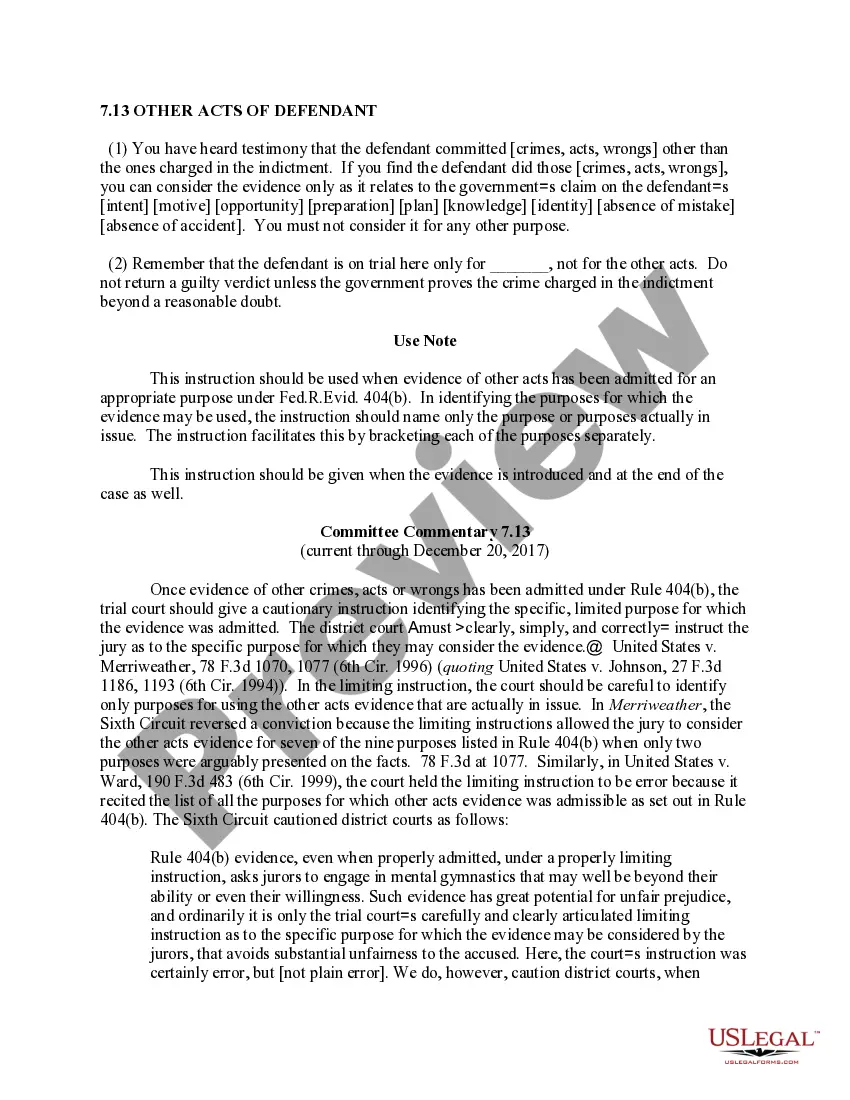
The Similar Acts form is a legal instruction used in criminal cases, allowing the jury to consider evidence of the defendant's previous acts or crimes. This form clarifies how such evidence may be relevant to key aspects of the case, such as the defendantâs motive, intent, or identity. The purpose of this instruction is to ensure that the jury understands the limited use of this evidence, distinguishing it from other forms of evidence that may not directly relate to the current charges.
Main sections of this form
- Definition of similar acts and their relevance to the case.
- Guidelines on how the jury should consider evidence of other crimes or acts.
- Clarification that similar past acts do not imply guilt in the current case.
- Requirements for the government to demonstrate relevance before admission of evidence.
- Instructions on the timing of presenting this instruction during trial.
Common use cases
This form should be used in criminal trials when there is evidence presented regarding the defendant's prior acts or crimes. It is particularly relevant when the prosecution seeks to demonstrate motives, intentions, or consistency in the defendant's actions that may support the case against them. The form ensures that the jury is appropriately guided on the limits of how this evidence can be interpreted.
Intended users of this form
- Judges presiding over criminal trials.
- Prosecutors wishing to present evidence of similar acts in court.
- Defense attorneys seeking to challenge the admissibility of past acts evidence.
Steps to complete this form
- Review the evidence presented regarding the defendant's past acts.
- Weigh the relevance of similar acts to the current caseâs charges.
- Instruct the jury on how to interpret similar acts without presuming guilt.
- Provide the prosecution with guidelines on demonstrating the relevance of the evidence.
- Ensure the instruction is given both during the trial and in closing arguments.
Does this form need to be notarized?
Notarization is generally not required for this form. However, certain states or situations might demand it. You can complete notarization online through US Legal Forms, powered by Notarize, using a verified video call available anytime.
Get your form ready online
Our built-in tools help you complete, sign, share, and store your documents in one place.
Make edits, fill in missing information, and update formatting in US Legal Forms—just like you would in MS Word.
Download a copy, print it, send it by email, or mail it via USPS—whatever works best for your next step.
Sign and collect signatures with our SignNow integration. Send to multiple recipients, set reminders, and more. Go Premium to unlock E-Sign.
If this form requires notarization, complete it online through a secure video call—no need to meet a notary in person or wait for an appointment.
We protect your documents and personal data by following strict security and privacy standards.

Make edits, fill in missing information, and update formatting in US Legal Forms—just like you would in MS Word.

Download a copy, print it, send it by email, or mail it via USPS—whatever works best for your next step.

Sign and collect signatures with our SignNow integration. Send to multiple recipients, set reminders, and more. Go Premium to unlock E-Sign.

If this form requires notarization, complete it online through a secure video call—no need to meet a notary in person or wait for an appointment.

We protect your documents and personal data by following strict security and privacy standards.
Avoid these common issues
- Failing to limit the jury's consideration of similar acts solely to their relevance.
- Admitting similar acts evidence without properly establishing its purpose.
- Ignoring the need for jurors to understand the potential prejudicial effects of such evidence.
Why use this form online
- Convenient access to professionally drafted legal instructions.
- Easy download and customization to suit specific case needs.
- Increases reliability by ensuring adherence to legal standards established by licensed attorneys.
Legal use & context
- This form is legally recognized in the Tenth Circuit, helping clarify jury instructions related to similar acts.
- Use of this form enhances fair trial principles by clearly delineating the purpose of evidence regarding past acts.
- Important for ensuring that jurors do not misuse prior acts evidence, maintaining focus on the current charges.
Key takeaways
- The Similar Acts form helps juries understand the limited use of past acts evidence in criminal cases.
- It ensures adherence to specific evidentiary standards and promotes fair trial practices.
- Judges, prosecutors, and defense attorneys should utilize this form accurately to guide juror decision-making.
Looking for another form?
Form popularity
FAQ
In the law of evidence, similar fact evidence (or the similar fact principle) establishes the conditions under which factual evidence of past misconduct of the accused can be admitted at trial for the purpose of inferring that the accused committed the misconduct at issue.
Similar Facts evidence connotes proving a fact before the court by relying on past dealings of the defendant which are similar to the issue at hand. It is applicable to both criminal and civil proceedings. As a general rule, Evidence of Similar Facts is not admissible in trial.
For example, a defendant's illicit affair with a homicide victim's wife is an other-act which tends to show "motive," and a person with a motive is more likely to have intentionally killed than a person without a motive.
Similar Fact Evidence (SFE) is a form of character evidence that relates to "extrinsic misconduct by an accused" and is presumed inadmissible. The SFE rule is described as an exception to the general rule against bad character evidence. It has also been described as the "rule against general bad character".
Hodges Rule The Hodge's rule test states that guilt can only be found where the judge is "satisfied that the facts were such as to be inconsistent with any other rational conclusion than that the prisoner was the guilty person."
(a) Permitted Uses. In a criminal case in which a defendant is accused of a sexual assault, the court may admit evidence that the defendant committed any other sexual assault. The evidence may be considered on any matter to which it is relevant.
For example, in a fraud case, the criminal defendant is may call witnesses to testify that he's an honest person. In a trial for a violent crime such as homicide, battery, or assault, he may bring witnesses to testify that he's a peaceful person. Note, though, that the character evidence still must be relevant.
Similar fact evidence is a pattern of behaviour that supports an allegation that a particular event likely occurred on the basis that the Respondent has engaged in similar behaviours in the past. Similar fact evidence is subject to a special set of rules regarding admissibility in a hearing.