Bank Robbery - Inference From Possession of Recently Stolen Money
Understanding this form
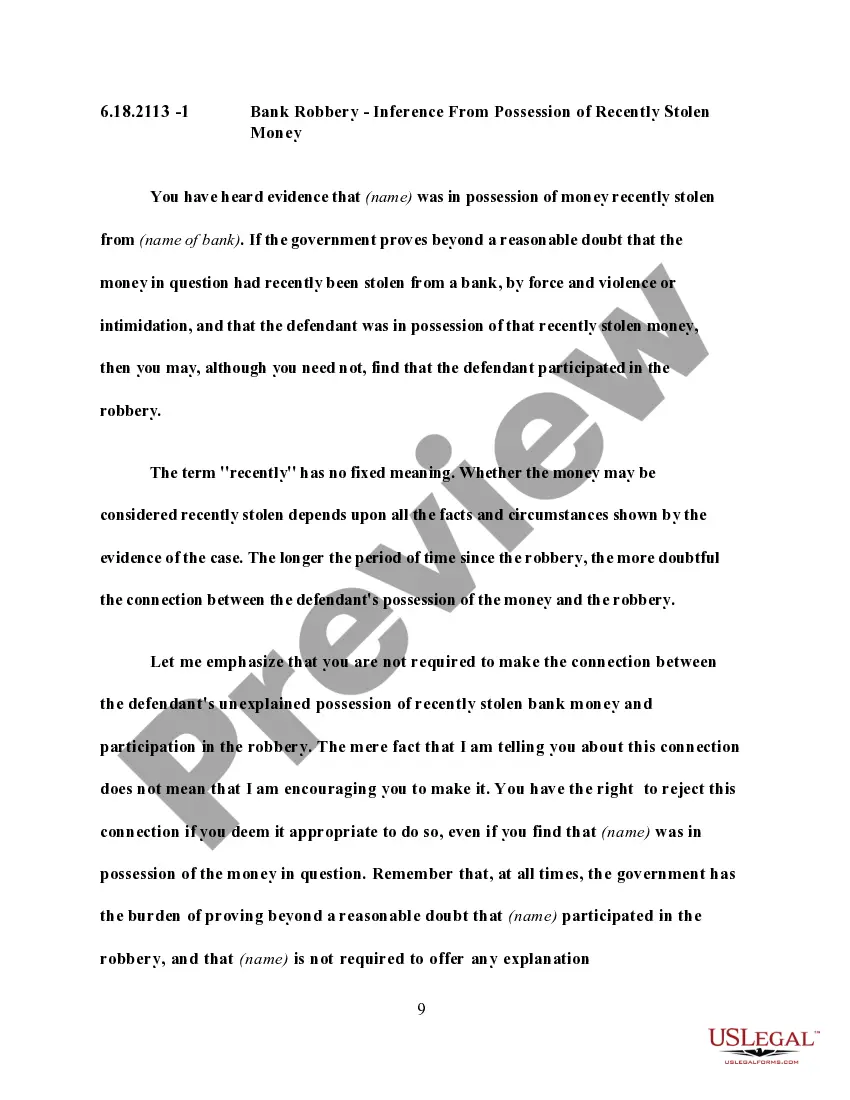
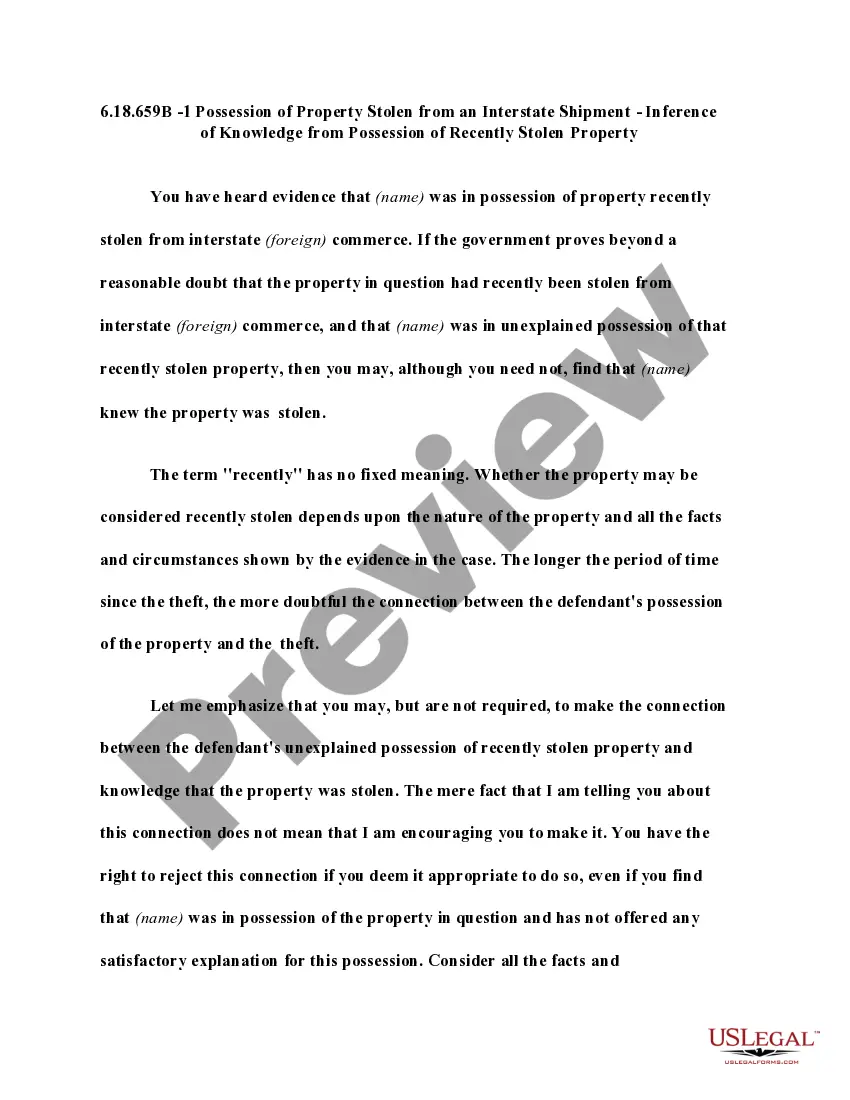
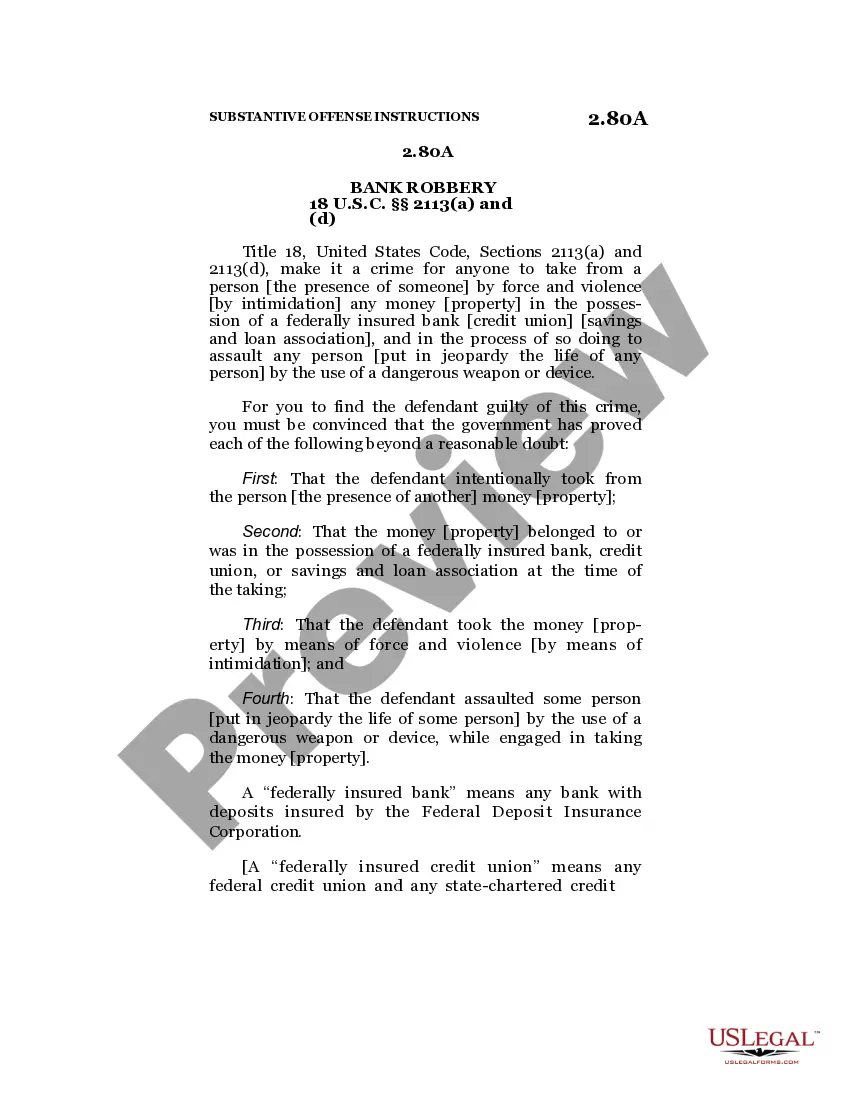
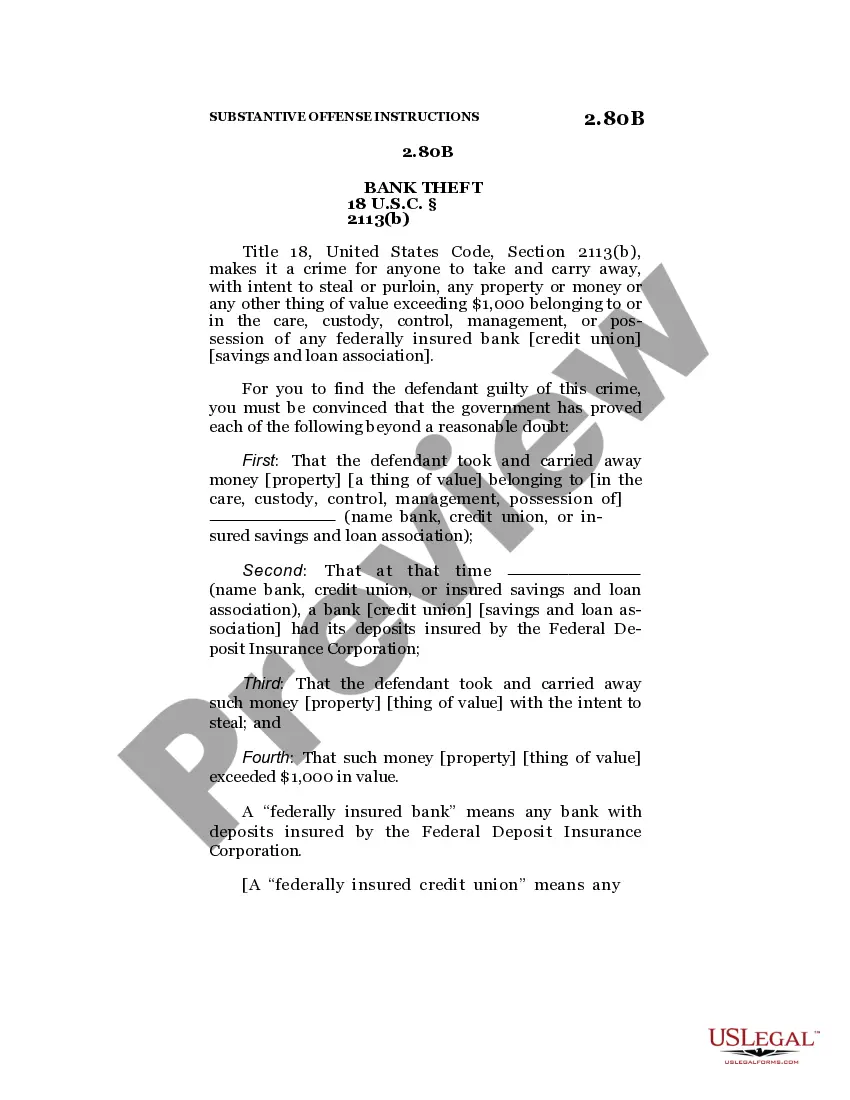
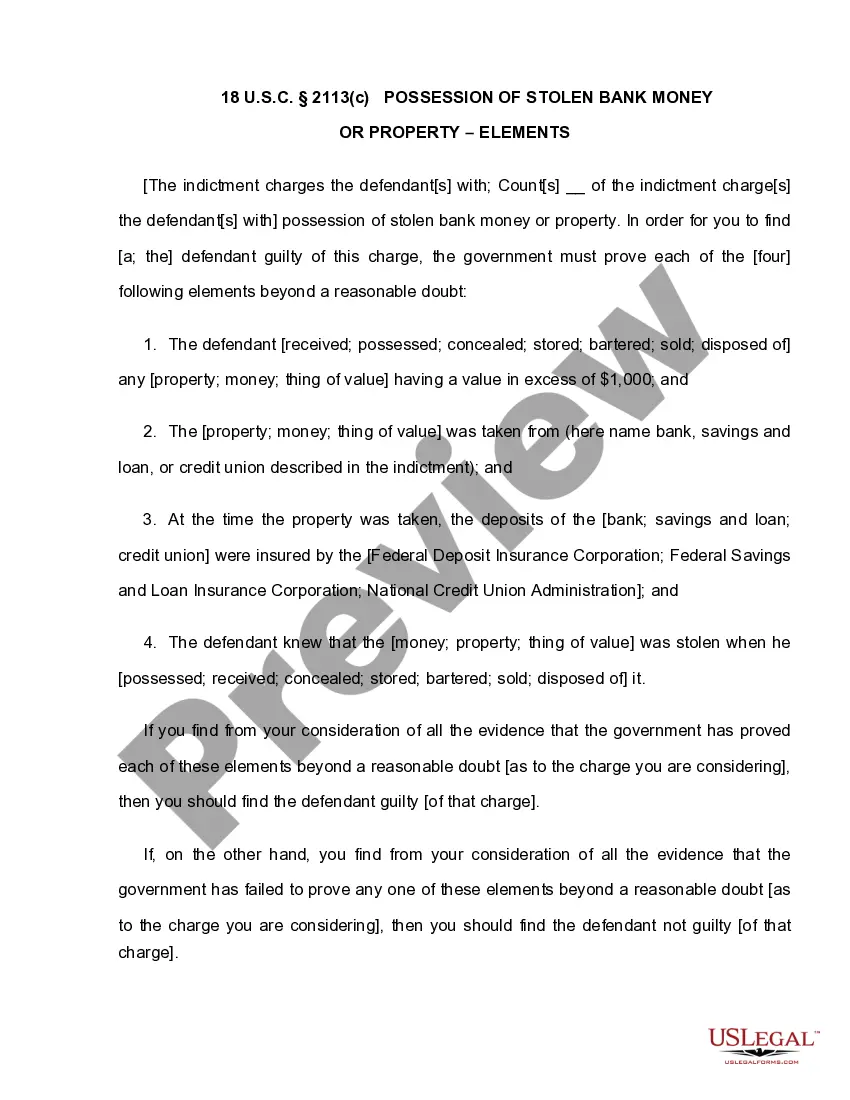
The Bank Robbery - Inference From Possession of Recently Stolen Money form is a legal instruction used in criminal cases where a defendant is accused of participating in a bank robbery. This form assists juries in understanding the implications of a defendantâs possession of money that has been recently stolen, providing a framework to consider whether that possession implies involvement in the robbery. Unlike other forms that may focus on distinct legal definitions or procedures, this form emphasizes the inference that can be drawn from recent possession of stolen money related to bank crimes.
Key parts of this document
- Evidence of possession: Addresses the importance of a defendant being in possession of money stolen from a bank.
- Definition of "recently": Explains that the term does not have a strict duration and varies based on circumstances.
- Jury discretion: States that jurors are not required to link possession of the stolen money to participation in the robbery.
- Burden of proof: Clarifies that the government must prove guilt beyond a reasonable doubt.
- No requirement for explanation: Indicates that the defendant is not obligated to explain the possession of the stolen money.
Situations where this form applies
This form is used in criminal trials involving bank robbery charges. It is applicable when a defendant is found with money that has been identified as stolen from a bank shortly after the theft. This form serves as guidance for jurors assessing whether the evidence of possession is sufficient to imply participation in the robbery under crime laws.
Intended users of this form
- Judges presiding over criminal cases involving bank robbery accusations.
- Jurors tasked with making decisions based on evidence presented during a trial.
- Defense attorneys who wish to understand the inferences applicable to their client's case.
- Prosecutors working to establish a link between a defendant and a robbery charge.
Instructions for completing this form
- Review the evidence presented regarding the possession of recently stolen money.
- Determine the duration since the money was stolen and the circumstances surrounding its possession.
- Assess whether the defendantâs possession can be reasonably linked to the bank robbery.
- Consider the burden of proof required by the prosecution to establish guilt beyond a reasonable doubt.
- Make a judgment about the defendant's connection to the robbery based on the evidence and instructions provided.
Does this form need to be notarized?
In most cases, this form does not require notarization. However, some jurisdictions or signing circumstances might. US Legal Forms offers online notarization powered by Notarize, accessible 24/7 for a quick, remote process.
Get your form ready online
Our built-in tools help you complete, sign, share, and store your documents in one place.
Make edits, fill in missing information, and update formatting in US Legal Forms—just like you would in MS Word.
Download a copy, print it, send it by email, or mail it via USPS—whatever works best for your next step.
Sign and collect signatures with our SignNow integration. Send to multiple recipients, set reminders, and more. Go Premium to unlock E-Sign.
If this form requires notarization, complete it online through a secure video call—no need to meet a notary in person or wait for an appointment.
We protect your documents and personal data by following strict security and privacy standards.

Make edits, fill in missing information, and update formatting in US Legal Forms—just like you would in MS Word.

Download a copy, print it, send it by email, or mail it via USPS—whatever works best for your next step.

Sign and collect signatures with our SignNow integration. Send to multiple recipients, set reminders, and more. Go Premium to unlock E-Sign.

If this form requires notarization, complete it online through a secure video call—no need to meet a notary in person or wait for an appointment.

We protect your documents and personal data by following strict security and privacy standards.
Typical mistakes to avoid
- Assuming that possession alone proves guilt without considering all evidence.
- Not fully understanding the term "recently" and its context in the case.
- Forgetting that the burden of proof lies with the prosecution.
- Misinterpreting juror discretion concerning linking possession to robbery involvement.
Advantages of online completion
- Convenient access to standard jury instruction templates.
- Editability allows for quick adjustments based on specific cases.
- Reliable format that aligns with legal standards across jurisdictions.
Legal use & context
- This form is based on established legal principles regarding the inference of guilt from possession of stolen property.
- Jurors are instructed to consider all relevant circumstances before making an inference.
- The form is designed to uphold the presumption of innocence until proven guilty.
Quick recap
- This form outlines how to approach jury instructions regarding possession of stolen money in bank robbery cases.
- Jurors have discretion but must adhere to the requirement that guilt must be established beyond a reasonable doubt.
- The timeframe for considering money "recently stolen" is flexible and based on case specifics.
Looking for another form?

Form popularity
FAQ
William Francis Sutton Jr. (June 30, 1901 ? November 2, 1980) was an American bank robber. During his forty-year robbery career he stole an estimated $2 million, and he eventually spent more than half of his adult life in prison and escaped three times.
What percentage of bank robbers are eventually apprehended? Approximately 70% of bank robbers are eventually apprehended, either through the efforts of law enforcement agencies or as a result of public tips.
Consequently, many bank robbers are caught the same day. The clearance rate for bank robbery is among the highest of all crimes, at nearly 60%.
It's important to note that a few specific elements have to be present in order for a certain crime to be considered a bank robbery. First, there must be a presence of a gun or other type of weapon (or the implication of a weapon). Also, there has to be a threat of injury or death. Finally, money has to be stolen.
The maximum bank robbery sentence for someone convicted of taking bank property through the use of force or intimidation under 18 USC 2113(a) is up to 20 years in federal prison. If someone steals property from a bank valued under $1,000 without the use of force, he may face up to one year in prison.
Heist at Belfast Bank (2004) The first heist on our list is the notorious Belfast Bank Robbery, which is the biggest unsolved heist in the history of the UK and Europe.
Consequently, many bank robbers are caught the same day. The clearance rate for bank robbery is among the highest of all crimes, at nearly 60%. The urban location of the crime also contributes to its repeat victimization profile, a measure of how quickly a crime victim will suffer a repeat of the original crime.
Approximately 60% of bank robberies in the United States are successful, resulting in the acquisition of money. What is the average amount of money stolen in a bank robbery in the United States? The average amount of money stolen in a bank robbery in the United States is about $10,000.