Agreement for Accord and Satisfaction - Disputed Claim for Personal Injuries or Property Damage
Understanding this form
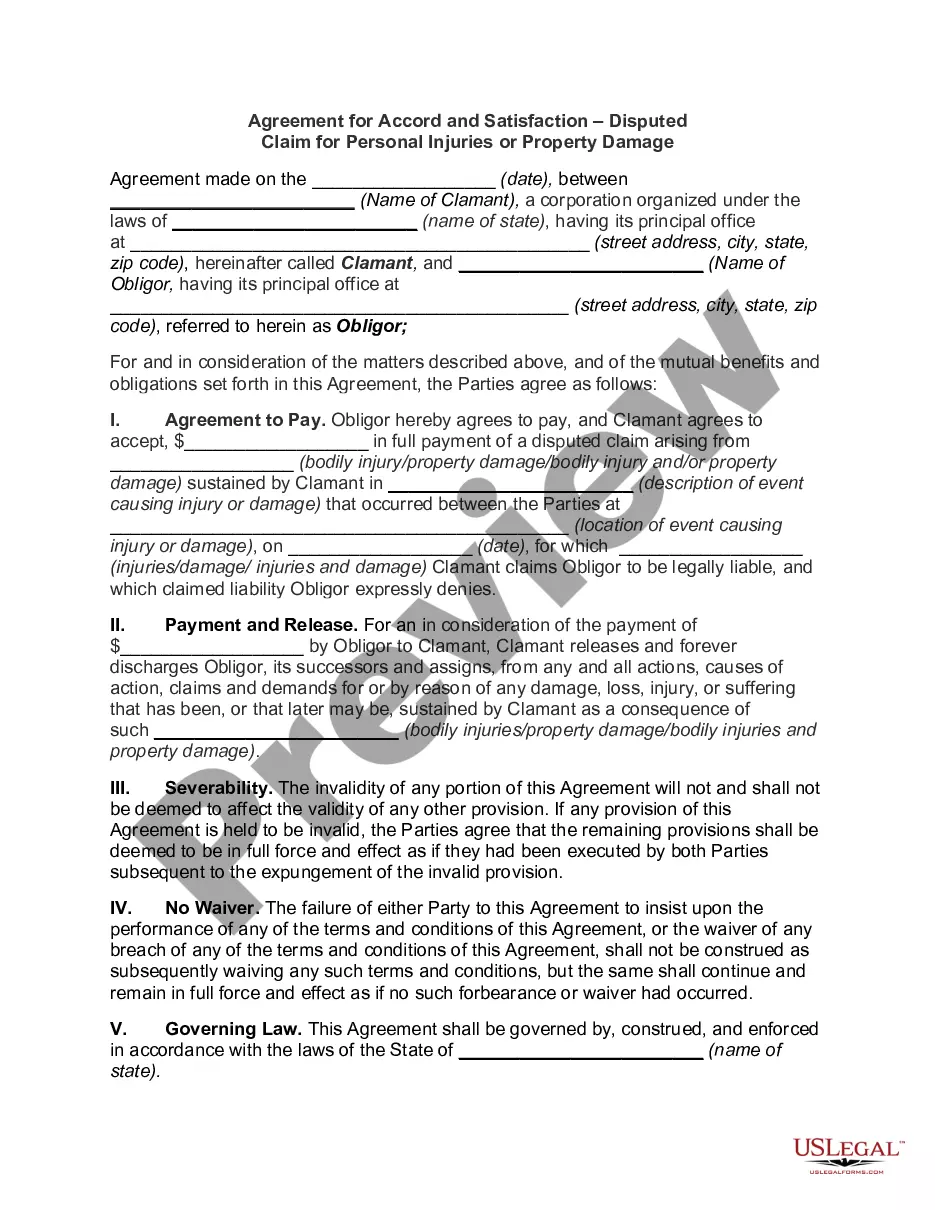
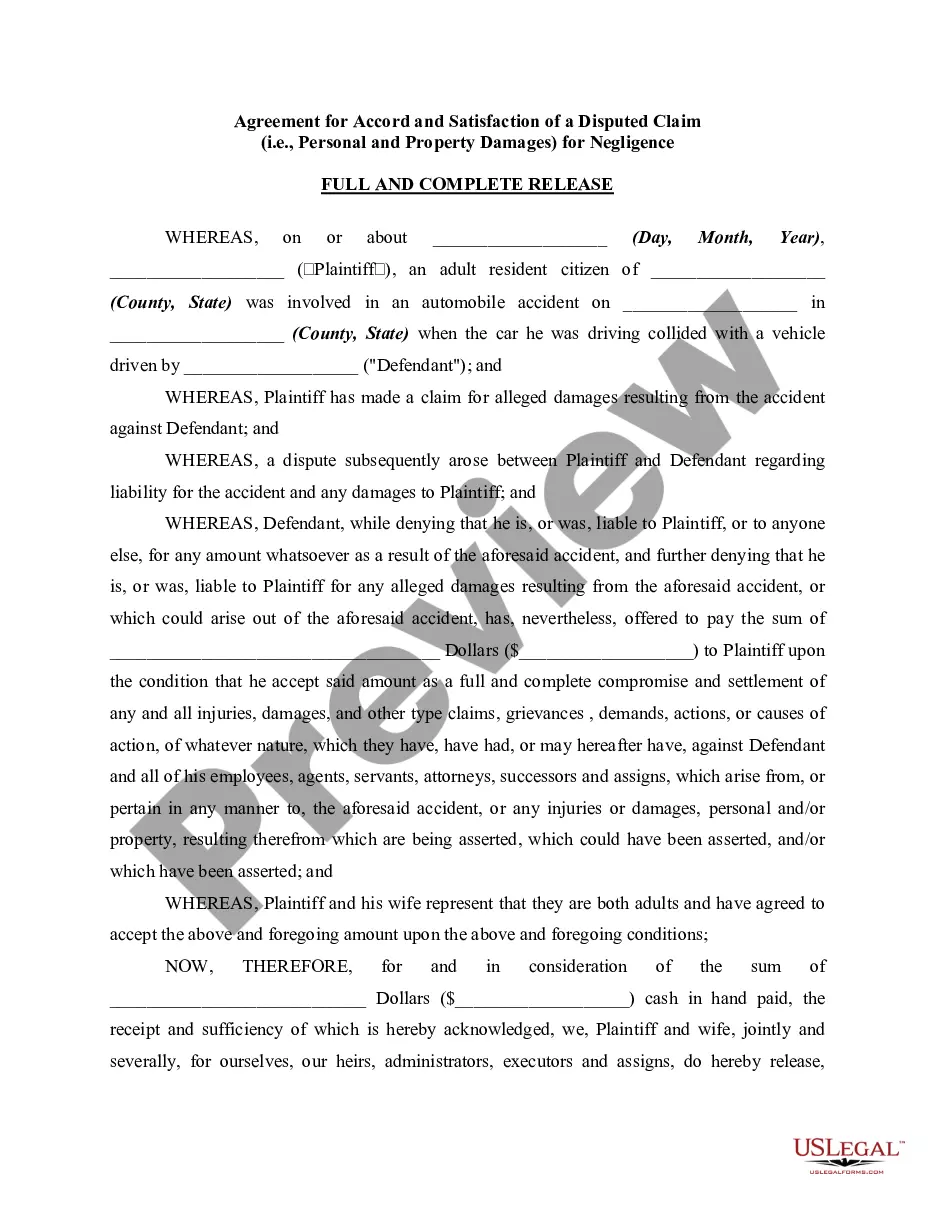
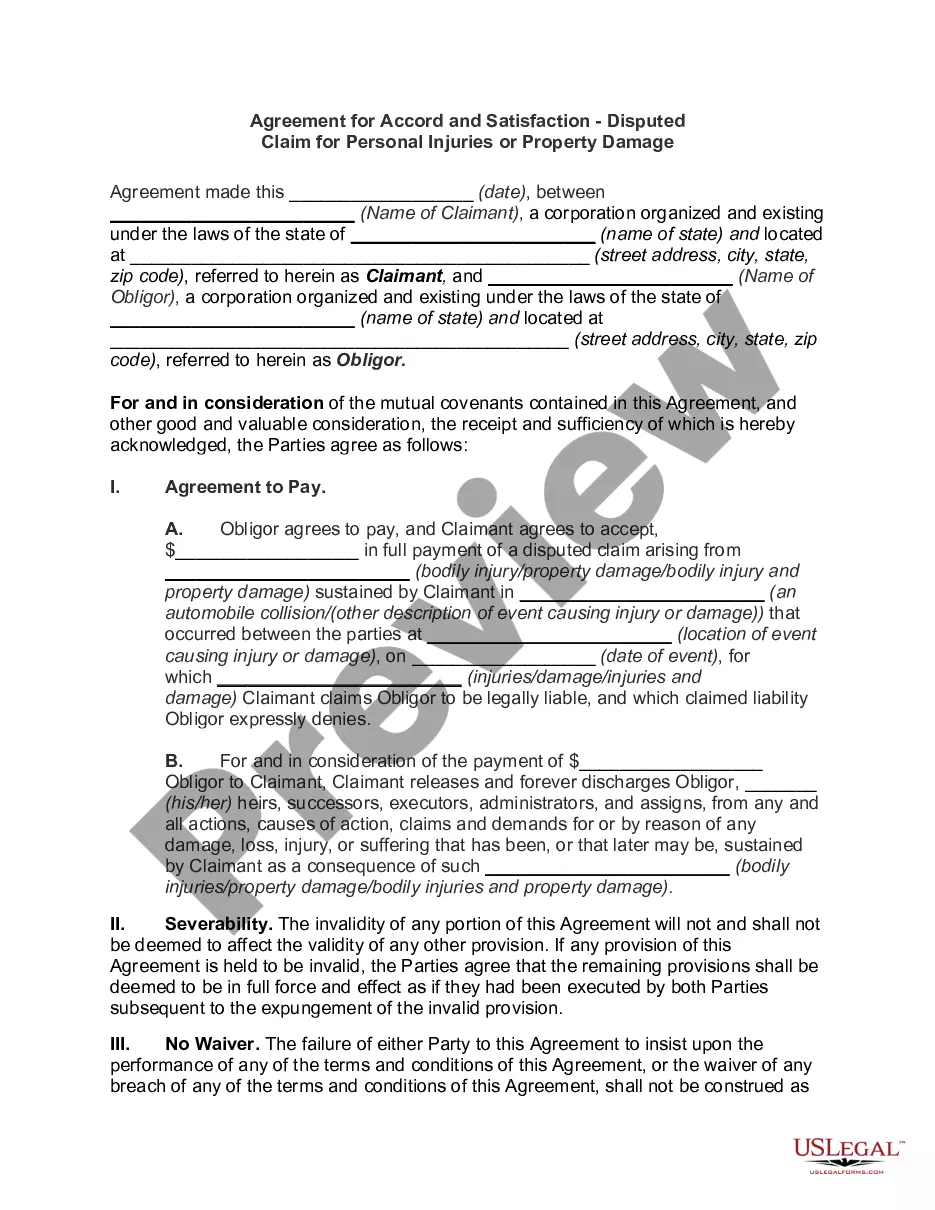
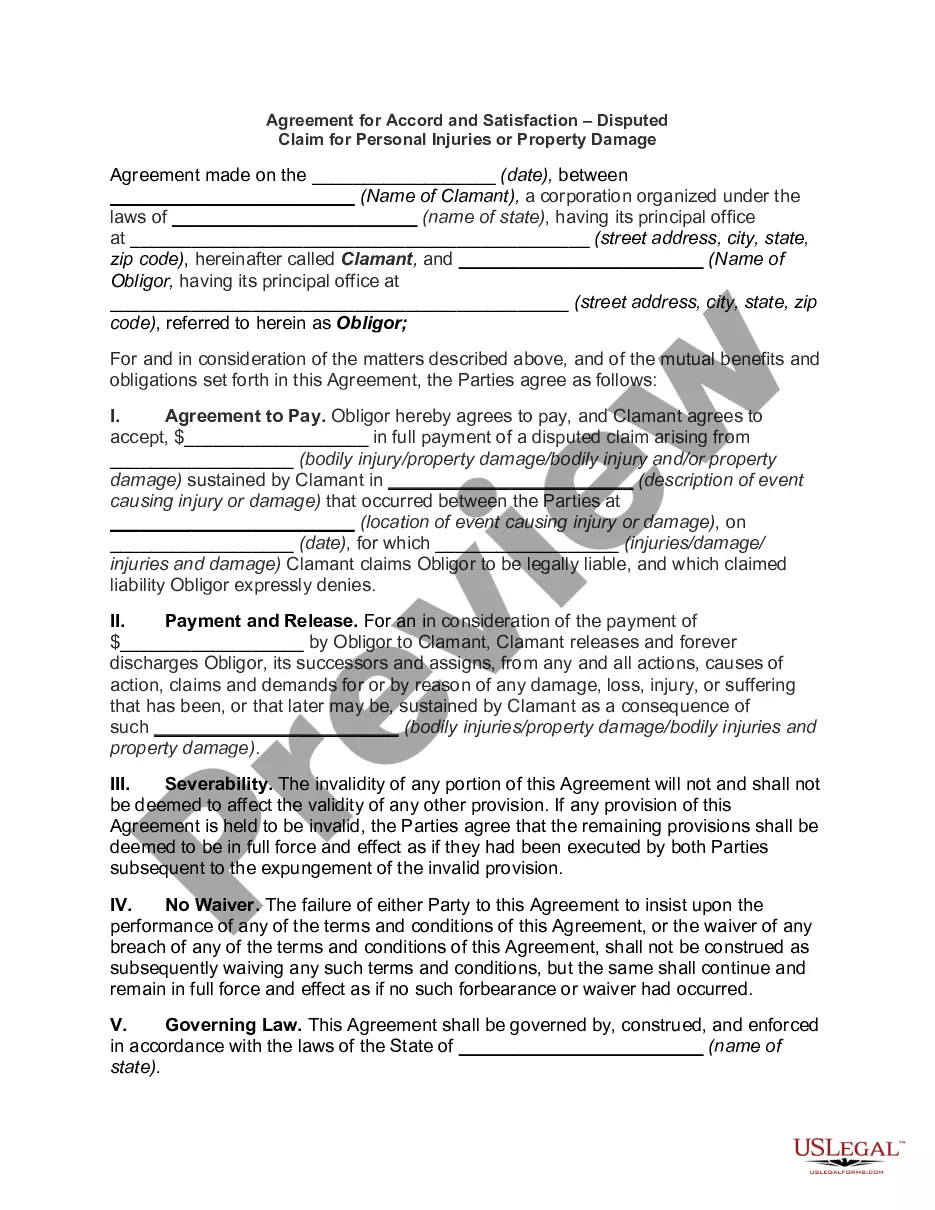
The Agreement for Accord and Satisfaction for Disputed Claims for Personal Injuries or Property Damage is a legal document designed to facilitate the resolution of disputes regarding claims of injury or damage. This form allows the claimant and obligor to mutually agree on a settlement amount, typically in scenarios where the obligor denies liability. By using this agreement, parties can clarify their obligations and prevent further legal actions related to the disputed claim.
Main sections of this form
- Date of the agreement
- Name and contact information of the claimant
- Name and contact information of the obligor
- Details of the disputed claim
- Agreement on payment amount
- Release of claims against the obligor
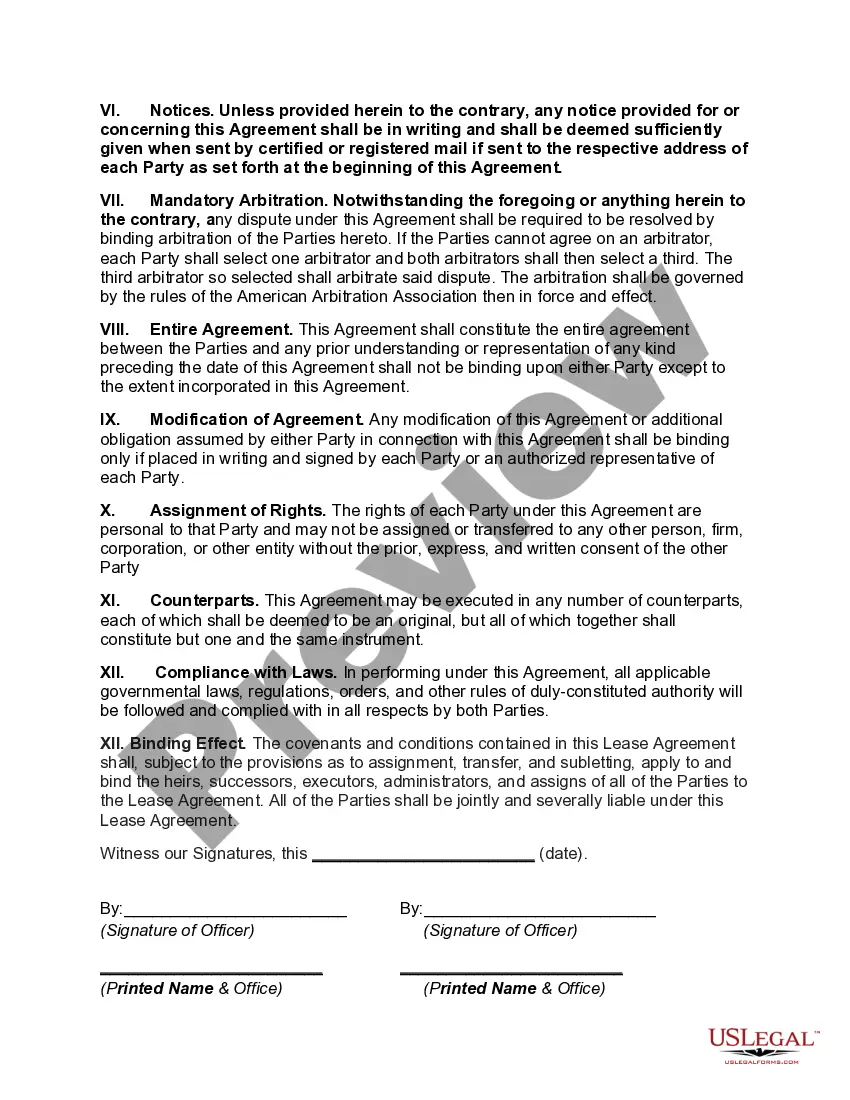
- Governing law and arbitration clauses
- Signature lines for both parties


Situations where this form applies
This form is used when two parties are in dispute regarding claims for personal injuries or property damage. It is particularly appropriate when the obligor denies responsibility for the alleged damages but both parties agree to settle the matter without further litigation. Scenarios may include car accidents, tenant damage claims, or workplace injuries where the parties seek a harmonious resolution.
Who can use this document
This form is intended for:
- Individuals or corporations making claims for personal injuries or property damage
- Obligors who wish to resolve disputes without litigation
- Legal representatives acting on behalf of a claimant or obligor
Steps to complete this form
- Identify the parties involved by filling in the names and contact information for both the claimant and obligor.
- Specify the date the agreement is being made.
- Clearly describe the nature of the disputed claim and specify the agreed-upon settlement amount.
- Both parties should read and understand the release of claims clause and other terms outlined in the agreement.
- Sign and date the agreement, ensuring both parties have a signed copy for their records.
Is notarization required?
This form does not typically require notarization unless specified by local law. However, it is advisable to consult with a legal professional to ensure compliance with your jurisdiction's requirements.
Get your form ready online
Our built-in tools help you complete, sign, share, and store your documents in one place.
Make edits, fill in missing information, and update formatting in US Legal Forms—just like you would in MS Word.
Download a copy, print it, send it by email, or mail it via USPS—whatever works best for your next step.
Sign and collect signatures with our SignNow integration. Send to multiple recipients, set reminders, and more. Go Premium to unlock E-Sign.
If this form requires notarization, complete it online through a secure video call—no need to meet a notary in person or wait for an appointment.
We protect your documents and personal data by following strict security and privacy standards.

Make edits, fill in missing information, and update formatting in US Legal Forms—just like you would in MS Word.

Download a copy, print it, send it by email, or mail it via USPS—whatever works best for your next step.

Sign and collect signatures with our SignNow integration. Send to multiple recipients, set reminders, and more. Go Premium to unlock E-Sign.

If this form requires notarization, complete it online through a secure video call—no need to meet a notary in person or wait for an appointment.

We protect your documents and personal data by following strict security and privacy standards.
Typical mistakes to avoid
- Failing to specify a clear and agreed-upon amount for settlement.
- Not accurately detailing the nature of the disputed claim.
- Neglecting to obtain both parties' signatures.
- Overlooking state-specific legal requirements which may affect the validity of the agreement.
Benefits of completing this form online
- Convenience of accessing and completing the form from anywhere.
- Editable templates allow for easy customization to fit specific circumstances.
- Reliable legal language crafted by licensed attorneys to ensure enforceability.
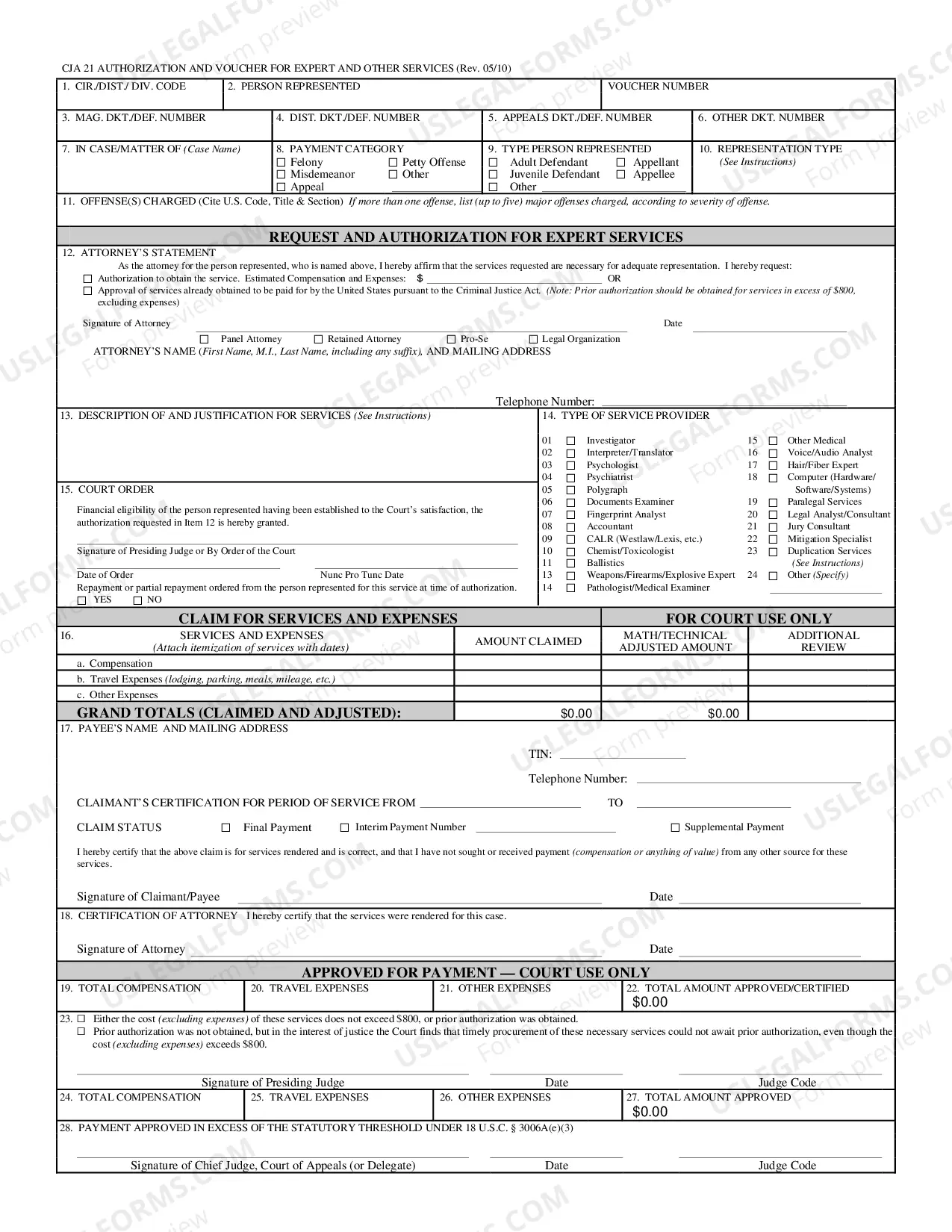
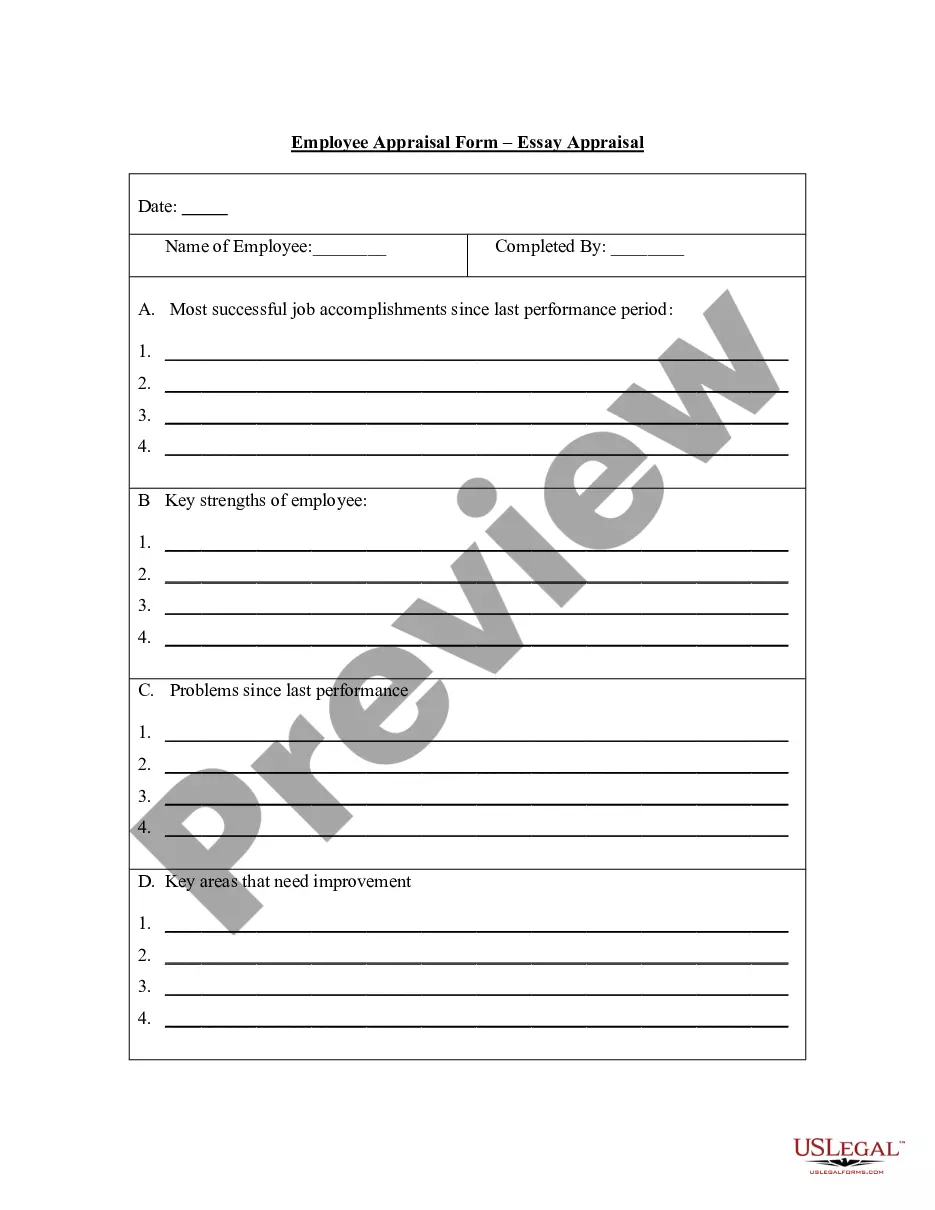
Looking for another form?
Form popularity
FAQ
Remission or waiver implies accepting a lesser performance of the contract or complete abandonment of the contractual obligations. However, in and satisfaction, the old obligations are replaced by new ones.
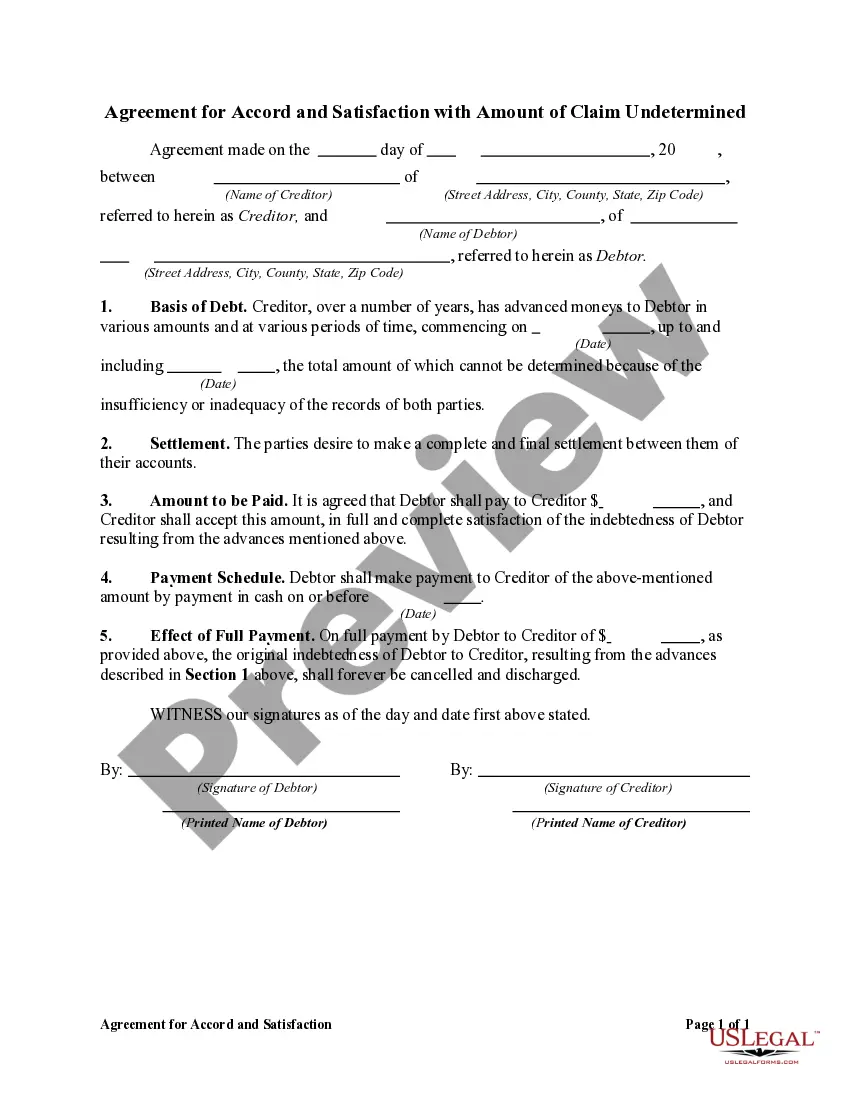
An ?? is an agreement where one of the parties agrees to accept something different from the amount believed owed in order to settle a disputed claim. The ?satisfaction? is the execution or acceptance of this agreement, and once satisfaction occurs, the previous contract is extinguished.
554, 561 (2001), for the rule that three elements must exist for there to be an ? and satisfaction?: (a) there must be a (good faith) dispute about the existence or extent of liability, (b) after the dispute arises, the parties must enter into an agreement in which one party must agree to pay more than that party
And satisfaction occurs when a business tries to get its full asking price for goods or services sold to a consumer, who in turn asserts he or she is not obligated to pay the full price billed because of a defect or breach of warranty relating to the goods and services.
And satisfaction refers to the agreement () between two contracting parties to accept alternate performance to discharge a pre-existing duty between them and the subsequent performance (satisfaction) of that agreement. The new performance is called the .
An and satisfaction is a legal contract whereby two parties agree to discharge a tort claim, contract, or other liability for an amount based on terms that differ from the original amount of the contract or claim. and satisfaction is also used to settle legal claims prior to bringing them to court.
Under most state law, a valid and satisfaction requires four elements as a minimum, usually, (1) proper subject matter, (2) competent parties, (3) meeting of the minds of the parties and (4) adequate consideration.