Agreement to Dispose of Solid Radioactive Wastes on Land
About this form
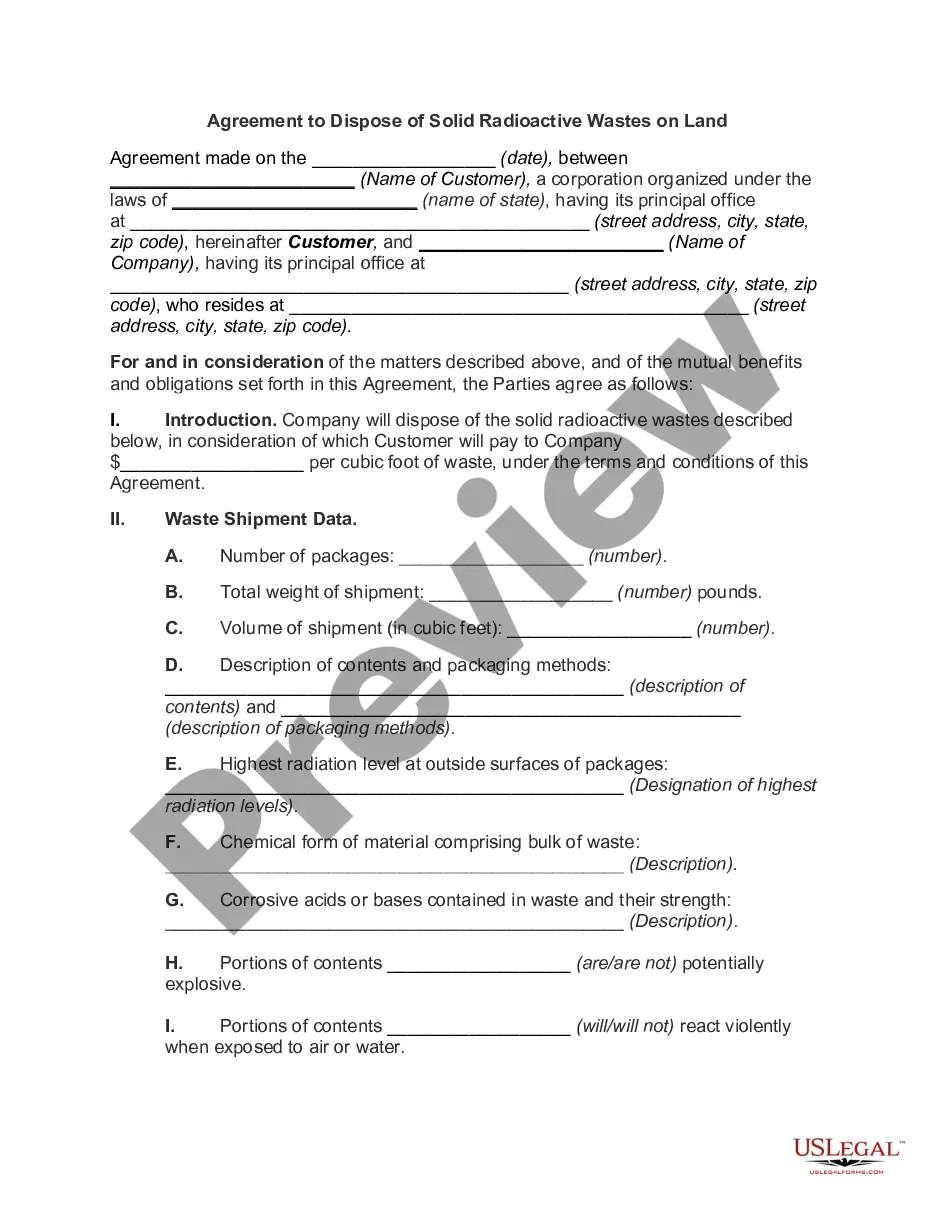
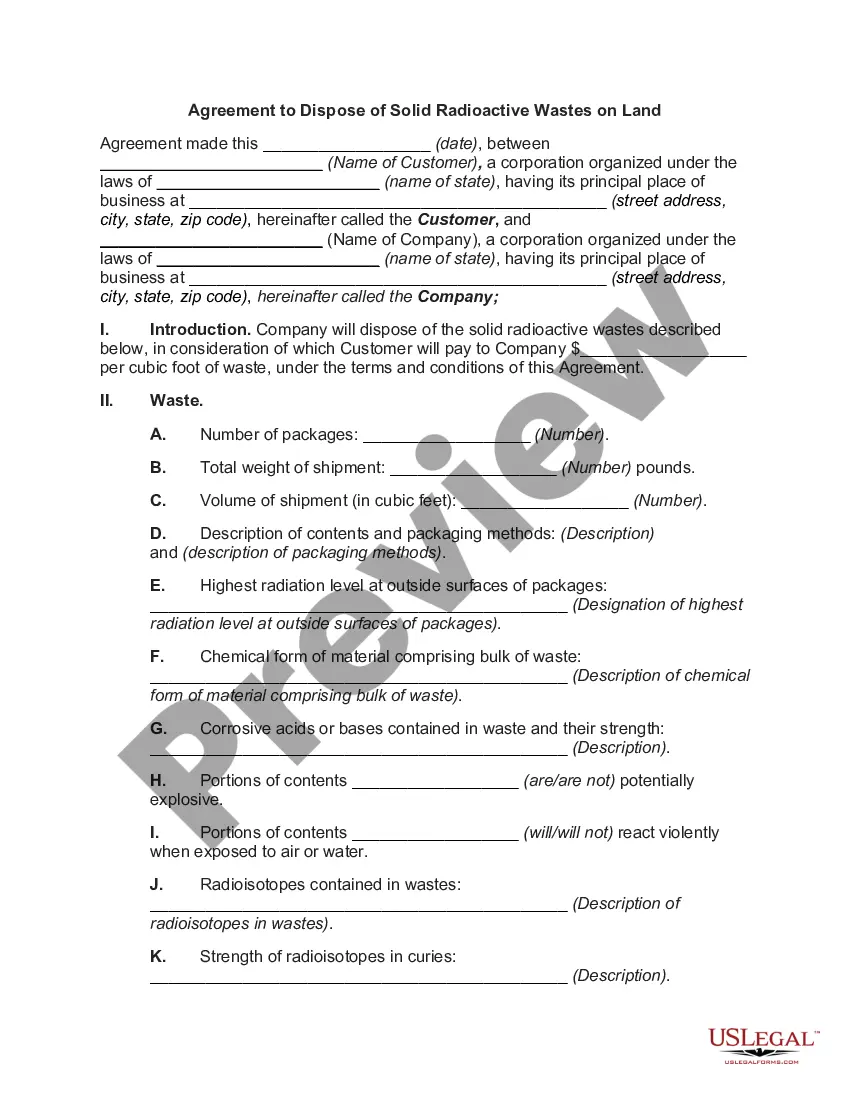
The Agreement to Dispose of Solid Radioactive Wastes on Land is a legal document that outlines the terms under which a company agrees to dispose of solid radioactive waste generated by various industries. This agreement ensures proper handling and compliance with legal regulations, making it essential for industries involved in mining, nuclear power generation, medicine, and scientific research. Unlike disposal agreements for liquid wastes, this form specifically deals with solid radioactive materials, ensuring that both parties are legally protected during the disposal process.
Key parts of this document
- Introduction specifying the disposal agreement and payment terms.
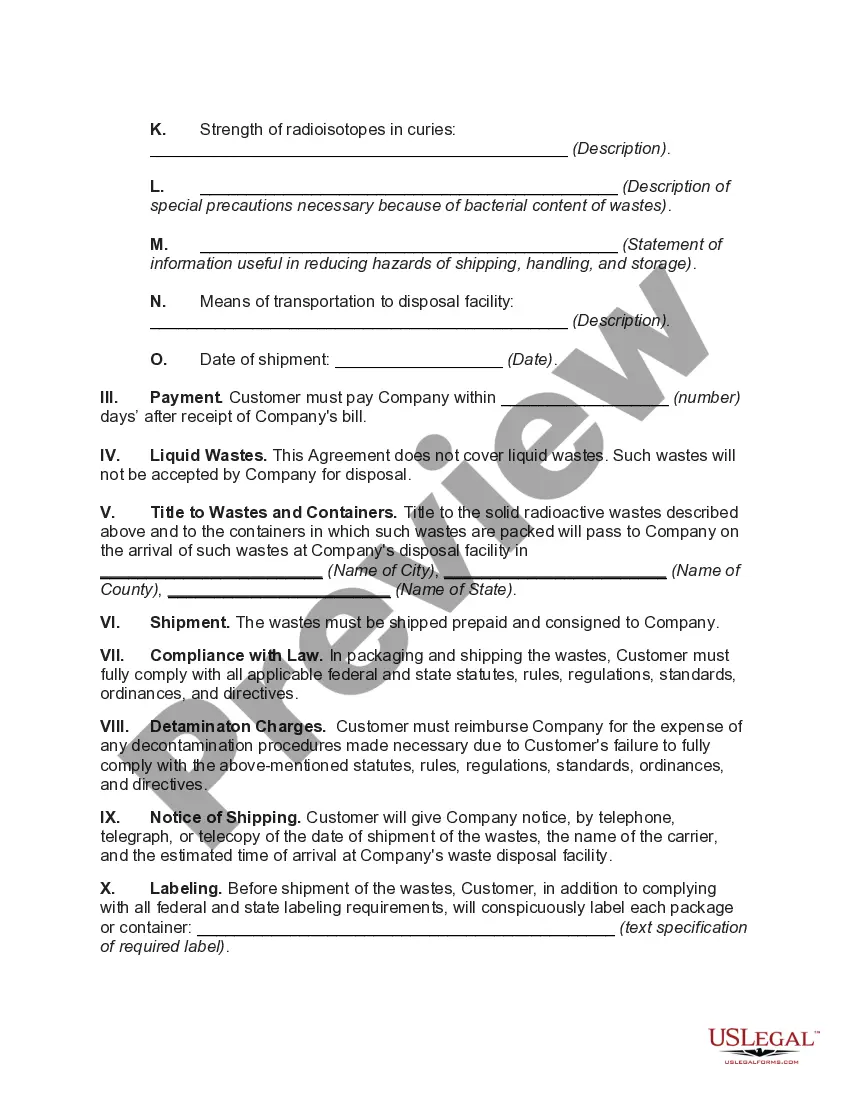
- Detailed waste shipment data, including volume, weight, and radiation levels.
- Payment terms outlining the timeline for payment after the invoice.
- Compliance requirements with federal and state laws regarding waste disposal.
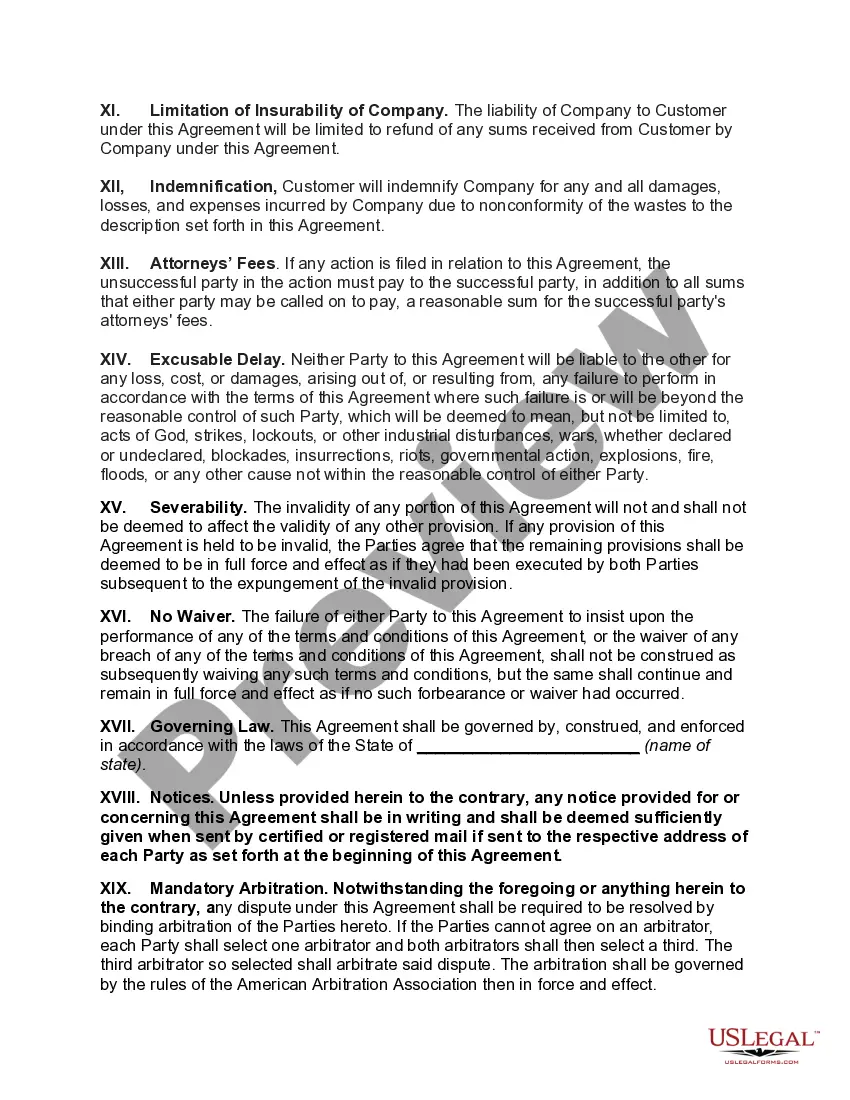
- Indemnification clauses protecting the disposal company from liability.
- Signatures of authorized officers to validate the agreement.
When to use this form
This form should be used when a business or organization needs to legally dispose of solid radioactive wastes. It is particularly relevant when the waste is generated from activities like mining operations, nuclear power production, medical procedures involving radioactive materials, or certain types of scientific research. Using this agreement helps ensure compliance with regulatory requirements and protects both the disposal company and the waste-producing entity.
Who this form is for
- Corporations generating solid radioactive waste that require safe disposal.
- Nuclear power plants practicing waste management.
- Medical facilities handling radioactive materials for diagnoses or treatments.
- Research institutions conducting experiments involving radioactive substances.
How to complete this form
- Identify the parties involved by entering the names and addresses of the Customer and the Company.
- Specify the date of the agreement and the payment per cubic foot of waste.
- Fill in the shipment data, including the number of packages and total weight.
- Describe the contents of the waste, including any hazardous characteristics.
- Ensure both parties review and sign the agreement to make it legally binding.
Does this document require notarization?
This form does not typically require notarization unless specified by local law. Ensure you check the local regulations to confirm whether notarization is needed for legal validity.
Get your form ready online
Our built-in tools help you complete, sign, share, and store your documents in one place.
Make edits, fill in missing information, and update formatting in US Legal Forms—just like you would in MS Word.
Download a copy, print it, send it by email, or mail it via USPS—whatever works best for your next step.
Sign and collect signatures with our SignNow integration. Send to multiple recipients, set reminders, and more. Go Premium to unlock E-Sign.
If this form requires notarization, complete it online through a secure video call—no need to meet a notary in person or wait for an appointment.
We protect your documents and personal data by following strict security and privacy standards.

Make edits, fill in missing information, and update formatting in US Legal Forms—just like you would in MS Word.

Download a copy, print it, send it by email, or mail it via USPS—whatever works best for your next step.

Sign and collect signatures with our SignNow integration. Send to multiple recipients, set reminders, and more. Go Premium to unlock E-Sign.

If this form requires notarization, complete it online through a secure video call—no need to meet a notary in person or wait for an appointment.

We protect your documents and personal data by following strict security and privacy standards.
Typical mistakes to avoid
- Failing to provide complete and accurate waste shipment data.
- Not including proper descriptions of waste characteristics or labeling requirements.
- Neglecting to review state-specific disposal regulations.
- Not obtaining the necessary signatures from authorized representatives.
Advantages of online completion
- Accessible from anywhere, allowing for convenient completion and downloading.
- Editable fields allow for precise input of necessary information.
- Provides a reliable structure ensuring compliance with legal standards.
- Saves time and resources compared to drafting a custom agreement.
Legal use & context
- The Agreement provides a legally binding framework for the disposal of radioactive waste.
- Ensures compliance with federal and state statutes regarding radioactive materials.
- Protects both parties from potential liability associated with waste disposal.
Key takeaways
- This agreement is essential for businesses dealing with solid radioactive waste.
- It helps ensure safe and compliant disposal while detailing payment terms.
- Completing the form accurately is crucial to avoid legal pitfalls.
Looking for another form?
Form popularity
FAQ
The Nuclear Waste Policy Act (NWPA) supports the use of deep geologic repositories for the safe storage and/or disposal of radioactive waste. The Act establishes procedures to evaluate and select sites for geologic repositories and for the interaction of state and federal governments.
Select a storage container made of material compatible with the chemical it will hold. Complete and attach a hazardous waste tag to the bag or container.Store the container in the radioactive waste storage area of the lab.Request hazardous waste collection when you're ready for a waste pick up.
Direct disposal The used fuel is placed in canisters which, in turn, are placed in tunnels and subsequently sealed with rocks and clay. The waste from recycling ? the so-called fission products ? will also be placed in the repository.
Disposal of low-level waste is straightforward and can be undertaken safely almost anywhere. Storage of used fuel is normally under water for at least five years and then often in dry storage. Deep geological disposal is widely agreed to be the best solution for final disposal of the most radioactive waste produced.
Nuclear Waste Disposal Methods Geological Disposal. The process of geological disposal centers on burrowing nuclear waste into the ground to the point where it is out of human reach.Reprocessing.Transmutation.Space Disposal.Conclusion.References.
Dealing with Uranium Waste Uranium Waste cannot be fed into an AWESOME Sink, (legitimately) deleted or destroyed; it must be stored indefinitely or reprocessed into Plutonium Fuel Rods. It is advised to reprocess it rather than store it.
Most of this waste is stored in tanks at 3 DOE sites. ing to federal law, certain high-level mixed waste must be vitrified?a process in which the waste is immobilized in glass?and disposed of in a deep geologic repository.
The Low-level Radioactive Waste Policy Amendments Act of 1985 gave the states responsibility for the disposal of their low-level radioactive waste. The Act encouraged the states to enter into compacts that would allow them to dispose of waste at a common disposal facility.