Stock Redemption Agreement between Corporation and Stockholder --Redemption on Death of Stockholder for Purpose of Payment of Estate Taxes
Understanding this form
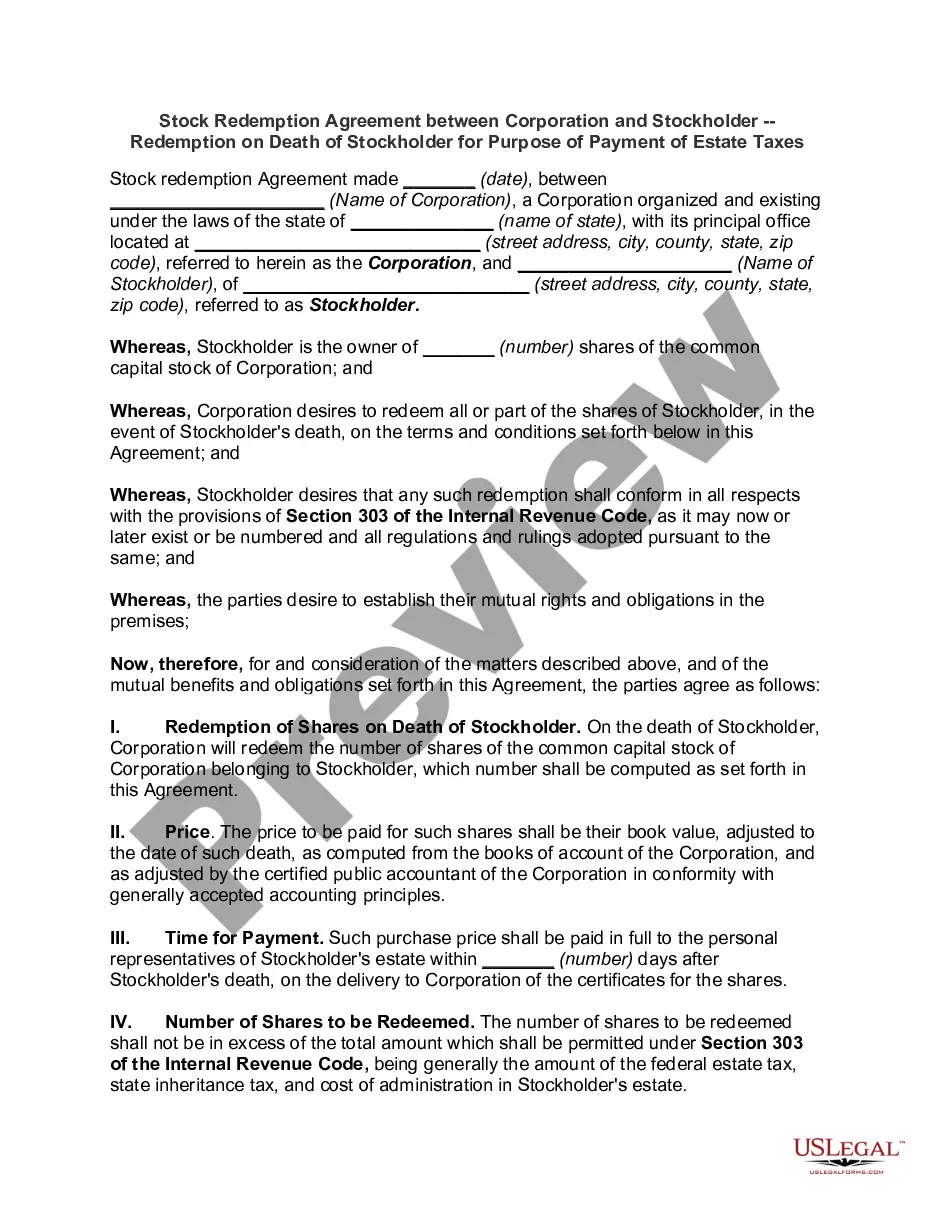
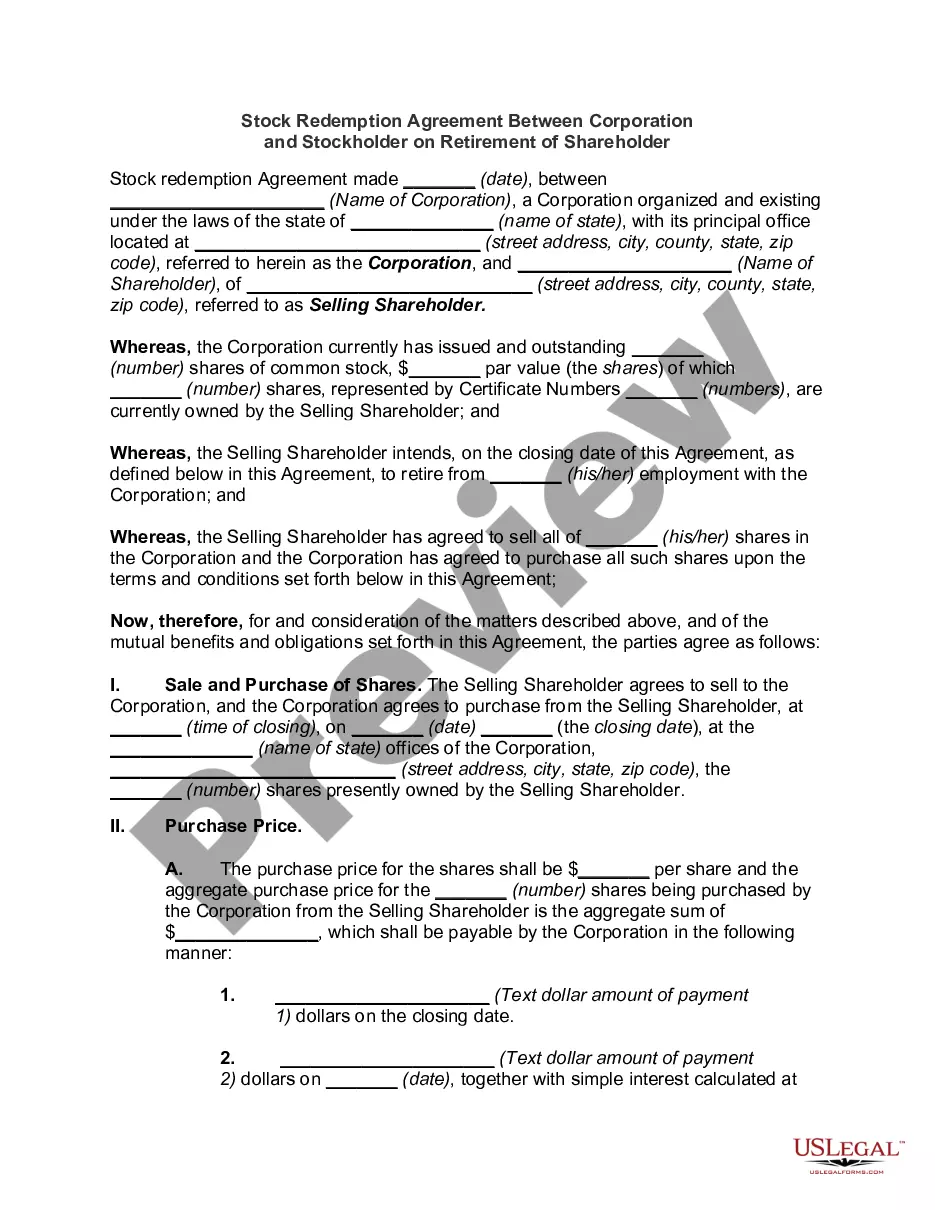
A stock redemption agreement is a legal document that outlines the terms under which a corporation will buy back shares from a stockholder upon their death. This specific Stock Redemption Agreement ensures that the corporation can redeem the shares of a deceased stockholder for the purpose of settling estate taxes. It clarifies the obligations of both the corporation and the stockholder or their estate, differentiating it from standard buy-sell agreements by focusing on redemption due to death and estate tax considerations.
What’s included in this form
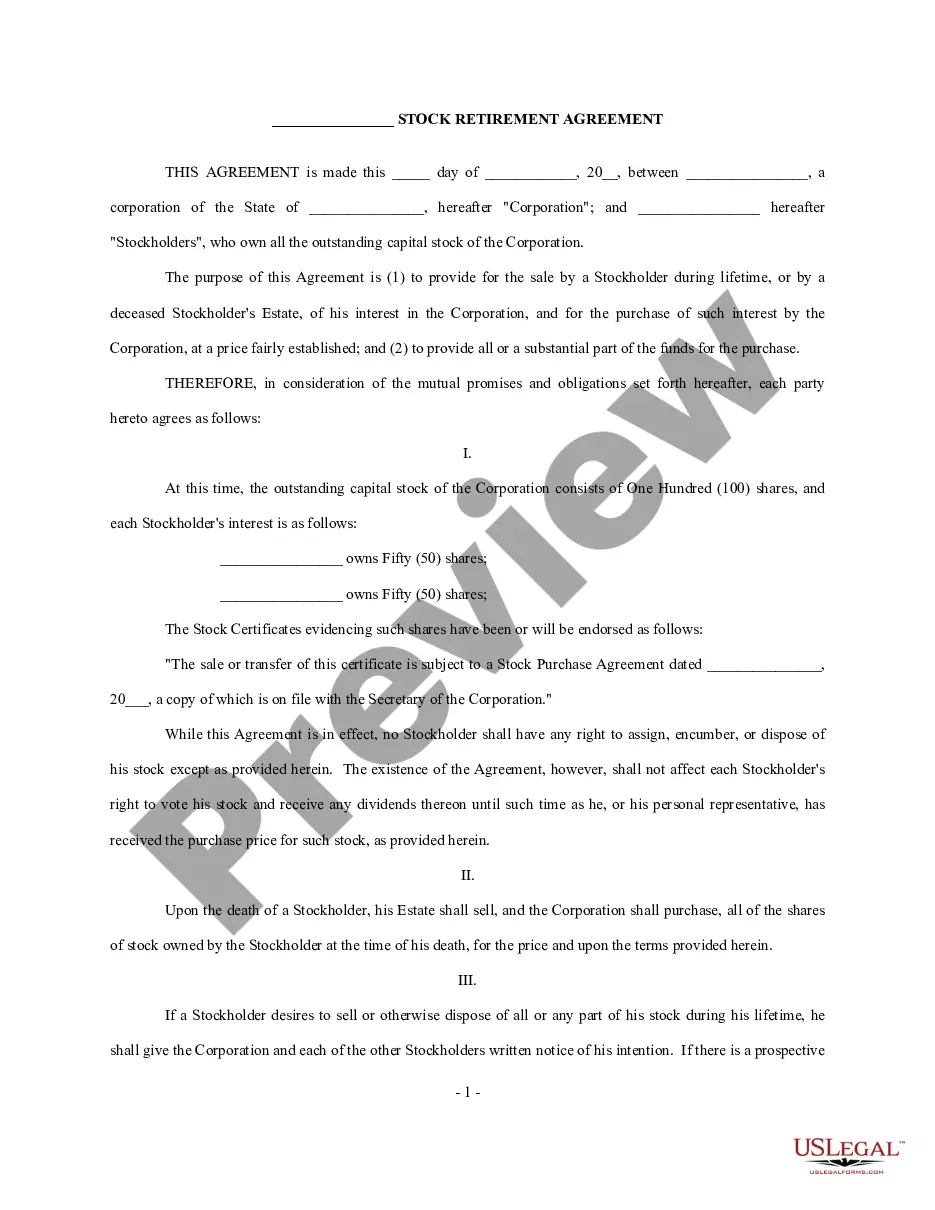
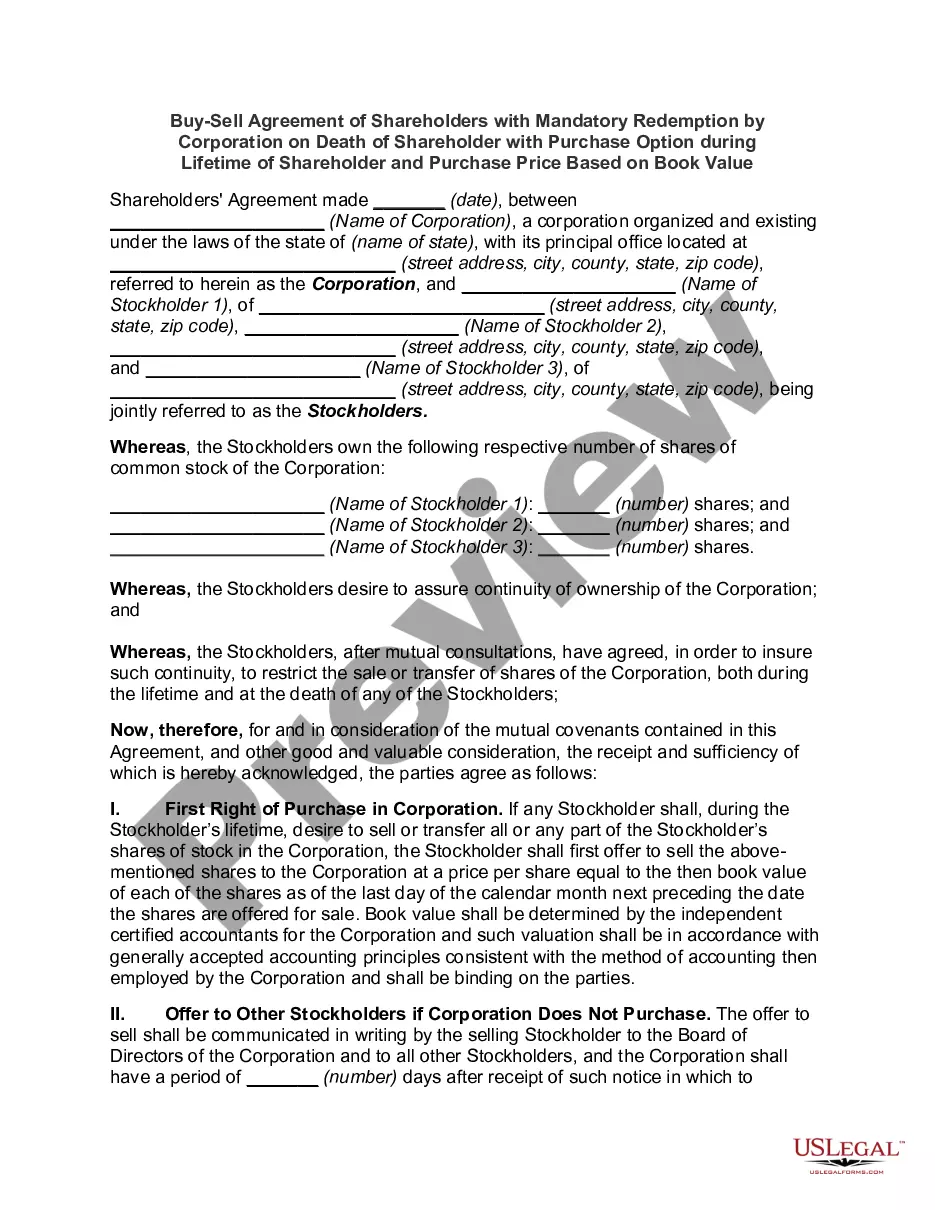
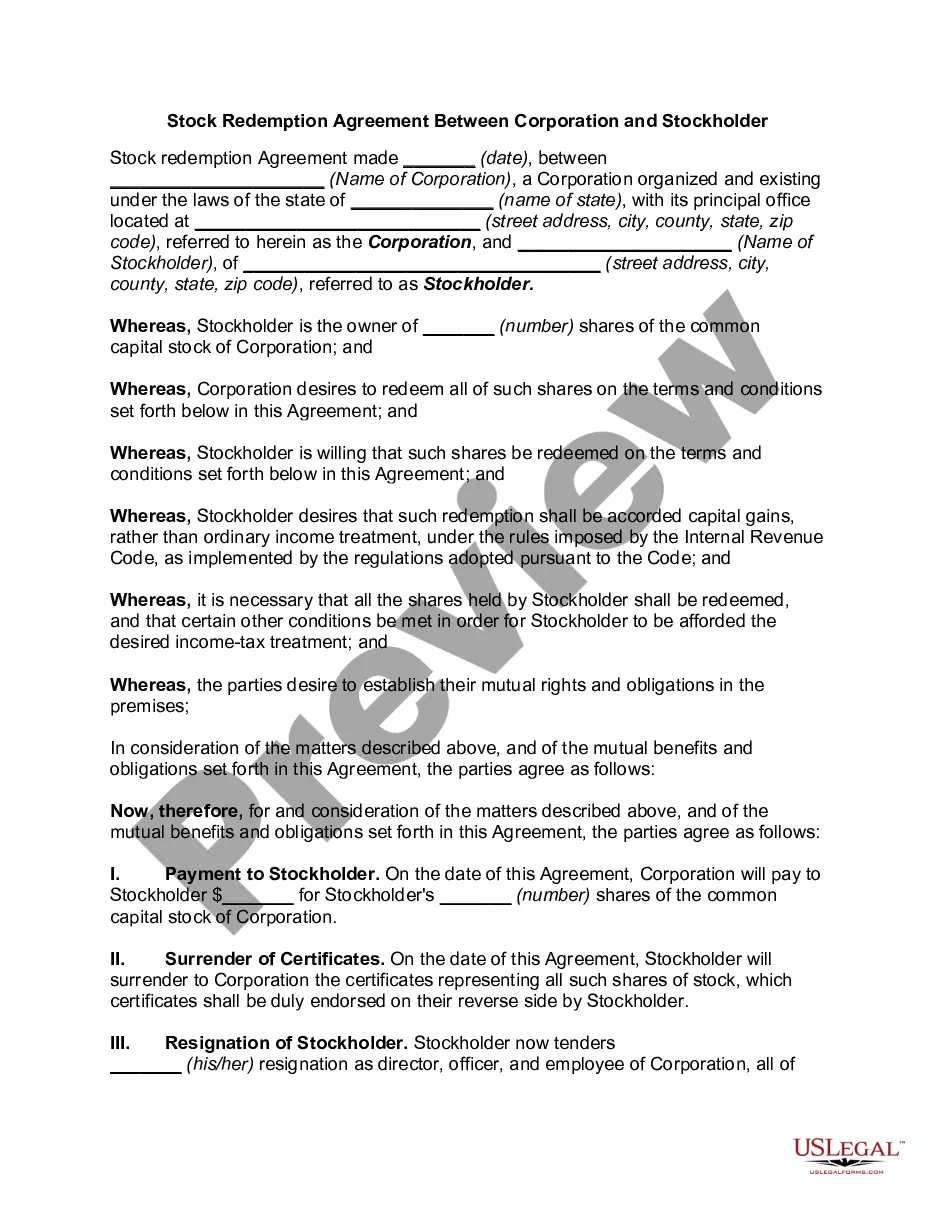
- Identification of the corporation and stockholder involved in the agreement.
- Conditions under which the shares will be redeemed, specifically upon the stockholder's death.
- Determination of the redemption price based on the book value of the shares at the time of death.
- Timeline for payment to the stockholder's estate after the stockholder's death.
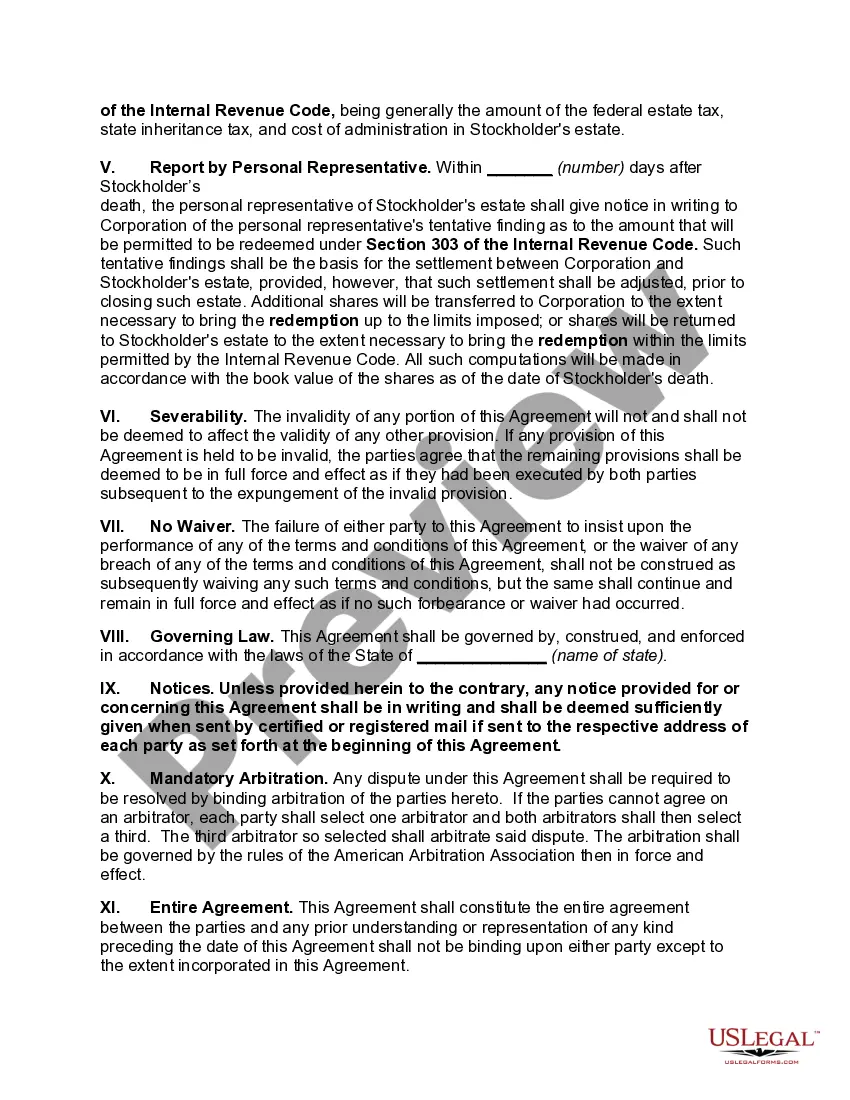
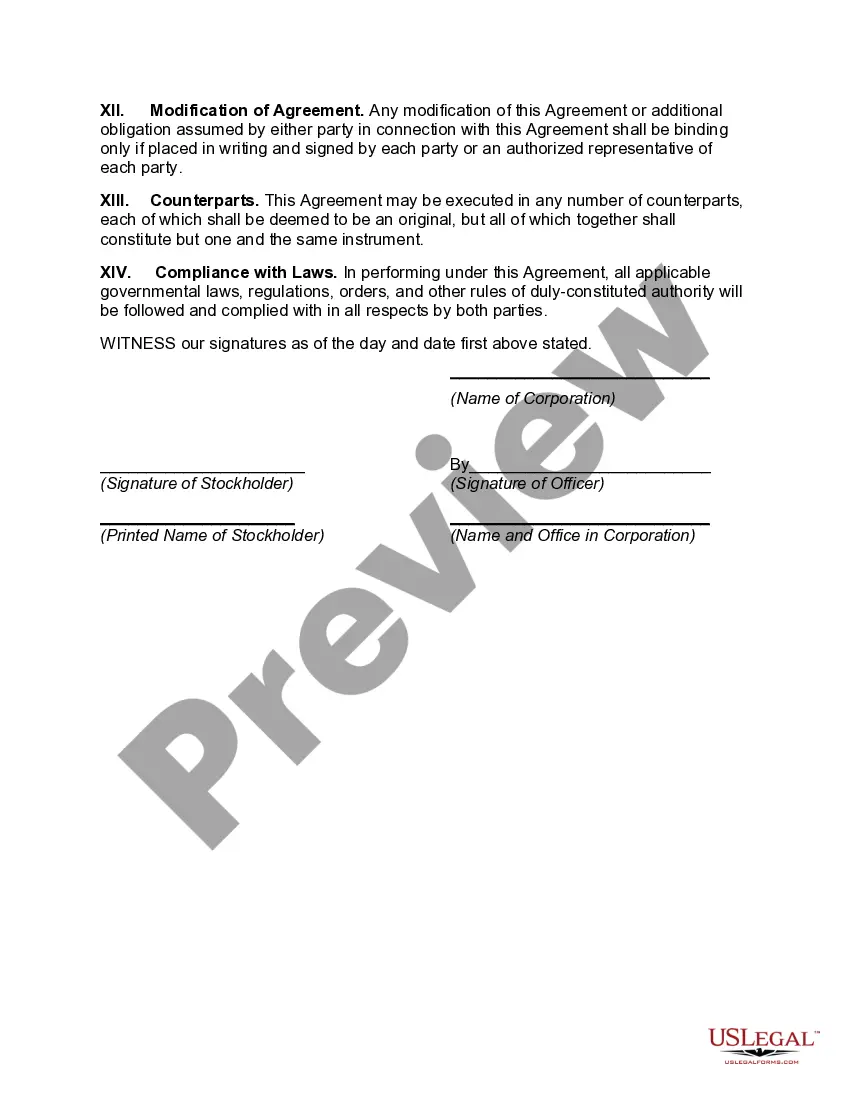
- Requirements for the personal representative of the deceased stockholder's estate to notify the corporation.
- Clauses addressing severability, waiver, governing law, and dispute resolution processes.
Common use cases
This form is essential when a stockholder of a corporation passes away, and the corporation needs to redeem their shares to facilitate the payment of estate taxes. It is particularly relevant in closely held corporations where ownership transfer affects tax liabilities and financial management. This agreement ensures a smooth transition by clarifying the stock redemption process under specific tax guidelines.
Who can use this document
- Corporations that wish to establish a buy-back provision for stockholder shares following a death.
- Stockholders who want to ensure their shares are redeemed by the corporation upon their death.
- Executors or personal representatives managing an estate of a deceased stockholder.
Steps to complete this form
- Identify the parties: Enter the names and addresses of both the corporation and the stockholder.
- Define the shares: Specify the number of shares owned by the stockholder that are subject to redemption.
- Calculate the price: Determine the book value of the shares at the time of the stockholder's death.
- Set payment terms: Specify how many days after death the corporation must pay the estate for the shares.
- Include governing law: Indicate which stateâs laws govern the agreement.
- Sign and date: Ensure all parties sign the agreement where indicated.
Is notarization required?
This form does not typically require notarization unless specified by local law. However, it's recommended to check with your legal advisor to ensure all requirements are met according to specific jurisdictional rules.
Get your form ready online
Our built-in tools help you complete, sign, share, and store your documents in one place.
Make edits, fill in missing information, and update formatting in US Legal Forms—just like you would in MS Word.
Download a copy, print it, send it by email, or mail it via USPS—whatever works best for your next step.
Sign and collect signatures with our SignNow integration. Send to multiple recipients, set reminders, and more. Go Premium to unlock E-Sign.
If this form requires notarization, complete it online through a secure video call—no need to meet a notary in person or wait for an appointment.
We protect your documents and personal data by following strict security and privacy standards.

Make edits, fill in missing information, and update formatting in US Legal Forms—just like you would in MS Word.

Download a copy, print it, send it by email, or mail it via USPS—whatever works best for your next step.

Sign and collect signatures with our SignNow integration. Send to multiple recipients, set reminders, and more. Go Premium to unlock E-Sign.

If this form requires notarization, complete it online through a secure video call—no need to meet a notary in person or wait for an appointment.

We protect your documents and personal data by following strict security and privacy standards.
Common mistakes
- Failing to update the agreement if ownership shares change or additional stockholders are added.
- Not specifying the correct number of shares to be redeemed or the calculation method for the redemption price.
- Neglecting to clarify the timeline for payment, which can lead to disputes later on.
- Omitting necessary signatures from authorized corporate officers or the stockholder.
Why complete this form online
- Instant access: Download the form immediately when you need it.
- Easy customization: Fill in specific details relevant to your corporation and stockholder.
- Legal clarity: Templates are drafted by licensed attorneys, ensuring legal compliance and clarity in terms.
- Environmentally friendly: Save paper by using an online form instead of printing it out.
Quick recap
- The Stock Redemption Agreement is crucial for managing stock transfers upon a stockholder's death to assist with estate tax payments.
- Clear terms regarding pricing and payment timelines prevent disputes between the corporation and the deceased's estate.
- Completing and maintaining this agreement helps ensure a smooth transition in ownership and fulfillment of tax obligations.
Looking for another form?
Form popularity
FAQ
Payment of cash to redeem stock has no effect on taxable income of the corporation, but if it distributes property, then it must recognize a gain, but not losses, as if the property were sold for the fair market value to the stockholder.
Payment of cash to redeem stock has no effect on taxable income of the corporation, but if it distributes property, then it must recognize a gain, but not losses, as if the property were sold for the fair market value to the stockholder.
Ingly, redeeming shares may give rise to a capital gain or loss. In short, a capital gain is taxable under normal tax rules, while a loss for tax purposes must be reduced by any tax credit already obtained. You do not have to repay the tax credit you obtained for buying the shares.
If the distribution is treated as a sale or exchange, the shareholder may recognize capital gain if the amount of the distribution exceeds the shareholder's basis in the redeemed stock. If the distribution is treated as a dividend, the amount of the distribution is considered ordinary income.
The redemption of an investment may generate a capital gain or loss, both of which are recognized on fixed-income investments and mutual fund shares. Taxation of capital gains is reduced by capital losses recognized in the same year.
Share repurchases are a popular method for returning cash to shareholders and are strictly voluntary on the part of the shareholder. Redemptions are when a company requires shareholders to sell a portion of their shares back to the company.
In particular, any amount over the initial issue price paid to the company will normally need to be treated as a distribution. This amount will be treated as taxable income and not as a capital gain, unless certain requirements are met. See our article on share buybacks for more details on these taxation issues.
What Is a Section 303 Stock Redemption? Section 303 of the Internal Revenue Code gives a close corporation shareholder's estate or heirs a tax- advantaged way to generate cash to pay the costs of estate settlement when the estate owner dies.