Release regarding Laboratory Activities
What this document covers
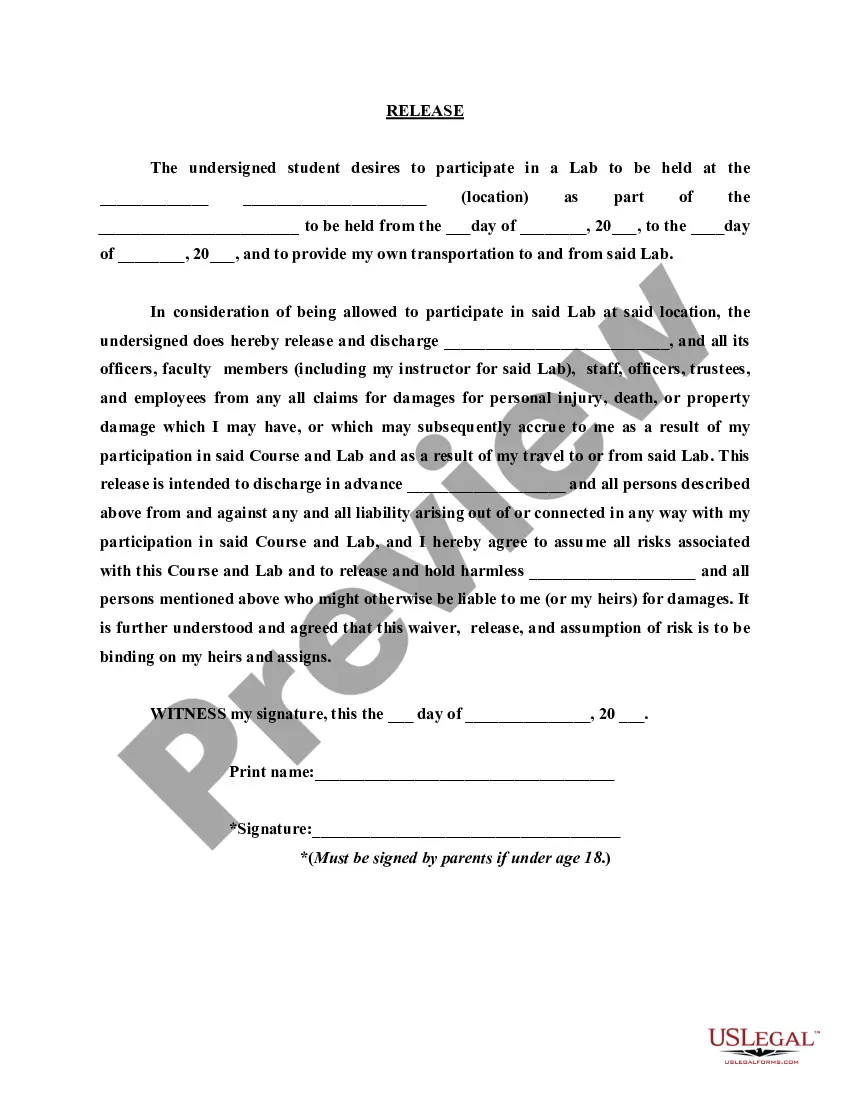
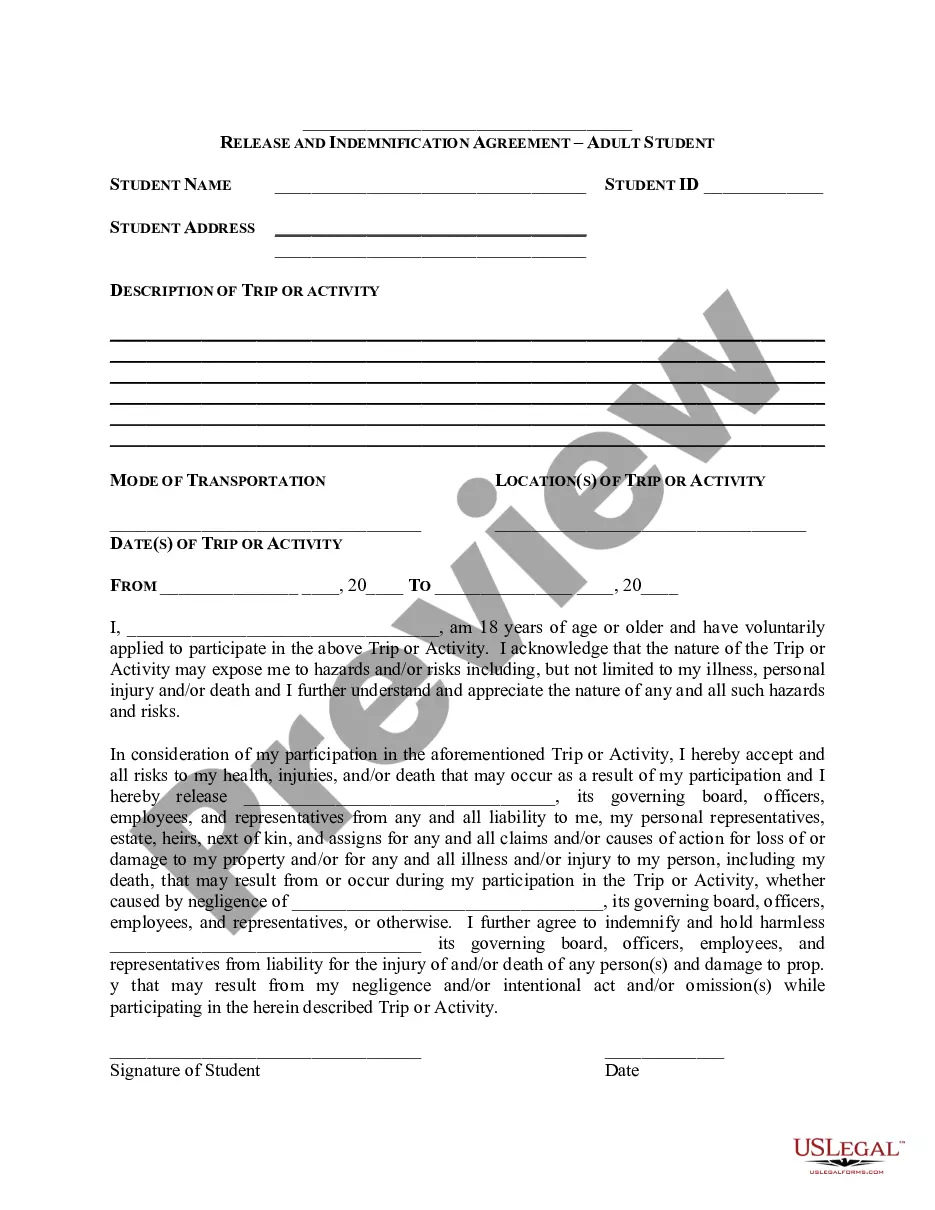
The Release regarding Laboratory Activities is a legal document that allows an individual to voluntarily participate in a laboratory activity while assuming responsibility for any potential risks involved. This form is crucial as it protects the organizing entity from legal claims arising from the participant's involvement, ensuring that all parties understand the associated responsibilities. It is distinct from other waivers as it specifically pertains to laboratory activities, highlighting the inherent risks linked to such participation.
Key components of this form
- Identification of the participant and the specific laboratory location.
- Duration of the laboratory activity, including start and end dates.
- Assumption of risk clause, detailing that the participant accepts any associated risks.
- Release of liability, which discharges the organizing entity and its personnel from any claims for damages.
- Signature requirements, including the necessity for a parent or guardian's signature if the participant is under age 18.
When this form is needed
This form should be used when an individual seeks to participate in a laboratory activity that involves potential risks, such as science experiments, medical labs, or other hands-on educational experiences. It is essential when the participant is required to acknowledge the inherent dangers of the activity and formally releases the organizing body from liability. This can be useful for schools, colleges, or independent organizations hosting such labs.
Who needs this form
- Students participating in laboratory activities.
- Parents or guardians of participants under the age of 18.
- Educational institutions or organizations that conduct laboratory activities.
- Any individual or group looking to mitigate liability concerns associated with experimental or lab-based activities.
How to complete this form
- Identify all parties involved by providing your name and the name of the organizing entity.
- Specify the exact location of the laboratory activity.
- Enter the start and end dates of the laboratory activity.
- Review the assumption of risk and release clauses to ensure understanding.
- Sign the form. If under age 18, ensure a parent or guardian's signature is provided.
Notarization requirements for this form
This form does not typically require notarization unless specified by local law. Participants should ensure that the signature is witnessed if needed by the organizing entity or local regulations.
Get your form ready online
Our built-in tools help you complete, sign, share, and store your documents in one place.
Make edits, fill in missing information, and update formatting in US Legal Forms—just like you would in MS Word.
Download a copy, print it, send it by email, or mail it via USPS—whatever works best for your next step.
Sign and collect signatures with our SignNow integration. Send to multiple recipients, set reminders, and more. Go Premium to unlock E-Sign.
If this form requires notarization, complete it online through a secure video call—no need to meet a notary in person or wait for an appointment.
We protect your documents and personal data by following strict security and privacy standards.

Make edits, fill in missing information, and update formatting in US Legal Forms—just like you would in MS Word.

Download a copy, print it, send it by email, or mail it via USPS—whatever works best for your next step.

Sign and collect signatures with our SignNow integration. Send to multiple recipients, set reminders, and more. Go Premium to unlock E-Sign.

If this form requires notarization, complete it online through a secure video call—no need to meet a notary in person or wait for an appointment.

We protect your documents and personal data by following strict security and privacy standards.
Mistakes to watch out for
- Failing to provide complete information about the laboratory location.
- Not including the parent or guardianâs signature when required.
- Leaving out the dates of the lab activity.
- Not fully understanding the risks involved before signing.
Why complete this form online
- Easy access to a professionally drafted legal form, reducing the need for legal consultation.
- Immediate download capability allows for quick preparation and use.
- Editability ensures that participants can personalize the form to reflect specific activity details.
- Secure storage of completed forms for future reference or legal requirements.
Legal use & context
- This form is legally binding and serves as a defense against personal injury claims related to laboratory activities.
- It is important for participants to understand that signing this release means they cannot hold the organizing entity liable for injuries sustained during the activity.
- The release is applicable to claims that occur both during the activity and while traveling to and from the lab.
Summary of main points
- The Release regarding Laboratory Activities is crucial for mitigating liability in lab settings.
- Both participants and responsible guardians must thoroughly review and understand the document before signing.
- Complete all fields accurately to ensure the form's effectiveness and legal standing.
Looking for another form?


Form popularity
FAQ
Make sure you understand the experiment before starting an experiment. Wear the right kind of clothing and gear. Be aware of safety equipment and where it's located. Fill out your lab form as you conduct your experiment. Complete your lab report as soon as possible after the lab.
The Most Important Lab Safety Rule. Know the Location of Safety Equipment. Dress for the Lab. Don't Eat or Drink in the Laboratory. Don't Taste or Sniff Chemicals. Don't Play Mad Scientist in the Laboratory. Dispose of Lab Waste Properly. Know What to Do With Lab Accidents.
Improve EQA performance by eliminating any undetected bias. Minimise false rejections whilst maintaining high error detection through the use of multi-rule QC procedures. Help laboratories have confidence in assigned target values.
Lab safety is one of the most important concerns when you are working with medical supplies, hazardous chemicals, and heavy-duty equipment. Wear Proper Lab Clothing. Handle Chemicals with Care. Properly Care for the Equipment. Always Locate Emergency Equipment. Keep Food and Drink Out of the Lab.
Go digital. Focus on management. Invest in quality equipment. Properly maintain equipment. Stay organized. Document information. Evaluate processes. Utilize automation.
Other ways of managing quality control include peer testing and alternative monthly review of QC trends. Clinical laboratories are frequently enrolled in clinical laboratory proficiency testing (PT) programs that are used to validate their testing protocols.
Dress for work in the laboratory. Wear clothing and shoes that cover exposed skin and protect you from potential splashes. Tie back long hair, jewelry, or anything that may catch in equipment. Never eat food, drink beverages, chew gum, apply cosmetics (including lip balm), or handle contact lenses in the laboratory.
Build Proper Processes. Quality control starts with processes. Keep a Clean Workspace. Hold Unscheduled Equipment Use Tests. Identify Essential Spare Parts. Ensure Managers are Properly Trained.
STAY ALERT - and stay alive. WEAR THE RIGHT CLOTHES - work clothes should fit properly. USE THE RIGHT TOOLS - if you need a hammer, get a hammer. LEARN HOW TO LIFT - Lifting takes more than muscle; it is an art. DON'T BE A PRANKSTER - practical jokes and horseplay can be dangerous, especially around heavy machinery.