Notice to Trustee of Assignment
Overview of this form
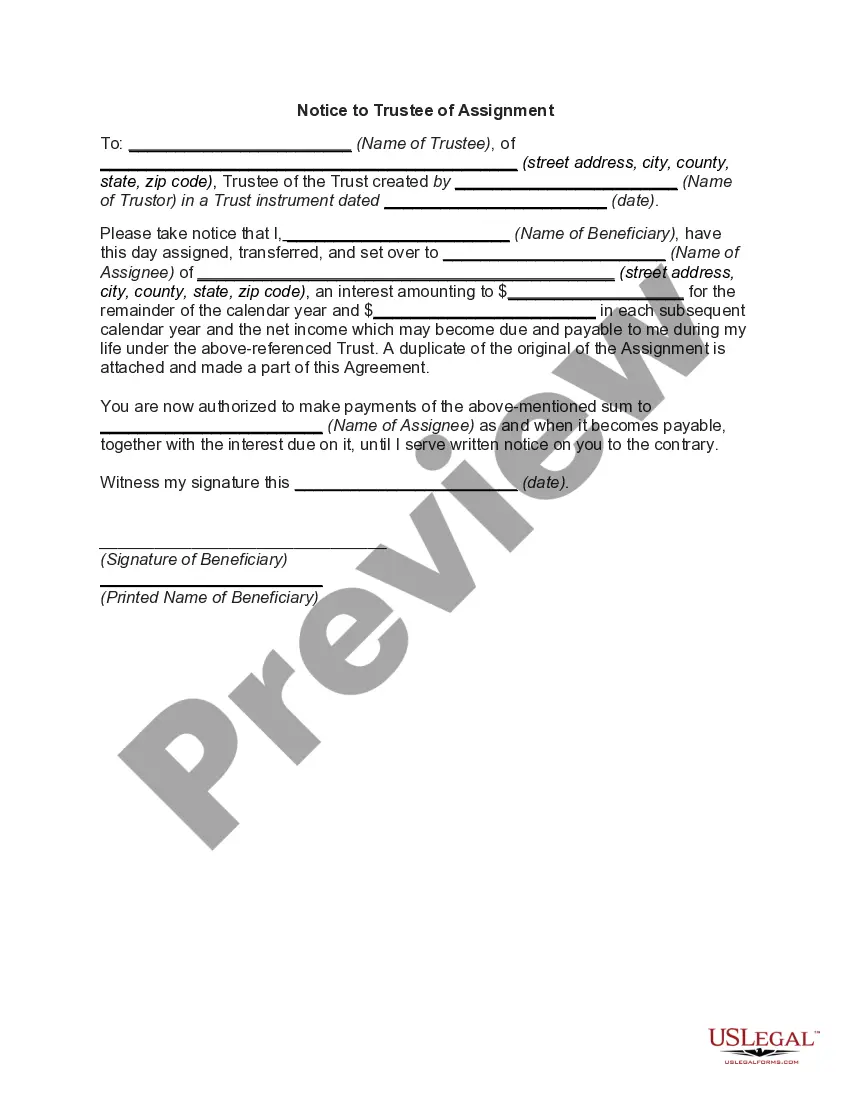
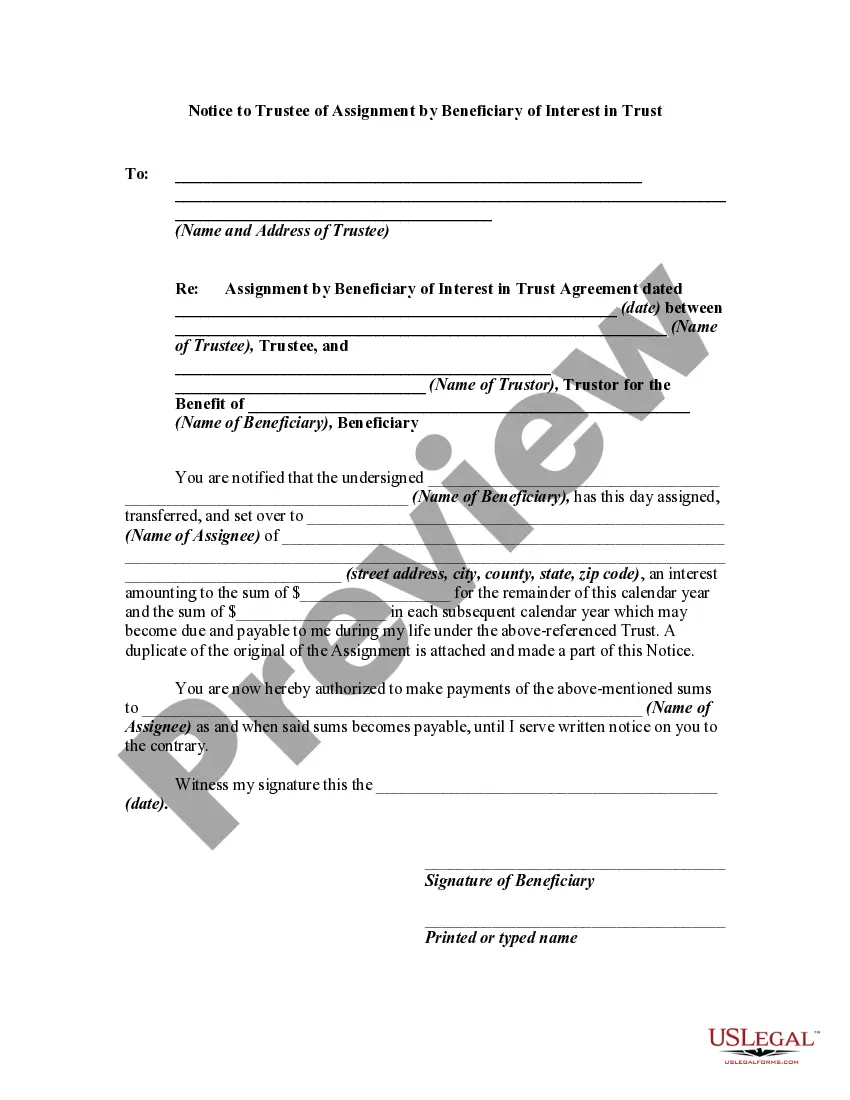
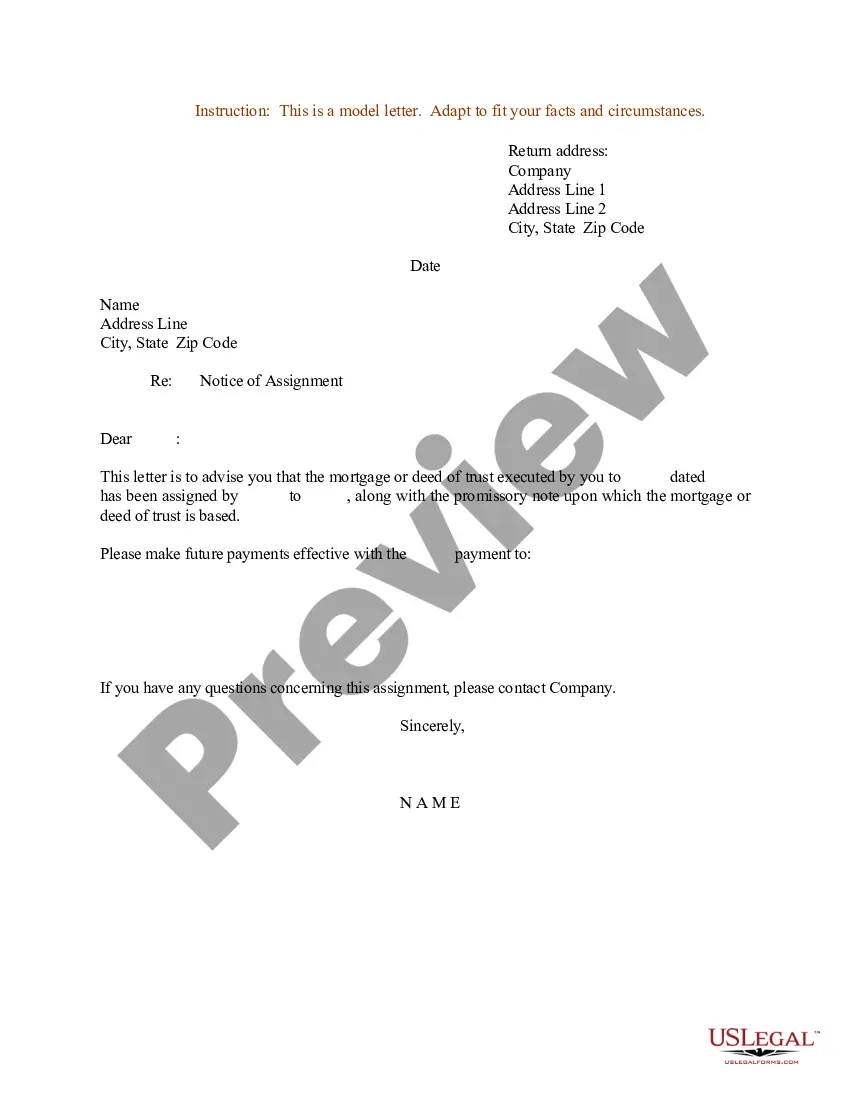
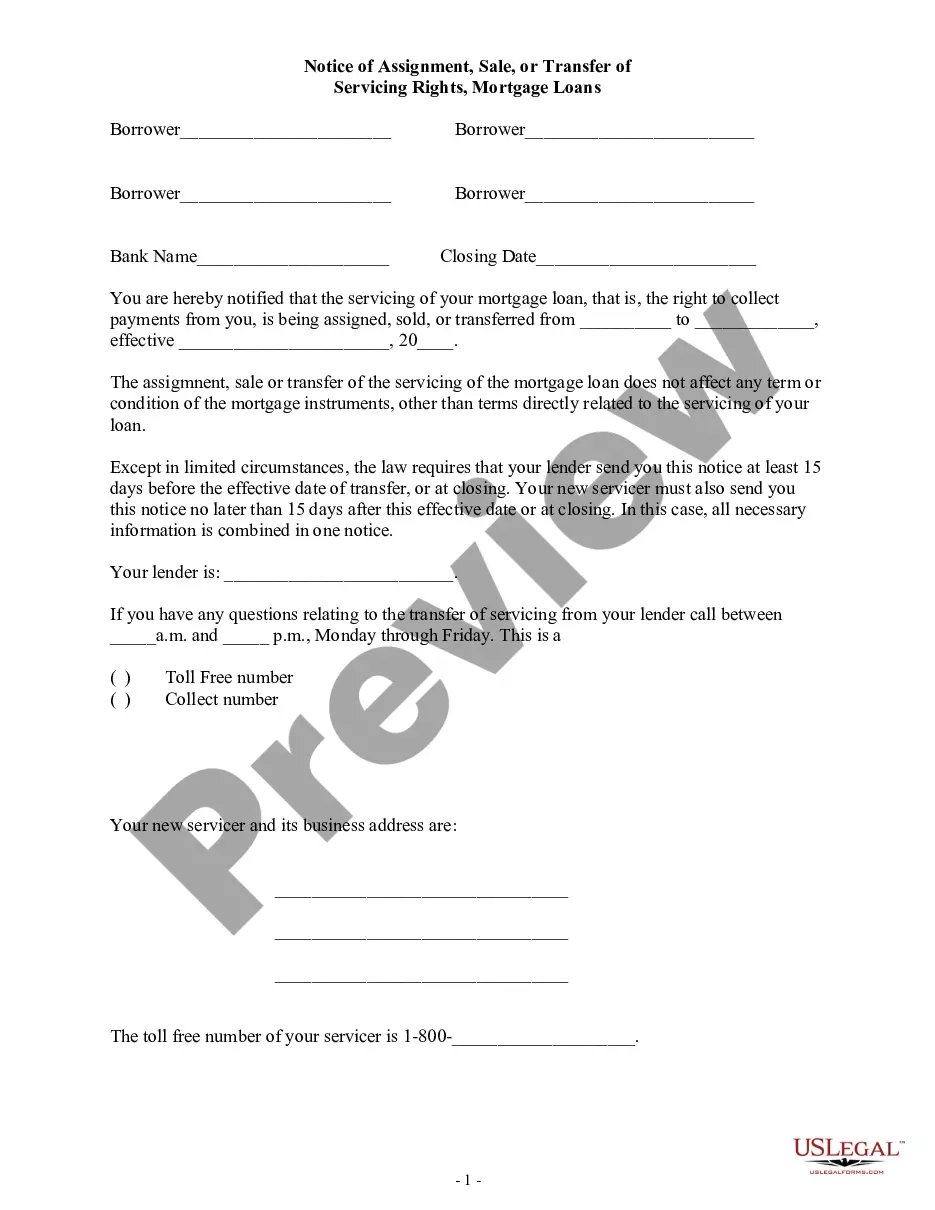
The Notice to Trustee of Assignment is a legal document used to inform a trustee about an assignment of interest from a beneficiary in a trust. This form serves to officially notify the trustee, allowing them to make payments to the designated assignee as outlined in the trust agreement. It ensures a clear transfer of rights along with the responsibilities of managing payments, differentiating it from similar forms that may not specify the assignment of interest.
Form components explained
- Name and address of the trustee
- Name of the trustor and the trust instrument date
- Name and address of the beneficiary
- Name and address of the assignee
- Space for the beneficiary's signature and date
When to use this document
This form is utilized when a beneficiary of a trust wishes to assign their interest to another party. This could occur in various scenarios, such as:
- The beneficiary needs to transfer their right to receive trust payments to another individual or entity.
- A beneficiary is unable to manage their interests due to financial difficulties or other personal reasons.
- A transfer of interest is part of an estate planning strategy or personal financial arrangement.
Intended users of this form
This form is suitable for:
- Beneficiaries of a trust looking to assign their interest.
- Trustees responsible for managing payments from the trust.
- Assignees who are receiving the interest from the beneficiary.
How to prepare this document
- Identify the party names involved, including the trustee, beneficiary, and assignee.
- Provide the address details for each party listed in the form.
- Clearly state the interest being assigned, including the specific payment amounts.
- Attach a duplicate of the original assignment document if required.
- Have the beneficiary sign and date the form to validate the assignment.
Notarization requirements for this form
This form does not typically require notarization unless specified by local law. Always check your stateâs requirements to ensure compliance.
Get your form ready online
Our built-in tools help you complete, sign, share, and store your documents in one place.
Make edits, fill in missing information, and update formatting in US Legal Forms—just like you would in MS Word.
Download a copy, print it, send it by email, or mail it via USPS—whatever works best for your next step.
Sign and collect signatures with our SignNow integration. Send to multiple recipients, set reminders, and more. Go Premium to unlock E-Sign.
If this form requires notarization, complete it online through a secure video call—no need to meet a notary in person or wait for an appointment.
We protect your documents and personal data by following strict security and privacy standards.

Make edits, fill in missing information, and update formatting in US Legal Forms—just like you would in MS Word.

Download a copy, print it, send it by email, or mail it via USPS—whatever works best for your next step.

Sign and collect signatures with our SignNow integration. Send to multiple recipients, set reminders, and more. Go Premium to unlock E-Sign.

If this form requires notarization, complete it online through a secure video call—no need to meet a notary in person or wait for an appointment.

We protect your documents and personal data by following strict security and privacy standards.
Common mistakes to avoid
- Failing to include the correct names and addresses of the parties involved.
- Not clearly specifying the amount of interest being assigned.
- Omitting the signature or date from the beneficiary.
Advantages of online completion
- Convenient access to legally vetted forms.
- Editable format allowing for easy customization to fit your specific needs.
- Reliable source of legal forms drafted by licensed attorneys.
Key takeaways
- The Notice to Trustee of Assignment serves to transfer interest rights from a beneficiary to an assignee.
- It's essential to provide accurate details about all parties involved.
- Proper completion and signature are crucial for the form's validity.
Looking for another form?


Form popularity
FAQ
Bank accounts, CDs, investment accounts, money markets, bonds, any assets that have your name on them should be transferred to your trust. The assets that generally don't go into a trust, although on some occasions they do, are those assets in which you can name a beneficiary.
Generally speaking, a trustee cannot withhold money from a beneficiary unless they are acting in ance with the trust. If the trust does not indicate any conditions for dispersing funds, the trustee cannot make them up or follow their own desires.
While trusts are highly structured, they do not protect your assets from creditors seeking restitution. In fact, creditors can file a claim against the beneficiaries of the estate should they learn of the person's passing.
The trustee can transfer real estate to the beneficiary by having a new deed written up or selling the property and giving them the money, writing them a check or giving them cash.
To distribute real estate held by a trust to a beneficiary, the trustee will have to obtain a document known as a grant deed, which, if executed correctly and in ance with state laws, transfers the title of the property from the trustee to the designated beneficiaries, who will become the new owners of the asset.
Retirement accounts like an IRA, Roth IRA, 401K, 403b, 457 and the like don't belong in your trust. Placing any of these assets in your trust would mean that you're taking them out of your name to retitle them in the name of your trust. The impact this will have on your taxes can be disastrous.
What assets cannot be placed in a trust? Retirement assets. While you can transfer ownership of your retirement accounts into your trust, estate planning experts usually don't recommend it.Health savings accounts (HSAs)Assets held in other countries.Vehicles.Cash.
To make sure your Beneficiaries can easily access your accounts and receive their inheritance, protect your assets by putting them in a Trust. A Trust-Based Estate Plan is the most secure way to make your last wishes known while protecting your assets and loved ones.