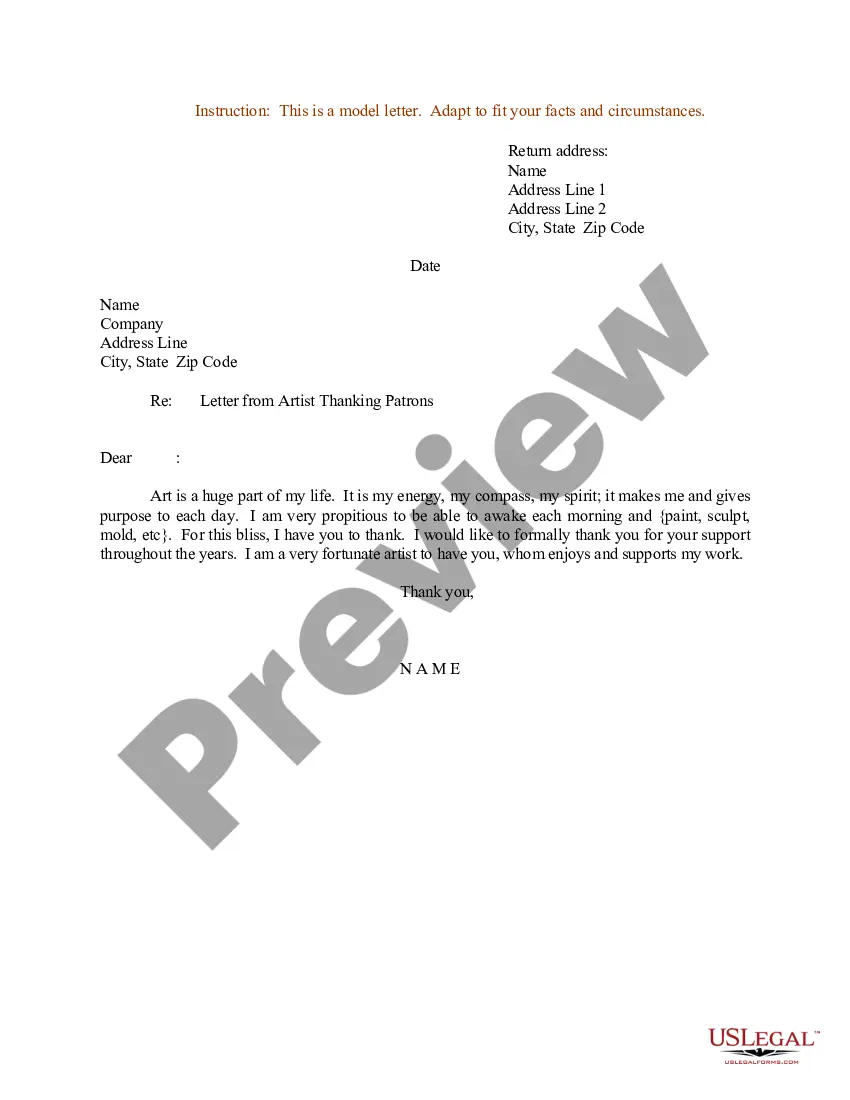
Sample Letter for Letter from Artist Thanking Patrons
Understanding this form
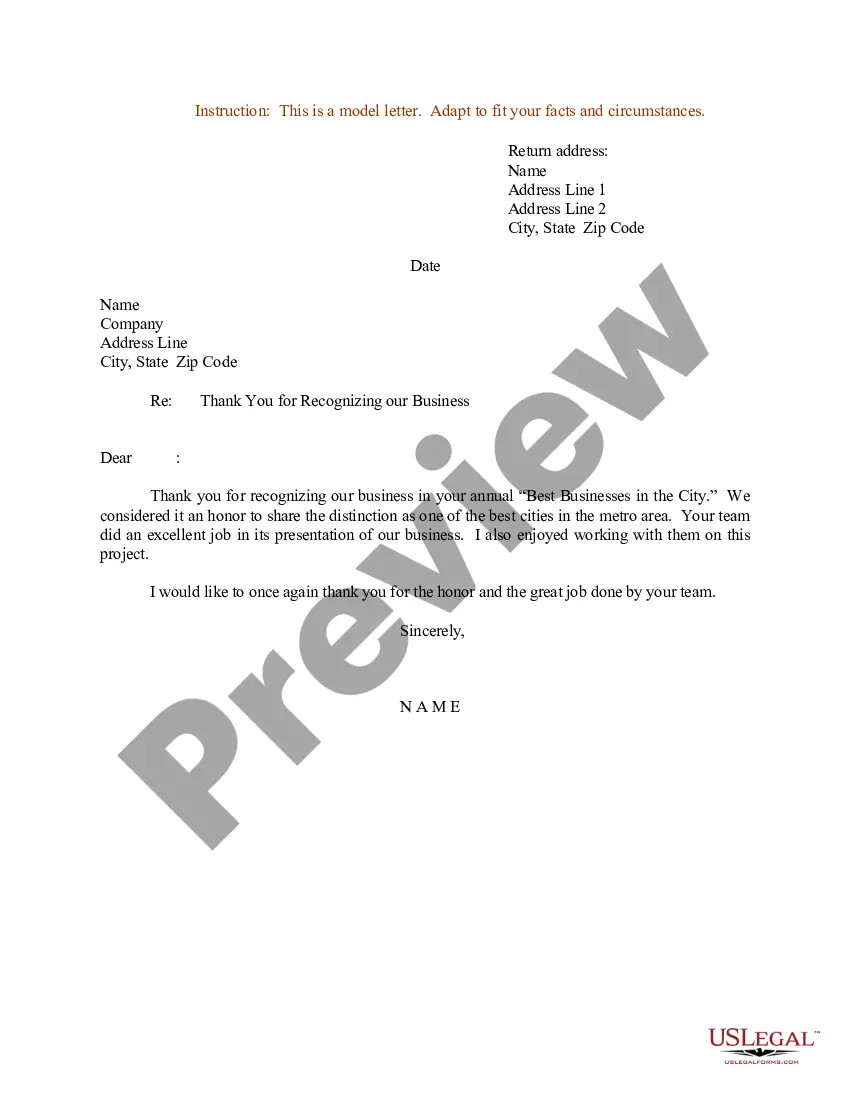
This form is a sample letter for artists to express gratitude to their patrons. It differs from other correspondence by specifically focusing on acknowledgment, appreciation, and fostering ongoing relationships with supporters. The Sample Letter for Letter from Artist Thanking Patrons is designed to convey sincere thanks in a polished and professional manner.
What’s included in this form
- Return Address: Includes the artist's name and contact information.
- Date: The date when the letter is being sent.
- Recipient's Information: Name and address of the patron or supporter.
- Subject Line: Clearly states the purpose of the letter.
- Body of the Letter: Expresses gratitude and thanks in a personal yet professional tone.
- Closing: A courteous sign-off from the artist.


When to use this form
This form is useful in various scenarios, such as following a successful gallery show, after receiving significant support from patrons, or when thanking individuals for their contributions to art projects. It helps maintain and strengthen relationships with supporters and keeps communication open between artists and their benefactors.
Who needs this form
- Artists who want to acknowledge their patrons or supporters.
- Nonprofit organizations in the arts seeking to foster donor relationships.
- Art galleries looking to thank their contributors.
Steps to complete this form
- Identify the sender's return address at the top of the letter.
- Insert the current date below the return address.
- Enter the recipient's name and address.
- Write a subject line indicating the purpose of the letter.
- Craft the body of the letter, expressing gratitude sincerely.
- Sign off with a polite closing and the artist's name.
Is notarization required?
In most cases, this form does not require notarization. However, some jurisdictions or signing circumstances might. US Legal Forms offers online notarization powered by Notarize, accessible 24/7 for a quick, remote process.
Get your form ready online
Our built-in tools help you complete, sign, share, and store your documents in one place.
Make edits, fill in missing information, and update formatting in US Legal Forms—just like you would in MS Word.
Download a copy, print it, send it by email, or mail it via USPS—whatever works best for your next step.
Sign and collect signatures with our SignNow integration. Send to multiple recipients, set reminders, and more. Go Premium to unlock E-Sign.
If this form requires notarization, complete it online through a secure video call—no need to meet a notary in person or wait for an appointment.
We protect your documents and personal data by following strict security and privacy standards.

Make edits, fill in missing information, and update formatting in US Legal Forms—just like you would in MS Word.

Download a copy, print it, send it by email, or mail it via USPS—whatever works best for your next step.

Sign and collect signatures with our SignNow integration. Send to multiple recipients, set reminders, and more. Go Premium to unlock E-Sign.

If this form requires notarization, complete it online through a secure video call—no need to meet a notary in person or wait for an appointment.

We protect your documents and personal data by following strict security and privacy standards.
Common mistakes
- Failing to personalize the letter for each patron.
- Omitting the return address or date.
- Using overly formal language that feels disconnected.
Why complete this form online
- Convenience of downloading and editing the form at any time.
- Direct access to professionally drafted content, ensuring clarity.
- Ability to tailor the letter easily to fit individual patron relationships.
Legal use & context
- This letter serves as acknowledgment and appreciation, contributing positively to artist-patron relationships.
- It is intended for personal communication and should not be used for legal claims or obligations.
Key takeaways
- This form facilitates meaningful communication between artists and patrons.
- Using a template saves time while ensuring professionalism.
- Personal touches can enhance the effectiveness of the gratitude expressed.
Looking for another form?


Form popularity
FAQ
In the Italian Renaissance, patrons either took on artists and commissioned them work-by-work, or they fully took them into their estates and provided them with housing while the artist was on-call for all art needs. Depending on the scale of a project, an artist could be funded by patrons for years.
A patron of the arts is a person who pays for or commissions works of art. A patron of the arts is a person who pays for or commissions works of art, and commonly refers to the support that kings and popes provided to painters, sculptors, musicians, and poets.
Who were the Medici family? Most profitable banking family in Europe, greatest patrons of art.
Patrons played a very large and important role in renaissance art and literature because they would provide the necessary funding and support for the artists to work and therefore survive.
The two most popular apps for recognizing artwork are Smartify and Magnus. These apps only have access to paintings that have been well-documented and catalogued by curators, professors, historians, and other artists.
According to humanist philosophies, art was morally uplifting for all of society. So when patrons commissioned a major work of public art, it was seen as a gift to the people. This added a final motivation for patrons to commission art, as a way to increase their fame and immortalize their legacies.
A patron of the arts is a person who pays for or commissions works of art, and commonly refers to the support that kings and popes provided to painters, sculptors, musicians, and poets.Art collectors can act as patrons as well, by commissioning specific works or styles from the artists they wish to support.
If you were an artist and had a powerful patron, your financial security was all but guaranteed. In the Italian Renaissance, patrons either took on artists and commissioned them work-by-work, or they fully took them into their estates and provided them with housing while the artist was on-call for all art needs.