Instructional Design ADDIE
About this form
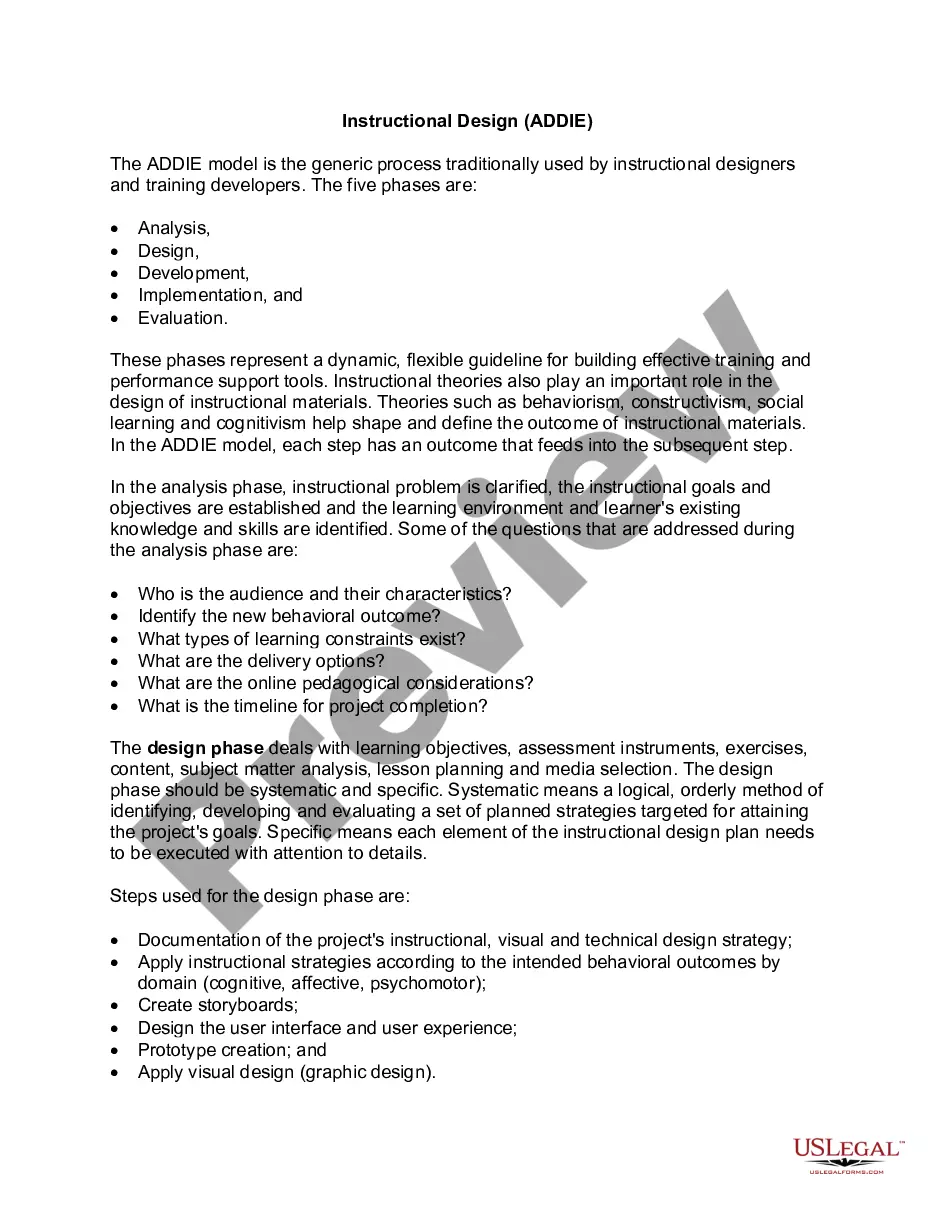
The Instructional Design ADDIE form outlines a structured approach to developing effective training programs through the ADDIE model. This model differentiates itself by emphasizing five key phases: Analysis, Design, Development, Implementation, and Evaluation. Unlike other instructional design frameworks, ADDIE provides a flexible yet systematic way to address learning needs and outcomes.
Main sections of this form
- Analysis: Identifies the instructional problem, goals, and learner characteristics.
- Design: Outlines learning objectives, assessment methods, and content planning.
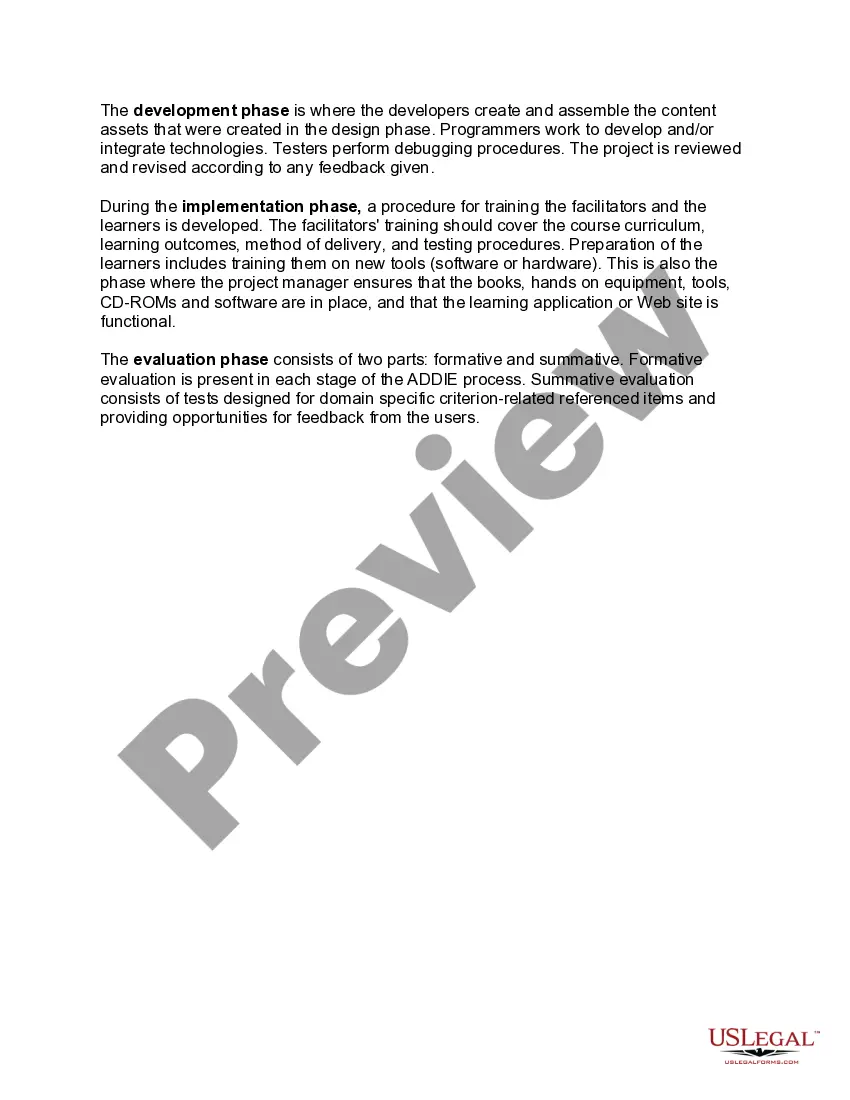
- Development: Involves creating and assembling content and materials.
- Implementation: Covers training facilitators and learners for effective delivery.
- Evaluation: Includes formative and summative assessments to gauge effectiveness.
When this form is needed
This form is essential when creating training programs or educational materials that require a structured, systematic approach. It is particularly useful when you need to enhance learner engagement, improve knowledge retention, or address specific instructional deficiencies in an organization.
Who this form is for
- Instructional designers creating training content for various audiences.
- Corporate trainers developing professional development programs.
- Educators designing curriculum or lesson plans.
- Non-profit organizations implementing educational initiatives.
Instructions for completing this form
- Identify the target audience and their existing skills and knowledge.
- Establish clear instructional goals and objectives for the training program.
- Develop a detailed design plan that includes content, assessments, and media choices.
- Assemble content, ensuring it aligns with the design plan.
- Implement the training and gather feedback for continuous improvement.
Does this document require notarization?
This form usually doesn’t need to be notarized. However, local laws or specific transactions may require it. Our online notarization service, powered by Notarize, lets you complete it remotely through a secure video session, available 24/7.
Get your form ready online
Our built-in tools help you complete, sign, share, and store your documents in one place.
Make edits, fill in missing information, and update formatting in US Legal Forms—just like you would in MS Word.
Download a copy, print it, send it by email, or mail it via USPS—whatever works best for your next step.
Sign and collect signatures with our SignNow integration. Send to multiple recipients, set reminders, and more. Go Premium to unlock E-Sign.
If this form requires notarization, complete it online through a secure video call—no need to meet a notary in person or wait for an appointment.
We protect your documents and personal data by following strict security and privacy standards.

Make edits, fill in missing information, and update formatting in US Legal Forms—just like you would in MS Word.

Download a copy, print it, send it by email, or mail it via USPS—whatever works best for your next step.

Sign and collect signatures with our SignNow integration. Send to multiple recipients, set reminders, and more. Go Premium to unlock E-Sign.

If this form requires notarization, complete it online through a secure video call—no need to meet a notary in person or wait for an appointment.

We protect your documents and personal data by following strict security and privacy standards.
Typical mistakes to avoid
- Skipping the analysis phase, leading to unclear goals.
- Not aligning assessment methods with learning objectives.
- Failing to include feedback mechanisms in the evaluation stage.
Why complete this form online
- Convenience of access and the ability to download anytime.
- Editability allows for customization to meet specific needs.
- Reliability of forms drafted by licensed attorneys ensures legal compliance.
Summary of main points
- The ADDIE model is a structured framework for instructional design.
- It consists of five interrelated phases: Analysis, Design, Development, Implementation, and Evaluation.
- Each phase builds on the previous one to create effective training programs.
Looking for another form?



Form popularity
FAQ
Addie is an acronym for the five stages of a development process: Analysis, Design, Development, Implementation, and Evaluation. The ADDIE model relies on each stage being done in the given order but with a focus on reflection and iteration.
Evaluation. ADDIE's main goal is to provide a structured method of creating training programs. It is also, however, a powerful model for improving the way in which future iterations are created. Getting feedback on every aspect of the courses is really important so that you can improve and revise the content.
The ADDIE model is the generic process traditionally used by instructional designers and training developers.This is the idea of receiving continual or formative feedback while instructional materials are being created. This model attempts to save time and money by catching problems while they are still easy to fix.
Training can be viewed as a process comprised of five related stages or activities: assessment, motivation, design, delivery, and evaluation.
Step 1: Analyze. This first step is all about gathering information. Step 2: Design. Step 3: Development. Step 4: Implementation. Step 5: Evaluation.
The ADDIE model is generic enough that it can be used to create any type of learning experience for any audience from creating K-12 teaching lessons on cellular biology to developing corporate training programs for an ERP software upgrade.
Learning the ADDIE model will help the trainers and instructional designers provide more effective quality designs, clearly defined learning objectives, structured and coherent content, measured and organized workload for educators and students, incorporated visualizations and media, and appropriate student activities
The ADDIE model is the generic process traditionally used by instructional designers and training developers. The five phasesAnalysis, Design, Development, Implementation, and Evaluationrepresent a dynamic, flexible guideline for building effective training and performance support tools.