Oath of Arbitrators
Understanding this form
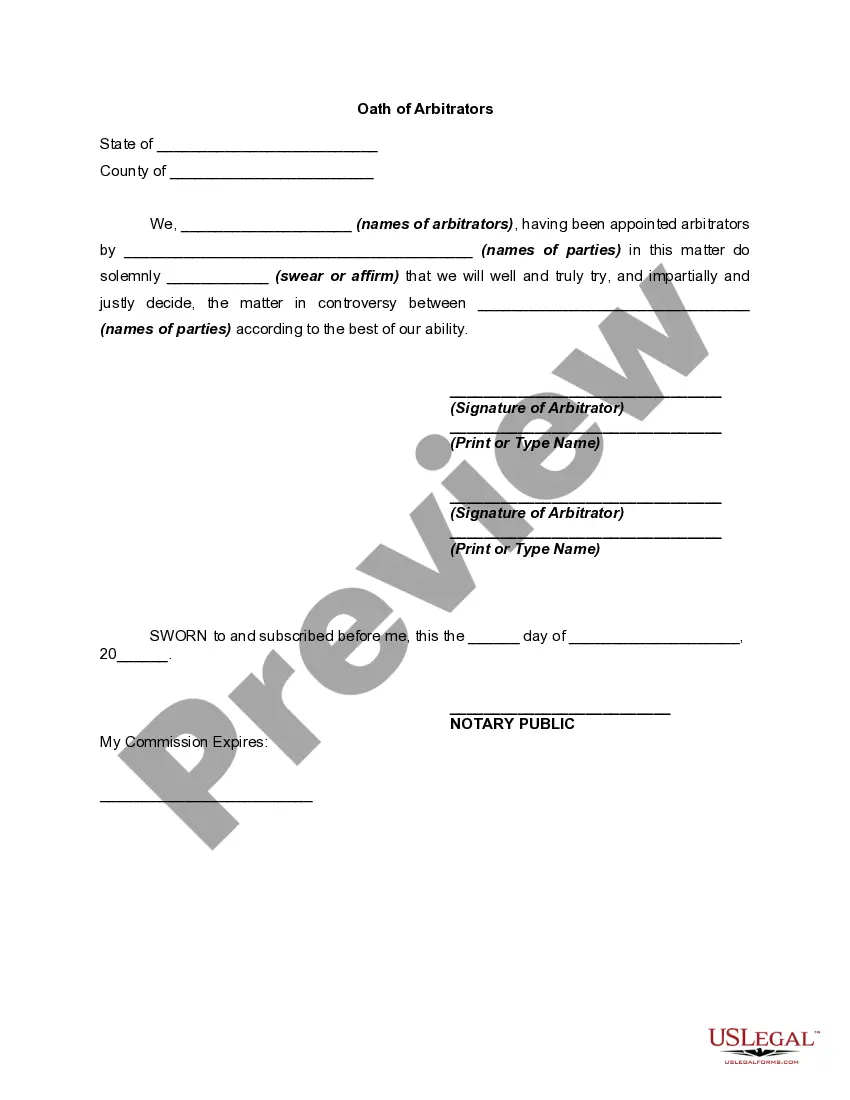
The Oath of Arbitrators is a legal document that formalizes the commitment of appointed arbitrators to fairly and impartially resolve disputes between parties involved in arbitration. This form is essential for ensuring that arbitrators adhere to ethical standards and legal requirements. Unlike other legal documents, the Oath of Arbitrators specifically focuses on the impartiality and integrity of the decision-making process in arbitration.
What’s included in this form
- Identification of the state and county where the oath is being administered.
- Names of the appointed arbitrators and parties involved in the arbitration.
- Statement of the solemn oath to impartially decide the matter.
- Signatures and printed names of the arbitrators.
- Notary public section, including a date and commission expiration.

Situations where this form applies
This form should be used when parties have agreed to arbitration for dispute resolution, and the appointed arbitrators are required to take an oath before commencing their duties. It is typically utilized in legal, commercial, or personal disputes where binding arbitration is the agreed-upon process for resolving issues.
Who should use this form
This form is intended for:
- Arbitrators who have been appointed to handle specific disputes.
- Legal professionals overseeing arbitration processes.
- Parties involved in arbitration who require their arbitrators to take an oath.
Instructions for completing this form
- Identify the state and county where the arbitration is taking place.
- Fill in the names of the arbitrators and the parties involved in the dispute.
- Choose between swearing or affirming to fairly decide the matter.
- Sign and print the names of each arbitrator on the designated lines.
- Have the completed form notarized, ensuring that it is dated and signed by the notary public.
Notarization guidance
This form must be notarized to be legally valid. US Legal Forms provides secure online notarization powered by Notarize, allowing you to complete the process through a verified video call.
Get your form ready online
Our built-in tools help you complete, sign, share, and store your documents in one place.
Make edits, fill in missing information, and update formatting in US Legal Forms—just like you would in MS Word.
Download a copy, print it, send it by email, or mail it via USPS—whatever works best for your next step.
Sign and collect signatures with our SignNow integration. Send to multiple recipients, set reminders, and more. Go Premium to unlock E-Sign.
If this form requires notarization, complete it online through a secure video call—no need to meet a notary in person or wait for an appointment.
We protect your documents and personal data by following strict security and privacy standards.

Make edits, fill in missing information, and update formatting in US Legal Forms—just like you would in MS Word.

Download a copy, print it, send it by email, or mail it via USPS—whatever works best for your next step.

Sign and collect signatures with our SignNow integration. Send to multiple recipients, set reminders, and more. Go Premium to unlock E-Sign.

If this form requires notarization, complete it online through a secure video call—no need to meet a notary in person or wait for an appointment.

We protect your documents and personal data by following strict security and privacy standards.
Typical mistakes to avoid
- Failing to properly identify the state and county.
- Not signing the form by all appointed arbitrators.
- Missing the notarization step, which can invalidate the document.
- Forgetting to specify whether to swear or affirm the oath.
- Using outdated or incorrect language that does not comply with local laws.
Why complete this form online
- Easy access to a legally valid form that can be downloaded and completed at your convenience.
- Editable formats allow for customization to suit specific arbitration needs.
- Reliability of forms drafted by licensed attorneys ensures legal compliance.
Looking for another form?



Form popularity
FAQ
Becoming an arbitratorArbitrators need to: have knowledge of the laws of contract, tort and evidence 2022 understand and be able to use the applicable procedural law 2022 be able to evaluate the arguments and evidence which seemingly supports conflicting points of view 2022 determine the award.
What is an arbitration agreement? It's typically a clause in a broader contract in which you agree to settle out of court, through arbitration cases, any dispute that arises with your counterpart.
Arbitration is a way to resolve disputes outside of court. There is no jury or judge; rather, an arbitrator is present who makes the final decision, which is called the arbitration award.
The arbitration process involves the parties submitting their dispute to an impartial arbitrator, who serves as an informal judge.Testimony during arbitration is given under oath, similar to in court.
Typically, the parties decidethey can decide to let an arbitrator decide the case (rather than a court) by entering into a binding arbitration agreement. In a recent case, the U.S. Court of Appeals for the Third Circuit took these seemingly simple questions one level deeper.
Arbitration is a procedure in which a dispute is submitted, by agreement of the parties, to one or more arbitrators who make a binding decision on the dispute. In choosing arbitration, the parties opt for a private dispute resolution procedure instead of going to court.
The Indian law does not lay down any specific qualifications for arbitrators. Every person who is of age and of sound mind can be appointed as an arbitrator. Arbitral institutions include in their panel a wide range of experts drawn from various professions, trade and business.
The arbitrator's final decision on the case is called the award. This is like a judge's or jury's decision in a court case. Once the arbitrator decides that all of the parties' evidence and arguments have been presented, the arbitrator will close the hearings. This means no more evidence or arguments will be allowed.
Arbitrators charge a daily rate for their services. Their rates are available from referral agencies or their web sites (if they have one).In most cases, the parties to an arbitration divide the cost of the arbitrator's fees and expenses evenly that is, each pays half.