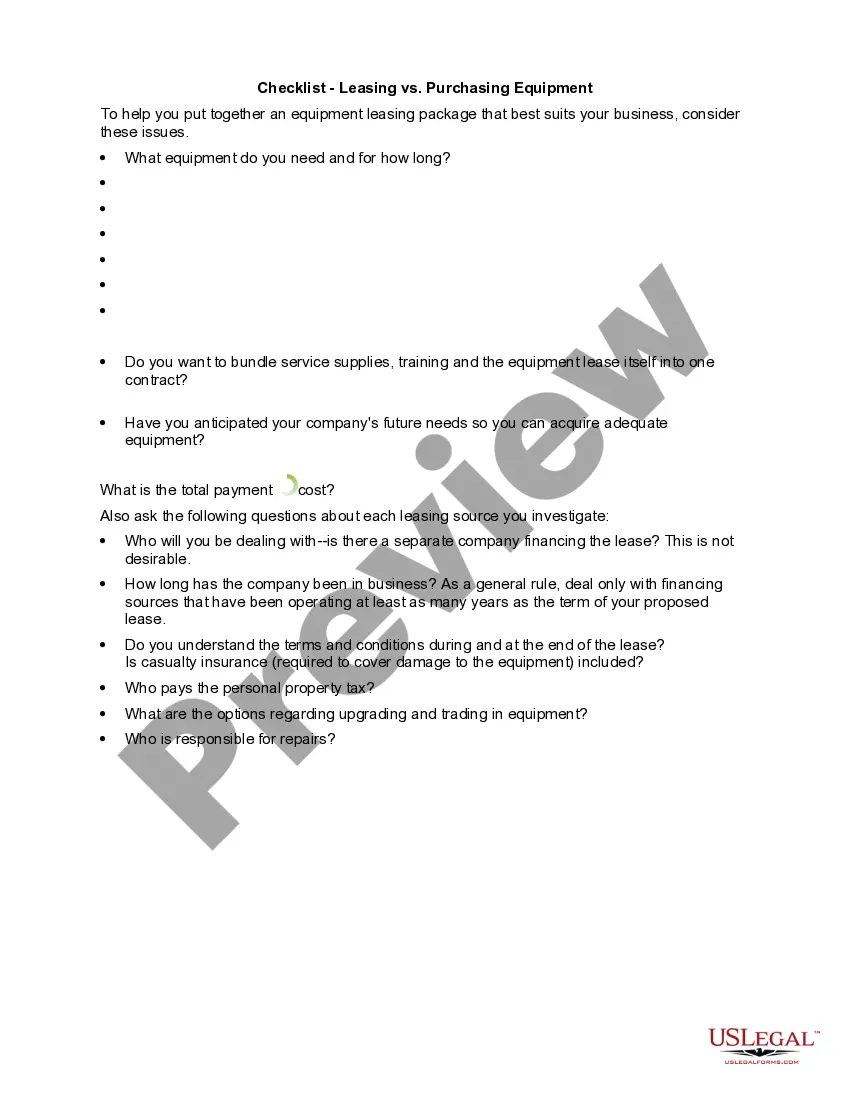
Leasing equipment can help your business stay up-to-date with the latest technology. Other benefits of leasing include making lower monthly payments than you would have with a loan, getting a fixed financing rate instead of a floating rate, benefiting from tax advantages, and conserving working capital by avoiding cash-devouring down payments. Leasing also has its downside, however: You may pay a higher price over the long term. You are also committed to retaining a piece of equipment for a certain time period, which can be problematic if your business is in flux.
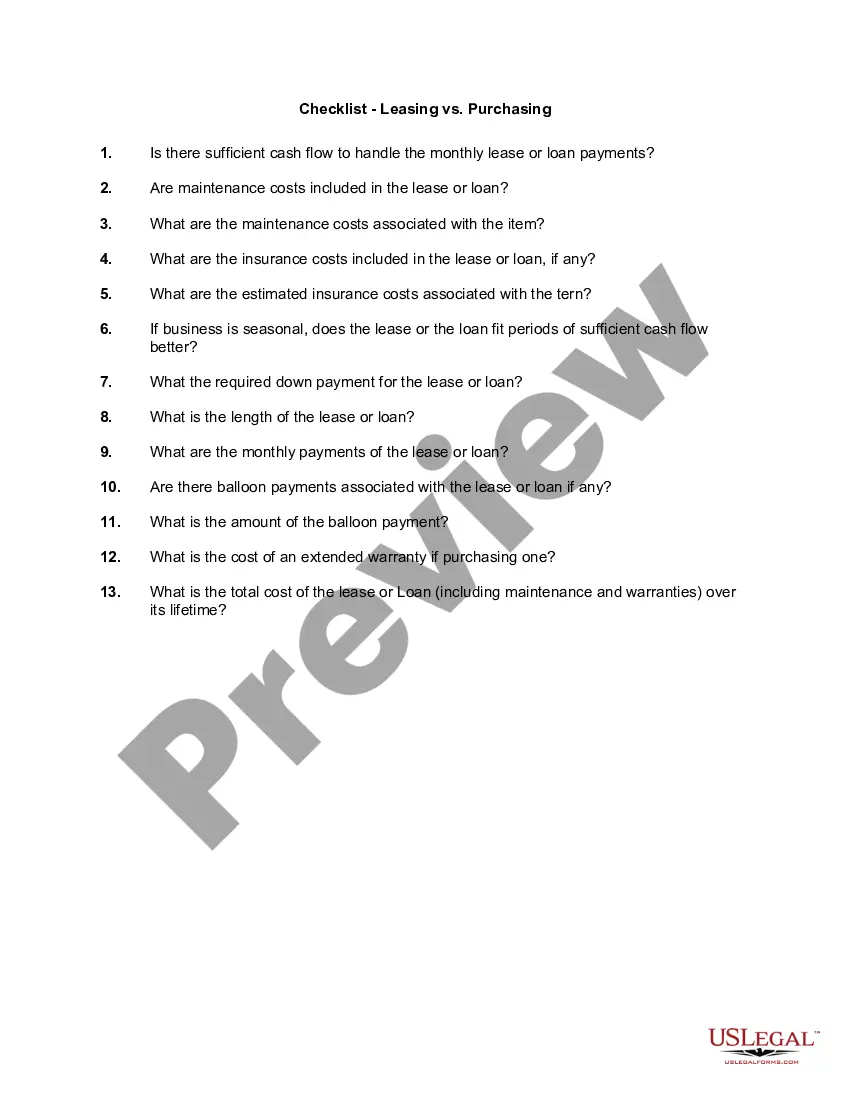
Every lease decision is unique so it's important to study the lease agreement carefully. When deciding to obtain equipment, you need to determine whether it is better to lease or purchase the equipment. You might use this checklist to compare the costs for each option.
Texas Checklist - Leasing vs. Purchasing Equipment
Category:
State:
Multi-State
Control #:
US-03082BG
Format:
Word;
Rich Text
Instant download
Description
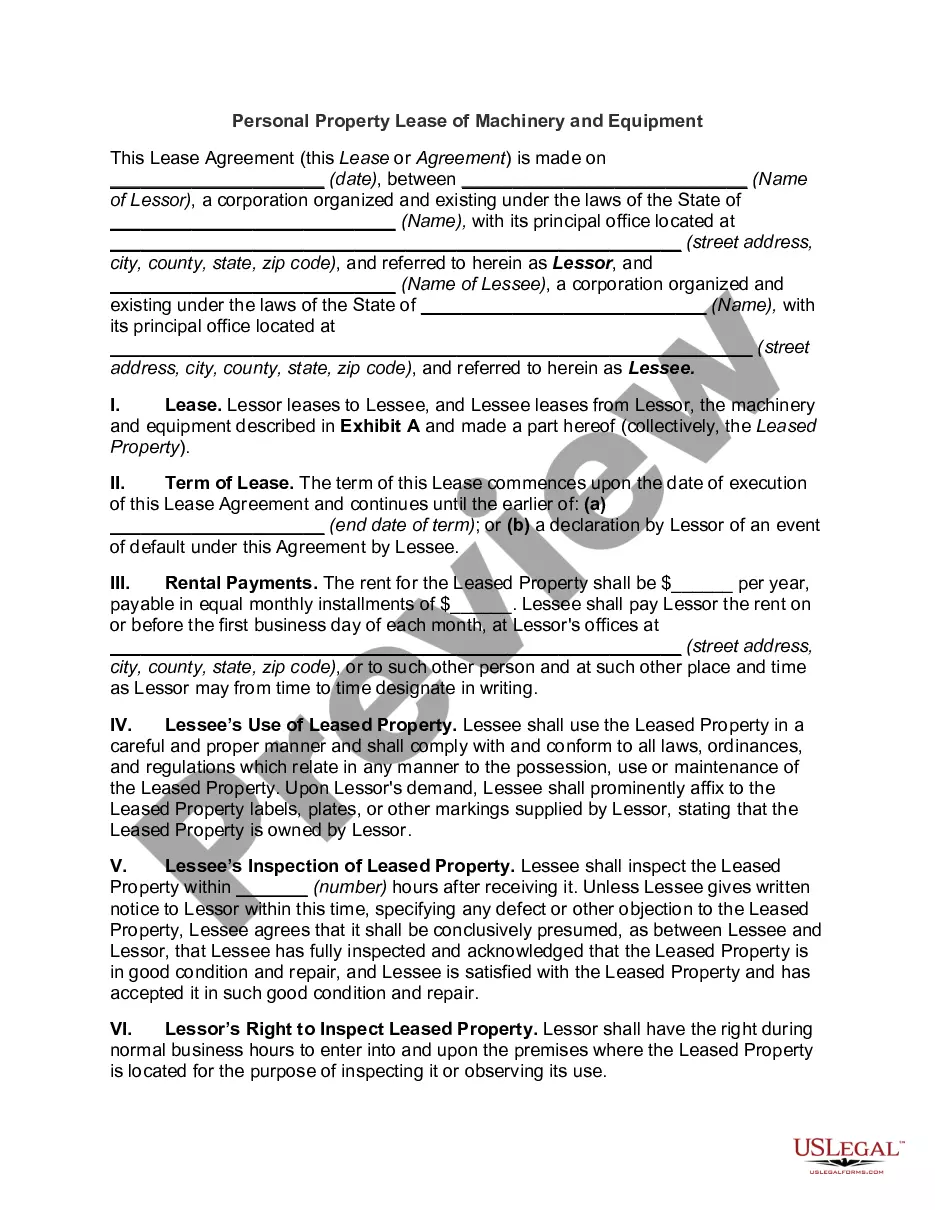
Get your form ready online
Our built-in tools help you complete, sign, share, and store your documents in one place.
Built-in online Word editor
Make edits, fill in missing information, and update formatting in US Legal Forms—just like you would in MS Word.
Export easily
Download a copy, print it, send it by email, or mail it via USPS—whatever works best for your next step.
E-sign your document
Sign and collect signatures with our SignNow integration. Send to multiple recipients, set reminders, and more. Go Premium to unlock E-Sign.
Notarize online 24/7
If this form requires notarization, complete it online through a secure video call—no need to meet a notary in person or wait for an appointment.
Store your document securely
We protect your documents and personal data by following strict security and privacy standards.

Make edits, fill in missing information, and update formatting in US Legal Forms—just like you would in MS Word.

Download a copy, print it, send it by email, or mail it via USPS—whatever works best for your next step.

Sign and collect signatures with our SignNow integration. Send to multiple recipients, set reminders, and more. Go Premium to unlock E-Sign.

If this form requires notarization, complete it online through a secure video call—no need to meet a notary in person or wait for an appointment.

We protect your documents and personal data by following strict security and privacy standards.
Looking for another form?


How to fill out Checklist - Leasing Vs. Purchasing Equipment?
You can utilize online resources to find the legal document template that meets the federal and state requirements you need.
US Legal Forms provides a wide array of legal forms that have been reviewed by experts.
You can easily download or print the Texas Checklist - Leasing vs. Purchasing Equipment from my services.
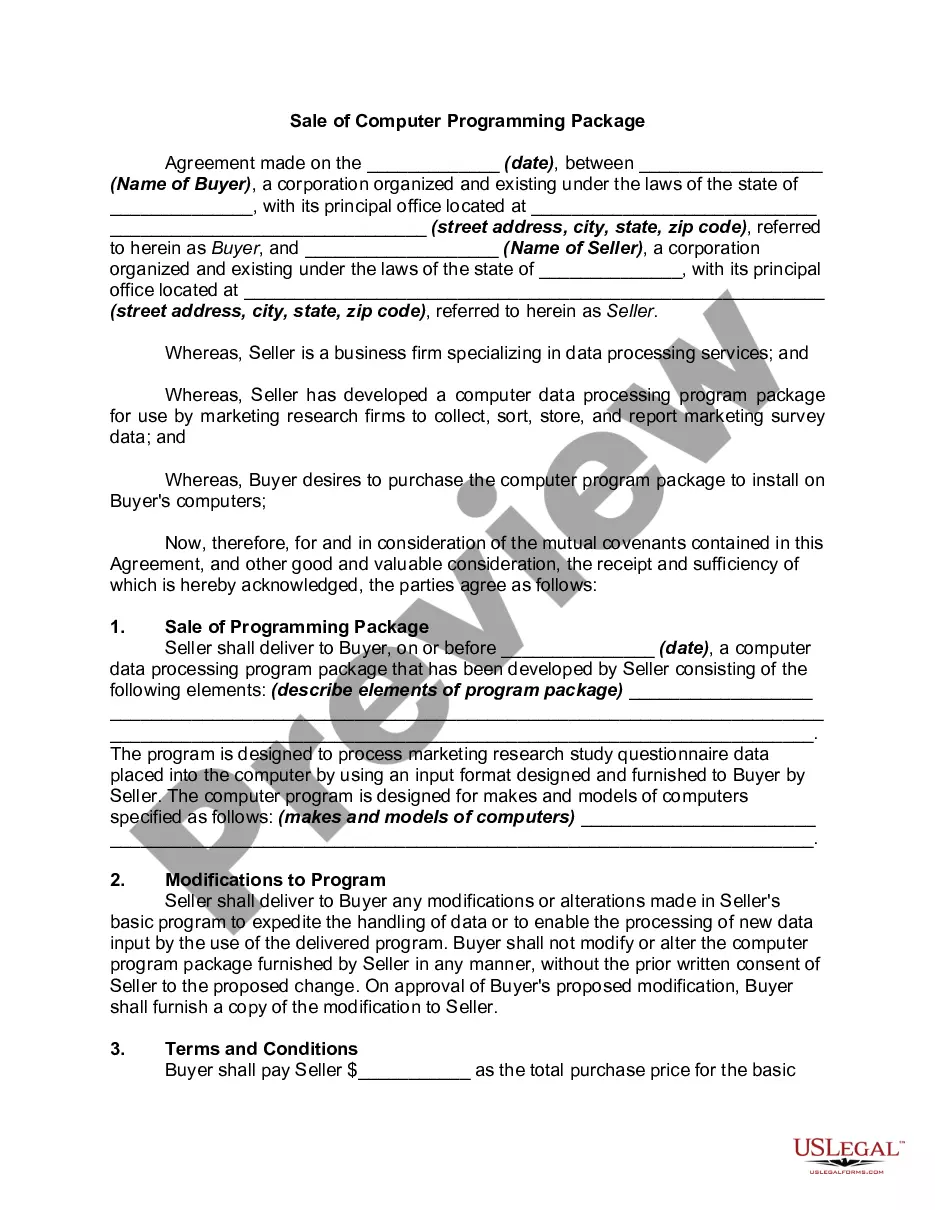
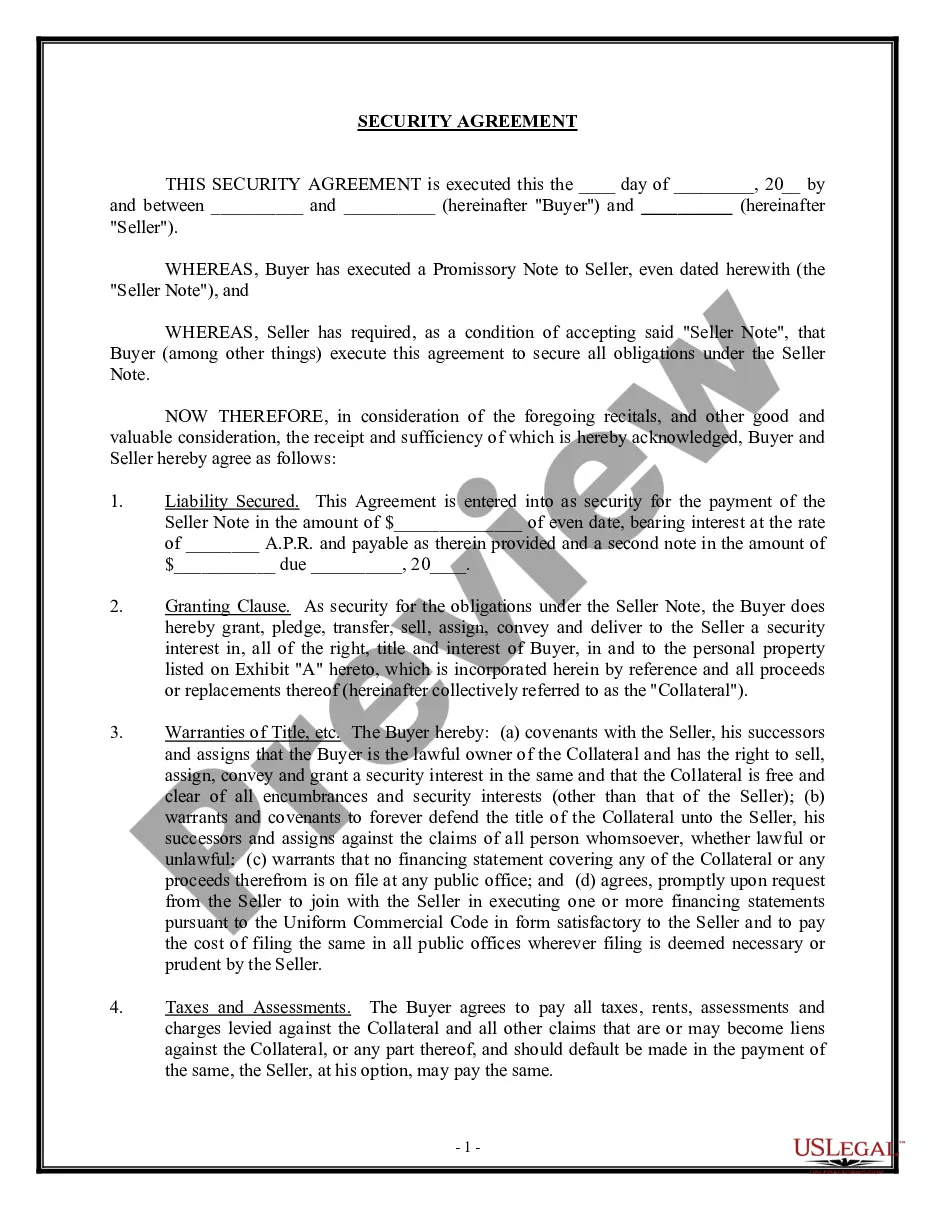
If available, use the Preview button to review the document template as well.
- If you possess a US Legal Forms account, you can Log In and click the Download button.
- After that, you can complete, modify, print, or sign the Texas Checklist - Leasing vs. Purchasing Equipment.
- Every legal document template you buy is yours indefinitely.
- To obtain an additional copy of a purchased form, navigate to the My documents section and click the relevant button.
- If this is your first time using the US Legal Forms website, follow the simple instructions below.
- First, ensure you have selected the correct document template for the county/region of your choice.
- Check the form description to ensure you have selected the right template.
Form popularity
FAQ
The primary difference between buying and leasing assets is ownership. When you buy equipment, you own it outright and can use it as needed. On the other hand, leasing allows you to use the equipment for a specific time, without the responsibilities of ownership. The Texas Checklist - Leasing vs. Purchasing Equipment can help you weigh the financial implications of both options, guiding you in making an informed decision.
To set up an equipment lease, start by determining your specific needs and budget. Next, research leasing companies that offer equipment that suits your requirements. Once you have selected a provider, review their lease terms, and negotiate any conditions that need adjustment. Lastly, sign the lease agreement, but always refer to the Texas Checklist - Leasing vs. Purchasing Equipment to ensure you meet all legal requirements.
Typically, a credit score of around 620 is required to lease equipment, but options may vary based on the leasing company. A better credit score often leads to lower interest rates and better terms. To ensure you secure the best deal, consider referencing the Texas Checklist - Leasing vs. Purchasing Equipment, which outlines credit requirements and tips for improving your score.
Equipment on operating leases refers to leased items that are not considered owned assets on a company's balance sheet. Businesses use operating leases for flexibility, allowing them to utilize vital equipment without substantial capital investment. Incorporating the Texas Checklist - Leasing vs. Purchasing Equipment will clarify how operating leases differ from other leasing options, helping you make an informed decision.
Lease-to-own on equipment functions by combining leasing payments with ownership potential. You agree to a lease term with regular payments, and at the end, you can either buy the equipment or return it. Utilizing a Texas Checklist - Leasing vs. Purchasing Equipment will help you evaluate the long-term benefits and costs effectively.
Leasing can be more beneficial than buying for tax purposes, as lease payments often qualify as deductible business expenses. This can provide immediate tax relief compared to purchasing, where you may have to wait to recover costs through depreciation. Businesses should examine their tax strategies to make informed choices in line with the Texas Checklist - Leasing vs. Purchasing Equipment.
The primary difference between buying and leasing equipment lies in ownership and financial commitment. When you buy, you own the equipment outright and can sell it later, while leasing provides temporary access without ownership. Understanding these distinctions is essential when assessing your options in the Texas Checklist - Leasing vs. Purchasing Equipment.
One disadvantage of leasing equipment is that it may lead to higher overall costs over time compared to purchasing. Businesses do not build equity in leased equipment, which can be a drawback for long-term projects. Furthermore, lease agreements may come with restrictions that could limit usage, so it's crucial to consider these factors as part of the Texas Checklist - Leasing vs. Purchasing Equipment.
Leasing equipment offers several advantages, including lower initial costs and access to advanced technology. It allows companies to upgrade equipment more frequently, keeping operations efficient. Leasing also helps businesses maintain flexibility and adaptability, which are essential in today's fast-paced market, especially when following the Texas Checklist - Leasing vs. Purchasing Equipment.
When it comes to tax purposes, leasing may offer more benefits compared to buying equipment. Lease payments are often fully deductible as operating expenses, while purchasing may involve depreciation and less immediate tax relief. Therefore, businesses should carefully evaluate their tax strategies concerning the Texas Checklist - Leasing vs. Purchasing Equipment.