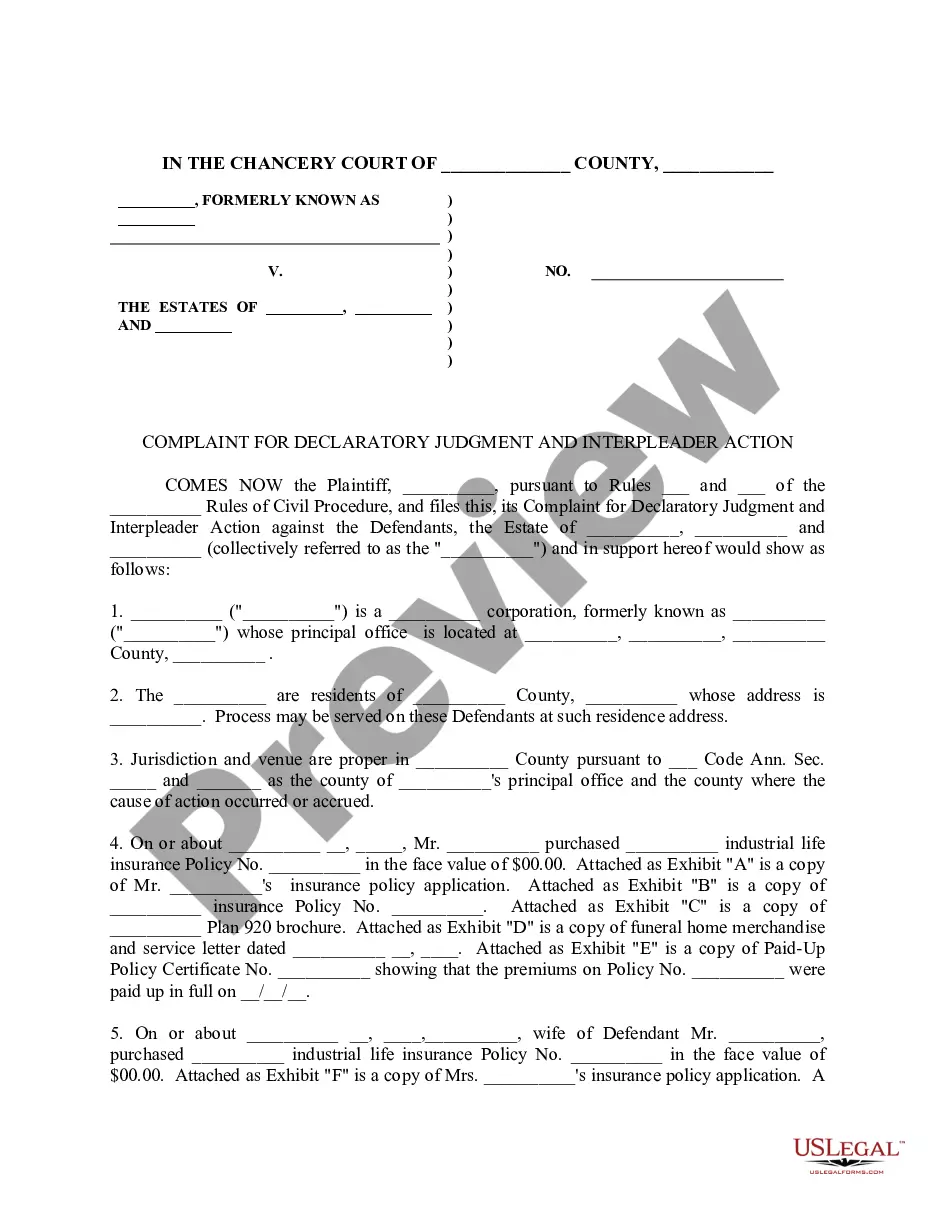
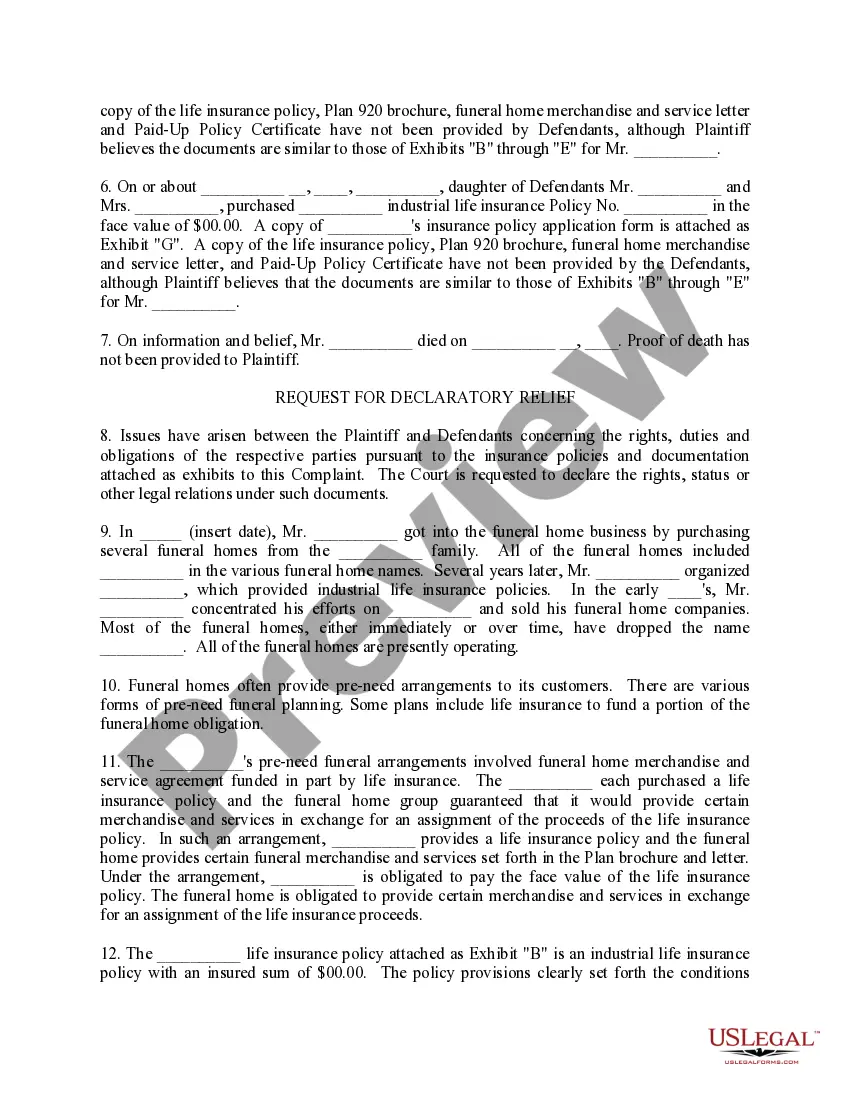
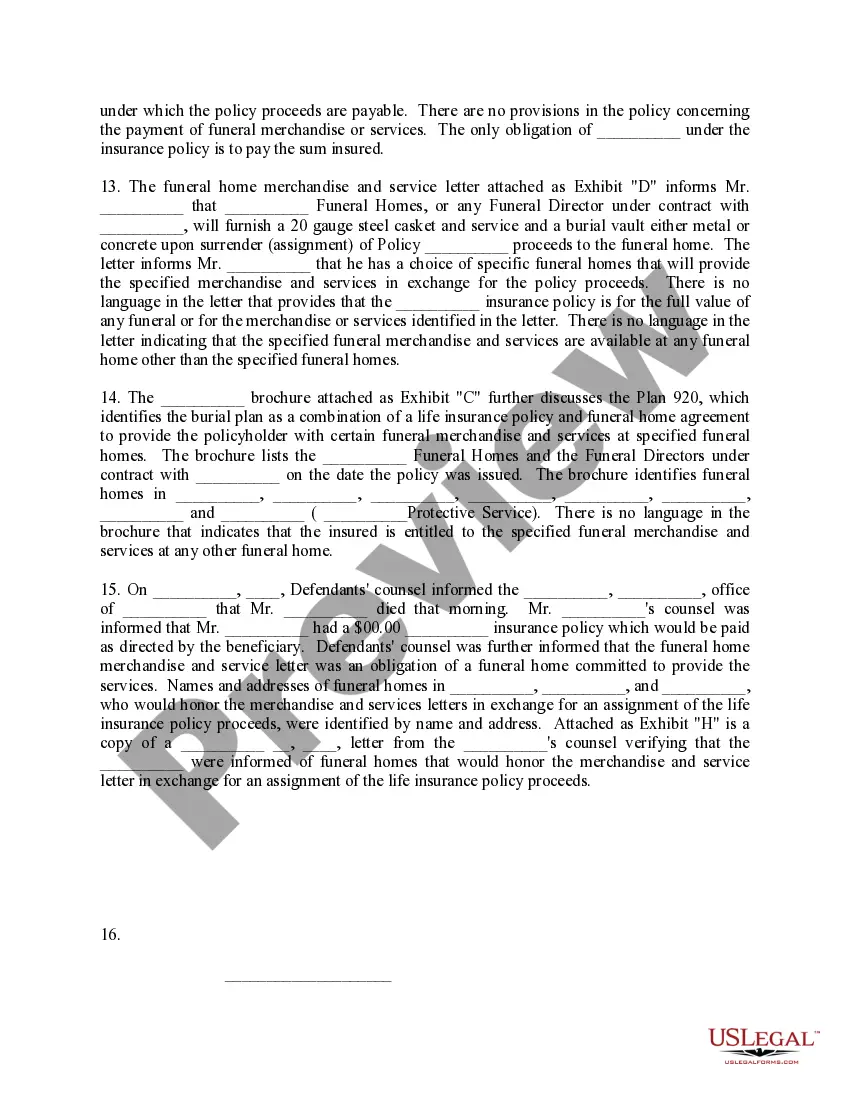
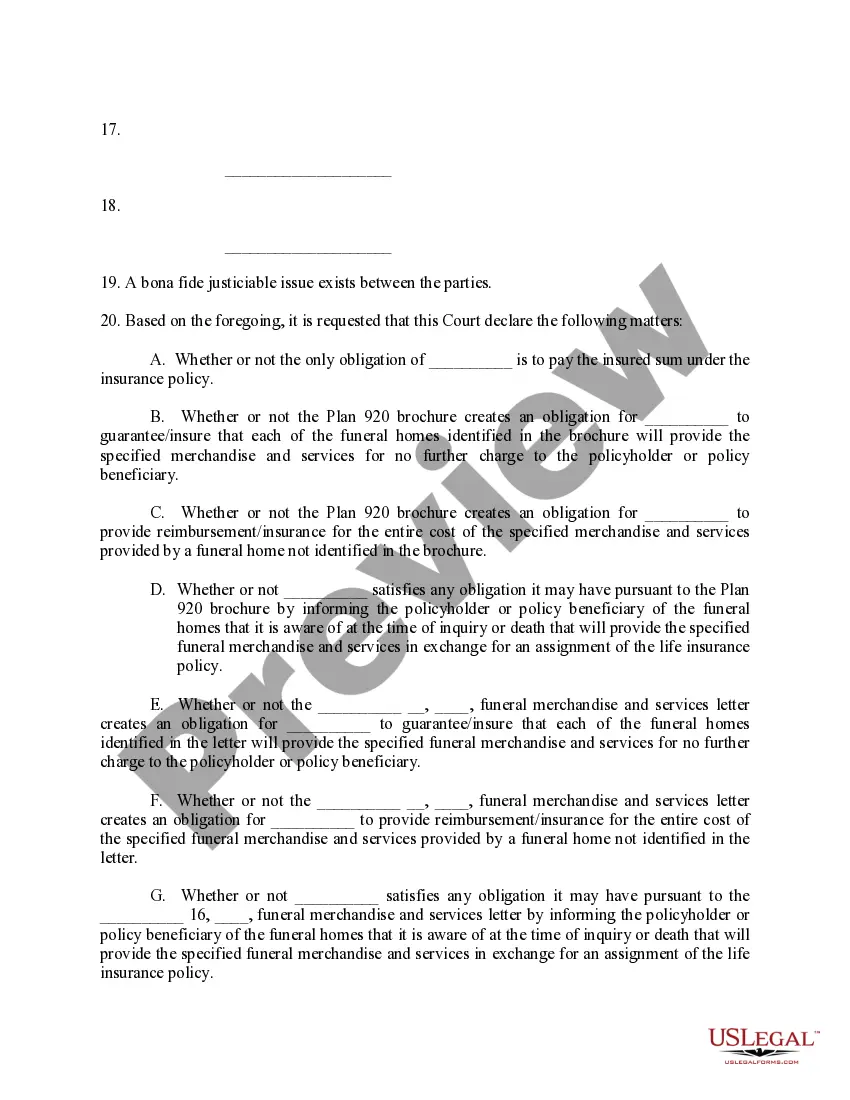
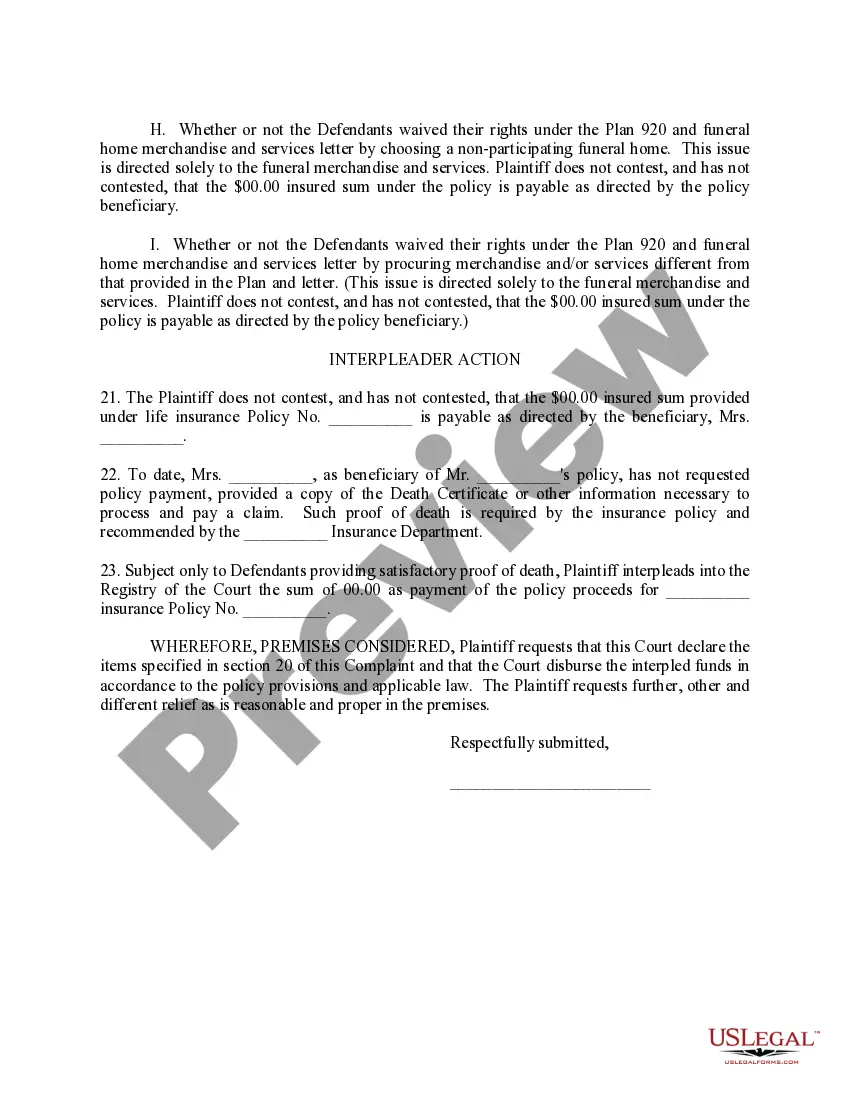
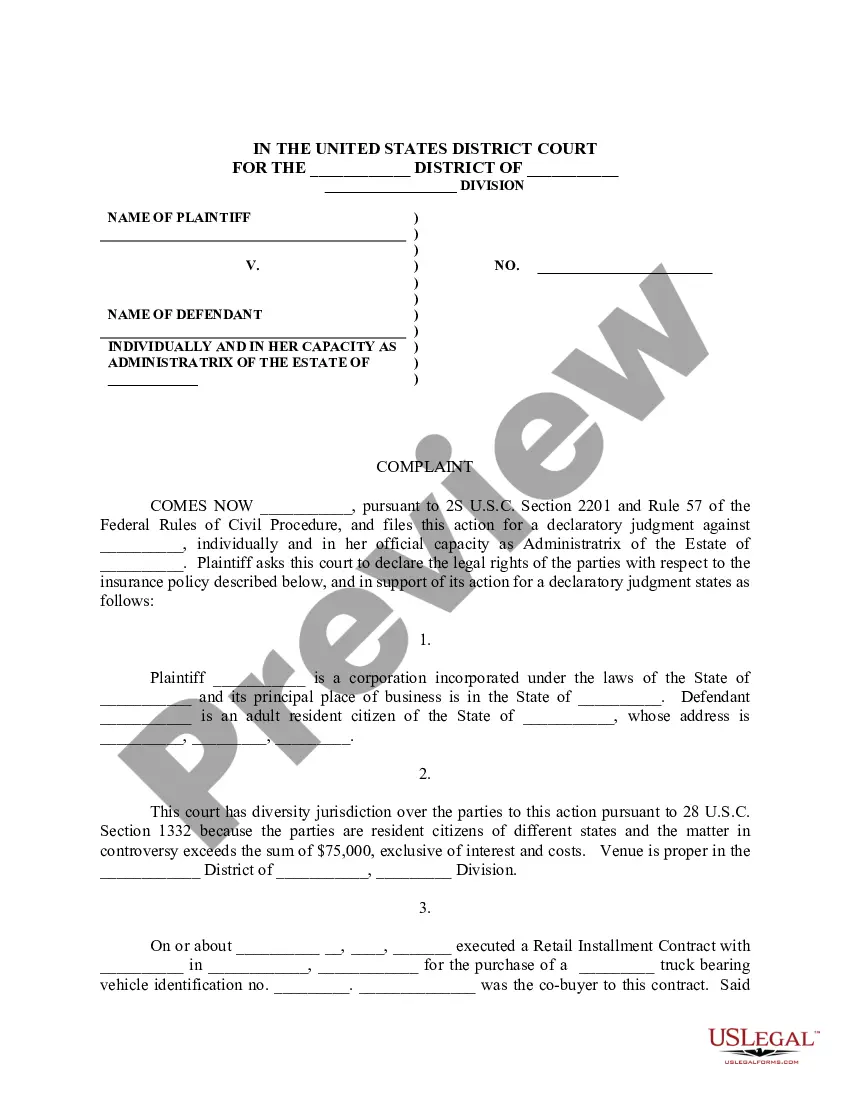
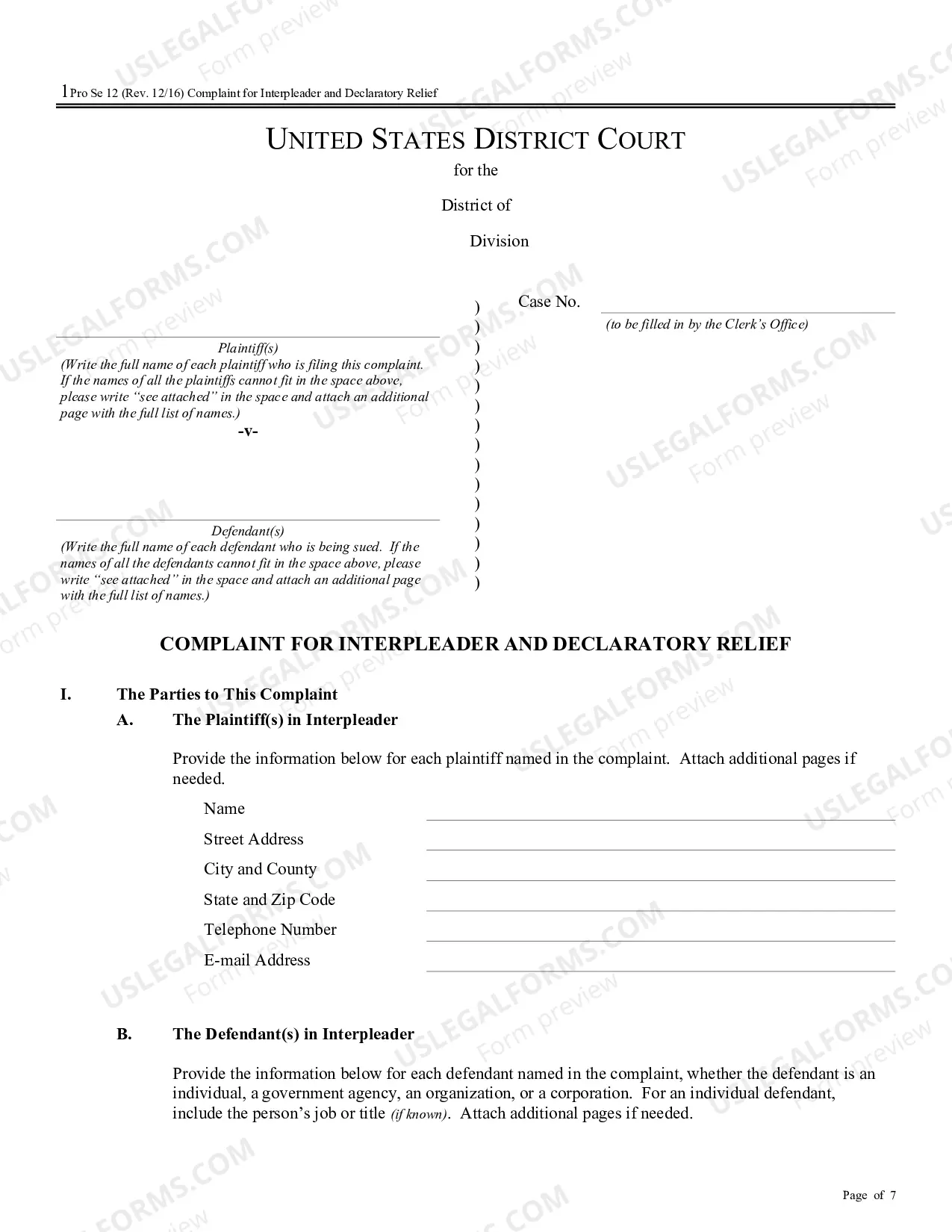
Texas Complaint for Declaratory Judgment and Interpleader Action or Burial Policy
Description


Get your form ready online
Our built-in tools help you complete, sign, share, and store your documents in one place.
Make edits, fill in missing information, and update formatting in US Legal Forms—just like you would in MS Word.
Download a copy, print it, send it by email, or mail it via USPS—whatever works best for your next step.
Sign and collect signatures with our SignNow integration. Send to multiple recipients, set reminders, and more. Go Premium to unlock E-Sign.
If this form requires notarization, complete it online through a secure video call—no need to meet a notary in person or wait for an appointment.
We protect your documents and personal data by following strict security and privacy standards.

Make edits, fill in missing information, and update formatting in US Legal Forms—just like you would in MS Word.

Download a copy, print it, send it by email, or mail it via USPS—whatever works best for your next step.

Sign and collect signatures with our SignNow integration. Send to multiple recipients, set reminders, and more. Go Premium to unlock E-Sign.

If this form requires notarization, complete it online through a secure video call—no need to meet a notary in person or wait for an appointment.

We protect your documents and personal data by following strict security and privacy standards.
Looking for another form?

How to fill out Complaint For Declaratory Judgment And Interpleader Action Or Burial Policy?
If you wish to obtain, download, or print authentic document templates, utilize US Legal Forms, the premier assortment of legal forms, which is accessible online.
Employ the site’s straightforward and user-friendly search to find the documents you require. Various templates for business and personal purposes are categorized by type and state, or keywords.
Utilize US Legal Forms to locate the Texas Complaint for Declaratory Judgment and Interpleader Action or Burial Policy in just a few clicks.
Every legal document template you purchase is yours for a long time. You have access to every form you downloaded in your account. Visit the My documents section and select a form to print or download again.
Stay competitive and download, and print the Texas Complaint for Declaratory Judgment and Interpleader Action or Burial Policy with US Legal Forms. There are thousands of professional and state-specific forms you can use for your business or personal needs.
- If you are already a US Legal Forms user, Log In to your account and click the Download button to obtain the Texas Complaint for Declaratory Judgment and Interpleader Action or Burial Policy.
- You can also access forms you previously downloaded in the My documents tab of your account.
- If you are using US Legal Forms for the first time, follow the instructions below.
- Step 1. Ensure you have selected the form for the correct city/state.
- Step 2. Use the Preview option to review the form’s content. Don’t forget to read the summary.
- Step 3. If you are not pleased with the form, utilize the Search field at the top of the screen to find other versions of the legal form template.
- Step 4. Once you have identified the form you need, click on the Get now button. Choose the pricing plan you prefer and enter your details to sign up for an account.
- Step 5. Complete the transaction. You can use your credit card or PayPal account to finalize the transaction.
- Step 6. Select the format of your legal form and download it to your device.
- Step 7. Complete, modify and print or sign the Texas Complaint for Declaratory Judgment and Interpleader Action or Burial Policy.
Form popularity
FAQ
Declaratory relief allows a party who is not certain of his rights to prevent the accrual of avoidable damages and to obtain an adjudication before the parties bring a coercive lawsuit.
A declaratory judgment is a binding judgment from a court defining the legal relationship between parties and their rights in a matter before the court. When there is uncertainty as to the legal obligations or rights between two parties, a declaratory judgment offers an immediate means to resolve this uncertainty.
Collusion, bad faith or inequitable conduct by the interpleading party which create the controversy may be a defense to an interpleader action.
Examples: a party to a contract may seek the legal interpretation of a contract to determine the parties' rights, or a corporation may ask a court to decide whether a new tax is truly applicable to that business before it pays it.
To establish federal jurisdiction in a declaratory judgment action, two conditions must be satisfied. First, is the constitutional inquiry - the case must be a 'case or controversy' pursuant to Article III of the US Constitution. Second is the prudential inquiry ? declaratory relief must be appropriate.
The Interpleader Process The law typically favors insurers that file interpleaders. An insurer facing claims to policy proceeds can interplead the funds, name the rival claimants, and be discharged from liability. The insurance company may be able to recover a portion of its legal fees from the life insurance policy.
The Uniform Declaratory Judgments Act is ?remedial? and meant to ?settle and to afford relief from uncertainty and insecurity with respect to rights, status, and other legal relations.? (CPRC §37.002) The resources listed below are not exhaustive and may not include the most up- to-date information.
So what is a "declaratory judgment" lawsuit? This answer is this: It's a lawsuit that a plaintiff files in which the plaintiff asks the court to "declare" through issuance of a "declaratory judgment" what the respective rights of the parties are.