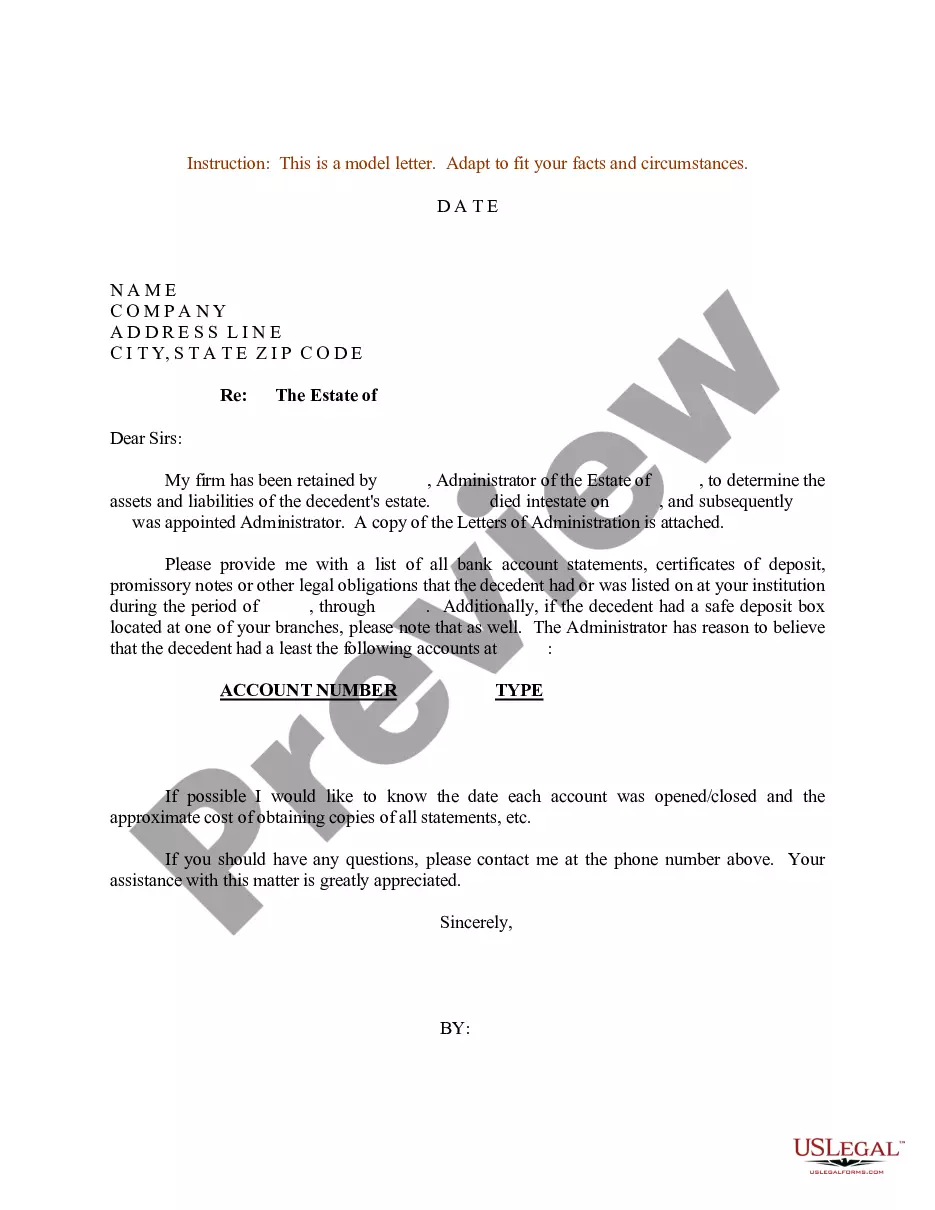
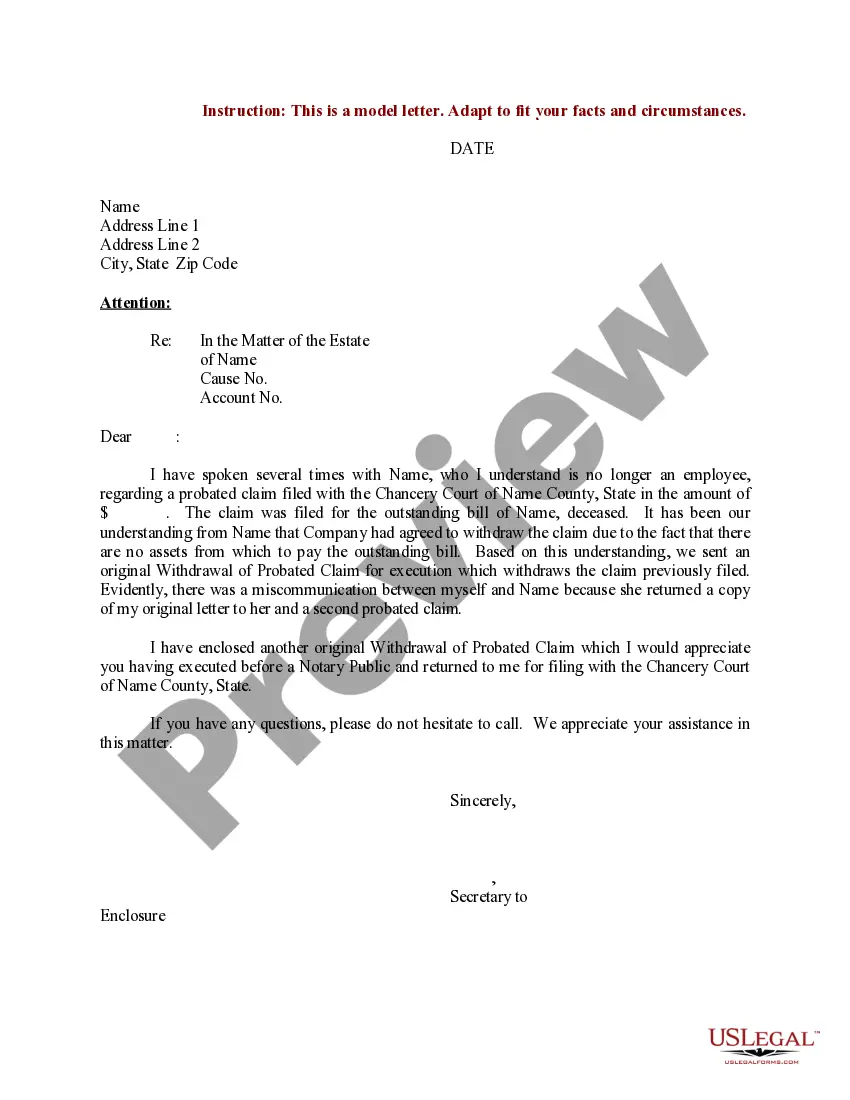
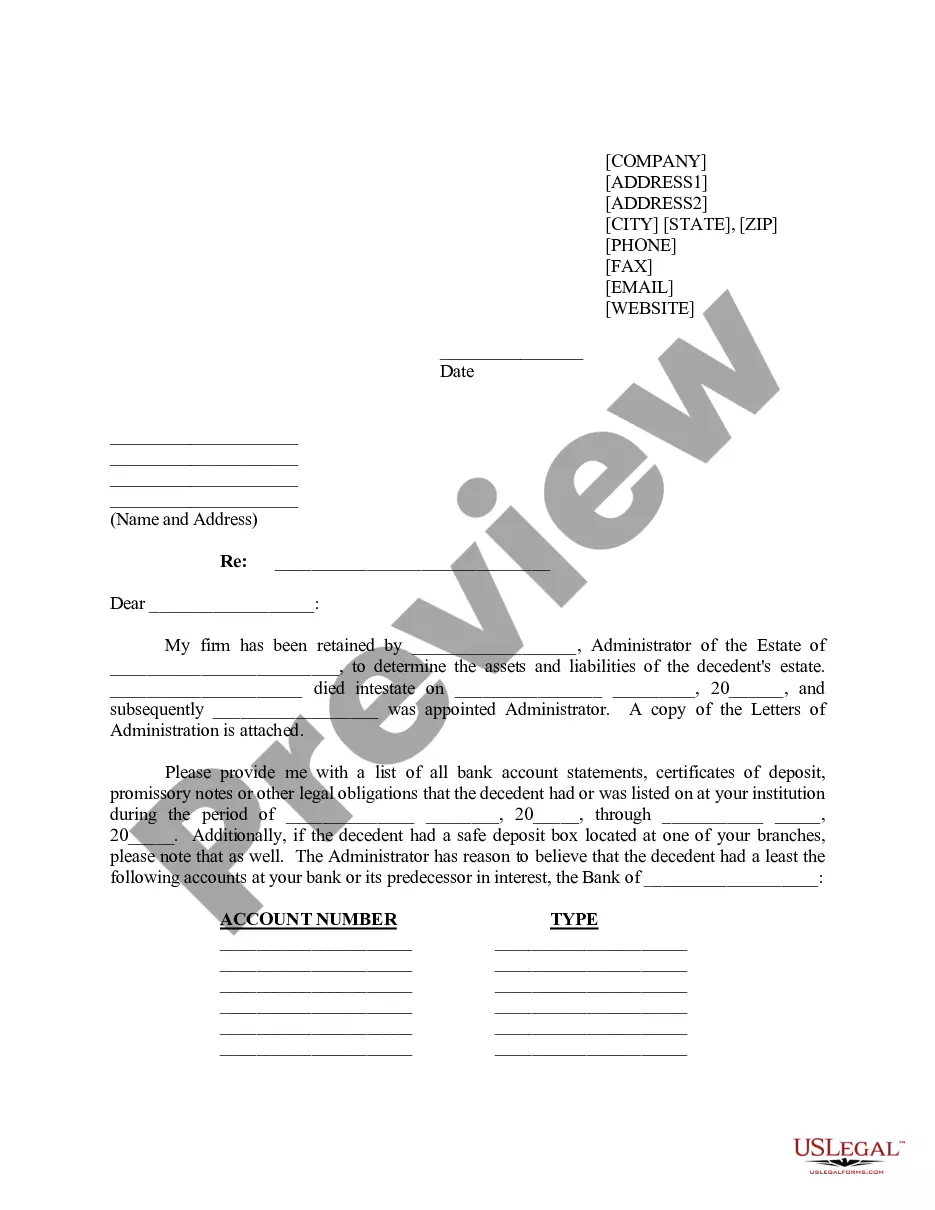
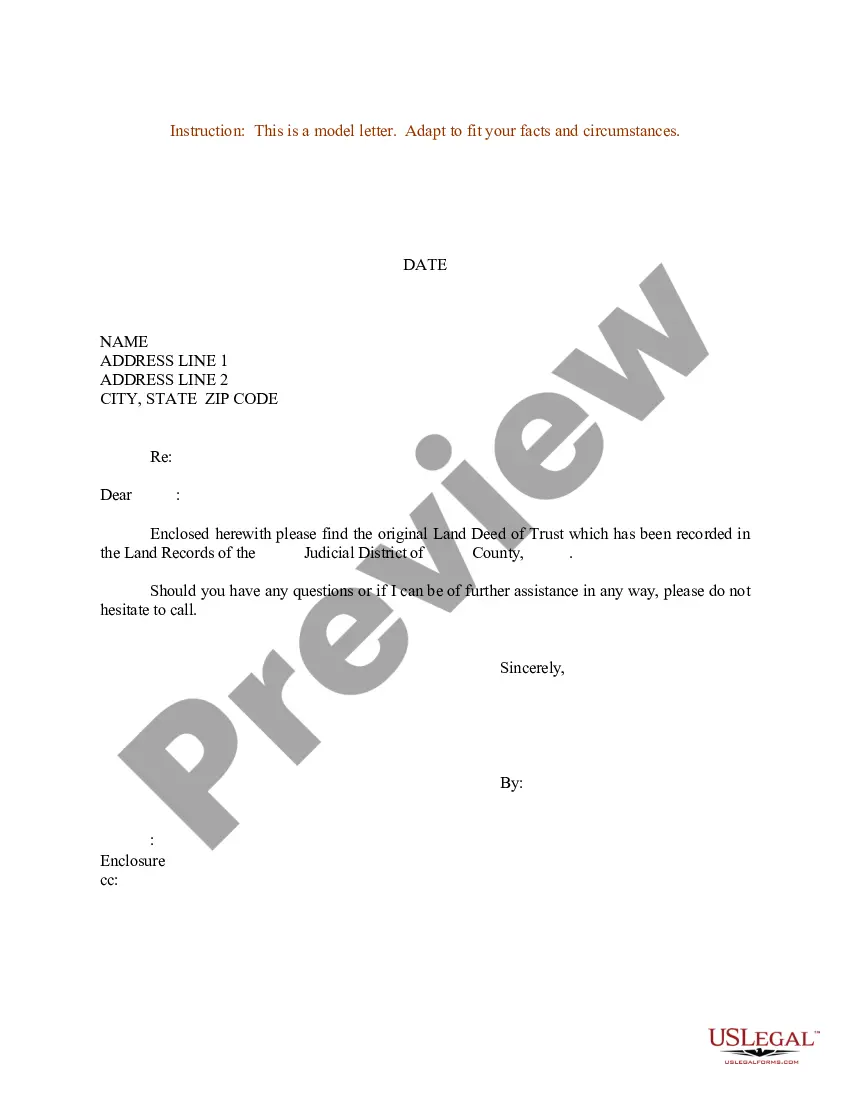
This form is a sample letter in Word format covering the subject matter of the title of the form.
Texas Sample Letter to Bank concerning Accounts of Decedent
State:
Multi-State
Category:
Control #:
US-0034LTR
Format:
Word;
Rich Text
48 downloads
Description
Free preview



Get your form ready online
Our built-in tools help you complete, sign, share, and store your documents in one place.
Built-in online Word editor
Make edits, fill in missing information, and update formatting in US Legal Forms—just like you would in MS Word.
Export easily
Download a copy, print it, send it by email, or mail it via USPS—whatever works best for your next step.
E-sign your document
Sign and collect signatures with our SignNow integration. Send to multiple recipients, set reminders, and more. Go Premium to unlock E-Sign.
Notarize online 24/7
If this form requires notarization, complete it online through a secure video call—no need to meet a notary in person or wait for an appointment.
Store your document securely
We protect your documents and personal data by following strict security and privacy standards.

Make edits, fill in missing information, and update formatting in US Legal Forms—just like you would in MS Word.

Download a copy, print it, send it by email, or mail it via USPS—whatever works best for your next step.

Sign and collect signatures with our SignNow integration. Send to multiple recipients, set reminders, and more. Go Premium to unlock E-Sign.

If this form requires notarization, complete it online through a secure video call—no need to meet a notary in person or wait for an appointment.

We protect your documents and personal data by following strict security and privacy standards.
Looking for another form?
How to fill out Sample Letter To Bank Concerning Accounts Of Decedent?
Locating the appropriate valid document template can be somewhat challenging. Naturally, there are numerous templates accessible online, but how do you find the legitimate format you require? Utilize the US Legal Forms website. This service provides a vast array of templates, such as the Texas Sample Letter to Bank regarding Accounts of Decedent, which you can utilize for business and personal purposes. All of the forms are evaluated by experts and comply with state and federal standards.
If you are currently registered, Log In to your account and click the Obtain button to retrieve the Texas Sample Letter to Bank regarding Accounts of Decedent. Use your account to browse through the legal forms you have previously acquired. Navigate to the My documents section of your account and download another copy of the document you need.
If you are a new user of US Legal Forms, here are some simple steps for you to follow: First, ensure that you have selected the correct form for your city/state. You can review the form using the Review button and read the form description to verify that it is indeed the right one for you. If the form does not meet your requirements, use the Search field to find the correct form. Once you are confident that the form is suitable, click the Acquire now button to obtain the form. Select the payment plan you desire and enter the required information. Create your account and pay for the order using your PayPal account or Visa or Mastercard. Choose the file format and download the legal document template to your device. Complete, modify, print, and sign the obtained Texas Sample Letter to Bank regarding Accounts of Decedent.
By leveraging US Legal Forms, you can simplify the process of obtaining the necessary legal documents tailored to your specific needs.
- US Legal Forms is the largest repository of legal forms where you can find various document templates.
- Utilize the service to obtain properly crafted paperwork that adheres to state regulations.
- Explore the extensive selection of templates available on the platform.
- Access expert-reviewed forms that meet legal requirements.
- Conveniently manage your documents with a user-friendly interface.
- Ensure compliance with both state and federal laws.
Form popularity
FAQ
Claiming a deceased bank account in Texas involves several steps. First, gather essential documents like the death certificate and proof of your relationship to the deceased. Next, contact the bank to inquire about their specific requirements and procedures. Utilizing a Texas Sample Letter to Bank concerning Accounts of Decedent can streamline your communication and ensure you provide all necessary details.
When writing to a bank manager regarding a death claim, start by addressing the manager directly and providing relevant details. State the deceased person's name, their account number, and your contact information. Clearly express your request for the death claim process and include any necessary documentation, such as the death certificate. A Texas Sample Letter to Bank concerning Accounts of Decedent offers a structured approach to help you compose this letter effectively.
Informing a bank about a deceased person requires a concise letter that includes essential details. Mention the deceased's full name, account number, and your relationship to them. Additionally, attach a copy of the death certificate to validate your claim. A Texas Sample Letter to Bank concerning Accounts of Decedent can serve as a helpful template in crafting this letter.
To write a letter for claim settlement, begin by clearly stating the purpose of your letter. Include the deceased person's name, account number, and your relationship to them. You should express your intention to settle the account and request any necessary information or forms required for the process. For a detailed guide, refer to a Texas Sample Letter to Bank concerning Accounts of Decedent.
Dear Sir, I am writing to inform you that my [relative] [Deceased Account Holder's Name] has passed away, and I would like to request the closure of their account [Account Number]. I will be very thankful to you for the processing of my application. I hope to receive a confirmation letter of the account's closure soon.
I am the personal representative of [deceased] who died on [date]. I enclose a copy of the death certificate, which I'd be grateful if you would return once you have noted the details. Please can you let me know: the balance on the account at the date of death.
Named Heirs If your bank account does not have a named beneficiary or any other third-party interests, it will pass through estate and inheritance law. If you have a will, your account will pass based on how you wrote your bequests.
Not all property becomes subject to the Texas probate process after one passes away. Assets such as jointly owned real estate, bank accounts, or insurance policies for which a beneficiary has been designated will transfer without becoming a part of the deceased's probate estate.
If the deceased person was the sole owner of the bank account and named a beneficiary, then the bank can release the funds to the beneficiary without probate. If there is no named beneficiary, then the bank will require probate before releasing any funds.
A court must grant you the power to withdraw money from the account if you're neither a joint owner or an account beneficiary. For example, an executor must produce proof of executor status and a certified copy of the death certificate to collect funds and place them in an estate account.