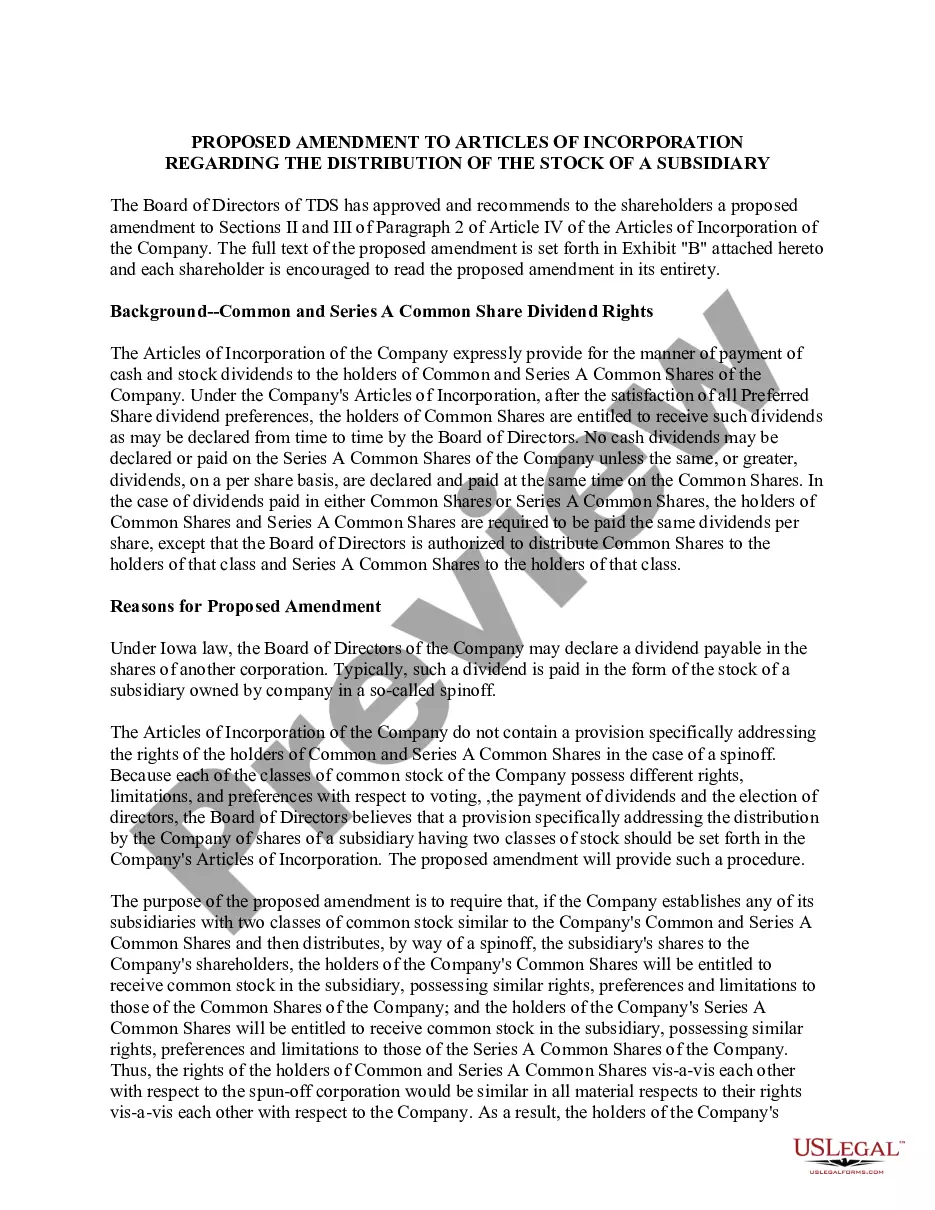
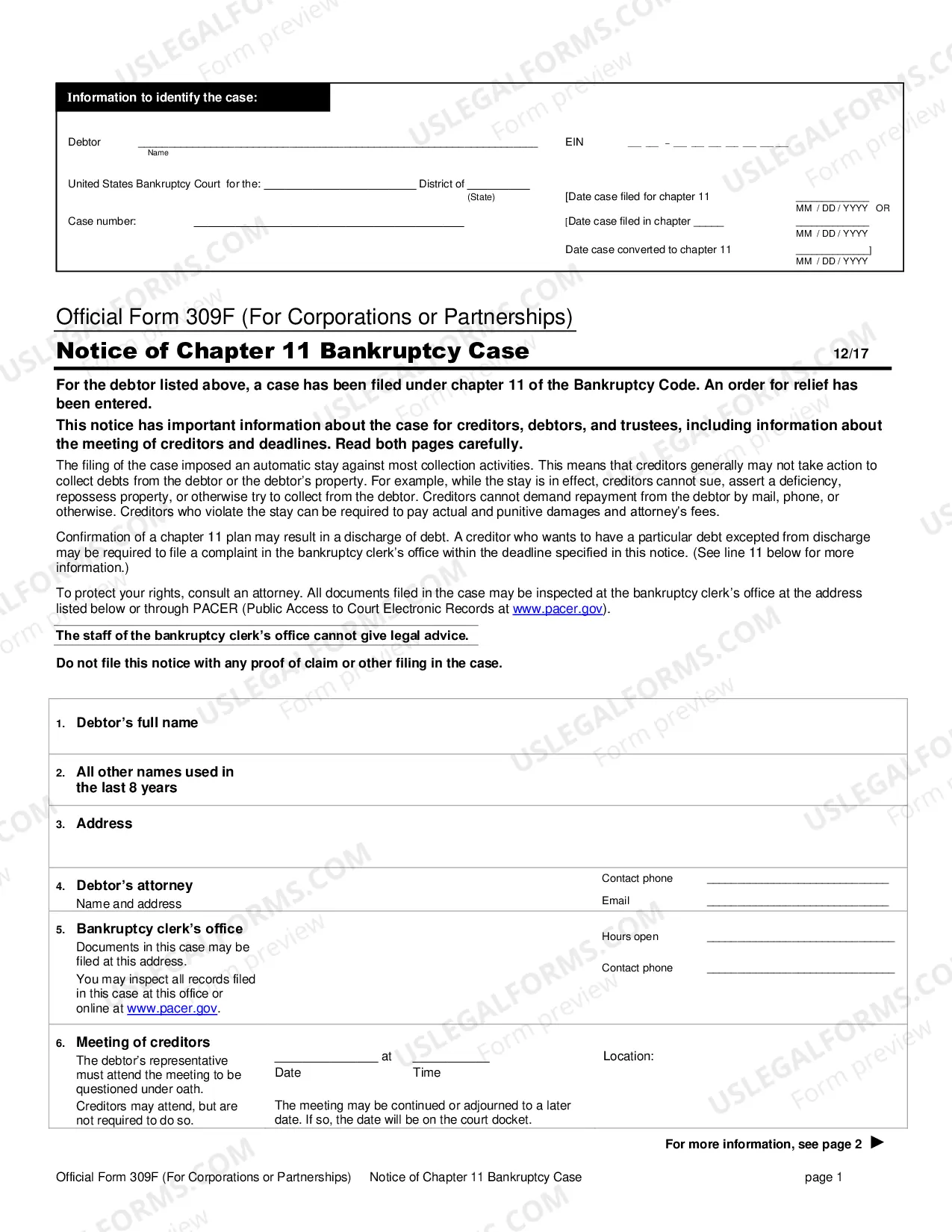
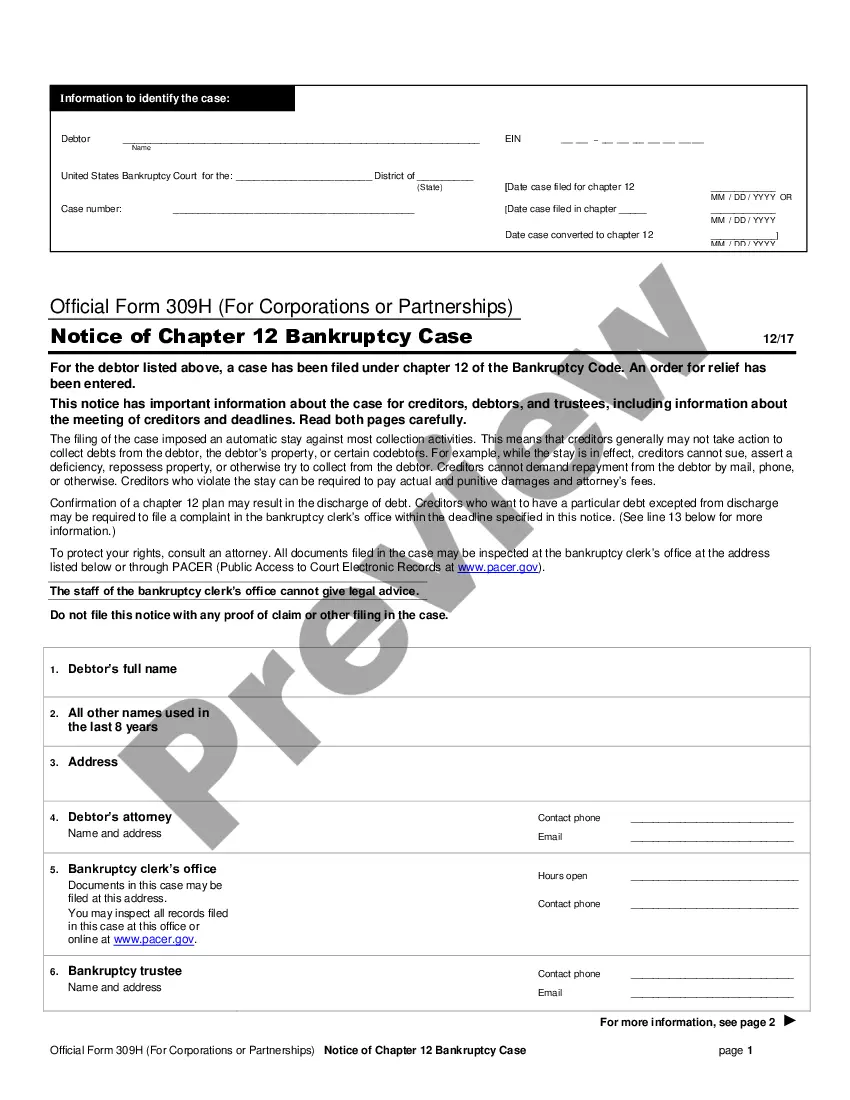
Texas Notice of Chapter 12 Bankruptcy Case (For Corporations or Partnerships)
Description
Get your form ready online
Our built-in tools help you complete, sign, share, and store your documents in one place.
Make edits, fill in missing information, and update formatting in US Legal Forms—just like you would in MS Word.
Download a copy, print it, send it by email, or mail it via USPS—whatever works best for your next step.
Sign and collect signatures with our SignNow integration. Send to multiple recipients, set reminders, and more. Go Premium to unlock E-Sign.
If this form requires notarization, complete it online through a secure video call—no need to meet a notary in person or wait for an appointment.
We protect your documents and personal data by following strict security and privacy standards.

Make edits, fill in missing information, and update formatting in US Legal Forms—just like you would in MS Word.

Download a copy, print it, send it by email, or mail it via USPS—whatever works best for your next step.

Sign and collect signatures with our SignNow integration. Send to multiple recipients, set reminders, and more. Go Premium to unlock E-Sign.

If this form requires notarization, complete it online through a secure video call—no need to meet a notary in person or wait for an appointment.

We protect your documents and personal data by following strict security and privacy standards.
Looking for another form?

How to fill out Texas Notice Of Chapter 12 Bankruptcy Case (For Corporations Or Partnerships)?
How much time and resources do you typically spend on composing formal documentation? There’s a better opportunity to get such forms than hiring legal specialists or wasting hours browsing the web for a proper blank. US Legal Forms is the leading online library that offers professionally designed and verified state-specific legal documents for any purpose, like the Texas Notice of Chapter 12 Bankruptcy Case (For Corporations or Partnerships).
To obtain and complete an appropriate Texas Notice of Chapter 12 Bankruptcy Case (For Corporations or Partnerships) blank, follow these easy steps:
- Examine the form content to make sure it meets your state requirements. To do so, check the form description or use the Preview option.
- In case your legal template doesn’t meet your needs, find another one using the search tab at the top of the page.
- If you already have an account with us, log in and download the Texas Notice of Chapter 12 Bankruptcy Case (For Corporations or Partnerships). If not, proceed to the next steps.
- Click Buy now once you find the correct document. Select the subscription plan that suits you best to access our library’s full opportunities.
- Create an account and pay for your subscription. You can make a transaction with your credit card or through PayPal - our service is absolutely reliable for that.
- Download your Texas Notice of Chapter 12 Bankruptcy Case (For Corporations or Partnerships) on your device and complete it on a printed-out hard copy or electronically.
Another advantage of our library is that you can access previously downloaded documents that you securely keep in your profile in the My Forms tab. Pick them up anytime and re-complete your paperwork as often as you need.
Save time and effort preparing formal paperwork with US Legal Forms, one of the most trustworthy web solutions. Sign up for us today!
Form popularity
FAQ
Individuals in Chapter 12 or 13 Only individuals may file a chapter 13 bankruptcy. Chapter 13 relief isn't available to corporations or partnerships.
Under chapter 12, debtors propose a repayment plan to make installments to creditors over three to five years.
Secured Creditors - often a bank, is paid first. Unsecured Creditors - such as banks, suppliers, and bondholders, have the next claim. Stockholders - owners of the company, have the last claim on assets and may not receive anything if the Secured and Unsecured Creditors' claims are not fully repaid.
Key Takeaways. Companies can file for either Chapter 7 or Chapter 11 bankruptcy if they're unable to pay their debts. Chapter 7 simply liquidates the company's assets, while Chapter 11 allows the business to continue to operate under a reorganization plan.
In general, secured creditors have the highest priority followed by priority unsecured creditors. The remaining creditors are often paid prior to equity shareholders.
Most plans will typically fall into the 3- to 5-year range. With that said, every business is different, and more complex cases for larger businesses may be structured to take even longer than five years. This is something that your legal team can advise you on while you are building and litigating your plan.
A case filed under chapter 11 of the United States Bankruptcy Code is frequently referred to as a "reorganization" bankruptcy. Usually, the debtor remains ?in possession,? has the powers and duties of a trustee, may continue to operate its business, and may, with court approval, borrow new money.
But if it cancels existing shares, yours will be worthless. With Chapter 7 bankruptcy, the company is closing its doors and your stock will have no value. Owners of common stock often get nothing when a company enters liquidation because they are the last in line for payment.