Texas Affidavit of Inability to Serve
Overview of this form
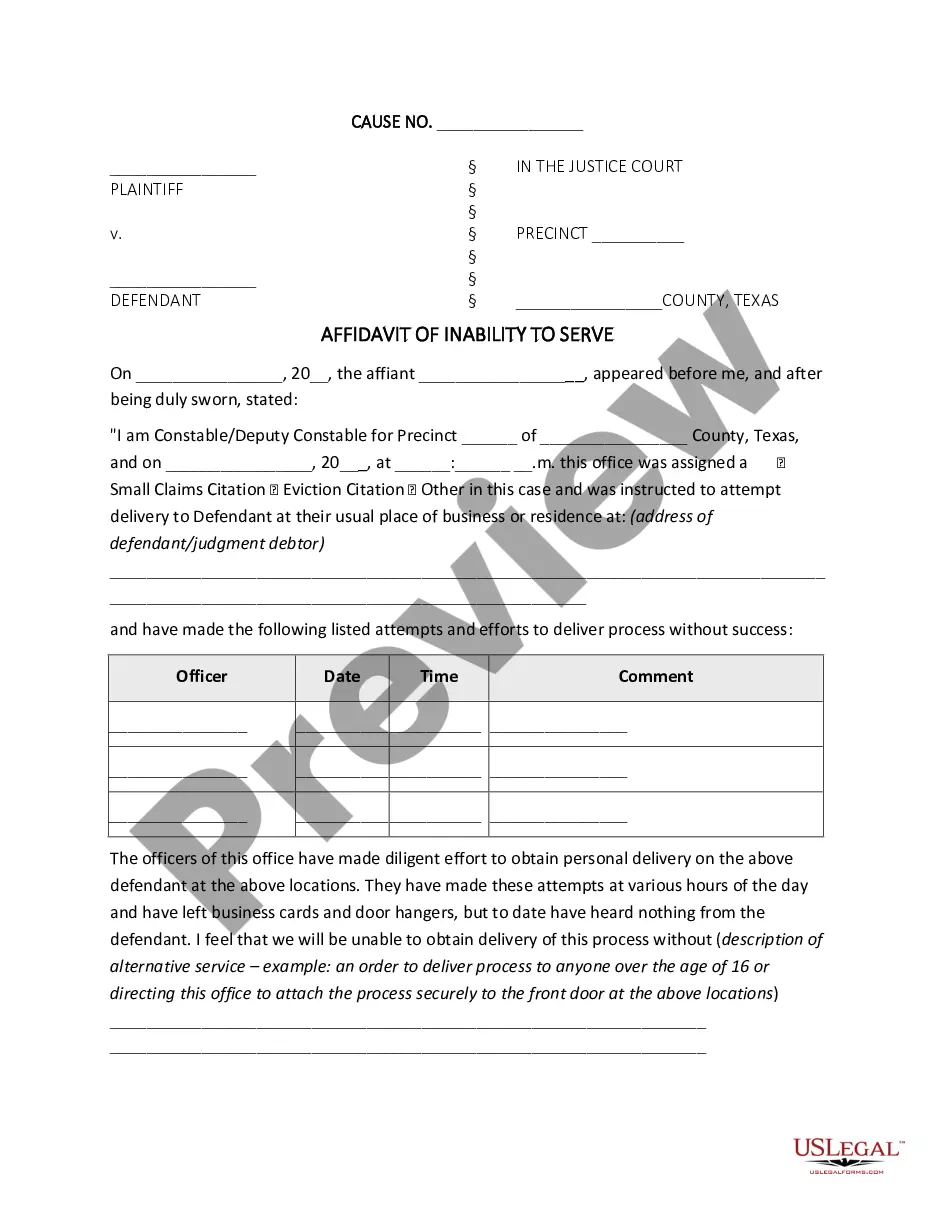
The Affidavit of Inability to Serve is a sworn statement used by law enforcement officers, such as constables or deputy constables, when they are unable to deliver legal documents to a defendant. This affidavit details the attempts made to serve the defendant at their known address and seeks permission for alternative service methods. Unlike other affidavits, this document specifically applies to service of process related to court actions, making it essential for facilitating legal proceedings when direct delivery is not feasible.
Main sections of this form
- Parties involved: Information about the plaintiff and defendant.
- Date of service attempts: The specific date when attempts to serve were made.
- Details of attempts: A record of when and how service was attempted.
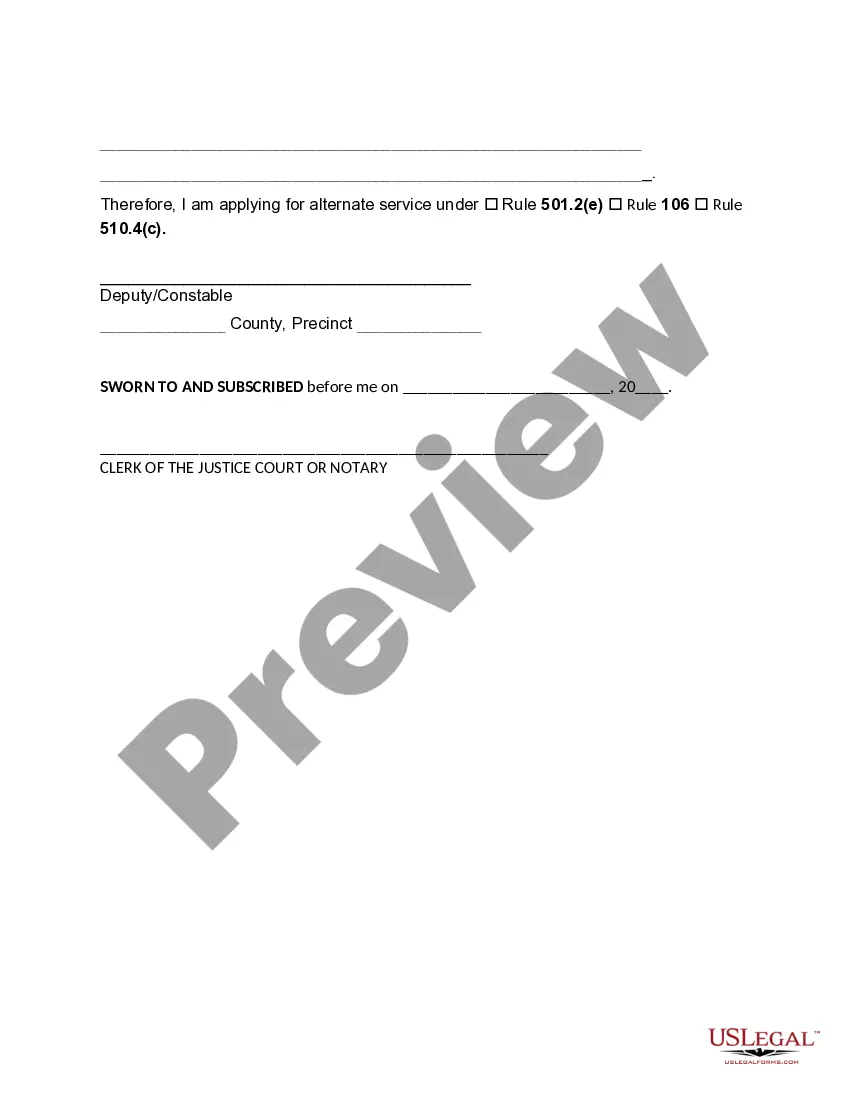
- Request for alternative service: Description of proposed alternative methods of serving the defendant.
- Signature of the officer: Confirmation of the affidavit by the constable or deputy constable.
- Notary acknowledgment: Certification from a notary public or justice court clerk verifying the affidavit.
When to use this document
This form is necessary when a constable or deputy constable has made multiple unsuccessful attempts to serve legal documents to a defendant at their known address. Situations that may require this affidavit include eviction cases, small claims actions, or any civil process where service is critical for moving forward legally. When all reasonable methods of delivery fail, this affidavit aids in seeking court approval for alternative service methods to ensure legal processes continue smoothly.
Who this form is for
This form is intended for:
- Constables or deputy constables tasked with serving legal documents.
- Law enforcement officials involved in civil process delivery.
- Legal representatives or attorneys who need to demonstrate efforts made to serve a defendant.
Instructions for completing this form
- Identify the parties: Fill in the names of the plaintiff and defendant.
- Record the date: Enter the specific date when service attempts were made.
- Document service attempts: Detail each attempt to serve the defendant, including date, time, and comments.
- Describe alternative service: Provide a clear explanation of the proposed alternative methods of delivery.
- Sign the affidavit: The constable or deputy constable must sign the document to confirm its accuracy.
- Obtain notarization: Have the form notarized by a notary public or a clerk of the justice court to validate it.
Is notarization required?
Yes, this form must be notarized to be legally valid. Notarization serves as an essential step in verifying the authenticity of the affidavit. US Legal Forms offers integrated online notarization with 24/7 availability, allowing you to complete the notarization process securely via video call, ensuring your document is legally acceptable without the need for in-person meetings.
Get your form ready online
Our built-in tools help you complete, sign, share, and store your documents in one place.
Make edits, fill in missing information, and update formatting in US Legal Forms—just like you would in MS Word.
Download a copy, print it, send it by email, or mail it via USPS—whatever works best for your next step.
Sign and collect signatures with our SignNow integration. Send to multiple recipients, set reminders, and more. Go Premium to unlock E-Sign.
If this form requires notarization, complete it online through a secure video call—no need to meet a notary in person or wait for an appointment.
We protect your documents and personal data by following strict security and privacy standards.

Make edits, fill in missing information, and update formatting in US Legal Forms—just like you would in MS Word.

Download a copy, print it, send it by email, or mail it via USPS—whatever works best for your next step.

Sign and collect signatures with our SignNow integration. Send to multiple recipients, set reminders, and more. Go Premium to unlock E-Sign.

If this form requires notarization, complete it online through a secure video call—no need to meet a notary in person or wait for an appointment.

We protect your documents and personal data by following strict security and privacy standards.
Typical mistakes to avoid
- Failing to provide complete information regarding service attempts.
- Not recording the date and time of each attempt accurately.
- Omitting the description of alternative service methods.
- Neglecting to sign or have the affidavit notarized, which may invalidate the document.
- Using the wrong format or language that does not comply with local court rules.
Summary of main points
- The Affidavit of Inability to Serve is crucial for documenting failed service attempts and seeking alternative methods.
- Accurate completion of all sections is vital to the affidavit's validity.
- This form must be notarized to hold legal weight in court proceedings.
- Failure to adhere to local rules may result in complications in legal processes.
Looking for another form?
Form popularity
FAQ
If a Statement of Inability to Afford Payment of Court Costs is approved, you do not have to pay for any costs charged by the court. This includes costs for issuance of service and copies. Court fees vary by county.
Collin County Divorce Filing Fees The Collin County clerk filing fees are around $300. There might be other court fees, such as those for making copies or serving your spouse, if you need it.
Our recommendation is to find an attorney that will represent you for a flat fee. That way, you know exactly how much it will cost. Expect to pay anywhere from $800-2500.
Talk to Your Landlord You may be able to come to an agreement without going to court. An eviction will cost both of you money (as well as time), and your landlord may be willing to stop the eviction if you agree to certain terms, such as paying rent you owe or stopping behavior that violates the lease.
If you can't afford the bond or a cash deposit, you can file an Affidavit of Inability to Pay (also called a Sworn Statement of Inability to Pay, or a fee waiver). The Justice Court should provide you a form Affidavit upon request. If you appeal with a fee waiver, you are not responsible for County Court filing fees.
The bill of costs (1) lists the ?costs on appeal,? such as the costs which were incurred for the appellate record and the court of appeals filing fees and (2) notes whether those costs have been paid and, if so, by whom.
If a Statement of Inability to Afford Payment of Court Costs is approved, you do not have to pay for any costs charged by the court. This includes costs for issuance of service and copies. Court fees vary by county.
A pauper's affidavit is used by a tenant to escape the burden of paying for the ?court cost? associated with an appeal. The affidavit is essentially a statement under oath that the tenant is too poor and incapable of paying a few hundred dollars to the State of Texas.