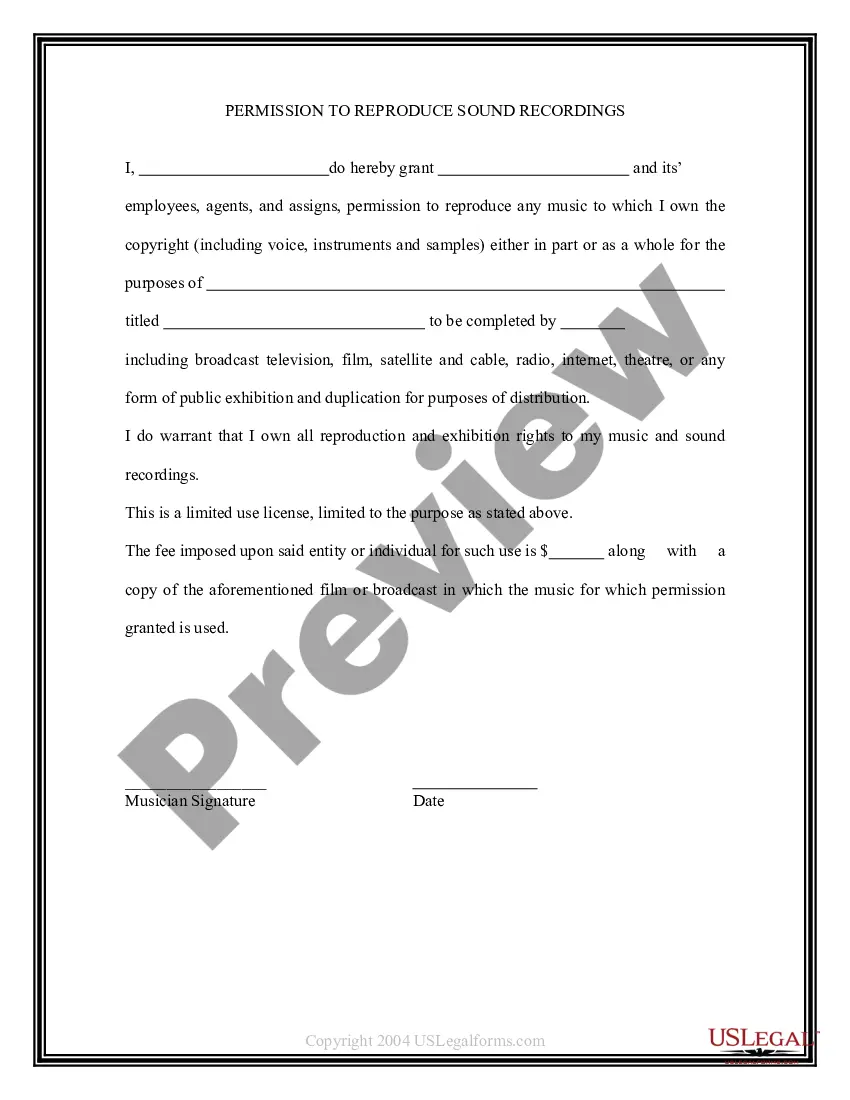
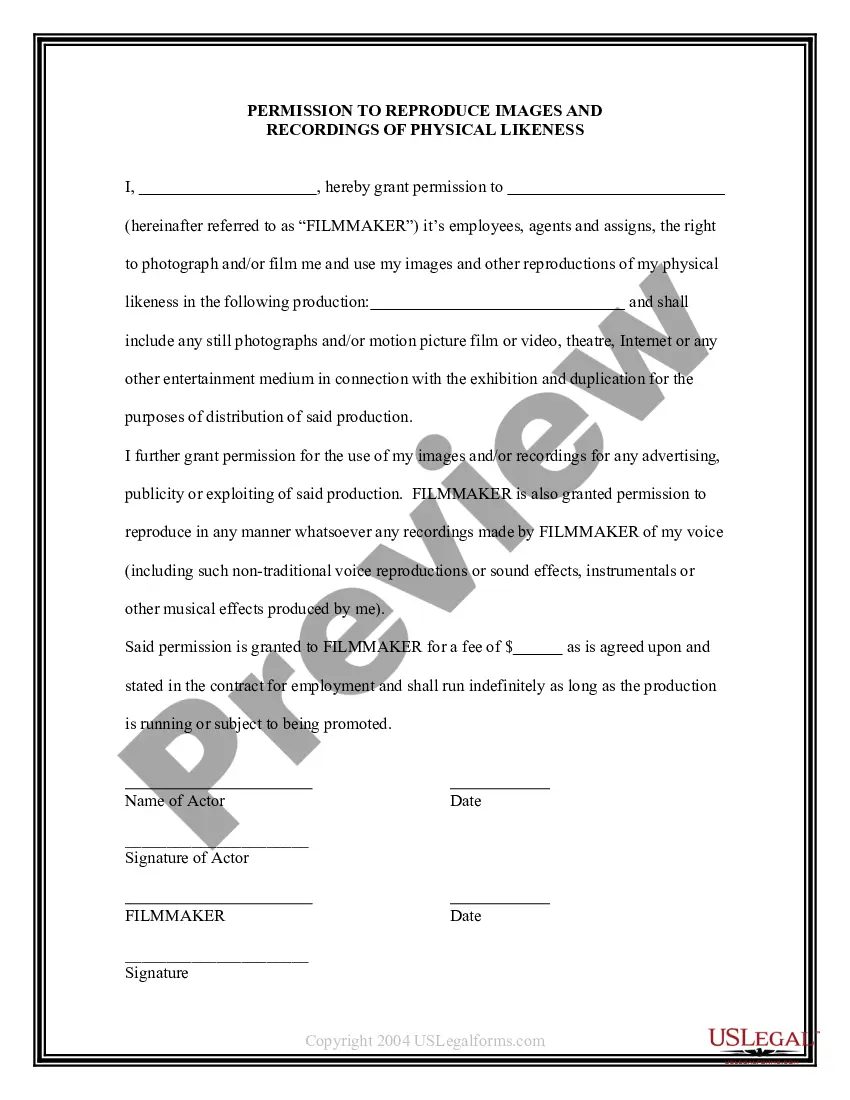
This is a form signed by a musician or owner of music granting permission to reproduce copyrighted music for use in a film, television, Internet, radio etc.
Tennessee Permission To Reproduce Sound Recordings
State:
Multi-State
Control #:
US-PRM-23
Format:
Word;
Rich Text
Instant download
Description

How to fill out Permission To Reproduce Sound Recordings?
US Legal Forms - one of the largest collections of legal documents in the United States - offers a vast array of legal form templates that you can download or create. By using the website, you can find countless forms for business and personal purposes, organized by categories, states, or keywords. You can access the latest forms such as the Tennessee Permission To Reproduce Sound Recordings in moments.
If you already have a monthly subscription, Log In and download the Tennessee Permission To Reproduce Sound Recordings from the US Legal Forms library. The Download button will appear on each form you view. You have access to all previously downloaded forms from the My documents section of your account.
If you are using US Legal Forms for the first time, here are simple instructions to help you get started: Ensure you have selected the correct form for your city/county. Click the Review button to examine the form’s content. Check the form details to confirm you have chosen the right form. If the form does not meet your needs, utilize the Search field at the top of the screen to find one that does. When you are satisfied with the form, confirm your choice by clicking the Get now button. Next, select the pricing plan you prefer and provide your information to register for the account. Complete the transaction. Use your credit card or PayPal account to finalize the payment. Retrieve the format and download the form onto your device. Make adjustments. Fill out, modify, and print and sign the downloaded Tennessee Permission To Reproduce Sound Recordings.
- Every template you save in your account has no expiration date and is yours permanently.
- So, if you wish to download or create another copy, simply go to the My documents section and click on the form you need.
- Access the Tennessee Permission To Reproduce Sound Recordings with US Legal Forms, one of the most extensive libraries of legal document templates.
- Utilize thousands of professional and state-specific templates that fulfill your business or personal needs and requirements.
- Simplify your legal documentation process with ease.
- Ensure your legal forms are up-to-date and compliant.
Form popularity
FAQ
Yes, you can sue someone for recording you without your permission in Tennessee, as this may violate your rights to privacy. The law protects individuals from unauthorized recordings, and if this occurs, you may have grounds for a legal claim. Navigating these legalities, especially concerning Tennessee Permission To Reproduce Sound Recordings, can be complex. Seeking professional legal advice can help you understand your options.
Yes, you can use a voice recording as evidence in family court in Tennessee, provided that the recording was obtained legally. This means that all parties must have consented to the recording, aligning with the requirements of Tennessee Permission To Reproduce Sound Recordings. Presenting such evidence can strengthen your case, but it's wise to ensure it meets court standards. Legal platforms like uslegalforms can assist in understanding how to properly use such recordings.
In Tennessee, consent for audio recording requires that all parties involved must explicitly agree to the recording. This means if you plan to record a conversation, you must inform the other person and obtain their permission. Understanding the nuances of Tennessee Permission To Reproduce Sound Recordings can help ensure that you comply with the law. When in doubt, consulting a legal service can provide clarity.
Yes, in Tennessee, audio recording someone without their consent can be illegal. The law requires that all parties involved in the conversation must give their consent for the recording to be lawful. This is particularly important when considering the implications of Tennessee Permission To Reproduce Sound Recordings. To navigate these legal waters safely, it is advisable to seek guidance from legal experts.
In Tennessee, it is generally illegal to record someone without their permission if they have a reasonable expectation of privacy. This means that if you are in a private setting, you should obtain consent before recording. However, Tennessee law allows for certain exceptions, especially in public places. Understanding Tennessee Permission To Reproduce Sound Recordings is crucial to avoid legal issues.
In many states, including Tennessee, it is generally illegal to record a conversation without the consent of at least one party. However, some states may have different rules, so it is essential to know your state's laws regarding audio recording. If someone records you without your consent, it may violate your privacy rights. For guidance on Tennessee Permission To Reproduce Sound Recordings and understanding your rights, US Legal Forms offers valuable resources to help you.
In the United States, two-party consent laws mean that all parties involved in a conversation must agree to the recording. States that enforce these laws include California, Florida, Illinois, Maryland, Massachusetts, New Hampshire, Pennsylvania, and Washington, among others. It's important to understand these regulations, especially when considering Tennessee Permission To Reproduce Sound Recordings. If you need assistance navigating these laws, consider using US Legal Forms for comprehensive guides and forms.
In Tennessee, you can typically record audio without consent under certain conditions. Tennessee follows a one-party consent rule, meaning only one person involved in the conversation needs to be aware of the recording. However, if you plan to use the recording for the Tennessee Permission To Reproduce Sound Recordings, it is wise to obtain consent to avoid potential legal complications. For clarity and resources, consider using platforms like uslegalforms to access legal documents and information related to consent laws.
In the United States, several states require two-party consent for audio recording. These states include California, Florida, Illinois, Maryland, Massachusetts, Michigan, Montana, Nevada, New Hampshire, Pennsylvania, and Washington. Knowing the rules in each state is crucial for anyone considering the Tennessee Permission To Reproduce Sound Recordings, as violating consent laws can lead to legal issues. Always check local laws to ensure compliance before recording.