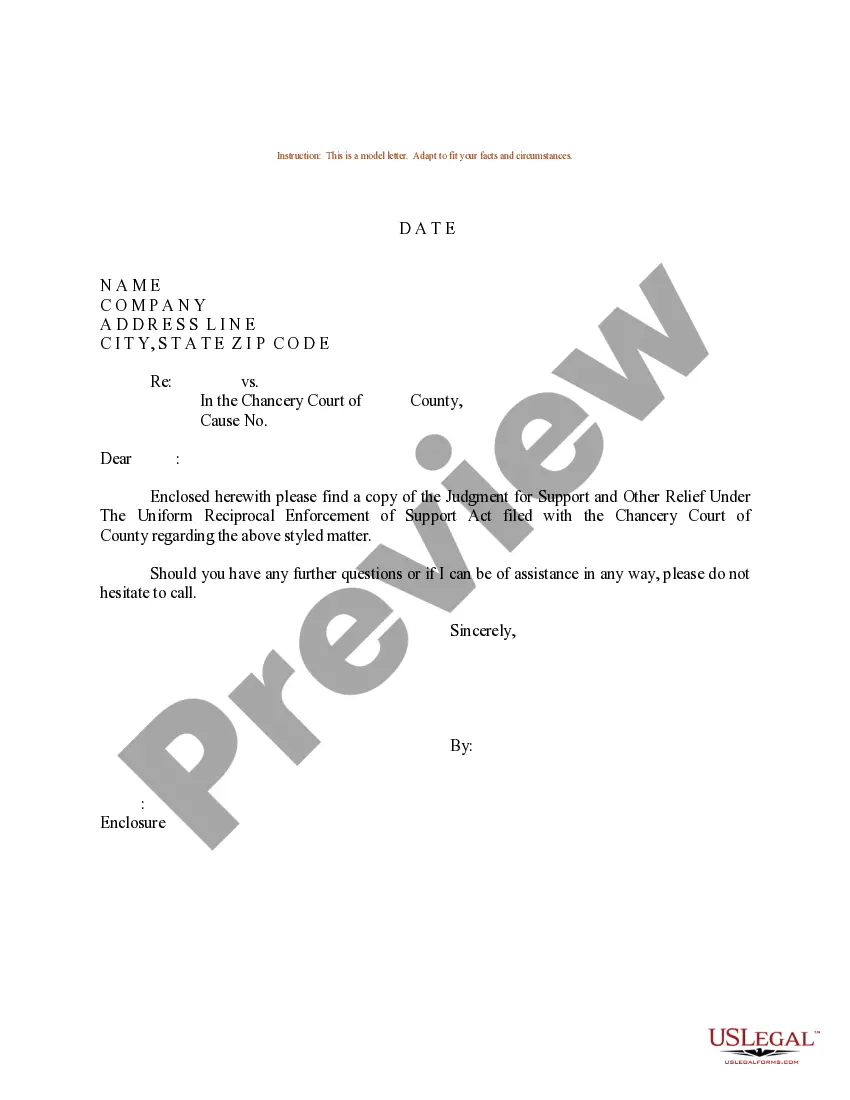
Tennessee Sample Letter for Judgment for Support and Other Relief
Description



Get your form ready online
Our built-in tools help you complete, sign, share, and store your documents in one place.
Make edits, fill in missing information, and update formatting in US Legal Forms—just like you would in MS Word.
Download a copy, print it, send it by email, or mail it via USPS—whatever works best for your next step.
Sign and collect signatures with our SignNow integration. Send to multiple recipients, set reminders, and more. Go Premium to unlock E-Sign.
If this form requires notarization, complete it online through a secure video call—no need to meet a notary in person or wait for an appointment.
We protect your documents and personal data by following strict security and privacy standards.

Make edits, fill in missing information, and update formatting in US Legal Forms—just like you would in MS Word.

Download a copy, print it, send it by email, or mail it via USPS—whatever works best for your next step.

Sign and collect signatures with our SignNow integration. Send to multiple recipients, set reminders, and more. Go Premium to unlock E-Sign.

If this form requires notarization, complete it online through a secure video call—no need to meet a notary in person or wait for an appointment.

We protect your documents and personal data by following strict security and privacy standards.
Looking for another form?
How to fill out Sample Letter For Judgment For Support And Other Relief?
It is possible to invest time online looking for the authorized papers design that suits the federal and state specifications you will need. US Legal Forms provides 1000s of authorized types which are evaluated by specialists. You can easily download or print the Tennessee Sample Letter for Judgment for Support and Other Relief from my services.
If you currently have a US Legal Forms profile, you can log in and click on the Download key. Afterward, you can full, revise, print, or sign the Tennessee Sample Letter for Judgment for Support and Other Relief. Every authorized papers design you acquire is your own eternally. To have another version for any obtained kind, check out the My Forms tab and click on the related key.
If you use the US Legal Forms web site the first time, adhere to the simple instructions listed below:
- First, make certain you have selected the best papers design for that state/metropolis of your liking. Look at the kind explanation to make sure you have picked the proper kind. If offered, utilize the Review key to look from the papers design too.
- In order to find another model from the kind, utilize the Search discipline to obtain the design that meets your needs and specifications.
- Once you have located the design you need, simply click Get now to carry on.
- Select the prices strategy you need, type in your credentials, and register for your account on US Legal Forms.
- Complete the financial transaction. You should use your credit card or PayPal profile to pay for the authorized kind.
- Select the formatting from the papers and download it in your device.
- Make changes in your papers if needed. It is possible to full, revise and sign and print Tennessee Sample Letter for Judgment for Support and Other Relief.
Download and print 1000s of papers themes using the US Legal Forms site, that offers the most important collection of authorized types. Use skilled and condition-distinct themes to take on your business or specific requires.
Form popularity
FAQ
[1] To be successful on a motion for summary judgment in state court in Tennessee, the moving party ?must either (1) affirmatively negate an essential element of the nonmovant's claim, or (2) show that the nonmoving party cannot prove an essential element of its claim at trial.? 270 S.W. 3d, 1, 9 (Tenn.
In all cases in which the supreme court may give judgment or decree through inadvertence and oversight, when upon the face of the record no cause of action existed against the party, the court may, upon its own motion, vacate the judgment or decree.
These forms are examples of some typical pleadings filed in civil cases. A complaint is the document that a plaintiff files to begin a lawsuit. It contains a clear statement of the important facts underlying the plaintiff's claims and states the legal cause(s) of action.
If you never knew you were being sued, and motion for default judgment is filed against you, you should respond with a Motion to Vacate Judgment, also known as a Motion to Set Aside Judgment.
A default judgment may be entered against the United States, its officers, or its agencies only if the claimant establishes a claim or right to relief by evidence that satisfies the court.
RULE 55. DEFAULT. No judgment by default shall be entered against the state of Tennessee or any officer or agency thereof unless the claimant establishes his claim or right to relief by evidence satisfactory to the court.
RULE 60. Clerical mistakes in judgments, orders or other parts of the record, and errors therein arising from oversight or omissions, may be corrected by the court at any time on its own initiative or on motion of any party and after such notice, if any, as the court orders.
A defendant shall serve an answer within thirty (30) days after the service of the summons and complaint upon him. A party served with a pleading stating a cross-claim against such party shall serve an answer thereto within thirty (30) days after the service upon him or her.