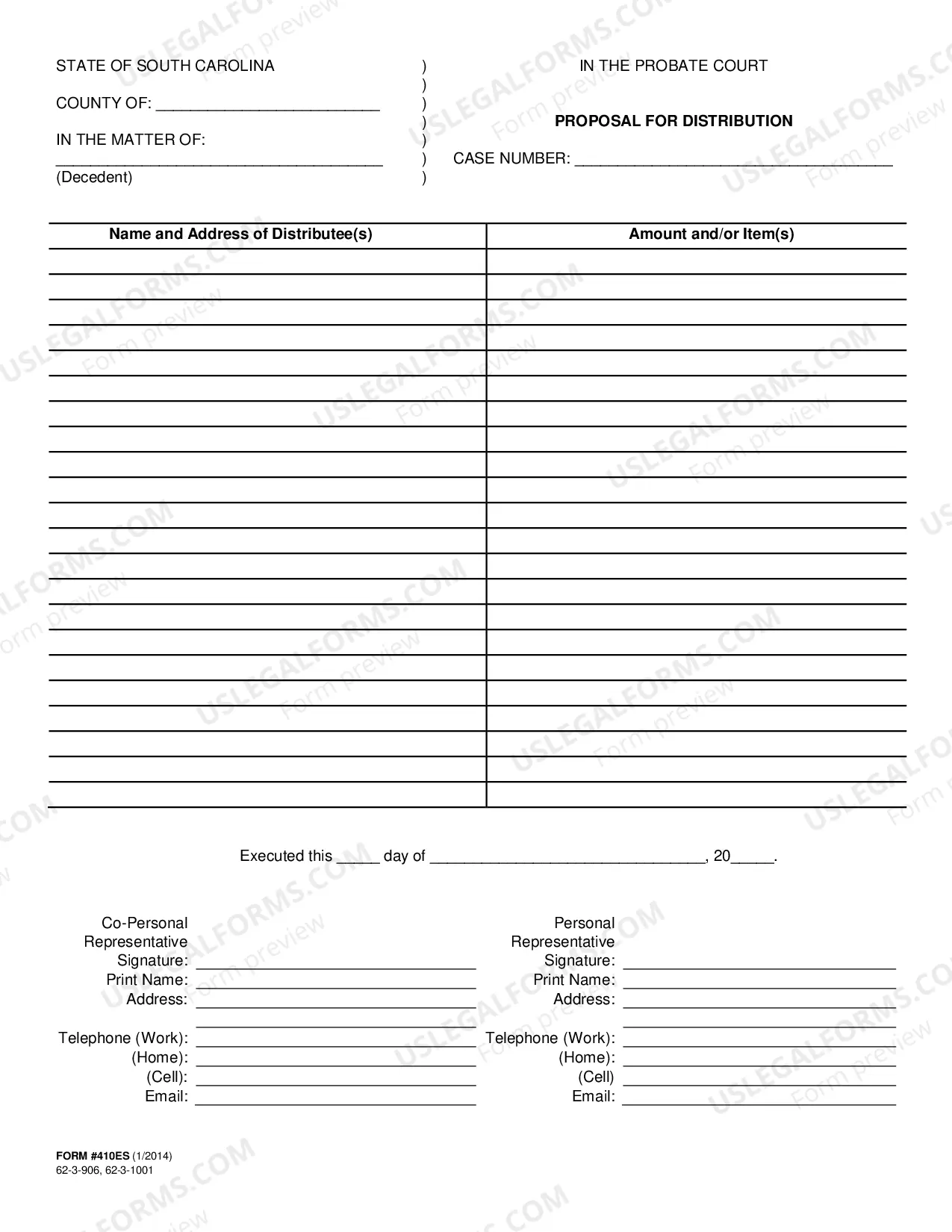
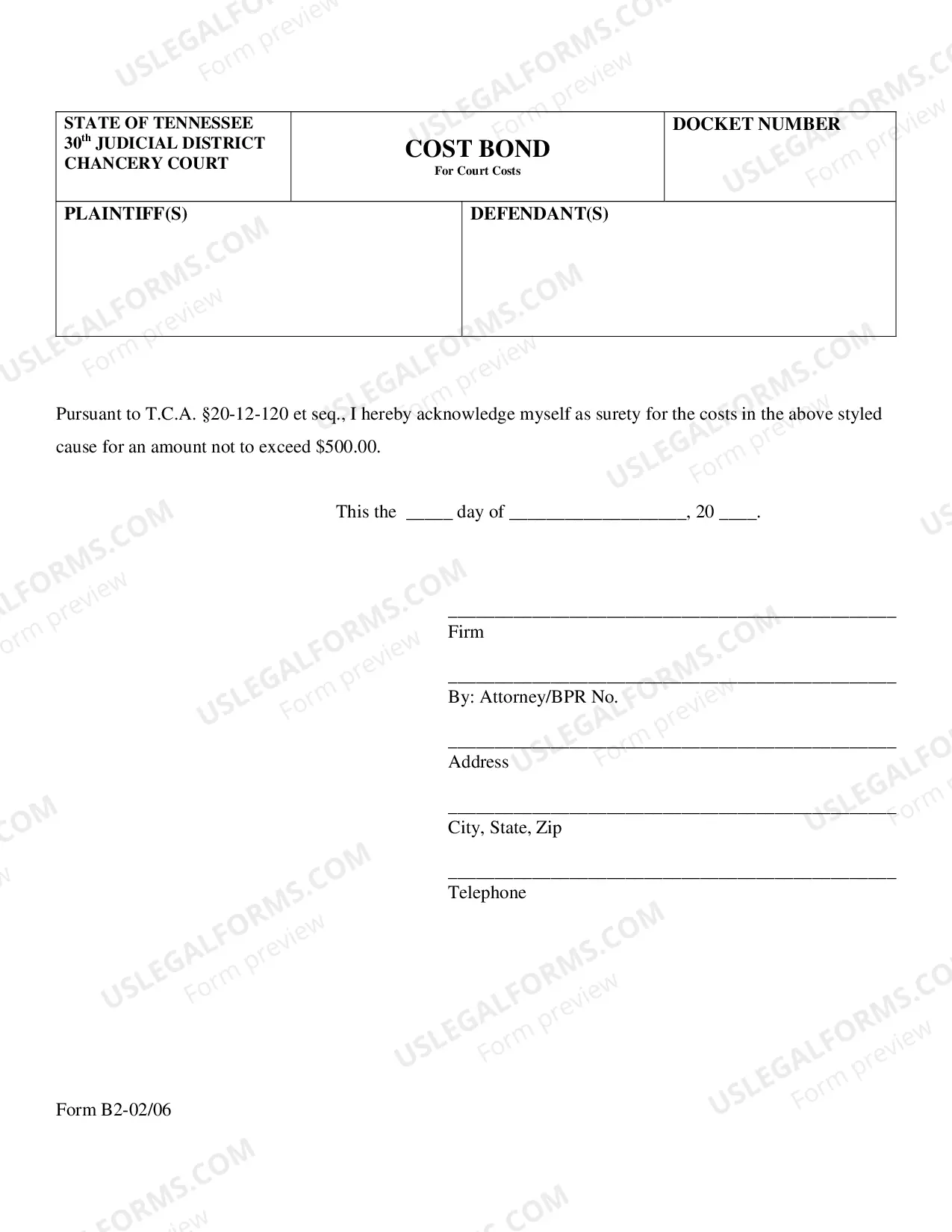
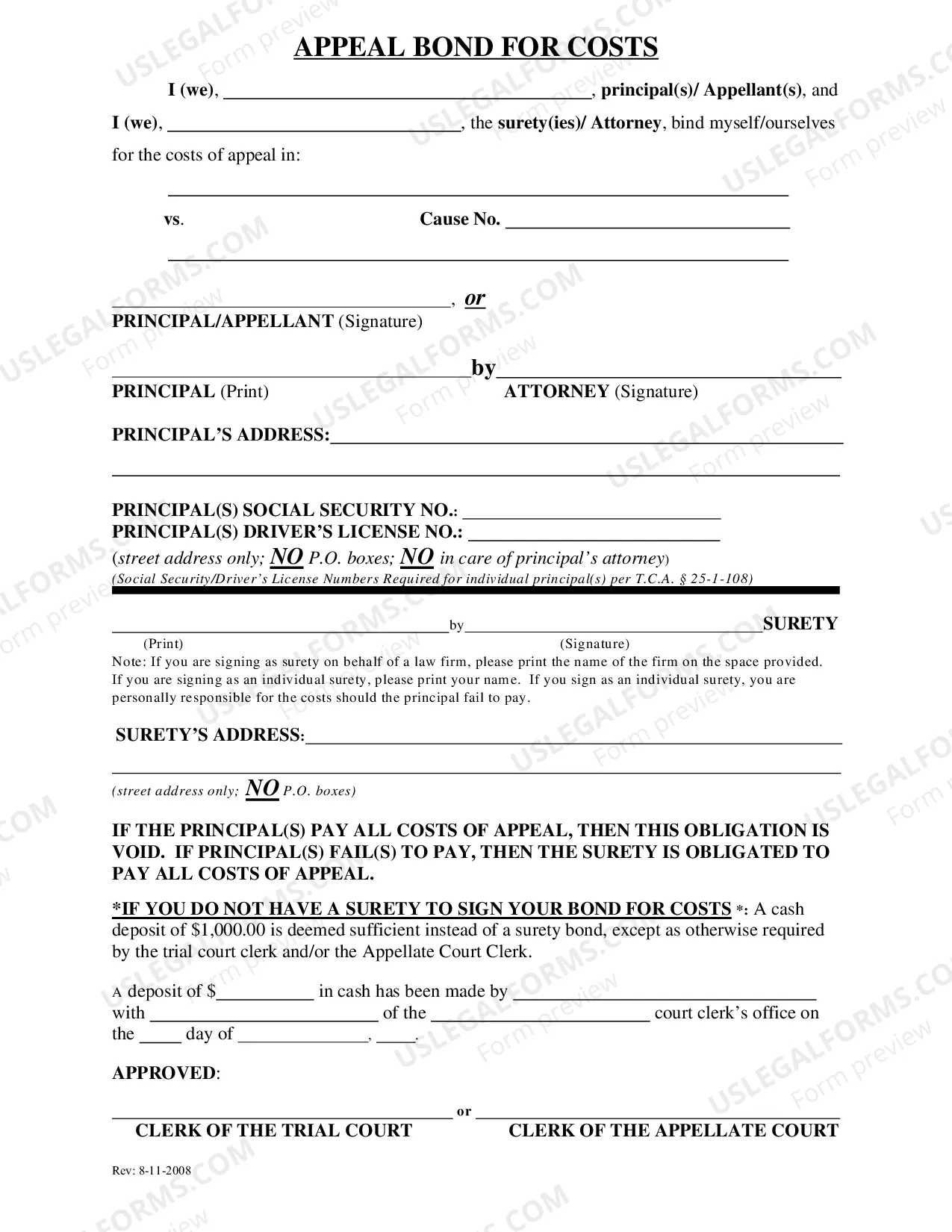
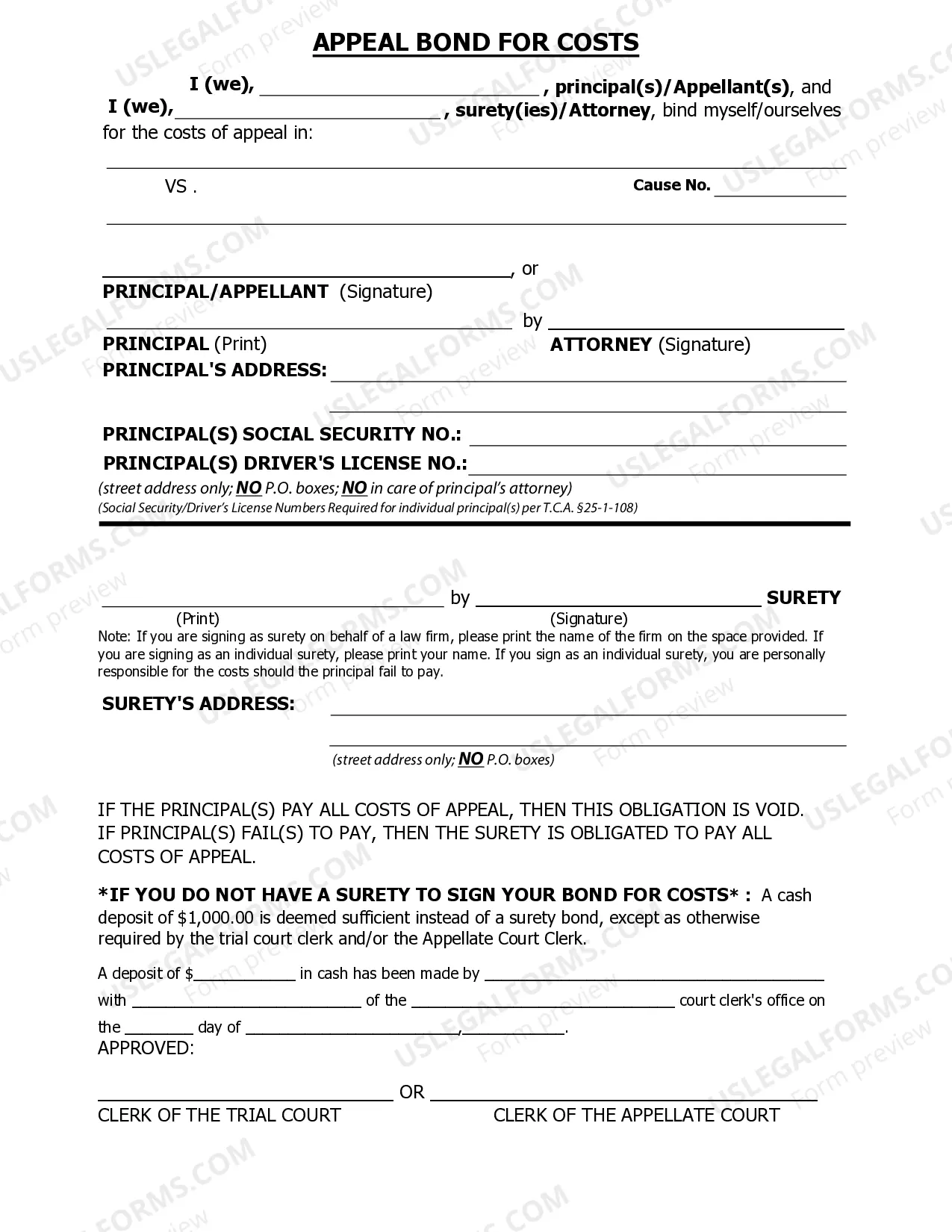
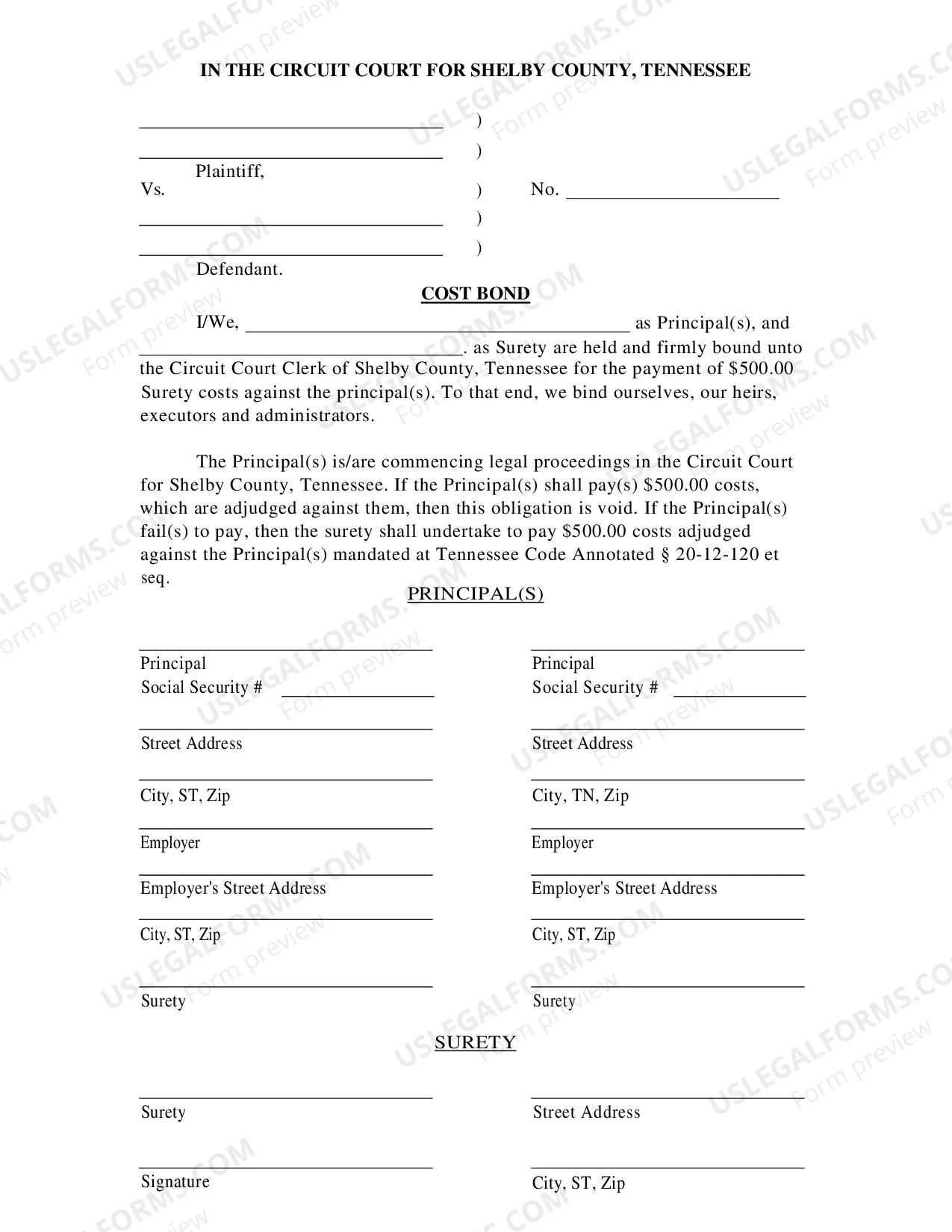
Tennessee Cost (Surety) Bond
Description

Get your form ready online
Our built-in tools help you complete, sign, share, and store your documents in one place.
Make edits, fill in missing information, and update formatting in US Legal Forms—just like you would in MS Word.
Download a copy, print it, send it by email, or mail it via USPS—whatever works best for your next step.
Sign and collect signatures with our SignNow integration. Send to multiple recipients, set reminders, and more. Go Premium to unlock E-Sign.
If this form requires notarization, complete it online through a secure video call—no need to meet a notary in person or wait for an appointment.
We protect your documents and personal data by following strict security and privacy standards.

Make edits, fill in missing information, and update formatting in US Legal Forms—just like you would in MS Word.

Download a copy, print it, send it by email, or mail it via USPS—whatever works best for your next step.

Sign and collect signatures with our SignNow integration. Send to multiple recipients, set reminders, and more. Go Premium to unlock E-Sign.

If this form requires notarization, complete it online through a secure video call—no need to meet a notary in person or wait for an appointment.

We protect your documents and personal data by following strict security and privacy standards.
Looking for another form?

How to fill out Tennessee Cost (Surety) Bond?
Preparing legal paperwork can be a real burden if you don’t have ready-to-use fillable templates. With the US Legal Forms online library of formal documentation, you can be certain in the blanks you find, as all of them comply with federal and state laws and are verified by our experts. So if you need to prepare Tennessee Cost (Surety) Bond, our service is the perfect place to download it.
Getting your Tennessee Cost (Surety) Bond from our service is as easy as ABC. Previously registered users with a valid subscription need only sign in and click the Download button after they locate the proper template. Afterwards, if they need to, users can pick the same blank from the My Forms tab of their profile. However, even if you are new to our service, signing up with a valid subscription will take only a few moments. Here’s a quick instruction for you:
- Document compliance verification. You should carefully examine the content of the form you want and check whether it satisfies your needs and complies with your state law regulations. Previewing your document and looking through its general description will help you do just that.
- Alternative search (optional). Should there be any inconsistencies, browse the library using the Search tab on the top of the page until you find a suitable blank, and click Buy Now when you see the one you want.
- Account registration and form purchase. Sign up for an account with US Legal Forms. After account verification, log in and select your most suitable subscription plan. Make a payment to continue (PayPal and credit card options are available).
- Template download and further usage. Select the file format for your Tennessee Cost (Surety) Bond and click Download to save it on your device. Print it to complete your paperwork manually, or use a multi-featured online editor to prepare an electronic copy faster and more effectively.
Haven’t you tried US Legal Forms yet? Subscribe to our service today to obtain any formal document quickly and easily whenever you need to, and keep your paperwork in order!
Form popularity
FAQ
How much does a Tennessee notary bond cost? Tennessee notary bonds cost $50 for the state-required 4-year term and include $10,000 of errors and omissions insurance.
The Bond Value Formula. One of the most common methods to value a financial asset is to discount all its future cash flows to the present and sum them up. Therefore, the bond can also be calculated as the discounted present value of all the future cash flows.
A bond rating is a way to measure the creditworthiness of a bond, which corresponds to the cost of borrowing for an issuer.
Tennessee contractor license bond costs start at $100 annually. Your exact cost will vary depending on the license type and bond amount required by your licensing authority. Contractors working in Tennessee must be licensed with the state and sometimes individual counties and cities.
A number of these factors fall under what the Surety industry calls ?The Three C's?; Character, Capacity, and Capital. All three of these are important to the underwriting process. The principal needs to exhibit the Character, Capacity, and Capital to qualify for surety credit.
You can obtain a corporate surety through many insurance providers. If your insurance provider does not write corporate surety bonds, there are third-party companies available that can assist you with finding a company to write your corporate surety bond for you.
Examples of Surety Bonds Includes bid or proposal bonds, performance bonds, payment or labor and material bonds, maintenance bonds and supply bonds. These bonds are required by state or federal law for most public construction projects or by a private developer.
Surety bond premiums (the amount you pay) are often calculated as a percentage of the total bond amount, usually between 0.5% and 5% of the bond amount for applicants with good credit, and between 5% up to as much as 20% of the bond amount for applicants with poor credit.