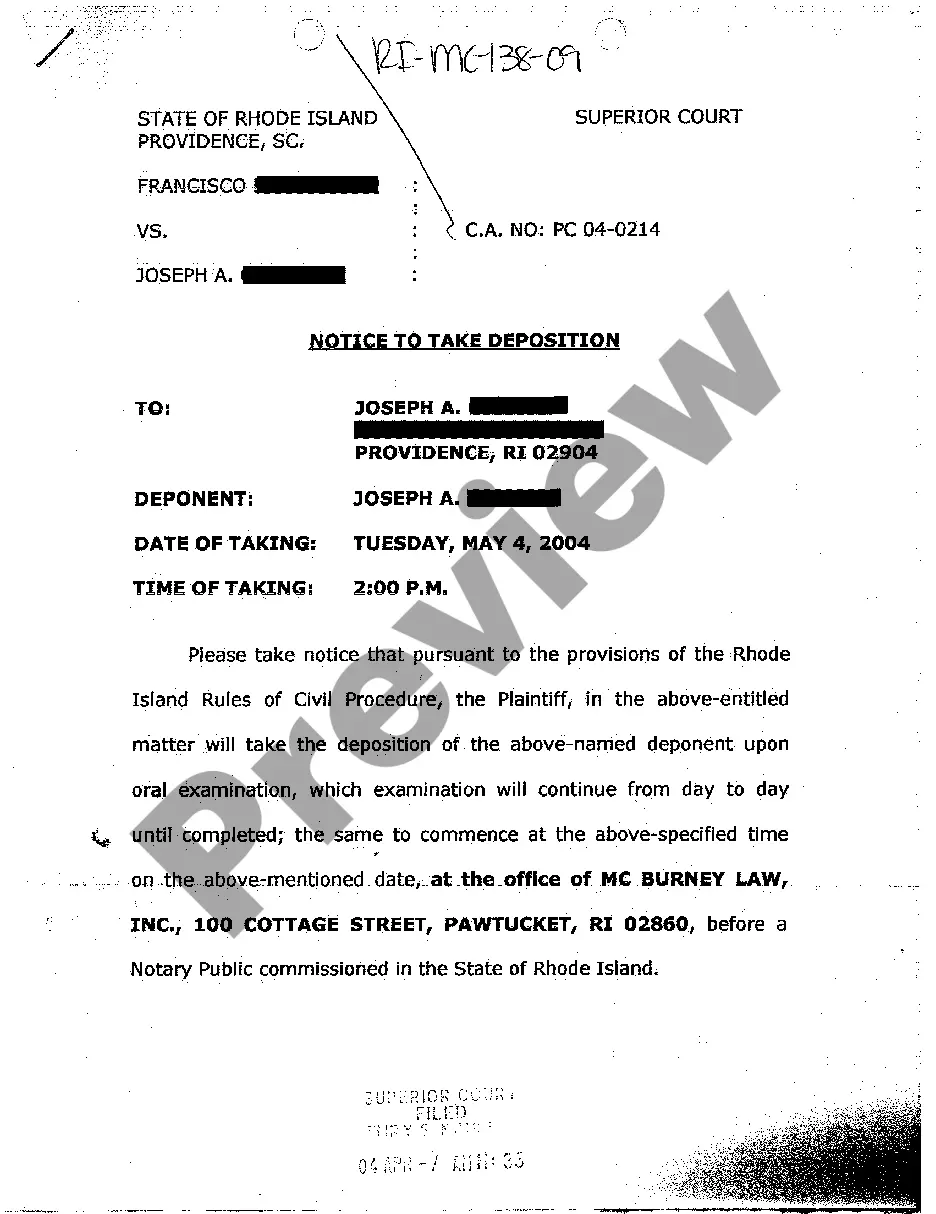
Tennessee Instructions for Filing a Civil Action (Pro Se)
What is this form?
The Instructions for Filing a Civil Action (Pro Se) provide a comprehensive guide for individuals who wish to file a civil lawsuit without the assistance of an attorney. This form outlines the necessary steps to prepare and submit a complaint, details about filing fees, and information on court procedures to ensure that individuals understand their rights and responsibilities. Unlike forms that require representation, this guide is tailored for self-represented litigants, making it essential for anyone pursuing legal action independently.
Main sections of this form
- Preparation of a complaint, including necessary case captions and factual allegations.
- Submission of a summons for each defendant requiring service.
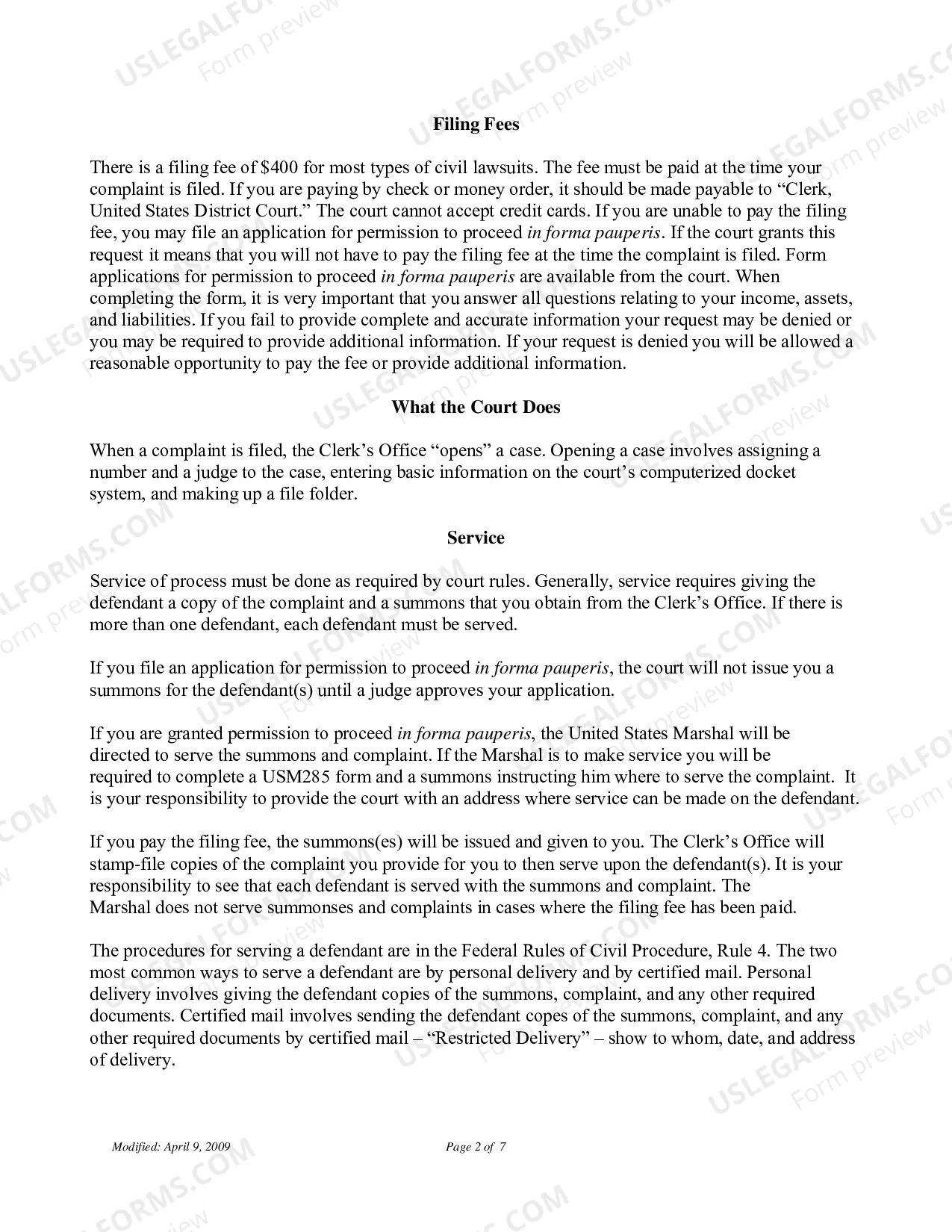
- Payment of the filing fee, or application for in forma pauperis status if applicable.
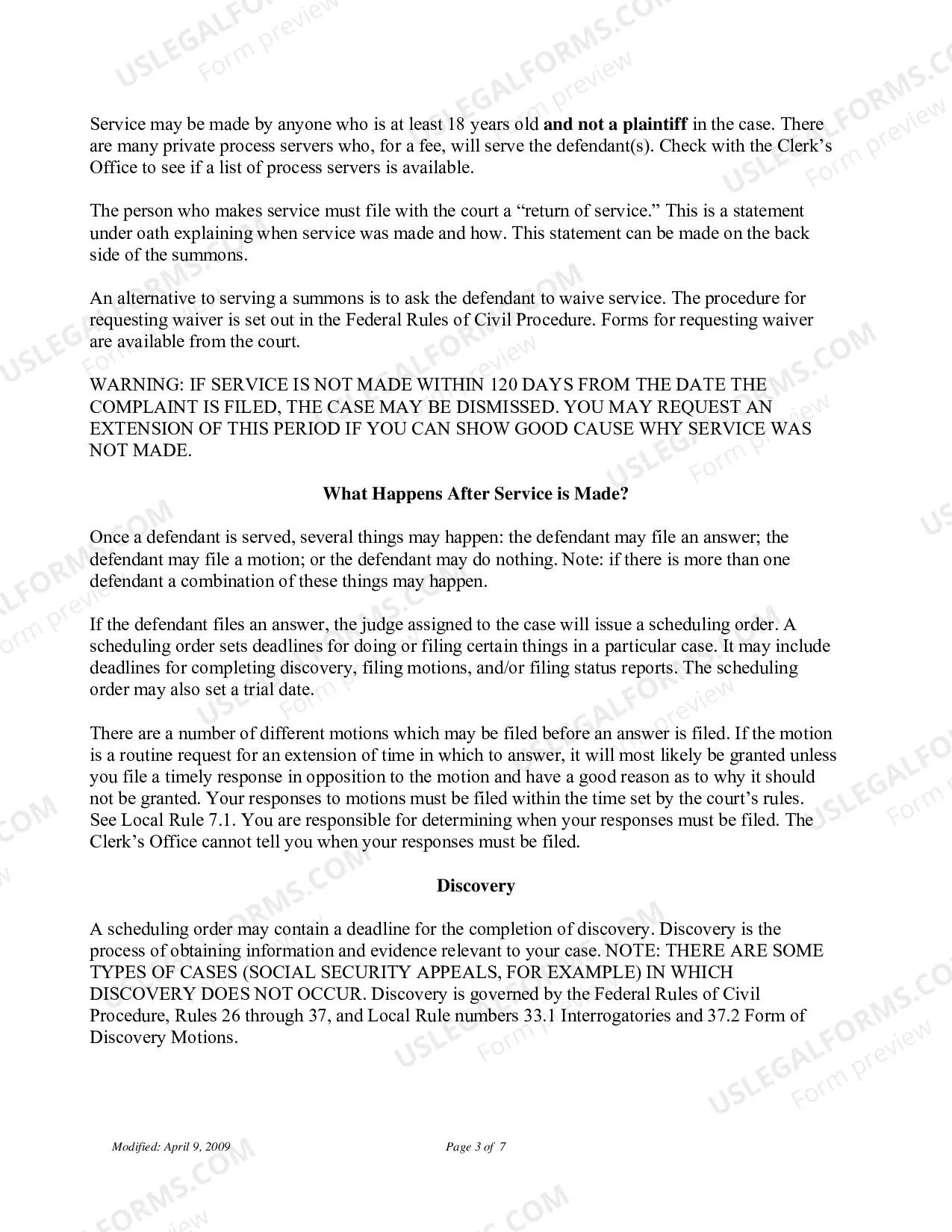
- Service of process guidelines including methods and time frames.
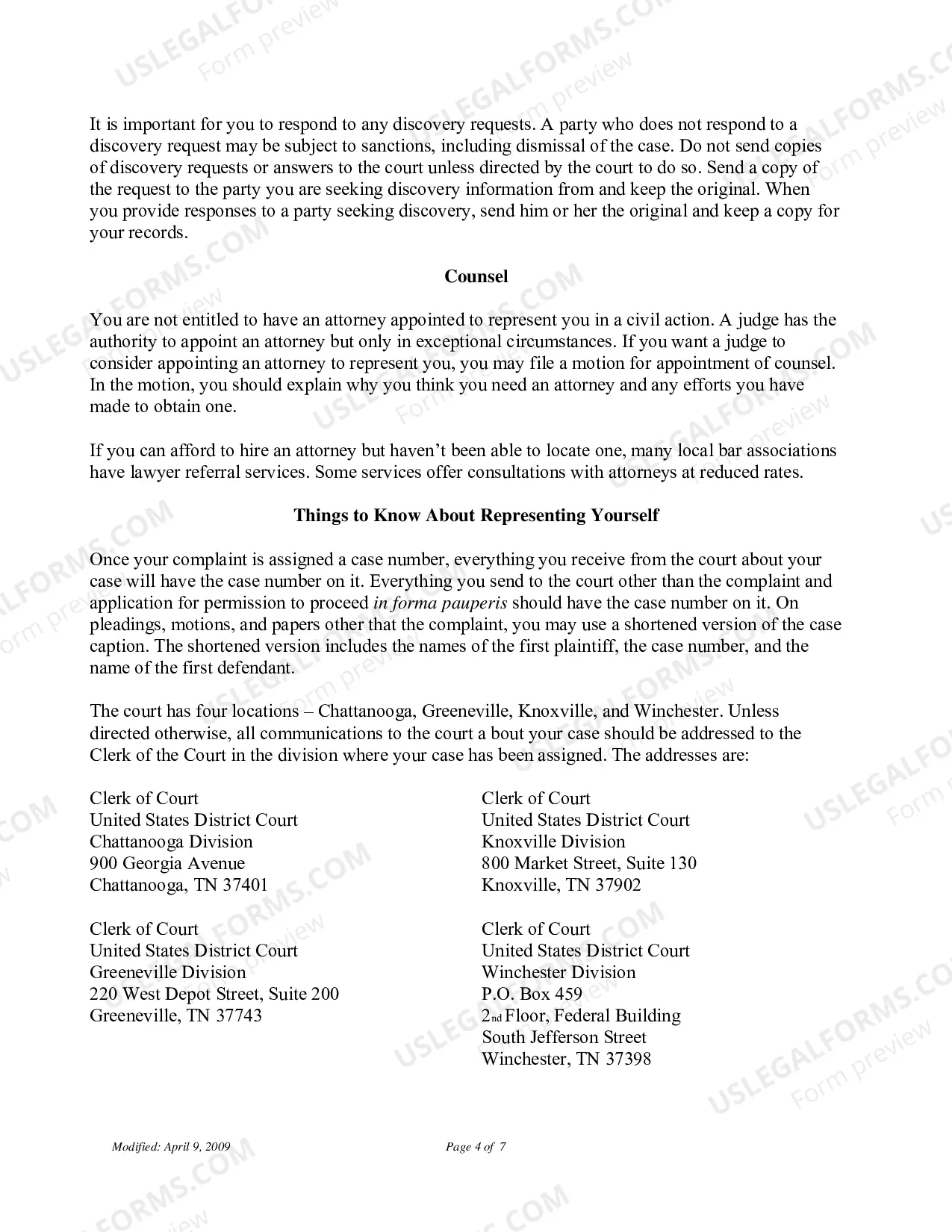
- Discovery process and the importance of adhering to court rules.
When this form is needed
This form is necessary when an individual decides to initiate a civil lawsuit in a U.S. District Court without legal representation. It is particularly useful for cases involving personal injuries, property disputes, civil rights violations, or any circumstances where an individual feels wronged and seeks legal recourse.
Who this form is for
- Individuals who do not have legal representation but wish to file a civil lawsuit.
- Litigants with a grievance regarding personal, civil, or property rights.
- Persons applying for in forma pauperis status due to financial hardship.
Instructions for completing this form
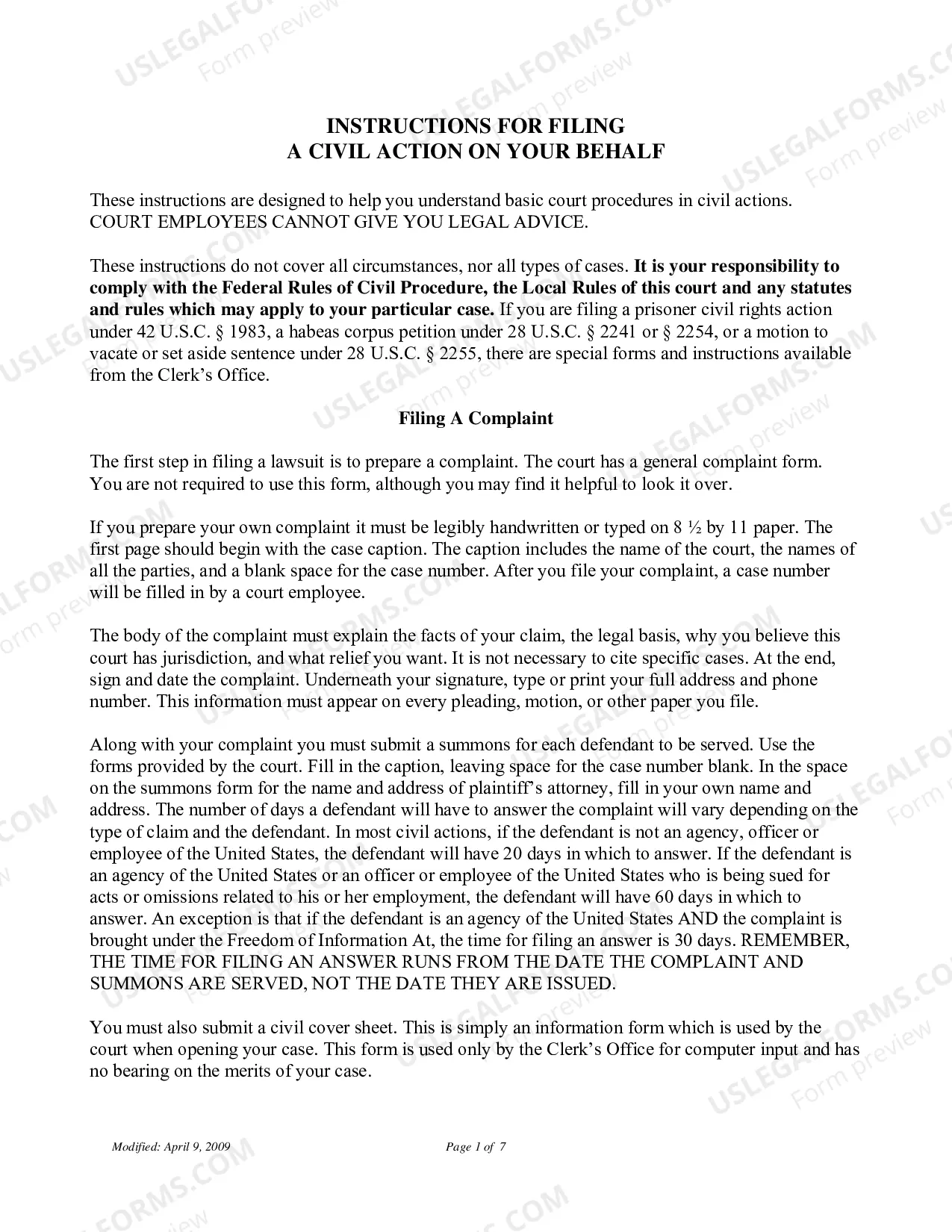
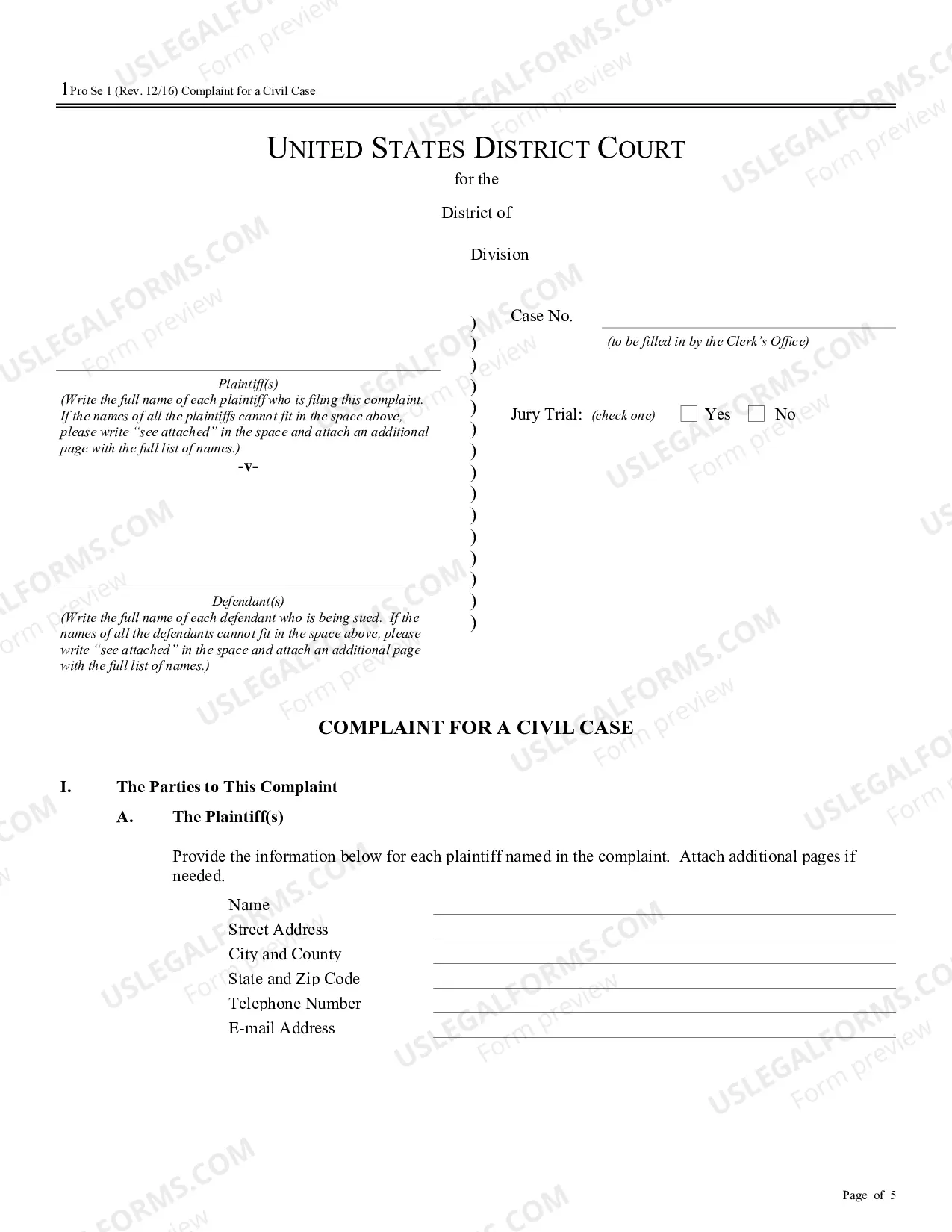
- Prepare your complaint, ensuring it includes a case caption with the court's name and parties involved.
- Detail the facts of your claim, the legal basis, and the relief you are seeking in the body of the complaint.
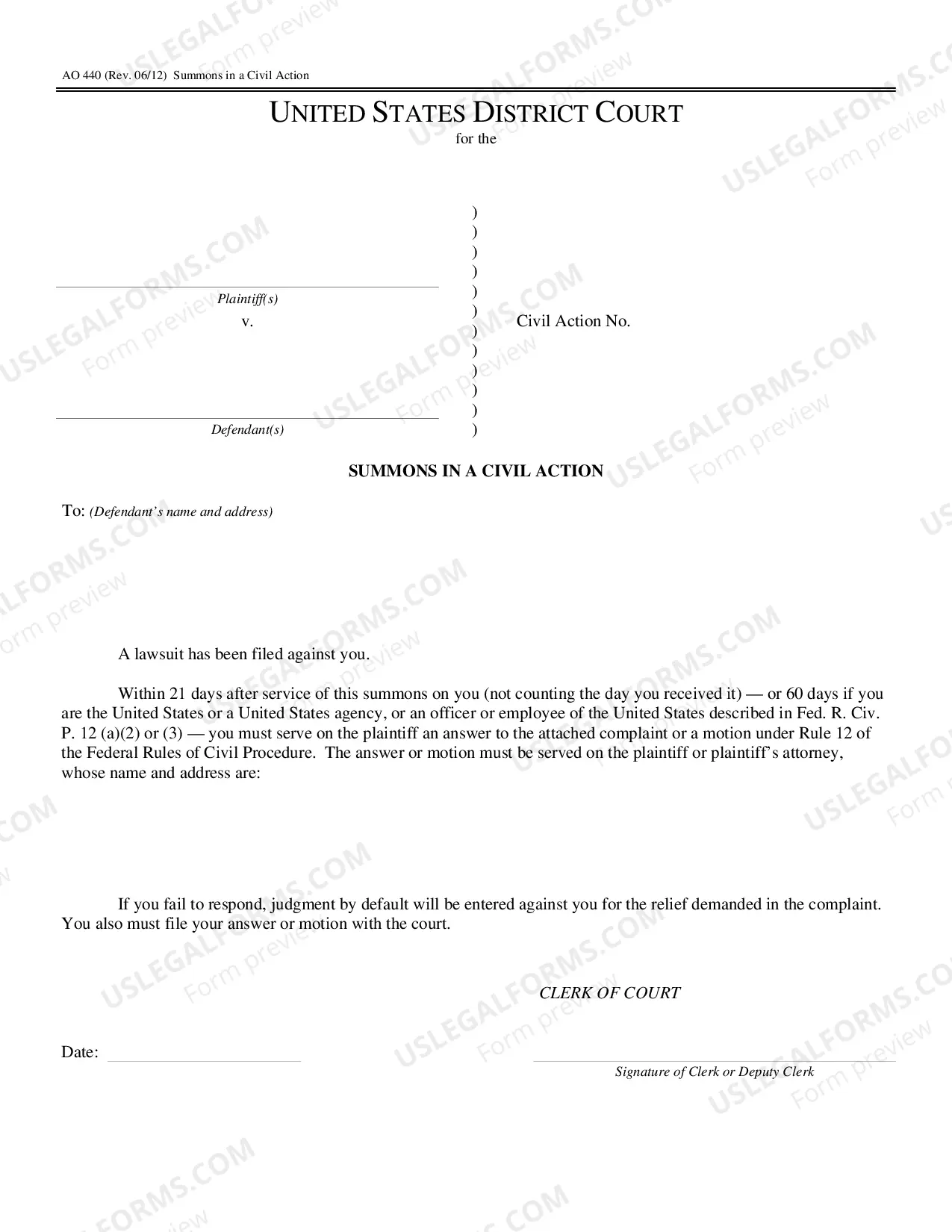
- Fill out and submit a summons for each defendant, leaving the case number blank for court assignment.
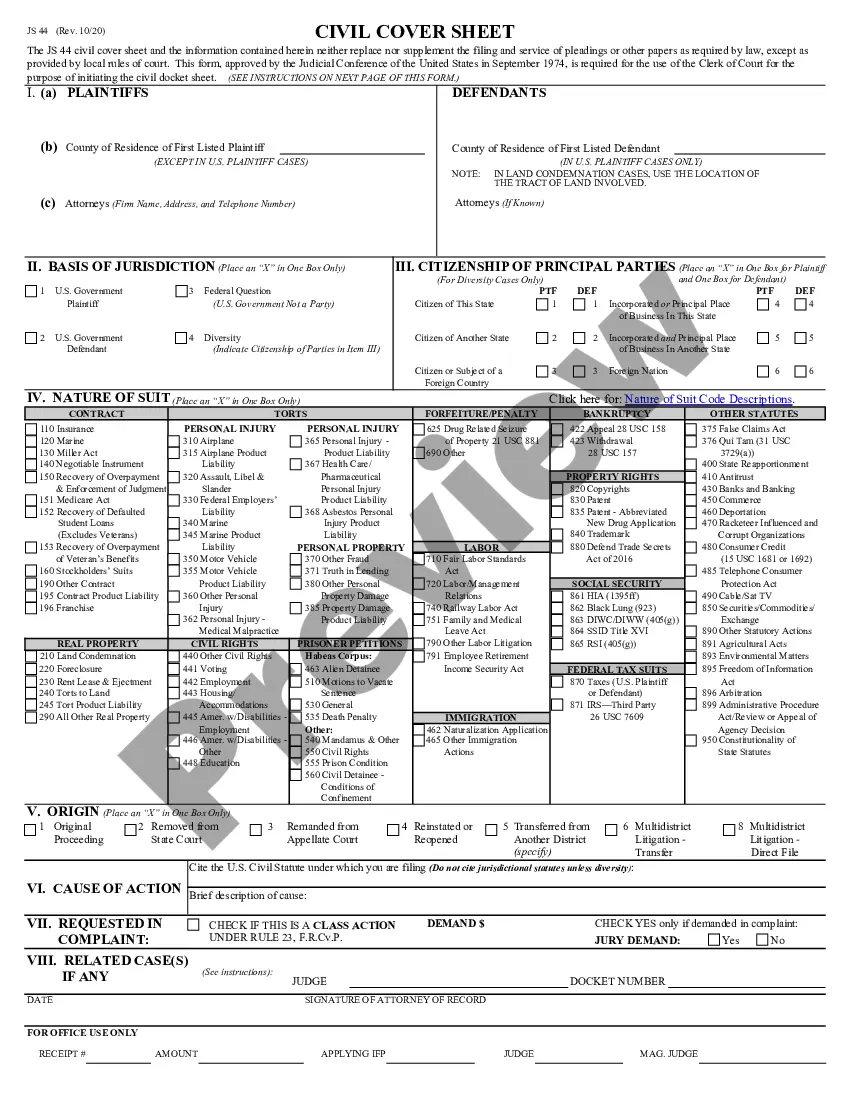
- Complete a civil cover sheet to accompany your complaint and summons.
- File your complaint and ensure all documents include your contact information for notification purposes.
Is notarization required?
In most cases, this form does not require notarization. However, some jurisdictions or signing circumstances might. US Legal Forms offers online notarization powered by Notarize, accessible 24/7 for a quick, remote process.
Get your form ready online
Our built-in tools help you complete, sign, share, and store your documents in one place.
Make edits, fill in missing information, and update formatting in US Legal Forms—just like you would in MS Word.
Download a copy, print it, send it by email, or mail it via USPS—whatever works best for your next step.
Sign and collect signatures with our SignNow integration. Send to multiple recipients, set reminders, and more. Go Premium to unlock E-Sign.
If this form requires notarization, complete it online through a secure video call—no need to meet a notary in person or wait for an appointment.
We protect your documents and personal data by following strict security and privacy standards.

Make edits, fill in missing information, and update formatting in US Legal Forms—just like you would in MS Word.

Download a copy, print it, send it by email, or mail it via USPS—whatever works best for your next step.

Sign and collect signatures with our SignNow integration. Send to multiple recipients, set reminders, and more. Go Premium to unlock E-Sign.

If this form requires notarization, complete it online through a secure video call—no need to meet a notary in person or wait for an appointment.

We protect your documents and personal data by following strict security and privacy standards.
Typical mistakes to avoid
- Failing to include the case caption correctly, which may lead to processing delays.
- Not providing adequate detail about the claim or legal basis for the lawsuit.
- Missing the filing fee or not completing the in forma pauperis application properly.
- Neglecting to serve the defendants within the required time frame, risking case dismissal.
Why use this form online
- Convenient access to legal forms from anywhere, eliminating the need for in-person visits to the court.
- Ability to download, fill out, and print forms, ensuring accuracy and compliance with formatting requirements.
- Quick and easy retrieval of multiple documents needed for filing a civil action.
Legal use & context
- The instructions provided are compliant with the Federal Rules of Civil Procedure.
- Understanding procedural rules is crucial to avoid missteps that could lead to case dismissal.
- This form serves as a foundational tool for pro se litigants to navigate the court system effectively.
Main things to remember
- Prepare your complaint carefully, including all necessary details and documentation.
- Be aware of court fees and options for fee waivers if financial constraints exist.
- Timely service of process is essential to keep your case active.
- Consult local court rules for any additional requirements specific to your district.
Looking for another form?


Form popularity
FAQ
6.01: By statute, "The time within which any act provided by law is to be done, shall be computed by excluding the first day and including the last, unless the last day is a Saturday, a Sunday, or a legal holiday, and then it shall also be excluded." Tenn. Code Ann. § 1-3-102.
RULE 52. In all actions tried upon the facts without a jury, the court shall find the facts specially and shall state separately its conclusions of law and direct the entry of the appropriate judgment. The findings of a master, to the extent that the court adopts them, shall be considered as the findings of the court.
A party shall plead in response to an amended pleading within the time remaining for response to the original pleading or within fifteen (15) days after service of the amended pleading, whichever period may be longer, unless the court otherwise orders.
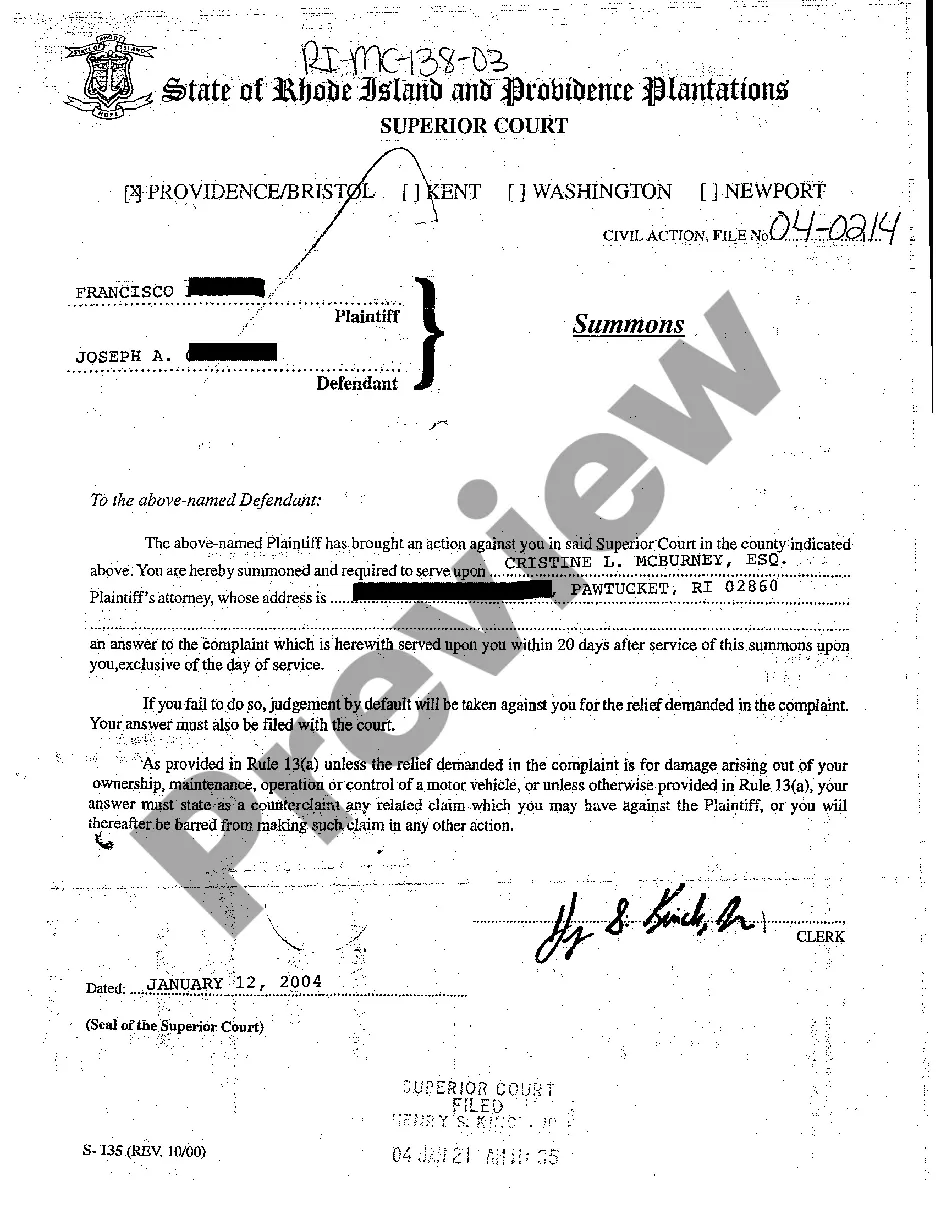
RULE 4. (1) Upon the filing of the complaint, the clerk of the court shall promptly issue the required summons and cause it, with necessary copies of the complaint and summons, to be delivered for service to any person authorized to serve process.
Go to the General Sessions Court Clerk's Office, 408 2nd Avenue, North Suite 2110 Nashville, TN 37201, (phone 615-862-5195). 2. Blank warrants, information forms, and guidance will be furnished to you but no legal advice will be given. You will be charged a filing fee.
RULE 25. (1) If a party dies and the claim is not thereby extinguished, the court may order substitution of the proper parties.
A person who is subject to service of process shall be joined as a party if (1) in the person's absence complete relief cannot be ed among those already parties, or (2) the person claims an interest relating to the subject of the action and is so situated that the disposition of the action in the person's absence
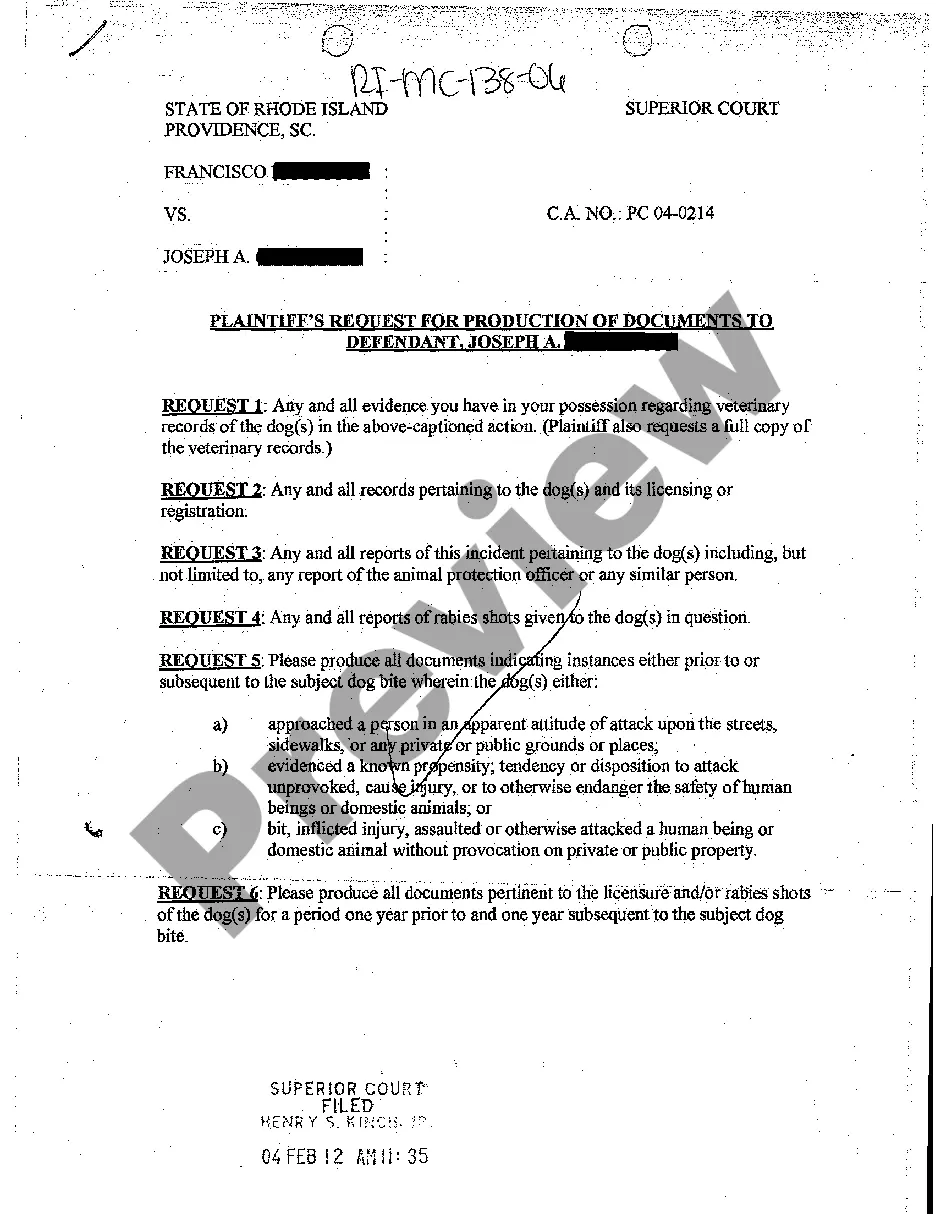
A responding party may object to part of a request, or to any item or category sought, but a party should produce those documents and things as to any part of a request for which no objection is made, making clear which parts, items, or categories are being produced.