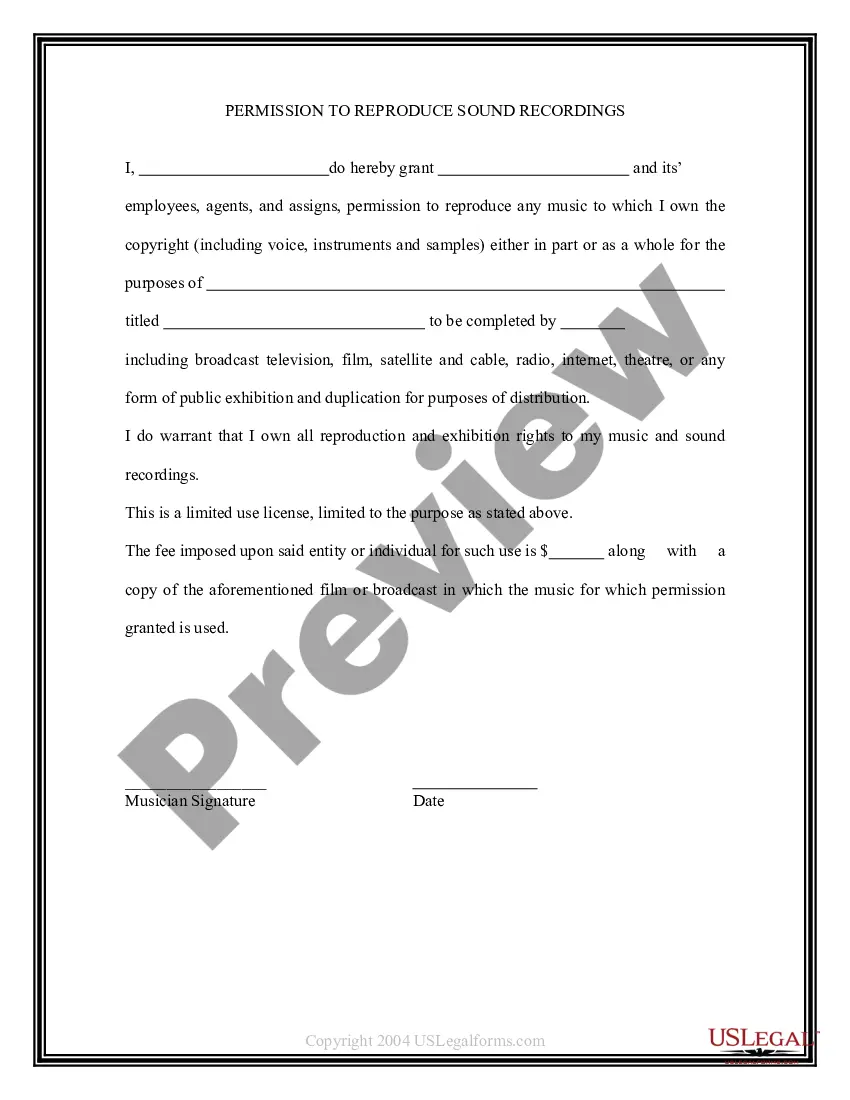
This is a form signed by a musician or owner of music granting permission to reproduce copyrighted music for use in a film, television, Internet, radio etc.
South Dakota Permission To Reproduce Sound Recordings
State:
Multi-State
Control #:
US-PRM-23
Format:
Word;
Rich Text
Instant download
Description

How to fill out Permission To Reproduce Sound Recordings?
Have you ever been in a situation where you require documentation for either business or specific aims almost every workday.
There are numerous legal document templates accessible online, but finding forms you can trust is challenging.
US Legal Forms offers a plethora of form templates, such as the South Dakota Permission To Reproduce Sound Recordings, which are crafted to meet federal and state requirements.
Once you acquire the right form, click on Acquire now.
Select the pricing option you prefer, complete the required information to create your account, and pay for the order using your PayPal or credit card.
- If you are already familiar with the US Legal Forms website and have an account, simply Log In.
- Then, you can download the South Dakota Permission To Reproduce Sound Recordings template.
- If you do not possess an account and wish to start using US Legal Forms, follow these steps.
- Locate the form you need and ensure it is for the correct city/region.
- Utilize the Preview button to review the form.
- Read the description to confirm that you have selected the correct form.
- If the form is not what you are looking for, use the Search section to find the form that suits your needs and specifications.
Form popularity
FAQ
The 26 8A 3 law in South Dakota pertains to the regulations surrounding the reproduction of sound recordings. It outlines the requirements for obtaining permission to reproduce such recordings, ensuring that creators' rights are protected. Understanding this law is essential if you plan to reuse sound recordings legally. For further assistance with South Dakota Permission To Reproduce Sound Recordings, US Legal Forms can provide valuable legal resources.
In South Dakota, recording a conversation without consent can lead to legal issues. Generally, you must obtain permission from all parties involved to record the conversation legally. This is crucial to avoid violations of privacy laws. If you need guidance on South Dakota Permission To Reproduce Sound Recordings, consider using resources like US Legal Forms for legal documents and advice.
States that operate under one-party consent laws include South Dakota, Texas, Illinois, and New York, among others. In these states, you can legally record a conversation if you are a participant. Knowing these laws is beneficial, especially when dealing with South Dakota Permission To Reproduce Sound Recordings, as it allows for more freedom in recording conversations.
If someone recorded you without your consent in South Dakota, you may have legal recourse under state privacy laws. You can consult an attorney to discuss your options, which may include seeking damages or filing a complaint. It’s advisable to gather all relevant information regarding South Dakota Permission To Reproduce Sound Recordings for your case.
The 22-42-5 law in South Dakota pertains to the unlawful interception of communications and outlines the penalties for such actions. It emphasizes the importance of obtaining consent before recording private conversations. Understanding this law is crucial, especially in relation to South Dakota Permission To Reproduce Sound Recordings.
In South Dakota, you do not have to inform someone that you are recording them, as long as you are a participant in the conversation. However, transparency is often best practice, as it can prevent misunderstandings. If you have questions about this and South Dakota Permission To Reproduce Sound Recordings, consulting legal resources can help.
Recording a conversation without consent can lead to legal repercussions in South Dakota. As a one-party consent state, you are allowed to record as long as you are involved in the conversation. However, violating privacy can lead to complications, so it’s wise to understand South Dakota Permission To Reproduce Sound Recordings thoroughly.
In South Dakota, you typically need the consent of at least one party to record a conversation. This means that if you are part of the conversation, you can record without needing permission from others. It's always good to clarify any legal concerns regarding South Dakota Permission To Reproduce Sound Recordings to ensure compliance.
To expunge your record in South Dakota, you must first meet specific eligibility requirements, such as completing your sentence and not committing further offenses. You will need to file a petition with the court that handled your case. Utilizing resources like USLegalForms can help you navigate the expungement process effectively, including understanding South Dakota Permission To Reproduce Sound Recordings laws.
In the United States, states that do not permit audio recording include California, Delaware, Maryland, Massachusetts, New Hampshire, and Washington. These states require all parties involved in a conversation to give their consent for recording. If you're looking for guidance on South Dakota Permission To Reproduce Sound Recordings, it’s essential to familiarize yourself with the consent laws in your state.