South Carolina Acknowledgment for Verification
Overview of this form
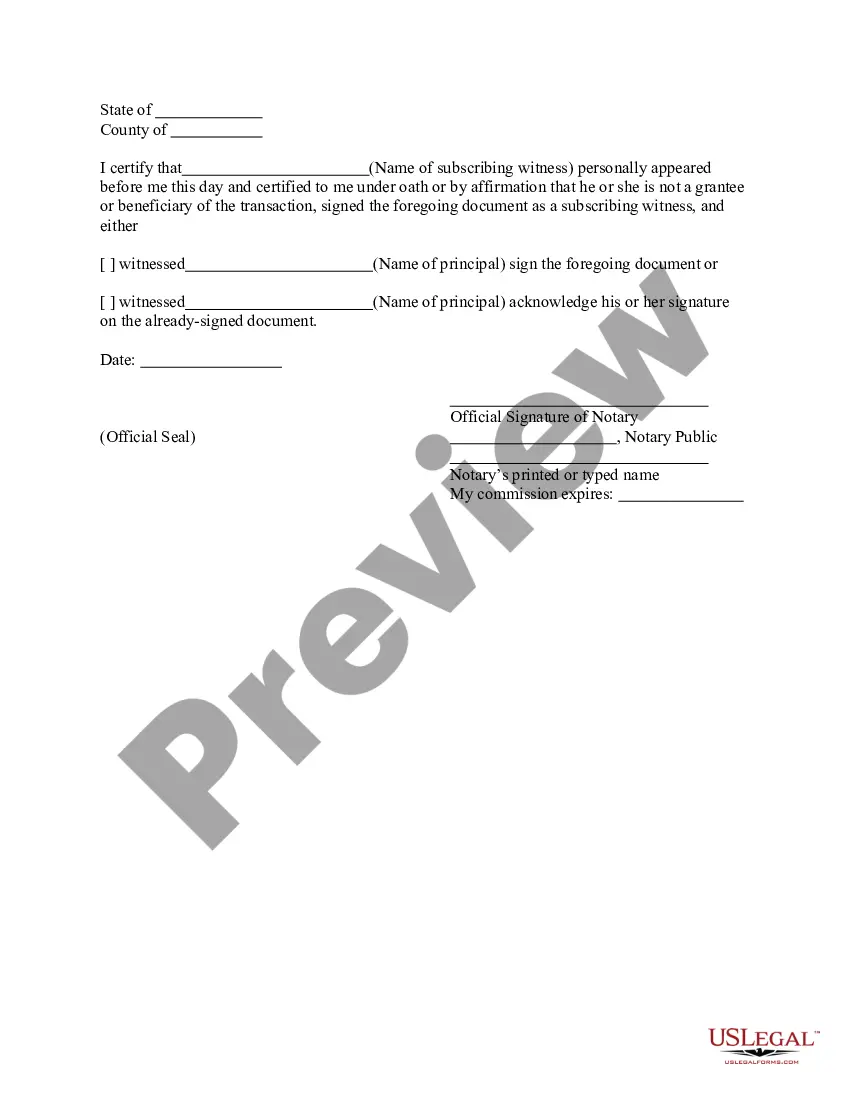
The Acknowledgment for Verification is a legal document used to confirm a witness's identity and their involvement in the signing of a document. This form is specifically designed for scenarios where a witness certifies that they observed the signing of another person's document, providing an extra layer of validation. Unlike a standard witness statement, this form serves a specific verification purpose with a formal acknowledgment of the witness's role.
Key components of this form
- Name of subscribing witness: The individual who confirms their presence during the signing of the document.
- Name of principal: The person whose document was signed in the witness's presence.
- Date of acknowledgment: The specific date when the acknowledgment takes place.
- Official seal: A certification mark typically required for notarized documents.
- Signature of the notary public: Indicates that the form has been properly executed and certified.

Common use cases
This form should be used in situations where a legal document needs to be verified by a witnessing party. Common scenarios include real estate transactions, legal agreements, or any situation requiring an official confirmation of signing, where a neutral third party can validate the involved parties and the legitimacy of the document signing process.
Intended users of this form
- Individuals who need a witness to confirm their signature on a legal document.
- Notary publics who are verifying the signing of documents.
- Parties involved in transactions where verification of witness involvement is legally beneficial.
- Attorneys who are preparing documents that require official witness acknowledgment.
How to complete this form
- Enter the name of the subscribing witness in the designated field.
- Specify the name of the principal regarding the document being acknowledged.
- Fill in the date of acknowledgment at the bottom of the form.
- Sign the document as the witness, confirming the actions taken.
- Have the notary public complete their section, including signature and official seal.
Does this document require notarization?
Yes, this form must be notarized to be legally valid. Notarization adds an official layer of verification and authenticity to the document. With US Legal Forms, you can utilize integrated online notarization services, offering 24/7 availability, secure video calls, and legal equivalence without needing to travel.
Get your form ready online
Our built-in tools help you complete, sign, share, and store your documents in one place.
Make edits, fill in missing information, and update formatting in US Legal Forms—just like you would in MS Word.
Download a copy, print it, send it by email, or mail it via USPS—whatever works best for your next step.
Sign and collect signatures with our SignNow integration. Send to multiple recipients, set reminders, and more. Go Premium to unlock E-Sign.
If this form requires notarization, complete it online through a secure video call—no need to meet a notary in person or wait for an appointment.
We protect your documents and personal data by following strict security and privacy standards.

Make edits, fill in missing information, and update formatting in US Legal Forms—just like you would in MS Word.

Download a copy, print it, send it by email, or mail it via USPS—whatever works best for your next step.

Sign and collect signatures with our SignNow integration. Send to multiple recipients, set reminders, and more. Go Premium to unlock E-Sign.

If this form requires notarization, complete it online through a secure video call—no need to meet a notary in person or wait for an appointment.

We protect your documents and personal data by following strict security and privacy standards.
Common mistakes
- Failing to complete all required fields, especially names and dates.
- Using incorrect legal terminology that might invalidate the document.
- Not obtaining the required notarization if applicable.
- Overlooking the need for the official seal in states that require it.
Advantages of online completion
- Convenience: Downloadable and printable formats simplify obtaining necessary documents without visiting an office.
- Editability: Users can fill in fields online at their convenience before printing.
- Reliability: Legal forms are drafted by licensed attorneys, ensuring adherence to relevant laws.
Looking for another form?
Form popularity
FAQ
1Require Personal Appearance.2Review The Document.3Screen The Signer And Verify The Facts.4Record The Notarization.5Complete The Notarization.
For an acknowledgment, the signer must always: Be positively identified by the Notary. The Notary must always identify the signer for an acknowledgement; whether the signer personally knows the Notary, presents an ID document, or is identified by a credible witness depends on the circumstances.
An acknowledgment is a formal declaration before an authorized official such as a notary, by a person who has signed a document, that the document is his or her act. The person acknowledging the document must personally appear before the notary.
They key difference is that for a signature witnessing, the signer must always sign the document in the Notary's presence.An acknowledgment, on the other hand, does not require the Notary to witness the signature in most states (one exception is Maryland).
Acknowledgee. An acknowledgee is a family member, friend, associate, or honoree that should be notified or thanked when a gift is donated to honor, memorialize, or celebrate an honor/memorial constituent. For example, you create a tribute honoring William Smith on his 50th birthday.
Respect individual beliefs and choices.Do not joke or behave frivolously during the procedure.Use appropriate ceremonial gestures.Other State Requirements.
Step 1: Require Personal Appearance. Step 2: Check Over The Document. Step 3: Carefully Identify The Signer. Step 4: Record Your Journal Entry. Step 5: Complete The Notarial Certificate. A Last Note: Never Give Advice.
Require Personal Appearance. Review The Document. Screen The Signer And Verify The Facts. Record The Notarization. Complete The Notarization.