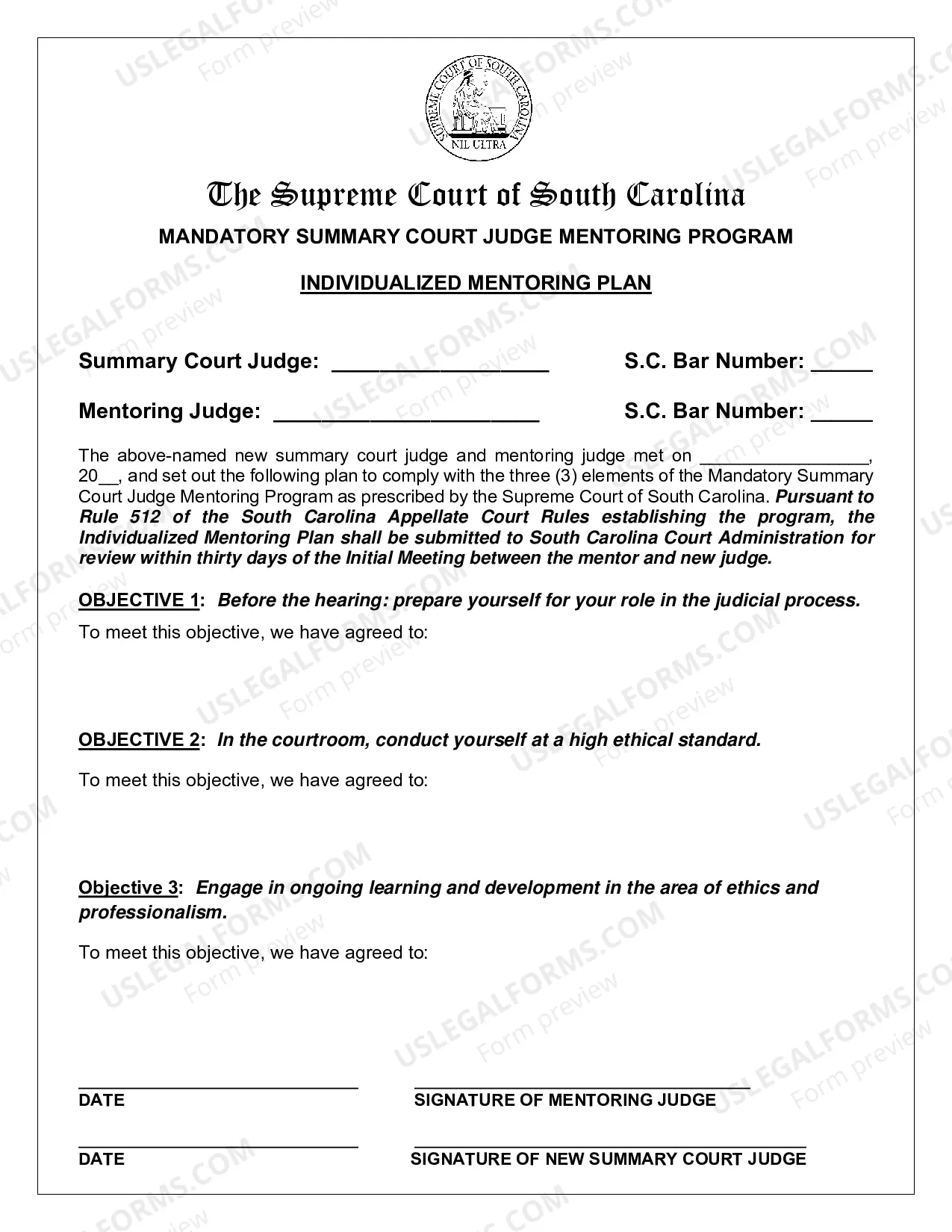
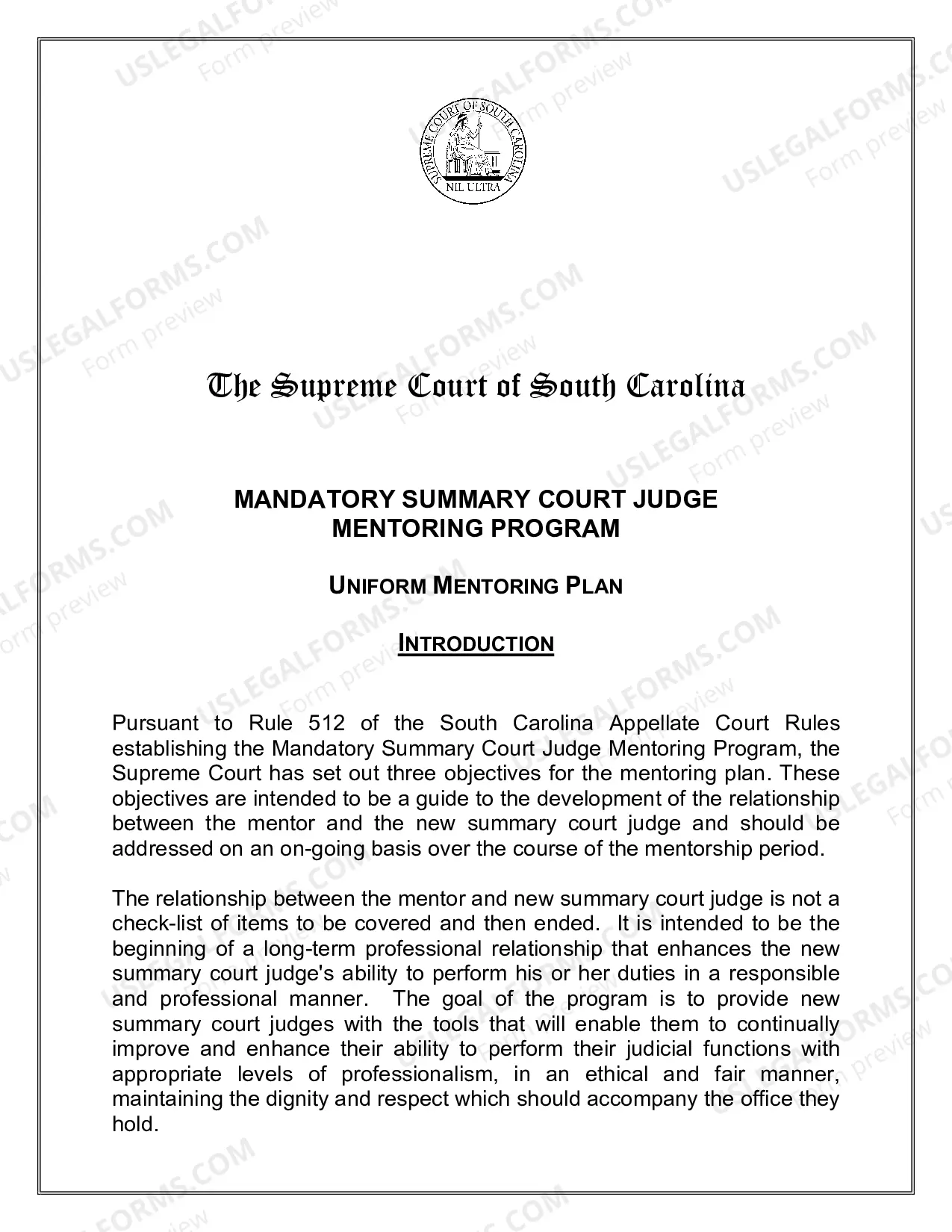
South Carolina Summary Court Judge Individualized Mentoring Plan
Description
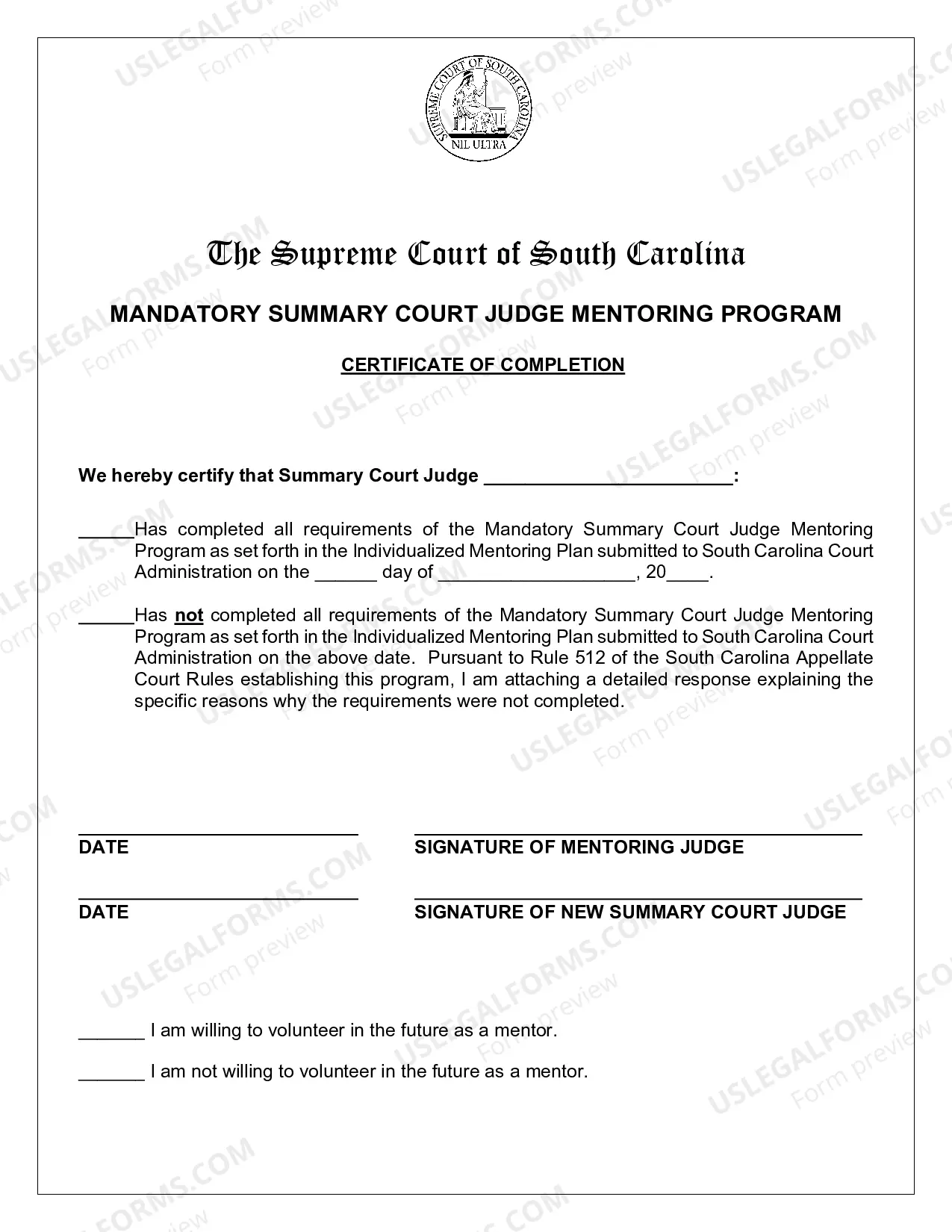


Get your form ready online
Our built-in tools help you complete, sign, share, and store your documents in one place.
Make edits, fill in missing information, and update formatting in US Legal Forms—just like you would in MS Word.
Download a copy, print it, send it by email, or mail it via USPS—whatever works best for your next step.
Sign and collect signatures with our SignNow integration. Send to multiple recipients, set reminders, and more. Go Premium to unlock E-Sign.
If this form requires notarization, complete it online through a secure video call—no need to meet a notary in person or wait for an appointment.
We protect your documents and personal data by following strict security and privacy standards.

Make edits, fill in missing information, and update formatting in US Legal Forms—just like you would in MS Word.

Download a copy, print it, send it by email, or mail it via USPS—whatever works best for your next step.

Sign and collect signatures with our SignNow integration. Send to multiple recipients, set reminders, and more. Go Premium to unlock E-Sign.

If this form requires notarization, complete it online through a secure video call—no need to meet a notary in person or wait for an appointment.

We protect your documents and personal data by following strict security and privacy standards.
Looking for another form?








How to fill out South Carolina Summary Court Judge Individualized Mentoring Plan?
Coping with legal documentation requires attention, precision, and using properly-drafted templates. US Legal Forms has been helping people across the country do just that for 25 years, so when you pick your South Carolina Summary Court Judge Individualized Mentoring Plan template from our service, you can be certain it meets federal and state regulations.
Dealing with our service is straightforward and fast. To get the required document, all you’ll need is an account with a valid subscription. Here’s a brief guideline for you to get your South Carolina Summary Court Judge Individualized Mentoring Plan within minutes:
- Remember to carefully look through the form content and its correspondence with general and law requirements by previewing it or reading its description.
- Look for an alternative official blank if the previously opened one doesn’t suit your situation or state regulations (the tab for that is on the top page corner).
- Log in to your account and save the South Carolina Summary Court Judge Individualized Mentoring Plan in the format you prefer. If it’s your first time with our service, click Buy now to proceed.
- Create an account, select your subscription plan, and pay with your credit card or PayPal account.
- Choose in what format you want to obtain your form and click Download. Print the blank or upload it to a professional PDF editor to prepare it electronically.
All documents are created for multi-usage, like the South Carolina Summary Court Judge Individualized Mentoring Plan you see on this page. If you need them one more time, you can fill them out without re-payment - simply open the My Forms tab in your profile and complete your document any time you need it. Try US Legal Forms and prepare your business and personal paperwork quickly and in full legal compliance!
Form popularity
FAQ
The Constitution states that Justices "shall hold their Offices during good Behaviour." This means that the Justices hold office as long as they choose and can only be removed from office by impeachment.
Summary Courts Magistrate (County) Court and Municipal (City/Town) Court, are the Summary Courts. Magistrates Court Who are the judges? There are approximately 311 magistrates in South Carolina, each serving the county for which he or she is appointed.
If a majority of the members of the United States House of Representatives vote to impeach, the impeachment is referred to the United States Senate for an impeachment trial. A conviction requires a two-thirds vote in the Senate.
Court can declare a law unconstitutional; allowing Congress to override Supreme Court decisions; imposing new judicial ethics rules for Justices; and expanding transparency through means such as allowing video recordings of Supreme Court proceedings.
The Constitution allows for the impeachment and removal of justices in much the same manner as a president: The House can vote for impeachment, and then a Senate trial is held, with a two-thirds vote needed to convict. Only one justice has ever been impeached, and it was more than 200 years ago.
Federal judges can only be removed through impeachment by the House of Representatives and conviction in the Senate. Judges and Justices serve no fixed term ? they serve until their death, retirement, or conviction by the Senate.
Superior court judges serve six-year terms and are elected by county voters on a nonpartisan ballot at a general election. Vacancies are filled through appointment by the Governor.
The elections for this court are partisan contested elections. To serve on this court, a judge must be a U.S. citizen, a qualified elector of the county, older than 21 years of age, and have either a bachelor's degree or four years of experience as an employee in a probate judge's office.